The Next Frontier in Coatings
Application Innovations Powered by Technology and Automation
Need to Know
- Application technology influences coating performance alongside formulation. Equipment selection and process control affect transfer efficiency, film uniformity, productivity and material consumption.
- Electrostatic spraying, rotary bell atomizers and precision deposition systems offer different approaches to controlling coating placement. Electrocoat, paint films and in-mold coatings expand the available application methods.
- Robotic platforms and drones can help reduce operator exposure and improve access to large or difficult-to-reach assets. Integrated sensors support more targeted coating operations.
- Model-based control frameworks offer opportunities to adjust deposition parameters as conditions change. The article considers how these developments support more consistent, efficient coating processes.
Coatings innovation is shifting beyond traditional formulation-focused chemistry toward a more holistic systems approach. While formulation remains essential, it cannot independently deliver consistent performance in global industrial environments. The application process, including equipment, automation, sensing and controls, plays a central role in determining overall coating quality and operational outcomes.
By broadening the innovation boundary to the full delivery ecosystem, suppliers can better align with customer priorities such as throughput, labor efficiency, sustainability and cost per job. This perspective turns the application process into a strategic lever for measurable improvements in productivity and performance.
This evolution positions coatings companies not just as material suppliers but as providers of integrated performance solutions. It marks a significant shift in how value is created and delivered across the coatings industry.
Advances in Application Technologies
Pressure-Fed Roller Application
The pressure-fed roller system is an evolution of the traditional roller application developed to increase speed and efficiency. This method automates material delivery by continuously feeding the coating to the roller with the help of a high-pressure pump. This approach eliminates the need for paint trays and the repetitive dipping process associated with conventional rollers. Material flow is controlled directly by the operator using a trigger mechanism on the roller handle, allowing steady and consistent film application.³
While the method delivers faster throughput than standard manual rolling, its productivity does not yet match that of airless spray systems. Pressure-fed technologies provide a conceptual bridge to electrostatic application methods, which similarly aim to improve transfer efficiency and reduce material loss.
Electrostatic Application in the Marine Markets
Electrostatic applications are widely used in automotive and aerospace markets, and recently PPG successfully introduced them into the marine sector.⁴
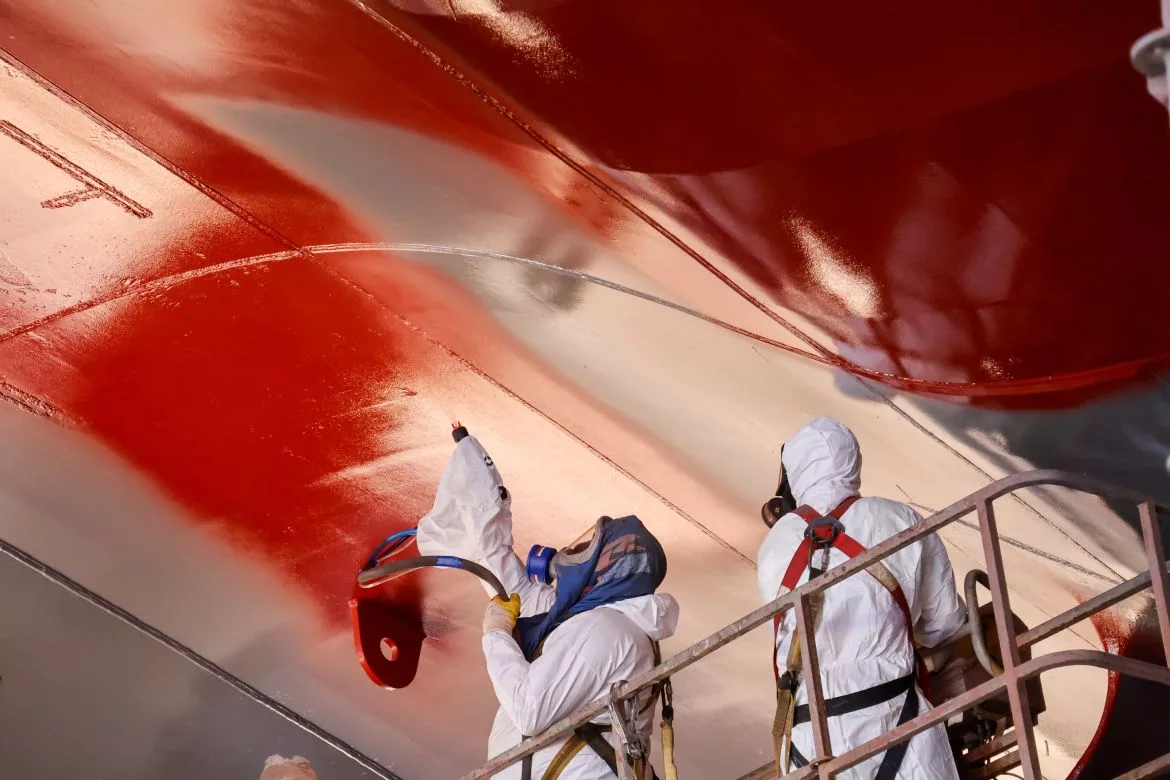
PPG’s engineering breakthroughs have enabled electrostatic application of marine coatings such as PPG NEXEON® 810 antifouling and PPG SIGMAGLIDE® 2390 fouling release solution. Electrostatic attraction between charged droplets and steel hulls increases transfer efficiency and minimizes overspray, resulting in an ultra-smooth application for reduced waste and a streamlined masking and cleanup process for applicators, a long-standing challenge in the shipping industry. Because electrostatic deposition results in cleaner operations, shipyards experience shorter maintenance cycles, reduced material waste and lower exposure risks for applicators.
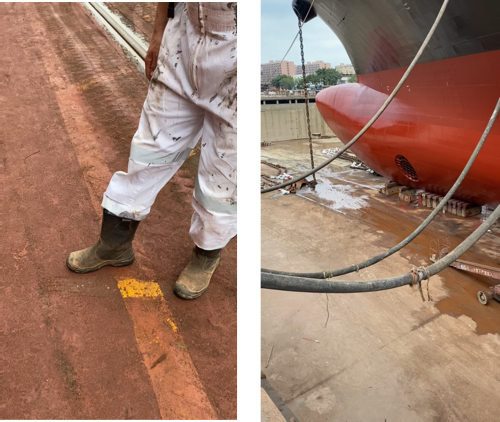
At Antwerp Shipyard, electrostatic application of PPG SIGMAGLIDE 2390 reduced overspray by approximately 40%, generating meaningful material and environmental benefits (Figure 1).
Figure 1. Comparison of conventional spray application (left) and electrostatic spray application (right), highlighting how electrostatics improve transfer efficiency and reduce material waste for a more sustainable process.
 PPG
Low-Pressure Precision Spray Systems
Recently, PPG introduced the PPG SPRAYMASTER™ system, a precision spray system designed for exterior applications. This is a portable, low-pressure spray technology engineered for ease of use, offering up to 50% faster application and fine-finish quality.⁵ The lightweight system is worn like a backpack, allowing operators full mobility during application.
Coating material is supplied through sealed, interchangeable cartridges, enabling rapid color changes and simplified cleanup. When combined with the system’s precision-engineered nozzle, the ultra-low operating pressure produces a fine, controlled spray pattern with minimal overspray or material waste. The resulting lacquer finish is smooth, uniform and free of brush marks.
High-Efficiency Rotary Bell Atomizers
Rotary bell atomizers remain foundational in high-throughput finishing environments, especially where appearance and material conservation are critical. Manufacturers such as SAMES (InoBell® and NanoBell®)⁶ and other global suppliers continue to refine bell designs to achieve narrow droplet-size distribution, superior wraparound effects, higher transfer efficiency, reduced overspray and enhanced film uniformity.
These innovations are widely adopted across automotive, aerospace and general industrial markets. Major suppliers have adopted bell systems to reduce overspray and deliver consistently smooth finishes on complex geometries, illustrating how equipment innovation can unlock significant sustainability benefits.
Aerospace Adoption of Electrocoat Application
Electrocoating (e-coat) is an immersion process in which electrically charged paint particles deposit onto a conductive substrate under an applied electrical current. Long established in the automotive sector, this technology is now gaining adoption in industrial and most recently in aerospace markets due to its coverage across complex geometries, uniformity and corrosion-resistant performance.
In aerospace manufacturing, e-coat technologies such as PPG AEROCRON® are used to apply a highly uniform, corrosion-resistant primer to complex aircraft components.⁷ The electrically driven deposition ensures consistent film build in recessed areas, internal cavities and intricate geometries that are difficult to coat with traditional spray application methods. This uniformity supports improved corrosion protection and can contribute to weight reduction by minimizing excess coating thickness.
Paint Protection Film Application
Traditional liquid and powder coatings, while widely adopted, can introduce variability due to application technique, equipment differences and environmental conditions. To address these limitations, coating suppliers are increasingly turning to paint protection film technologies. This application delivers highly consistent thickness, eliminates field overspray, provides a gloss-like or textured finish and enables expanded design options. Their removability and replaceability also create meaningful lifecycle advantages over conventional coatings.
PPG is leading this transition with a growing portfolio of paint film solutions engineered for both protection and aesthetic enhancement.⁸ The company’s acquisition of Wörwag and the subsequent formation of Advanced Surface Technologies (AST) underscore a strategic shift toward film-based innovation. These integrated solutions support the needs of automotive OEMs, marine, industrial manufacturers and specialty markets seeking next-generation surface performance.
In-Mold Coating Application
As industry intensifies its focus on sustainability, coating suppliers continue to adopt new technologies that reduce emissions and improve production efficiency. One rapidly emerging approach is in-mold application, a process in which the coating is applied directly inside the mold during part formation.⁹ By integrating coating and molding into a single step, manufacturers eliminate post-production painting, thereby reducing energy consumption, minimizing overspray waste and lowering overall production costs. The result is a durable, uniform and customizable finish achieved with far fewer environmental impacts.
Coating suppliers have made strides in advancing in-mold coating technologies, delivering integrated in-mold solutions tailored for the automotive, aerospace, wind energy and other markets. This highlights the growing industry shift toward coating technologies that support sustainability without compromising performance.
Precision No-Masking Deposition Technologies
Another advancement is the emergence of precision application technologies. These ultra-high transfer efficiency processes deposit coatings with remarkable accuracy, producing sharply defined edges without masking and without overspray.
Dürr’s EcoPaintJet™¹⁰ and similar jet-based systems represent a major advance for high-definition, mask-free applications. Benefits include sharply defined edges without masking, reduced overspray, compatibility with two-tone decorations and reduced booth energy and filtration demands.
As OEMs increasingly pursue mass customization, sustainability targets and fully automated paint-shop environments, these technologies offer substantial advantages. They reduce energy consumption, lower emissions associated with overspray capture and enable complex visual effects without additional labor or capital cost.
Integration of Automation and Robotics
Robotic coating systems are expanding rapidly due to demands for safety, consistency and process control.
Traditional and Advanced Robotic Platforms
Global robotics and paint-system suppliers such as ABB and Dürr supply integrated robot-plus equipment solutions for conventional paint shops, while agile newcomers like QLayers provide specialized crawlers and 10Q robotic units that coat large industrial assets (tanks, vessels, plant infrastructure) with very low overspray, no scaffolding and reduced manpower requirements. Robots minimize variability, reduce rework and allow work to be completed safely in hazardous or hard-to-reach areas.
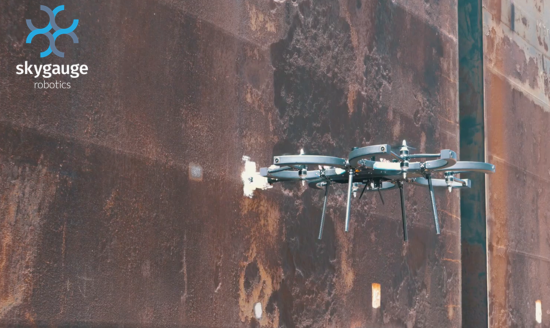
Unmanned aerial systems, such as those developed by companies like Skygauge,¹¹ demonstrate how drone application and inspection can enhance safety and reduce risk in high-elevation coating and assessment tasks (Figure 2).¹²
Figure 2. Illustration of drone-assisted spot-rust-coating application, highlighting the safety and operational advantages afforded by unmanned systems. Courtesy of Skygauge Robotics.
 PPG
Sensing-Enabled Intelligent Robotics
The next stage of advancement involves integrating sensing and diagnostic technologies directly into robotic systems.¹³ Machine vision (Cognex), multispectral imaging, lidar and ultrasonic sensors are increasingly integrated into robotic platforms. These enable robots to identify important factors such as edges, defects or inconsistent film builds. In addition, robots could adjust spray patterns in real time, trigger localized surface preparation and only apply material where needed.
This sensory intelligence elevates uniformity, reduces waste and enhances compliance with performance specifications. These systems also support more consistent adherence to regulatory and performance standards by providing highly repeatable outcomes independent of operator variability.
Advanced Control Frameworks for Application Optimization
In parallel with hardware and sensing advances, the development of intelligent control frameworks is enabling more accurate and adaptive application processes. A recent study¹⁴ highlighted practical frameworks that combine online model identification with model-based input shaping. This combination allows deposition parameters to be tuned dynamically and converge on target line widths and film volumes within just a few iterations.
Advantages include reduced trial-and-error testing, compensation for environmental or material variability, continuous improvement through system learning and greater predictability in production environments.
These advancements transition coating applications from expert-driven heuristics to data-driven closed-loop optimization.
Conclusion
Innovation beyond the coating formulation is redefining how the coatings industry delivers value. Application technologies, automation platforms, sensing systems and intelligent controls are becoming inseparable from the coating product itself.
From electrostatic marine breakthroughs to drone-assisted application and advanced precision systems, the opportunities for customer value creation continue to expand. As performance-based purchasing models grow, investing in application innovation will be critical to sustainable industry leadership.
By embracing a system-level perspective and extending innovation beyond the paint can, coating suppliers can transform not only what their products are but what those products enable.
Acknowledgments
Susan Donaldson, Greta Edgar Borza, Elizabeth Wymard, Denise Callihan and Jaclyn Laurich.
References
¹ Sources of Innovation in the Paint and Coatings Industry. CoatingsTech 2021, 18 (1), January.
² An Eco-Strategy for Development of More Sustainable Coatings. Progress in Organic Coatings 2024, 197, 108781.
³ Graco. Pressure Roller Kit.
⁴ Reducing Marine Coating Overspray Using Electrostatic Application. Paint & Coatings Industry, July 15, 2024.
⁵ PPG SPRAYMASTER Portable Spray System for Exterior Woodwork. Coatings World, May 30, 2022.
⁶ SAMES Kremlin. InoBell and NanoBell Atomizer Technology Overview. Product and technical datasheets, 2022–2025. [Specific source details needed.]
⁷ PPG Electrocoat Primer Qualified by US Air Force. Paint & Coatings Industry, Nov. 6, 2019.
⁸ Scarborough, V. Can Paint Films Disrupt Traditional Coatings? Paint & Coatings Industry, Aug. 6, 2025.
⁹ In-Mold Coating Breakthrough Cuts VOCs and CO₂ in Automotive Manufacturing. Paint & Coatings Industry, June 13, 2025.
¹⁰ Dürr. EcoPaintJet: Overspray-Free Paint Application.
¹¹ Skygauge Robotics. Skygauge (accessed Nov. 24, 2026).
¹² Companies Collaborate to Create Spray-Painting Drone. Materials Performance, March 24, 2020.
¹³ Integration of LiDAR and Multispectral Sensors in Industrial Robotics. IEEE Robotics & Automation Society. Proceedings of the IEEE RAS, 2020–2025. [Citation as supplied; source confirmation needed.]
¹⁴ Hawa, A.; Kou, Y.; Gonzalez, L.; Hicken, F.; Barton, K. Online Model-Based Input Shaping for Precision Application Processes. In Proceedings of the ASME 2025 20th International Manufacturing Science and Engineering Conference; 2025; Paper MSEC2025-155759.
Looking for a reprint of this article?
From high-res PDFs to custom plaques, order your copy today!