Painting & Coating Industry (PCI) logo Powder coating summit logo
search
cart
facebook twitter linkedin youtube
  • Sign In
  • Create Account
  • Sign Out
  • My Account
Painting & Coating Industry (PCI) logo Powder coating summit logo
  • NEWS
    • Latest News
    • Market Trends & Reports
    • Finishing News
    • Price Alerts
    • Subscribe to Newsletters
    • Global Top 10/ PCI 25
    • Weekly Featured Article
    • COATLE Word Game
  • PRODUCTS
    • Product News
    • Featured Products
    • Must See Products and Services
  • MATERIALS
    • Additives
    • Resins/Polymers
    • Pigments
    • Equipment
    • Distributors
  • TECHNOLOGIES
    • Adhesives
    • Architectural Coatings
    • Finishing Articles
    • Finishing Technologies
    • Finishing Equipment
    • Industrial Coatings
    • Nanotechnology
    • Powder Coatings
    • Solventborne
    • Special Purpose Coatings
    • Sustainability
    • UV Coatings
    • Waterborne
  • RESOURCES
    • Columns
      • Did you know?
      • Distribution Dive
      • Formulating With Mike
      • Innovation Insights
      • Powder Coating Perspectives
      • TiO2 Insider
    • Blogs
      • Editor's Viewpoint
      • Industry Insights
    • Coatings Supplier Handbook
    • Podcasts and Videos
      • COAT-IT! Podcast
      • Videos/PCI TV
    • PCI Store
    • Classifieds
    • eBooks
    • Sponsor Insights
    • White Papers
    • COATLE Word Game
  • EVENTS
    • Coatings Trends & Technologies Summit
    • Paint and Coatings Academy
    • Webinars
    • Calendar of Events
    • Lifetime Achievement Award
  • DIRECTORIES
    • Buyer's Guide
    • Equipment Directory
    • Materials Directory
  • EMAGAZINE
    • Current Issue
    • eMagazine Archive
    • China Issue Archive
    • Editorial Advisory Board
  • CONTACT
    • Contact Us
    • Advertise
    • Subscribe to eMagazine
    • Subscribe to Newsletters
  • SIGN UP!

Nanoadditives: The Smart Way to Improved Coating Performance
June 1, 2005
Nano is the buzzword for the beginning of the 21st century. No other technology is currently more thought provoking. Starting from self-cleaning surfaces and ending with self-reproducing nanorobots, the borderline between technology, science and science fiction is almost non-existent. Nanotechnology is evolving across very different disciplines like physics, chemistry, biology and engineering, creating new solutions because of this interdisciplinary approach. One of the most advanced markets in the field of nanotechnology is in the area of modifying surface properties using nanotechnology. Starting from new lithography, to self-assembling, to the use of nanotechnology in existing coatings, the range where this technology can be applied is huge. Especially in coatings, the evaluation of the potential use of nano-sized particles is of great interest for academia and industry.

Definition of Nanotechnology

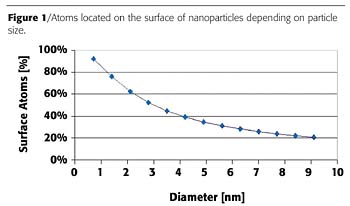
Everyone is familiar with the term "atom" meaning the smallest indivisible part of matter that the Greek philosopher Democrit could think about. He came to the philosophical conclusion that atoms must exist by dividing matter into smaller and smaller parts that ultimately would lead to the smallest part that all matter is made of. If one picks up these thoughts today it is surprising that the change in size going from macroscopic matter to atoms is always accompanied by a change in properties. For example, the colours of metals change drastically when reducing the size of an individual unit of metal. If the size of gold particles is reduced to approximately 5 nm, the metal colour turns into an intensive red that, for example, has been used in former times to colour glass windows of churches. So only by changing the size does the physical property of colour change as well. The dimension needed to cause such a change in colour is in the area of a few 10-9 m or, in other words, in the range of a few nanometers. This change in physical properties is attributed to a change in the electronic properties of matter. Electrons are confined in a smaller space, causing these changes to occur. Nanotechnology deals with those electronic effects. Matter reduced in at least one dimension to a size less than 100 nm can be considered nanomaterial. At the same time, the surface area of nanomaterial is enhanced by orders of magnitude so that surface effects become a critical aspect in nanotechnology. Stabilization of individual units as well as the surface activity become important when using nanomaterials. Assuming a dense packing of atoms, almost 60% of all atoms are located on the surface of 2-nm particles. Even for 10-nm particles it is still around 20%, as can be seen in Figure 1.

Only well-dispersed individual units of nanomatter behave like nanomaterial in the best way. Even slight aggregation can cause the loss of all nanoeffects. For that reason, pre-dispersed nanoparticle master batches are an ideal way to utilize nanomaterials in coatings. By using only small amounts of the active ingredient and by achieving very high active ingredient contents in the master batch, nanoadditives are the smart way to introduce new or enhanced coating properties.
Nanotechnology in Coatings

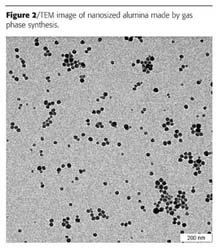
There is a huge potential for nanotechnology in different areas of our daily life. One of the most mature areas where nanotechnology is applied today is in the field of plastics and coatings. The main reasons to apply a coating to a substrate can be for the intended decorative or protective effects. The protective need for surface coatings includes the need for protection against all types of environmental effects such as UV, humidity and oxygen, mechanical attack, and so forth. For those demands, technical solutions have been developed over time based mainly on organic and polymeric chemistry. Today more and more nanotechnology is being focused on by coatings manufacturers in order to achieve comparable, improved or even new effects in coatings. For example, by using certain nanosized oxides well dispersed into the coating formulation, the mechanical properties of these coatings can be improved significantly. Especially nanosized alumina and silica is of interest because high-gloss, high-transparent coatings can be achieved by using nanosized fillers instead of micron-sized materials. Figure 2 shows a TEM image of nanosized alumina made by gas phase synthesis. The material is dispersed at concentrations of more than 50% in different media. Due to the nature of the particles, the viscosity of those dispersions is very low since there is no tendency for bridging flocculation, as for example in materials made by flame pyrolysis. When incorporating a small amount of nanoalumina in a UV-curable coating system, the resistance against mechanical scratching can be increased significantly. In Figure 3, the increase in haze due to scratches formed on the coated surface is measured as an indicator for scratch resistance.
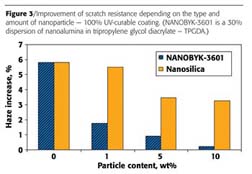


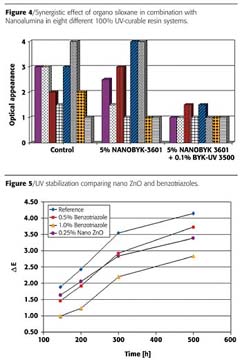
As can be seen, 1% nanoalumina reduces the haze increase by 70%. At the same time, using 10% silica has a less pronounced effect. The reason for this difference is the difference in mechanical properties of the nanosized alumina and silica. For the alumina the Youngs modulus is about 410 GPa while for silica it is only 55 GPa, assuming no change in modulus while changing the size to about 40 nm. The harder material simply results in more scratch-resistant nanocomposites. Besides the material itself, it is the interface between the particles and the matrix that determines the improvement in mechanical properties. So, for example, there is a synergistic effect of the nanoalumina and certain silicone additives when applied together. In Figure 4, the combination of nanoalumina with a UV-curable organo siloxane (BYK-UV 3500) in eight different UV-curable resin systems is shown.

Without the organo siloxane the effect of scratch resistance cannot be achieved in all systems. Sometimes the appearance after scratching is worse (e.g., system 3 changes from 2 to 3). By adding a small amount of only 0.1% BYK-UV 3500, the effectivity of the nanoalumina can be enhanced significantly, leading to an improved appearance after scratching in seven out of eight coating systems.

Currently, the focus on the use of nanomaterials in coatings is in several other areas besides scratch resistance, including UV stabilization, anti-microbial activity, IR absorbance, or conductivity/anti-static properties. Inorganic UV absorbers are used more and more in coatings. Here, three different materials are under intensive development: nanosized titania, nanosized ZnO and nanosized cerium dioxide.


The materials differ in price, performance and absorption characteristics. The most expensive material is Ceria. In addition, Ceria is an oxidation catalyst - a property currently used in the field of mechanical-chemical planarization (CMP) of semiconductor wafers. This catalytic activity, combined with the high cost of raw materials, are the two major drawbacks when thinking about the use of Ceria in coatings. Titania is less expensive than Ceria but as pure rutile it is photoactive under UV radiation. The formation of radicals leads to a decomposition of organic materials. For that reason, titania must be coated and doped in order to quench the radical formation. Looking at the absorbance characteristics of nano titania, the absorbance edge is around 320-350 nm, which is in the UV-A region.

Compared to ZnO, the last of the three inorganic UV absorbers, titania has a higher absorption coefficient but is more transparent in the near UV-A region. ZnO very effectively blocks radiation below 400 nm while being less expensive compared to the two other oxides. In Figure 5, the stabilization effect of ZnO is compared to benzotriazole in a styrene-unsaturated polyester coating cured by radical polymerization. Due to the high amount of polystyrene, yellowing occurs even after moderate irradiation with UV-A light.

After 150 hours, the reference shifted by almost 2 units in the DE value mainly caused by a shift in the b-value, which is equal to a yellowing process. Benzotriazole (BT), at a level of 1%, can reduce this shift to 1, while 0.25% ZnO and 0.5% BT show equal effectivity. After 500 hours the ZnO is out-performing twice the amount of BT. These results are still preliminary but indicate already the advantages of inorganic nanosized UV absorbers. Due to the nanosize of the particles, the gloss and the colour of the coating is not affected when adding less than 2% of, for example, ZnO. Even with initially equally good performance of the inorganic and organic UV absorbers, especially over a long lifetime, the inorganic will out-perform the organic absorbers simply because it does not decompose by photochemical reaction induced by UV light.

Summary

In the short and midterm future, nanotechnology will influence our life more and more. Simply by changing the size of currently existing materials, new, improved or enhanced properties occur that can be taken advantage of. One area where nanotechnology is moving very fast into products is the field of nanocomposites and mainly in coatings. Improving the protective nature of coatings or creating new properties in coatings by adding small amounts of nanoadditives will be the future of nanotechnology in this area. Industry is taking the lead in this current area of R&D, including the environmental and health aspects of nanotechnology. A sustainable and safe use of nanotechnology will help to use existing resources in an even more responsible way.

This paper was presented at the Nano and Hybrid Coatings conference sponsored by The Paint Research Association, January 2005, Manchester, UK. Conference proceedings are obtainable by contacting Janet Saraty, Conference Administrator, at j.saraty@pra.org.uk.

Share This Story

Looking for a reprint of this article?
From high-res PDFs to custom plaques, order your copy today!


Recommended Content

JOIN TODAY
to unlock your recommendations.

Already have an account? Sign In

  • pci1022-Kinaltek-Lead-1170.jpg

    A Novel Pigment Production Technology

    Following an extensive R&D program that demonstrated...
    Paint and Coating Pigments
    By: Jawad Haidar and Nitin Soni
  • pci global top 10

    2025 Global Top 10: Top Paint and Coatings Companies

    The following is PCI’s annual ranking of the top 10...
    Paint and Coating Market Reports
    By: Courtney Bassett
  • 2025 pci 25

    2025 PCI 25: Top Paint and Coatings Companies

    PCI's annual ranking of the top 25 North American paint...
    Global Top 10 and PCI 25
    By: Courtney Bassett
You must login or register in order to post a comment.

Report Abusive Comment

Manage My Account
  • eMagazine
  • Newsletters
  • Online Registration
  • Subscription Customer Service

More Videos

Sponsored Content

Sponsored Content is a special paid section where industry companies provide high quality, objective, non-commercial content around topics of interest to the PCI audience. All Sponsored Content is supplied by the advertising company and any opinions expressed in this article are those of the author and not necessarily reflect the views of PCI or its parent company, BNP Media. Interested in participating in our Sponsored Content section? Contact your local rep!

close
  • wooden kitchen set and shelving
    Sponsored bySirca North America

    Leveraging Coatings to Meet ESG Goals in Manufacturing

  • man woodworking in workshop
    Sponsored byGemini Industries, Inc.

    Waterborne Coatings Aren't the Future -- They're the New Performance Benchmark

  • colorful building exterior
    Sponsored byDow

    Insights into Exterior Architectural Coating Degradation: Bridging Accelerated and Natural Weathering

Popular Stories

Supply chain question and cargo piles up and piling shipping containers question concept

Energy Disruptions Begin to Hit Coatings Supply Chain

basf

BASF Coatings Names Incoming CEO Ahead of Separation

PPG announced the installation of a state-of-the-art pilot finishing line that features IPG’s PhotoniCURE™ laser curing system at its powder manufacturing and technical facility in Strongsville, Ohio.

PPG Tests Laser Curing for Powder Coatings

POB-Point-and-Shoot

PCI Buyers Guide

Submit a Request for Proposal (RFP) to suppliers of your choice with details on what you need with a click of a button

Start your RFP

Browse our Buyers Guide for manufacturers and distributors of all types of coatings products and much more!

Find Suppliers

Events

September 4, 2025

N-Butylpyrrolidone (NBP) as a Green Solvent to Replace N-Methylpyrrolidone (NMP) in Industrial Coating Applications

ON DEMAND: EPA published a regulation proposal around N-methylpyrrolidone (NMP) in June 2024 to ban or limit NMP in many applications, such as paints and coatings and their removers. N-butylpyrrolidone (NBP) is a powerful and versatile solvent for a variety of industries looking for alternatives to substance of very high concern (SVHC)-listed solvents.

April 28, 2026

Next Gen Dispersion Technology in Paint Production: Driving Higher Quality at Lower Costs

Join this webinar to see how manufacturers reduce costs, energy use, raw materials, labor, and floor space while improving quality.

View All Submit An Event

Poll

Longest-running laboratory experiment

What is the longest-running laboratory experiment?
View Results Poll Archive

Products

Automotive Paints and Coatings, 2nd Edition

Now in its second edition and still the only book of its kind, this is an authoritative treatment of all stages of the coating process.

See More Products
Register for webinar: Next-Gen Dispersion Technology in Paint Production

Related Articles

  • ask-joe-powder-column-1170.jpg

    What is the best way to specify powder coating performance on steel substrates?

    See More
  • A Smart New Way to Measure

    See More
  • defelsko

    A Smart New Way to Measure

    See More

Related Products

See More Products
  • smart coatings.jpg

    Smart Coatings Fundamentals, Developments, and Applications

  • durability.jpg

    Increasing the Durability of Paint and Varnish Coatings in Building Products and Construction 1st Edition

See More Products
×

Keep the info flowing with our eNewsletters!

Get the latest industry updates tailored your way.

JOIN TODAY!
  • RESOURCES
    • Advertise
    • Contact Us
    • Directories
    • Store
    • Want More
    • Manufacturing Division
  • SIGN UP TODAY
    • Create Account
    • eMagazine
    • Newsletters
    • Customer Service
    • Manage Preferences
  • SERVICES
    • Marketing Services
    • Reprints
    • Market Research
    • List Rental
    • Survey & Sample
  • STAY CONNECTED
    • LinkedIn
    • Facebook
    • Youtube
    • X (Twitter)
  • PRIVACY
    • PRIVACY POLICY
    • TERMS & CONDITIONS
    • DO NOT SELL MY PERSONAL INFORMATION
    • PRIVACY REQUEST
    • ACCESSIBILITY

Copyright ©2026. All Rights Reserved BNP Media, Inc. and BNP Media II, LLC.

Design, CMS, Hosting & Web Development :: ePublishing