Painting & Coating Industry (PCI) logo Powder coating summit logo
search
cart
facebook twitter linkedin youtube
  • Sign In
  • Create Account
  • Sign Out
  • My Account
Painting & Coating Industry (PCI) logo Powder coating summit logo
  • NEWS
    • Latest News
    • Market Trends & Reports
    • Finishing News
    • Price Alerts
    • Subscribe to Newsletters
    • Global Top 10/ PCI 25
    • Weekly Featured Article
    • COATLE Word Game
  • PRODUCTS
    • Product News
    • Must See Products and Services
  • MATERIALS
    • Additives
    • Resins/Polymers
    • Pigments
    • Equipment
    • Distributors
  • TECHNOLOGIES
    • Adhesives
    • Architectural Coatings
    • Finishing Articles
    • Finishing Technologies
    • Finishing Equipment
    • Industrial Coatings
    • Nanotechnology
    • Powder Coatings
    • Solventborne
    • Special Purpose Coatings
    • Sustainability
    • UV Coatings
    • Waterborne
  • RESOURCES
    • Columns
      • Did you know?
      • Distribution Dive
      • Formulating With Mike
      • Innovation Insights
      • Powder Coating Perspectives
      • TiO2 Insider
    • Blogs
      • Editor's Viewpoint
      • Industry Insights
    • Coatings Supplier Handbook
    • Podcasts and Videos
      • COAT-IT! Podcast
      • Videos/PCI TV
    • PCI Store
    • Classifieds
    • eBooks
    • Sponsor Insights
    • White Papers
    • COATLE Word Game
  • EVENTS
    • Coatings Trends & Technologies Summit
    • Paint and Coatings Academy
    • Webinars
    • Calendar of Events
    • Lifetime Achievement Award
  • DIRECTORIES
    • Buyer's Guide
    • Equipment Directory
    • Materials Directory
  • EMAGAZINE
    • Current Issue
    • eMagazine Archive
    • China Issue Archive
    • Editorial Advisory Board
  • CONTACT
    • Contact Us
    • Advertise
    • Subscribe to eMagazine
    • Subscribe to Newsletters
  • SIGN UP!

Taber Test or Oscillating Sand?
DOE Improves Polycarbonate Plasma Coating Process
March 1, 2004


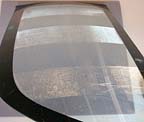
Growing demands in the automotive industry for innovative designs in panoramic roof modules and lightweight door windows are driving polycarbonate window improvements. Compared with glass, polycarbonate offers unique opportunities for meeting complex styling and design-driven challenges in today's competitive automotive market. Along with increased polycarbonate demand is a realization by some industry experts that the Taber abrasion test, a staple for glass manufacturers, may not be the best method for testing polycarbonate abrasion.

Researchers at Exatec, LLC, recently determined that the oscillating sand test reveals better wear assessment information for polycarbonates. This finding has allowed the company, a 50:50 joint venture of Bayer Polymers and GE Plastics, to optimize coating processes at its state-of-the-art Technology Development Center near Detroit.

Designing With DOE

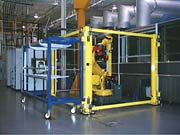
Because uncoated polycarbonate is easily scratched and doesn't withstand UV exposure well, abrasion-resistant and weatherable coatings are deposited onto polycarbonate to overcome these unwanted characteristics. Exatec's proprietary in-line, plasma-deposition machine bonds abrasive-resistive layers onto silicon hard-coated polycarbonate.

When this first-of-its-kind machine became operational, correct settings needed to be found to establish an effective process. A screening design of experiments (DOE) was conceived to determine which direction to pursue in order to optimize the Exatec500TM coating system.

Research and development work had already revealed to Exatec that deposition coating thickness was the key to successful polycarbonate glazing. Based on those findings, a DOE was designed to discover how thickness varied as a function of key input factors. This article focuses on the DOE screening phase, in which researchers rapidly sifted through a large number of factors using the fewest number of trials that would give them precise results. The aim of these screening experiments was to find those precious few variables that most affected the desired response - and eliminate the trivial many. The "big-hitter" variables were later used to optimize the deposition process.

Experimentation is time-consuming and expensive. Therefore, minimizing the number of experiments while maximizing information is essential. Exatec researchers Thomas Miebach, Steven Gasworth and Alex Scholten initially set up a simple fractional-factorial, resolution III design, looking at six factors simultaneously. The exact process results shown using Design-Expert® software are masked for proprietary reasons.

The six variables in Exatec's screening DOE were:

  • process pressure;
  • temperature of polycarbonate entering the coater;
  • plasma generator power; and
  • three differing flows of proprietary reactive gases making up the coating layer.
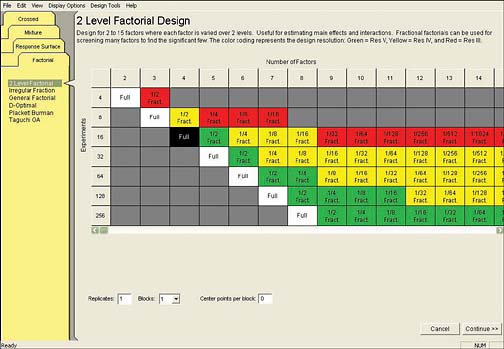
Upon finding interactions during the DOE that seemed unlikely, we "folded over" the design. Folding over adds specific runs that create a resolution IV design from a resolution III design. The procedure involves systematic plus and minus factor-level sign switching - a simple procedure when using powerful and intuitive DOE software. See Figure 1 and the sidebar. Upon folding over and running additional experiments, we discovered that the true interaction was between plasma generator power and one of the reagent flows - and not between pressure and temperature.

Based on the new information obtained from the foldover design, we discovered precise coating thickness settings that are now in use (Figure 2).
Meeting the Requirements

An important, Critical-To-Quality (CTQ) element at Exatec is abrasion resistance. Legislative requirements state that haze increase upon completing 1000 Taber wheel cycles cannot be more than two percent for automotive glazing applications with driver visibility requirements. The Taber test (ASTM D 1044) was found to have a huge variability when applied to coated polycarbonate - and was not a likely representation of real-life conditions. (The overall variability in individual test results was larger than the 0-2% tolerance on abrasion resistance.) Therefore, we looked at other tests to verify abrasion resistance. Detailed profilometry analysis of actual automotive glazing surface damage revealed better approximations of real surface damage by using a modified version of the ASTM F 735 oscillating sand test. In this test, four samples are tested (not one), and a different type of abrasive sand is used. Moreover, the oscillating sand test provided a much better model to fit plasma process data (Table 1).

The initial screening DOE outcome between Taber test and oscillating test results revealed differing directions to pursue for meeting CTQ and legislative requirements. By analyzing oscillating sand test DOE data, we found process settings resulting in coated polycarbonates with good layer adhesion properties and a low haze value. Just as important, we met all Taber test specifications. Had we relied solely on the Taber test results, we might have been led to incorrect process settings.

For more information, contact Exatec, LLC, 31220 Oak Creek Dr., Wixom, MI 48393; phone 248/926.4237; e-mail info@exatec.biz; or visit www.exatec.de.

For information on Design-Expert® software, contact Stat-Ease, Inc., 2021 East Hennepin Ave., Suite 480, Minneapolis, MN 55413; phone 612/378.9449; fax 612/378.2152; e-mail info@statease.com; or visit www.statease.com.
Screening Designs Explained

Screening experiments are often used in industry to identify factors having an important impact on responses. Screening reduces a large list of potential factors to a manageable few.

Although screening doesn't reveal extensive information about interactions (such as synergisms or antagonisms), it does make the "significant few" factors stand out over the "trivial many." The ultimate benefit is in allowing affordable and in-depth experimentation to occur.

As an example, a 2k factorial design requires 2k experimental points to estimate linear effects of k variables and their interactions. For example, if k=5, 32 experiments are required (2x2x2x2x2=32). Practitioners may opt for a fractional-factorial design and focus just on finding important main effects and 2-way interactions (resolution V), or just main effects (resolution III), or main and selected 2-way interactions (resolution IV). With k=5, a resolution V design requires 16 experimental points. This number of required runs is much more realistic, but the ability to estimate interaction effects is reduced. If k=15, a full-factorial design would require over 32,000 experiments, an impossible task. Instead, a 215-8 fraction only requires 128 runs - still a large number, but feasible. This fraction can estimate main effects and some 2-way interactions (resolution IV).

Analyzing fractional-factorial resolution patterns can be simplified using DOE software such as Design-Expert® from Stat-Ease, Inc. It provides a "traffic light" metaphor so users can look at color-coded resolution relationships:

  • Red - Stop and Think: A resolution III design indicates that main effects may be aliased with two-factor interactions. Resolution III designs can be misleading when significant two-factor interactions affect the response.

  • Yellow - Proceed with Caution: A resolution IV design indicates that main effects may be aliased with three-factor interactions. Two-factor interactions may be aliased with other two-factor interactions. Resolution IV designs are a good choice for a screening design because the main effects will be clear of two-factor interactions.

  • Green - Go Ahead: Resolution V (or higher) designs are just about as good as a full factorial, generally at a great savings in the number of runs to perform. Assuming that no three-factor (and higher) interactions occur, all the main effects and two-factor interactions can be estimated.
  • Share This Story

    Looking for a reprint of this article?
    From high-res PDFs to custom plaques, order your copy today!

    Recommended Content

    JOIN TODAY
    to unlock your recommendations.

    Already have an account? Sign In

    • pci1022-Kinaltek-Lead-1170.jpg

      A Novel Pigment Production Technology

      Following an extensive R&D program that demonstrated...
      Paint and Coating Pigments
      By: Jawad Haidar and Nitin Soni
    • pci global top 10

      2025 Global Top 10: Top Paint and Coatings Companies

      The following is PCI’s annual ranking of the top 10...
      Global Top 10 and PCI 25
      By: Courtney Bassett
    • 2025 pci 25

      2025 PCI 25: Top Paint and Coatings Companies

      PCI's annual ranking of the top 25 North American paint...
      Paint and Coating Market Reports
      By: Courtney Bassett
    You must login or register in order to post a comment.

    Report Abusive Comment

    Manage My Account
    • eMagazine
    • Newsletters
    • Online Registration
    • Subscription Customer Service

    More Videos

    Sponsored Content

    Sponsored Content is a special paid section where industry companies provide high quality, objective, non-commercial content around topics of interest to the PCI audience. All Sponsored Content is supplied by the advertising company and any opinions expressed in this article are those of the author and not necessarily reflect the views of PCI or its parent company, BNP Media. Interested in participating in our Sponsored Content section? Contact your local rep!

    close
    • colorful building exterior
      Sponsored byDow

      Insights into Exterior Architectural Coating Degradation: Bridging Accelerated and Natural Weathering

    • digital pigments
      Sponsored bySiltech

      The Fourth Dimension of Silicon: Siltech Q Resins

    Popular Stories

    Company News

    What the AkzoNobel–Axalta Merger Means for the Future of Coatings

    AkzoNobel and Axalta Headquarters

    AkzoNobel and Axalta Announce $25 Billion Merger

    Wacker logo

    WACKER Plans More Than 1,500 Job Cuts

    pci academy

    PCI Buyers Guide

    Submit a Request for Proposal (RFP) to suppliers of your choice with details on what you need with a click of a button

    Start your RFP

    Browse our Buyers Guide for manufacturers and distributors of all types of coatings products and much more!

    Find Suppliers

    Events

    September 4, 2025

    N-Butylpyrrolidone (NBP) as a Green Solvent to Replace N-Methylpyrrolidone (NMP) in Industrial Coating Applications

    ON DEMAND: EPA published a regulation proposal around N-methylpyrrolidone (NMP) in June 2024 to ban or limit NMP in many applications, such as paints and coatings and their removers. N-butylpyrrolidone (NBP) is a powerful and versatile solvent for a variety of industries looking for alternatives to substance of very high concern (SVHC)-listed solvents.

    March 24, 2026

    The Manufacturing & Automation eXchange (MAX)

    MAX presents a rare opportunity to observe the full scope of manufacturing in one environment. From systems integration and materials handling to automation, quality, safety, and packaging, each discipline is represented through live, operational displays. By experiencing these technologies side by side, as they are on actual production floors, attendees gain a grounded understanding of how manufacturing functions align, overlap, and evolve in practice.

    View All Submit An Event

    Poll

    Longest-running laboratory experiment

    What is the longest-running laboratory experiment?
    View Results Poll Archive

    Products

    Automotive Paints and Coatings, 2nd Edition

    Automotive Paints and Coatings, 2nd Edition

    Now in its second edition and still the only book of its kind, this is an authoritative treatment of all stages of the coating process.

    See More Products
    pci case ebook

    PCI webinar

    Related Articles

    • EQUIPMENT: Oscillating Sand Tester - Posted 5/2/07

      See More
    • 86 GRMN sports car

      Toyota Is First to Industry with Plasma-Coated Polycarbonate Rear Quarter Window

      See More
    • GreenTechnologies-100560492.jpg

      BioAmber Achieves Milestone in U.S. DOE Loan Guarantee Process

      See More

    Related Products

    See More Products
    • marketsandmarketslogo.jpg

      Metallic Powder Coatings Market by Process Type (Bonding, Blending, Extrusion)...

    • coatings.jpg

      Advanced Coating Materials

    See More Products
    ×

    Keep the info flowing with our eNewsletters!

    Get the latest industry updates tailored your way.

    JOIN TODAY!
    • RESOURCES
      • Advertise
      • Contact Us
      • Directories
      • Store
      • Want More
      • Manufacturing Division
    • SIGN UP TODAY
      • Create Account
      • eMagazine
      • Newsletters
      • Customer Service
      • Manage Preferences
    • SERVICES
      • Marketing Services
      • Reprints
      • Market Research
      • List Rental
      • Survey & Sample
    • STAY CONNECTED
      • LinkedIn
      • Facebook
      • Youtube
      • X (Twitter)
    • PRIVACY
      • PRIVACY POLICY
      • TERMS & CONDITIONS
      • DO NOT SELL MY PERSONAL INFORMATION
      • PRIVACY REQUEST
      • ACCESSIBILITY

    Copyright ©2025. All Rights Reserved BNP Media.

    Design, CMS, Hosting & Web Development :: ePublishing