
Painting & Coating Industry (PCI) logo Powder coating summit logo
search
cart
facebook twitter linkedin youtube
  • Sign In
  • Create Account
  • Sign Out
  • My Account
Painting & Coating Industry (PCI) logo Powder coating summit logo
  • NEWS
    • Latest News
    • Market Trends & Reports
    • Finishing News
    • Price Alerts
    • Subscribe to Newsletters
    • Global Top 10/ PCI 25
    • Weekly Featured Article
    • COATLE Word Game
  • PRODUCTS
    • Product News
    • Must See Products and Services
  • MATERIALS
    • Additives
    • Resins/Polymers
    • Pigments
    • Equipment
    • Distributors
  • TECHNOLOGIES
    • Adhesives
    • Architectural Coatings
    • Finishing Articles
    • Finishing Technologies
    • Finishing Equipment
    • Industrial Coatings
    • Nanotechnology
    • Powder Coatings
    • Solventborne
    • Special Purpose Coatings
    • Sustainability
    • UV Coatings
    • Waterborne
  • RESOURCES
    • Columns
      • Did you know?
      • Distribution Dive
      • Formulating With Mike
      • Innovation Insights
      • Powder Coating Perspectives
      • TiO2 Insider
    • Blogs
      • Editor's Viewpoint
      • Industry Insights
    • Coatings Supplier Handbook
    • Podcasts and Videos
      • COAT-IT! Podcast
      • Videos/PCI TV
    • PCI Store
    • Classifieds
    • eBooks
    • Sponsor Insights
    • White Papers
    • COATLE Word Game
  • EVENTS
    • Coatings Trends & Technologies Summit
    • Paint and Coatings Academy
    • Webinars
    • Calendar of Events
    • Lifetime Achievement Award
  • DIRECTORIES
    • Buyer's Guide
    • Equipment Directory
    • Materials Directory
  • EMAGAZINE
    • Current Issue
    • eMagazine Archive
    • China Issue Archive
    • Editorial Advisory Board
  • CONTACT
    • Contact Us
    • Advertise
    • Subscribe to eMagazine
    • Subscribe to Newsletters
  • SIGN UP!

EVOPeration

By Richard R. Roesler
March 1, 2007

Previously, we learned how Dr. Scientist used factorial design to optimize the manufacturing process of POLYGLOP 123 to increase the yield from 65 to 95% and save the company.1 In this article, Dr. Scientist will learn how plant engineers can continually optimize processes in production equipment without disrupting yields.

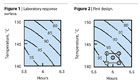
Figures 1 & 2

Batch History Review

Mr. Engineer enters Dr. Scientist’s offices and says, “I understand you wanted to talk to me about the batch records for POLYGLOP 123?”

“Yes. I noticed that you are not running at the same conditions that were defined in the statistically designed laboratory process study and wondered if you could tell me what has happened?” said Dr. Scientist.

Mr. Engineer replied, “When you used statistically designed experimentation to define the response surface for the reaction yield, you found that the optimum conditions to maximize the yield occurred at 142 °C and 6 hours.” (Figure 1)

Mr. Engineer continued, ”When we transferred these conditions to the plant, we did not achieve the 97% yield that you reported, but instead the first batch only achieved about 87%. This is not unusual when lab data is used in production, usually due to different equipment configuration, for example agitation. Fortunately we know of a technique to optimize manufacturing procedures, using experimental design techniques that will not disrupt production work-flow. The technique is called EVOP.”

Dr. Scientist replied, “I’ve heard of EVOP. I recall that this is an acronym for Evolutionary Operation. How does it work?”

“You’re correct. EVOP was first discussed by Box in 1957 and was then discussed in greater detail in the book Evolutionary Operation, written by Box and Draper in 1969.2 In operation, minor variations for selected variables are made to each batch. These variations are so small that the yield differences remain within the normal yield variations of production. Only by repeating these production experiments many times can trends in improvements be seen. Once a trend is identified, a small change in operating conditions is made to achieve the improvement. Then the process is repeated until no changes are indicated. Typically, only two or three of the most important variables are evaluated. Once these variables are under control, other minor variables can be evaluated for continuous improvement. Of course, the original variables continue to be monitored by EVOP in case of changes in raw materials or other production variables.”

“That’s very interesting. What are the current operating conditions and yields?” asked Dr. Scientist. “Currently, the plant is operating at 145 °C for 6 hours and 10 minutes to give an average yield of 96.6% with a standard deviation of 1.6%,” answered Mr. Engineer. “Such a minor change resulted in regaining the 97% change in yield,” replied Dr. Scientist thoughtfully. “Please tell me more about the EVOP procedure.”
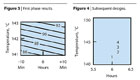


Figures 3 & 4

EVOP Applied to the POLYGLOP 123 Process

Mr. Engineer began, “We took the laboratory results shown in Figure 1 as the starting point and selected an experimental design with four corner points and a center point, as shown in Figure 2. Code 0, the center point, was assigned to the suggested operating conditions, and Codes 1 to 4 were assigned to the corner points.”

In his book, Evolutionary Operation, Box utilized a five experiment factorial design. When each of the experiments were run once, he called this a cycle; five cycles he called a phase. So, each phase represents 25 experiments. After five cycles, that is one phase, are run, the data are analyzed to determine whether the center point of the design should be changed to new temperature and time coordinates. Whether the change in coordinates is made or not, the procedure is repeated with five new cycles and subsequent data analysis. Normally, all five experiments are run before any are repeated. The order could be uniform: 1,2,3,4,0; 1,2,3,4,0; etc.; or could be random: 2,3,0,1,4; 1,3,4,0,2; etc. Of course, random is better.

“The reason five cycles are run is that for any one cycle, the noise in the operation will drown out the effect of the variation imposed by the small changes in the temperature and the time. By running several cycles, the signal-to-noise ratio can be increased, so that the real effect can be seen. This has to do with standard error of measurements3 (Applied statistics simplified: or,‘t time,’ APCJ, September 11, 1995).

“In the case of POLYGLOP 123, the first cycle for the design centered at 142 °C and 6 hours gave the following results: Experiment 0 gave a yield of 89%; Experiment 1 gave 87; Experiment 2 gave 89; Experiment 3 gave 88; and Experiment 4 gave 90. There is no clear pattern evident.

However, after five cycles, the completed phase, the situation clarified itself because the replication decreased the noise. The results are given in Table 1 and plotted in Figure 3.”

“From the table or the figure it is obvious that the next set of experiments should be centered at 143 °C and 6 hours and 10 minutes, the site of the maximum yield for the first phase of EVOP. Another phase was run at these new conditions and the evaluation of the data was repeated. A total of 4 phases were run to get to the current operating conditions. The centers, Experiment 0’s, of each phase are shown in Figure4.”

“When we ran the five cycles of five experiments of the fourth phase, we found that Experiment 0, the center point, gave a yield of 97%; Experiment 1 gave 94; Experiment 2 gave 95; Experiment 3 gave 95; and Experiment 4 gave 96. Since the completion of that phase, the standard operating conditions have been set at 145 °C and 6 hours and 10 minutes, and the average yield has been 96.6%,” finished Mr. Engineer.
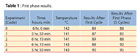


Table 1

Continuous Improvement

Dr. Scientist wondered, “Does this mean that you no longer need to use the EVOP procedure in production?” Mr. Engineer answered, “We are continuing to run EVOP phases on time and temperature. So far there has been no need to change the coordinates for the center of the design. In the future, however, something in the process might change: the raw materials might change; a thermocouple or clock might be replaced; or the process procedure or equipment might be modified. So we continue to use EVOP to study optimum temperature and time conditions.

“Also, since it appears that we are at an optimum for time and temperature, we are now considering if there are other variables that could be evaluated by EVOP, such as reactant ratios or agitation rate. “By continuing to run EVOP we can be assured that we will always have our process centered at the process conditions to achieve an optimum yield.”

Share This Story

Looking for a reprint of this article?
From high-res PDFs to custom plaques, order your copy today!


Crystal Lake Consultants, Pelican Rapids, MN

Recommended Content

JOIN TODAY
to unlock your recommendations.

Already have an account? Sign In

  • pci1022-Kinaltek-Lead-1170.jpg

    A Novel Pigment Production Technology

    Following an extensive R&D program that demonstrated...
    Paint and Coating Pigments
    By: Jawad Haidar and Nitin Soni
  • pci global top 10

    2025 Global Top 10: Top Paint and Coatings Companies

    The following is PCI’s annual ranking of the top 10...
    Global Top 10 and PCI 25
    By: Courtney Bassett
  • 2025 pci 25

    2025 PCI 25: Top Paint and Coatings Companies

    PCI's annual ranking of the top 25 North American paint...
    Global Top 10 and PCI 25
    By: Courtney Bassett
You must login or register in order to post a comment.

Report Abusive Comment

Manage My Account
  • eMagazine
  • Newsletters
  • Online Registration
  • Subscription Customer Service

More Videos

Sponsored Content

Sponsored Content is a special paid section where industry companies provide high quality, objective, non-commercial content around topics of interest to the PCI audience. All Sponsored Content is supplied by the advertising company and any opinions expressed in this article are those of the author and not necessarily reflect the views of PCI or its parent company, BNP Media. Interested in participating in our Sponsored Content section? Contact your local rep!

close
  • colorful building exterior
    Sponsored byDow

    Insights into Exterior Architectural Coating Degradation: Bridging Accelerated and Natural Weathering

  • digital pigments
    Sponsored bySiltech

    The Fourth Dimension of Silicon: Siltech Q Resins

Popular Stories

Company News

What the AkzoNobel–Axalta Merger Means for the Future of Coatings

AkzoNobel and Axalta Headquarters

AkzoNobel and Axalta Announce $25 Billion Merger

Wacker logo

WACKER Plans More Than 1,500 Job Cuts


PCI Buyers Guide

Submit a Request for Proposal (RFP) to suppliers of your choice with details on what you need with a click of a button

Start your RFP

Browse our Buyers Guide for manufacturers and distributors of all types of coatings products and much more!

Find Suppliers

Events

September 4, 2025

N-Butylpyrrolidone (NBP) as a Green Solvent to Replace N-Methylpyrrolidone (NMP) in Industrial Coating Applications

ON DEMAND: EPA published a regulation proposal around N-methylpyrrolidone (NMP) in June 2024 to ban or limit NMP in many applications, such as paints and coatings and their removers. N-butylpyrrolidone (NBP) is a powerful and versatile solvent for a variety of industries looking for alternatives to substance of very high concern (SVHC)-listed solvents.

March 24, 2026

The Manufacturing & Automation eXchange (MAX)

MAX presents a rare opportunity to observe the full scope of manufacturing in one environment. From systems integration and materials handling to automation, quality, safety, and packaging, each discipline is represented through live, operational displays. By experiencing these technologies side by side, as they are on actual production floors, attendees gain a grounded understanding of how manufacturing functions align, overlap, and evolve in practice.

View All Submit An Event

Poll

Longest-running laboratory experiment

What is the longest-running laboratory experiment?
View Results Poll Archive

Products

Automotive Paints and Coatings, 2nd Edition

Automotive Paints and Coatings, 2nd Edition

Now in its second edition and still the only book of its kind, this is an authoritative treatment of all stages of the coating process.

See More Products
pci voices from the top ebook

PCI webinar

Related Articles

  • deSigns of the Times: Slacking Off!

    See More
  • The Effect of Water Resistance on the Durability of Waterborne Coatings

    See More
  • Coatings Customers Improve Performance with DuPont Portal

    See More
×

Keep the info flowing with our eNewsletters!

Get the latest industry updates tailored your way.

JOIN TODAY!
  • RESOURCES
    • Advertise
    • Contact Us
    • Directories
    • Store
    • Want More
    • Manufacturing Division
  • SIGN UP TODAY
    • Create Account
    • eMagazine
    • Newsletters
    • Customer Service
    • Manage Preferences
  • SERVICES
    • Marketing Services
    • Reprints
    • Market Research
    • List Rental
    • Survey & Sample
  • STAY CONNECTED
    • LinkedIn
    • Facebook
    • Youtube
    • X (Twitter)
  • PRIVACY
    • PRIVACY POLICY
    • TERMS & CONDITIONS
    • DO NOT SELL MY PERSONAL INFORMATION
    • PRIVACY REQUEST
    • ACCESSIBILITY

Copyright ©2025. All Rights Reserved BNP Media.

Design, CMS, Hosting & Web Development :: ePublishing