Color: A Balance of Emotions and Chemistry
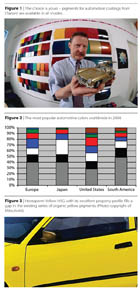
In addition to color stylists, consumers also know about the importance of colors in the purchasing decision (Figure 1). According to representative surveys, almost 40 percent of consumers would be ready to pick a different brand if the color they wanted was not available from their first brand of choice. Color taste is not the same everywhere. It is closely linked to the cultural environment. Based on regional color preferences, color designers anticipate color trends for each region (Figure 2).
In Europe, bright, cheerful base colors combined with metallic effects are the preferred choice. Yet some brand new colors look as if they were directly taken out of a 19th century history book. One new color is "powdered mauve," which is expected to make it to the top of automotive colors in Europe. In North America, on the other hand, statistics indicate a desire for classic colors, such as silver, dark blue and red. These colors get a new sparkle through glitter or reflecting effects. In Japan, neutral colors remain at the top of the list. However, they are given a futuristic touch by combining a smooth surface with changing color effects. In the next few years, color stylists expect a slight increase in chromatic colors, such as red, blue and yellow, and a moderate decrease in popularity in the silver shades.
Color is generated by the interaction of matter with light. Of special interest is the portion of light that can be seen by the human eye, in the range between 400 and 800 nm. When colorants absorb, emit or reflect certain spectral portions of light, the retina registers a different color, which makes the eye see specific colors.
In color chemistry, these color-creating substances are called colorants. They are divided into two sub-categories: dyes and pigments. Their solubility, a physical property, is decisive for their categorization. According to the coloring materials classification standard DIN 55944, pigments are practically non-soluble in their application medium; they are crystalline. Dyes, on the other hand, are perfectly dissolved in the application medium, where their molecular structure is equally distributed. In dyes, it is the individual molecule that determines the light absorption and consequently the color, while in pigments the crystalline structure is an additional determining factor of the visual qualities of the color.
High-Performance Pigments: The Perfect Match
Not all colorants are suitable for every application. The coloration of automotive coatings, for example, requires high-end products with outstanding properties. High-performance pigments (HPPs), which include both inorganic and organic pigments, are a perfect match for this application. HPPs are characterized by the "three essential E's" as defined by Gunter Buxbaum ("High-Performance Pigments," Ed. Hugh M. Smith): effectiveness (technical performance); economy (benefits for the customer); and ecology (environmental and toxicological safety).
HPPs feature high color strength, high insolubility and heat stability. Furthermore, they have extremely good light and weatherfastness properties, solvent and bleeding fastness and low migration. Because of these properties, HPPs are the preferred choice in applications that require excellent lightfastness and weatherfastness, like outdoor applications such as automotive coatings, exterior house paints and outdoor signs.
A Yellow Pigment for Demanding Applications
There are two outstanding pigment classes that illustrate the latest success in the search for a new HPP. These pigments not only offer extraordinary properties and tantalizing color quality, but they also are tailored to their individual application.
For coatings, an innovative class of heterocyclic monoazo pigments was recently introduced: azo quinoxalindione. This pigment class owes its higher insolubility to an additional cyclic amide group, which is absent from benzimidazolone pigments. Unlike other yellow pigments common on the market, the new high-performance pigment Hostaperm® Yellow H5G (C.I. Pigment Yellow 213) is weatherfast and does not bleed. It is a unique, bright greenish yellow pigment with excellent color strength, especially in waterborne systems (Figure 3). The pigment meets the requirements for waterborne basecoat systems, as well as those for high-solids paints.
While its use in bright solid shades, ranging from green via yellow to orange is easy to anticipate, Hostaperm Yellow H5G also opens up new styling possibilities for the formulation of metallic shades. An opaque pigment for metallic shades seems an unusual choice at first because if too much of the pigment is used, the metallic effect disappears. If the amount is too small, the yellow pigments on the market are either not bright enough to color the aluminum or they lack the required weatherfastness. However, this new pigment has sufficient color strength and durability to be used at tinting levels. It creates a unique greenish yellow shade - a fresh breeze in metallic colors, ranging from green via gold to copper tones, both saturated and pale.
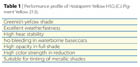
This azo quinoxalindione pigment is an example of Clariant's successful search for high-performance pigments that fulfill even the toughest demands. With its excellent property profile (Table 1), it fills a gap in the existing series of organic yellow pigments. Since its introduction, the yellow pigment has been quickly established in the market and today plays an important role in all major OEM automotive paint manufacturing. The pigment allows almost unlimited styling variations, as demonstrated by the latest Toyota and DC models. Major manufacturers of refinishing paint also use this pigment as a key yellow pigment in their second generation of waterborne refinishing systems.
Vibrant Red for Coatings and Plastics
In the orange and red shade area, HPPs include quinacridones, perylenes, perinones and diketopyrrolo pyrroles (DPPs). They feature excellent lightfastness and weatherfastness, high heat stability, and satisfactory migration properties.
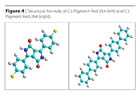
The basic chemical structure of DPP pigments consists of two fused five-member heterocyclic rings, both of which contain one carboxylic acid amide group (Figure 4). Since their discovery, the market for these high-performance red pigments has grown significantly. Today, it is estimated at 2,000 metric tons worldwide. With DPP pigments, shades from orange red to vibrant red and red-purple can be produced. Due to their balanced property profile and versatility, the pigments can be used in automotive and industrial coatings, as well as powder coatings. Applications in plastics include the coloration of polyolefins, polyvinyl chloride and a variety of consumer goods.
Especially for the production of DPP pigments (whose patent protection expired in 2003), Clariant has built a new facility that was inaugurated in October 2004 after fewer than 18 months of construction. The production process has been integrated into the existing HPP 1 facility in Frankfurt-Hoechst, Germany. The highly automated plant has the long-term potential to meet the market demand for high-value red pigments.
Currently, five pigments based on DPP chemistry are being produced at the plant. They include three new high-performance pigments that the Pigments & Additives Division recently added to its range in C.I. Pigment Red 254. Hostaperm Red D2G 70 is especially suited for the pigmentation of OEM automotive finishes and refinishes, as well as plastics coloration. Hostaperm Red D3G 70 is recommended for industrial coatings and printing inks. PV Fast® Red D3G is a high-value pure red pigment developed especially for the coloration of a wide range of plastics, including polyolefins and PVC. Soon this brand also will be available as a non-dusting and easy-dosing granule under the trade name DrizPearls® Red D3G.
In addition to these three red pigments, two innovative ruby pigments with significantly improved properties for coatings also are manufactured at the new plant: Hostaperm Rubine D3B and Hostaperm Rubine D3B-WD. The bluish red pigments with the C.I. Pigment Red 264 are highly transparent and offer excellent fastness properties. Compared to conventional ruby pigments based on DPP chemistry, these pigments not only show more color strength, but the specially modified surface of Hostaperm Rubine D3B improves their rheological properties and significantly increases their resistance to flocculation. Main areas of application are in combination with effect pigments, such as aluminum bronzes or mica pigments. Table 1 summarizes the technical data of the two pigments.
The Concept of "Twin Pigments"
With its two new ruby pigments, Clariant also is pursuing the concept of "twin pigments," taking DPP chemistry in a new direction. While Hostaperm Rubine D3B is ideally suited for solventborne paints, particularly for environmentally friendly high-solids coating systems, the same coloristic properties can be achieved with Hostaperm Rubine D3B-WD in aqueous systems.
The concept of twin pigments was developed in response to glitches created by the worldwide use of two fundamentally different automotive coating systems: solventborne high solids and aqueous basecoats. Depending on the technology, the use of conventional pigments leads to different coloristic results due to different pigment wetting and stabilization in the two coating systems. This can become a problem if the shade of an aqueous OEM basecoat needs to be recreated in a high-solids refinishing coating. Often the only solution is tailored surface refinishing. The new twin pigments, however, are available in two forms, both for solventborne and aqueous coating systems, allowing the simple transfer of a shade from one system to another.
Conclusion
The process of innovation continues as Clariant introduces new pigments as well as improved products in established ranges. Developing pigments that are tailored to changing markets is a top priority, and close cooperation with the companies that use the pigments is a key element for success. Other essential success factors include experience, know-how, quality management and a global network. Color follows fashion and, as such, it is subject to different trends around the globe. Creating novelty colors that fit the trends of the future is an exciting balance of emotions and chemistry.
For further information in the United States, contact Wiliam Zonin, 401/823.2769 or e-mail William. Zonin@Clariant.com.
Looking for a reprint of this article?
From high-res PDFs to custom plaques, order your copy today!