Alkyd Latexes: Opening the Door for a Greener Tomorrow
As environmental regulations and the “go green” era continue to be the driving force of current coatings resin development, the importance of having a versatile, low-VOC resin is evident.
As environmental regulations and the “go green” era continue to be the driving force of current coatings resin development, the importance of having a versatile, low-VOC resin is evident. With the chemical industry affected by the economic crisis that is being experienced globally, many companies have downsized their staff, production and research capabilities. This makes it hard for paint companies to delve into new research areas, as they are constantly reformulating product lines to meet current and future acceptable VOC levels as they also strive for “green” certification. The green certification process, available from a variety of independent third parties, is offered to companies and regarded as a positive from many consumers’ perspectives and has become a crucial part of new product development for several industries. These certification programs have a list of certain criteria that are required for a product to boast their stamp of approval. In addition, existing and novel coatings products must continue to meet allowable levels of VOCs in both architectural and industrial paints that vary from region to region. As the uncertainty of the economic situation continues, wouldn’t it be nice to have a multipurpose resin that can be used in multiple applications that easily meets current and future VOC allowances and qualifies for green certification?
 Credit: Reichhold, Inc. Credit: Reichhold, Inc.
|
| Table 1 Click to enlarge |
Green Certification Programs
While the environmental component emerges as an important aspect in a consumer’s decision, certification programs have been developed to help ensure the environmental benefits of specific products. These certifications are offered by independent third parties and typically entail a detailed certification process. Most programs for the coatings industry are focused on chemical exemptions, VOC limits, performance requirements and packaging constraints. Currently, reputable programs for a broad range of products, including coatings products, are Green Seal, Ecologo and the Coatings Research Group, Inc.’s Green Wise. Other programs exist, but are targeted toward specific market segments. Table 1 provides a summary of the certification plans and criteria for different coatings applications.
All of the certification programs outlined in Table 1 are currently the most frequently used across the coatings industry. It is evident the renewable resource content of the product does not play a role in any of these certification processes. As more of these organizations are developed and the definition of what characterizes a green product continues to evolve, one can presuppose that in the future the renewable resource content of a product will be pertinent for green certification.
History of Alkyds
 Credit: Reichhold, Inc. Credit: Reichhold, Inc. |
| Figure 1 Click to enlarge |
Alkyd chemistry has been a strong force in the coatings industry for many years. The chemistry, although very established, still has room for growth as the focus on materials from renewable resources continues to develop. Although alkyds have predominantly been available in organic vehicles, the thrust to develop superior waterborne alkyds has been set in motion. Waterborne alkyd technologies including water reducible alkyds, alkyd dispersions, and alkyd latexes have been commercially available for several decades. Although still possessing some of the positive attributes of alkyd resins, these first-generation waterborne alkyds were inferior to the acrylic latex due to their poor hydrolytic stability. Today, several large resin suppliers have brought a number of alkyd dispersions and alkyd latexes to the table that mimic solventborne alkyd performance while providing desired hydrolytic stability.
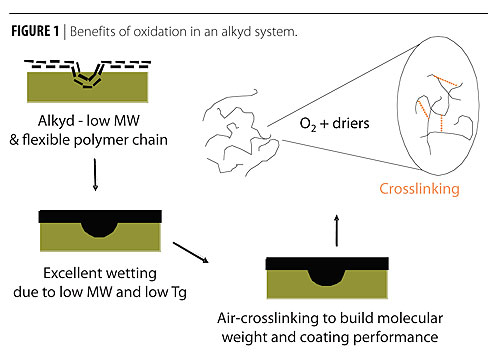
One attractive component of alkyd chemistry is the ability for oxidation that is contributed from the oil component of the polymer. Oxidation occurs through the unsaturated moieties that are found along the pendant fatty acid chains. The benefits presented by an oxidizable system are evident. With an alkyd-bound coating, the initial film exhibits good flow and leveling characteristics due to the low molecular weight, low glass transition temperature (Tg) and flexibility of the polymer chains. Then, following air crosslinking, the final film exhibits good adhesion, hardness, gloss and corrosion resistance. The film formation for an alkyd resin is depicted in Figure 1. By starting with a low-molecular-weight polymer, the lack of coalescent helps keep the VOC to a minimum when moving to an aqueous carrier.
 Credit: Reichhold, Inc. Credit: Reichhold, Inc. |
| Figure 2 Click to enlarge |
Using Alkyd Latexes to Achieve Green Products
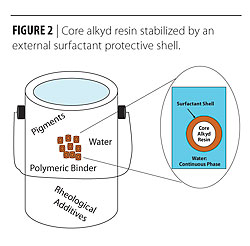
New-generation alkyd latexes, including the Beckosol® AQ line of alkyd latexes currently available from -Reichhold, are made by the introduction of external surfactants and advanced processing techniques that offer a stable latex in a continuous aqueous phase. These stable latexes are achieved by careful selection of the surfactant system and precise control of the emulsion process. A key factor for stabilization is attaining small emulsion particle diameters. The quality of the latex is dependent on the surface tension present in the particles. Alkyd latexes can be prepared by either direct emulsification or a phase inversion process. By achieving stable emulsions through the introduction of a protective surfactant shell, the core alkyd resin is stabilized and hydrolysis rates are hindered. This type of system addresses the VOC issue and provides the benefits of a traditional alkyd resin. See Figure 2 for a pictorial description of an alkyd binder in a latex paint stabilized by an outer protective layer.
One benefit of alkyd latex-based paint is once the coating is applied, the low-molecular-weight, low-Tg alkyd resin crosslinks through the traditional oxidative crosslinking mechanism characteristic of alkyd resins. This eliminates the need for expensive coalescing solvents and additives that are needed in acrylic latex paints in order to get excellent application properties. Another benefit of alkyd latexes is that it formulates like a typical latex paint. Standard latex rheological additives, dispersants and defoamers are effective in developing alkyd latex paints. Thus, once a system is established with an alkyd latex, formulating chemists will have more time to spend on new R&D instead of reformulating. This is all a result of the <50 g/L VOC capabilities of the alkyd latexes.
Furthermore, new waterborne alkyd technology is applicable to all classes of alkyds including long, medium and short oils as well as modified systems. This allows for a wide range of architectural and industrial product development based on a single technology. An added benefit of alkyd latexes is the renewable resource content that is contributed by the use of different plant/vegetable oils during polymer synthesis. As a specific example, the Beckosol AQ line contains up to 50% renewable material on a solids basis. Though renewable resource content is not a current requirement to obtain the green label from several agencies, as the development of what constitutes a green product continues to advance, renewable resource content could and probably will play a pertinent role as the third-party agencies seek to differentiate themselves from one another. Hence, converting to a product line based on alkyd latex provides a number of benefits and a head start in future markets.
Using Alkyd Latexes to Attain Green Assets
Since more companies are commercializing products based on the new and improved waterborne alkyds, realization of the convenience of such a technology is beginning to broaden. These product lines include but are not limited to deck stains, primers, gloss enamels and industrial paints. As research on the new generation of alkyd latexes continues it is anticipated that more companies will convert existing product lines to alkyd latex-based products. Furthermore, with the uncertainty of the current global economic crisis, companies are searching for ways to cut cost on manufacturing, raw materials and inventory. The use of the new generation of alkyd latexes will aide to achieve these goals as companies attempt to rebuild their staff and research capabilities. Finally, with the near-zero VOC capabilities of the technology, the need for having different formulas for different regions will also dissipate.
Summary
Alkyd latexes are versatile polymers that can be used to develop both architectural and industrial paints. With the near-zero VOC capabilities of these products, the ability to meet current and future allowable VOC levels are made easy and convenient through one product line. In addition, the renewable resource content that is contributed by the use of different plant/vegetable oils during polymer synthesis is an extra benefit as the focus on green technology continues to advance. The versatility of said resins contributes to a more efficient production and inventory system as companies continue to face the effects of a challenging global economy.
For more information, visit www.reichhold.com.
Looking for a reprint of this article?
From high-res PDFs to custom plaques, order your copy today!