Painting & Coating Industry (PCI) logo Powder coating summit logo
search
cart
facebook twitter linkedin youtube
  • Sign In
  • Create Account
  • Sign Out
  • My Account
Painting & Coating Industry (PCI) logo Powder coating summit logo
  • NEWS
    • Latest News
    • Market Trends & Reports
    • Finishing News
    • Price Alerts
    • Subscribe to Newsletters
    • Global Top 10/ PCI 25
    • Weekly Featured Article
    • COATLE Word Game
  • PRODUCTS
    • Product News
    • Must See Products and Services
  • MATERIALS
    • Additives
    • Resins/Polymers
    • Pigments
    • Equipment
    • Distributors
  • TECHNOLOGIES
    • Adhesives
    • Architectural Coatings
    • Finishing Articles
    • Finishing Technologies
    • Finishing Equipment
    • Industrial Coatings
    • Nanotechnology
    • Powder Coatings
    • Solventborne
    • Special Purpose Coatings
    • Sustainability
    • UV Coatings
    • Waterborne
  • RESOURCES
    • Columns
      • Did you know?
      • Distribution Dive
      • Formulating With Mike
      • Innovation Insights
      • Powder Coating Perspectives
      • TiO2 Insider
    • Blogs
      • Editor's Viewpoint
      • Industry Insights
    • Coatings Supplier Handbook
    • Podcasts and Videos
      • COAT-IT! Podcast
      • Videos/PCI TV
    • PCI Store
    • Classifieds
    • eBooks
    • Sponsor Insights
    • White Papers
    • COATLE Word Game
  • EVENTS
    • Coatings Trends & Technologies Summit
    • Paint and Coatings Academy
    • Webinars
    • Calendar of Events
    • Lifetime Achievement Award
  • DIRECTORIES
    • Buyer's Guide
    • Equipment Directory
    • Materials Directory
  • EMAGAZINE
    • Current Issue
    • eMagazine Archive
    • China Issue Archive
    • Editorial Advisory Board
  • CONTACT
    • Contact Us
    • Advertise
    • Subscribe to eMagazine
    • Subscribe to Newsletters
  • SIGN UP!
Paint and Coating PigmentsArchitectural CoatingsGreen Technology

IR-Reflective Pigment Helps Conserve Energy

By Robert Maul
pci0412-Eckert-F1-615.jpg
Credit: Eckart GmbH
pci0412-Eckert-F2-615.jpg
Credit: Eckart GmbH
pci0412-Eckert-F3-615.jpg
Credit: Eckart GmbH
pci0412-Eckert-T1-615.jpg
Credit: Eckart GmbH
pci0412-Eckert-T2-615.jpg
Credit: Eckart GmbH
pci0412-Eckert-T3-615.jpg
Credit: Eckart GmbH
pci0412-Eckert-F1-615.jpg
pci0412-Eckert-F2-615.jpg
pci0412-Eckert-F3-615.jpg
pci0412-Eckert-T1-615.jpg
pci0412-Eckert-T2-615.jpg
pci0412-Eckert-T3-615.jpg
April 2, 2012
Many residential buildings were built before 1980 – at a time when energy was regarded as an expense factor that could be neglected. This situation has changed radically, as energy prices have increased substantially. The challenge today is to consume less energy and to use the energy available in a more conscientious and intelligent way. The highest savings potential can be found in the modernization of buildings, as older buildings require about three times more energy than new housing.  In private households, approximately 75% of the energy used is necessary for heating. The highest heat loss from buildings occurs at the exterior walls and ceilings. This prompted ECKART to develop IReflex pigment, which when incorporated into simple wall paints, offers a way of improving the energy efficiency of buildings.

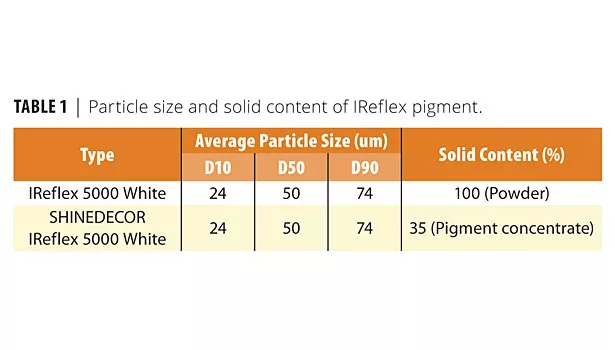
Aluminium shows the highest heat-reflection properties compared with other metals. IReflex uses this salient characteristic of aluminium pigments to achieve a maximum IR reflection. IReflex is environmentally friendly, as it is free of solvents and water pollutants (it complies with the requirements of the Ecolabel). It is available as a powder or a ready-to-use pigment concentrate (Table 1), and is simply stirred into transparent interior wall paints. For the highest protection possible of the stabilizing layer of the pigment, IReflex should be added to the paint carefully and at low shear forces. Strong shear forces can damage the pigment and result in an impairment of the effect. The desired color shade can be obtained by adding organic color pigments (Figure 1). The IR reflection behavior is not impaired by tinting colors. The paint can then be applied with all usual application methods. IReflex can be used in many applications, especially interior wall paints, but can also be used in wood coatings, facade paints, coil coating, etc. 

IReflex causes the heat energy, or the warmth emanating from the human body, to be reflected back into the room instead of being absorbed by the walls and ceiling. The heat reflection from the walls back into the room results in improved thermal comfort of the human body. The high-yield IReflex pigment works according to the thermos flask principle − in winter, the heat is reflected back into the room and stays inside. In summer, however, IReflex prevents the heat from getting inside the room. IReflex is especially suited for the energy-efficient modernization of existing buildings, as no construction work is necessary.

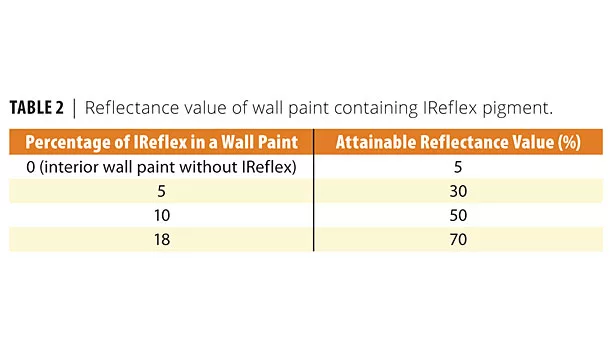
With a pigmentation level of approximately 10%, IReflex shows reflectance values of 50 %. In comparison, white interior wall paints reach a reflectance value of only 5% in a mid-IR range; i.e., 95% of the heat energy is absorbed by the wall. The higher the amount of IReflex pigment used in the paint, the higher the reflectance value of a wall paint (Table 2). If conditions are ideal, and if 10% of IReflex is incorporated into the wall paint, 22% of the heating costs can be saved.

The surface also plays an important role in increasing the reflectance value. The best reflectance values can be obtained by applying the wall paint with IReflex on a smooth surface. This effect is shown in Figure 2.

Study by the Bauhaus University in Weimar

Extensive research was conducted in co-operation with the Bauhaus University in Weimar (department Faculty for Building Physics) in order to prove the efficiency of IReflex. The study was carried out in a special climatic room measuring 9.84 x 9.84 x 8 ft. The walls and ceiling of the room were painted with a standard interior paint, and with an interior paint containing IReflex. NTC sensors that controlled the actual surface temperature were installed at different wall surfaces of the room. Specifically for this study, a sensor was installed and programmed in order to control the room temperature via the floor heating; the setpoint value was set to 69.8 °F.

In order to examine the influence of the building construction, different wall constructions and the surface temperatures connected with them were simulated. The U-values (thermal insulation values) of:

•   1.64 W/m²K (old building) / USA: R value approx. R-3;

•   1.11 W/m²K (building of the seventies) / USA: R value approx. -5; and

•   0.12 W/m²K (new low-energy house) / USA: R value approx. -47

were set in order to estimate the surface temperature of the exterior wall under the influence of the wall construction.

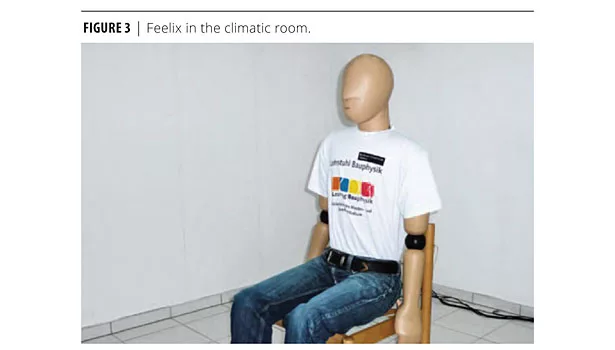
In order to measure the thermal comfort, an artificial model named Feelix was used (Figure 3). Feelix was covered with a special kind of plastic with 7000 metres of cable underneath that made it possible to simulate the temperature and feeling of human skin. Via different control modes, the surface temperature, the heat flow or even a comfort mode could be simulated.

The studies were based on the conditions of the German DIN standard 4108-2 regarding a minimum requirement to heat insulation (thermal bridges) with the following conditions:

•   Floor heating;

•   Outdoor temperature of 23 °F;

•   Room temperature of 69.8 °F;

•   Application of IReflex with a reflectance value
    of 50%; and

•   Heat flow density of Feelix: q = 70.2 W/m².

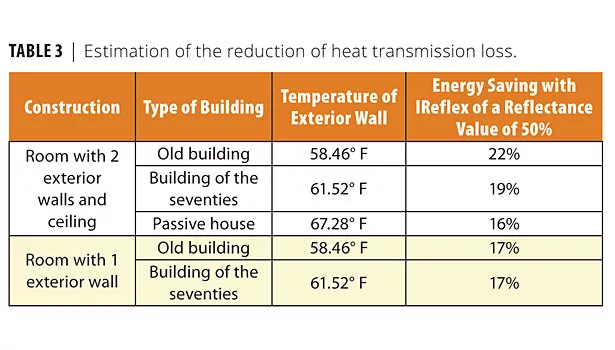
The results showed that the application of interior wall paint with IReflex significantly reduced the loss of transmission heat from the walls to the outside. After the application, the wall reflected the heat back into the room. The “human” body needed to produce less energy for the heat exchange and felt less cold. The thermal comfort of Feelix increased and the supplied heat output could be reduced. Accordingly, less heating energy was required to keep the thermal comfort at a constant level. The results of the research carried out by the Bauhaus University in Weimar highlight the high energy savings potential in the field of older buildings, or low-energy modern buildings (Table 3).

Conclusion

The study proves that the increase of the reflectance value of an interior wall paint results in energy savings. As the savings potential significantly depends on the surface temperature of the outside walls, the insulation of the building is important. The results of the research carried out by the Bauhaus University in Weimar highlight the high energy savings potential, especially in the field of old buildings. The poorer the heat insulation of a building, the more energy can be saved by using IReflex. 

KEYWORDS: IR-Reflecting Pigments technology

Share This Story

Looking for a reprint of this article?
From high-res PDFs to custom plaques, order your copy today!


Maul is Global Technical Service and Marketing for Eckart GmbH in Hartenstein, Germany

Recommended Content

JOIN TODAY
to unlock your recommendations.

Already have an account? Sign In

  • pci1022-Kinaltek-Lead-1170.jpg

    A Novel Pigment Production Technology

    Following an extensive R&D program that demonstrated...
    Paint and Coating Pigments
    By: Jawad Haidar and Nitin Soni
  • pci global top 10

    2025 Global Top 10: Top Paint and Coatings Companies

    The following is PCI’s annual ranking of the top 10...
    Global Top 10 and PCI 25
    By: Courtney Bassett
  • 2025 pci 25

    2025 PCI 25: Top Paint and Coatings Companies

    PCI's annual ranking of the top 25 North American paint...
    Global Top 10 and PCI 25
    By: Courtney Bassett
You must login or register in order to post a comment.

Report Abusive Comment

Manage My Account
  • eMagazine
  • Newsletters
  • Online Registration
  • Subscription Customer Service

More Videos

Sponsored Content

Sponsored Content is a special paid section where industry companies provide high quality, objective, non-commercial content around topics of interest to the PCI audience. All Sponsored Content is supplied by the advertising company and any opinions expressed in this article are those of the author and not necessarily reflect the views of PCI or its parent company, BNP Media. Interested in participating in our Sponsored Content section? Contact your local rep!

close
  • colorful building exterior
    Sponsored byDow

    Insights into Exterior Architectural Coating Degradation: Bridging Accelerated and Natural Weathering

  • digital pigments
    Sponsored bySiltech

    The Fourth Dimension of Silicon: Siltech Q Resins

Popular Stories

Company News

What the AkzoNobel–Axalta Merger Means for the Future of Coatings

AkzoNobel and Axalta Headquarters

AkzoNobel and Axalta Announce $25 Billion Merger

Wacker logo

WACKER Plans More Than 1,500 Job Cuts


PCI Buyers Guide

Submit a Request for Proposal (RFP) to suppliers of your choice with details on what you need with a click of a button

Start your RFP

Browse our Buyers Guide for manufacturers and distributors of all types of coatings products and much more!

Find Suppliers

Events

September 4, 2025

N-Butylpyrrolidone (NBP) as a Green Solvent to Replace N-Methylpyrrolidone (NMP) in Industrial Coating Applications

ON DEMAND: EPA published a regulation proposal around N-methylpyrrolidone (NMP) in June 2024 to ban or limit NMP in many applications, such as paints and coatings and their removers. N-butylpyrrolidone (NBP) is a powerful and versatile solvent for a variety of industries looking for alternatives to substance of very high concern (SVHC)-listed solvents.

March 24, 2026

The Manufacturing & Automation eXchange (MAX)

MAX presents a rare opportunity to observe the full scope of manufacturing in one environment. From systems integration and materials handling to automation, quality, safety, and packaging, each discipline is represented through live, operational displays. By experiencing these technologies side by side, as they are on actual production floors, attendees gain a grounded understanding of how manufacturing functions align, overlap, and evolve in practice.

View All Submit An Event

Poll

Longest-running laboratory experiment

What is the longest-running laboratory experiment?
View Results Poll Archive

Products

Automotive Paints and Coatings, 2nd Edition

Automotive Paints and Coatings, 2nd Edition

Now in its second edition and still the only book of its kind, this is an authoritative treatment of all stages of the coating process.

See More Products
pci voices from the top ebook

PCI webinar

Related Articles

  • IR-Reflective Pigments: A Black Rainbow of Options

    IR-Reflective Pigments: A Black Rainbow of Options

    See More
  • PPG Study Investigates Value of IR-Reflective Coatings

    See More
  • PPG Study Investigates Value of IR-Reflective Coatings

    See More
×

Keep the info flowing with our eNewsletters!

Get the latest industry updates tailored your way.

JOIN TODAY!
  • RESOURCES
    • Advertise
    • Contact Us
    • Directories
    • Store
    • Want More
    • Manufacturing Division
  • SIGN UP TODAY
    • Create Account
    • eMagazine
    • Newsletters
    • Customer Service
    • Manage Preferences
  • SERVICES
    • Marketing Services
    • Reprints
    • Market Research
    • List Rental
    • Survey & Sample
  • STAY CONNECTED
    • LinkedIn
    • Facebook
    • Youtube
    • X (Twitter)
  • PRIVACY
    • PRIVACY POLICY
    • TERMS & CONDITIONS
    • DO NOT SELL MY PERSONAL INFORMATION
    • PRIVACY REQUEST
    • ACCESSIBILITY

Copyright ©2025. All Rights Reserved BNP Media.

Design, CMS, Hosting & Web Development :: ePublishing