Painting & Coating Industry (PCI) logo Powder coating summit logo
search
cart
facebook twitter linkedin youtube
  • Sign In
  • Create Account
  • Sign Out
  • My Account
Painting & Coating Industry (PCI) logo Powder coating summit logo
  • NEWS
    • Latest News
    • Market Trends & Reports
    • Finishing News
    • Price Alerts
    • Subscribe to Newsletters
    • Global Top 10/ PCI 25
    • Weekly Featured Article
    • COATLE Word Game
  • PRODUCTS
    • Product News
    • Must See Products and Services
  • MATERIALS
    • Additives
    • Resins/Polymers
    • Pigments
    • Equipment
    • Distributors
  • TECHNOLOGIES
    • Adhesives
    • Architectural Coatings
    • Finishing Articles
    • Finishing Technologies
    • Finishing Equipment
    • Industrial Coatings
    • Nanotechnology
    • Powder Coatings
    • Solventborne
    • Special Purpose Coatings
    • Sustainability
    • UV Coatings
    • Waterborne
  • RESOURCES
    • Columns
      • Did you know?
      • Distribution Dive
      • Formulating With Mike
      • Innovation Insights
      • Powder Coating Perspectives
      • TiO2 Insider
    • Blogs
      • Editor's Viewpoint
      • Industry Insights
    • Coatings Supplier Handbook
    • Podcasts and Videos
      • COAT-IT! Podcast
      • Videos/PCI TV
    • PCI Store
    • Classifieds
    • eBooks
    • Sponsor Insights
    • White Papers
    • COATLE Word Game
  • EVENTS
    • Coatings Trends & Technologies Summit
    • Paint and Coatings Academy
    • Webinars
    • Calendar of Events
    • Lifetime Achievement Award
  • DIRECTORIES
    • Buyer's Guide
    • Equipment Directory
    • Materials Directory
  • EMAGAZINE
    • Current Issue
    • eMagazine Archive
    • China Issue Archive
    • Editorial Advisory Board
  • CONTACT
    • Contact Us
    • Advertise
    • Subscribe to eMagazine
    • Subscribe to Newsletters
  • SIGN UP!
Paint and Coatings AdditivesPaint and Coating Resins & PolymersIndustrial Coatings

A New Epoxy Curing Agent with Long Pot Life and Fast Cure
By Lorenzo N. Petway
pci0412-Huntsman-F1-615.jpg
Courtesy of Huntsman Advanced Materials
pci0412-Huntsman-F2-615.jpg
Courtesy of Huntsman Advanced Materials
pci0412-Huntsman-T1-615.jpg
Courtesy of Huntsman Advanced Materials
pci0412-Huntsman-T2-615.jpg
Courtesy of Huntsman Advanced Materials
pci0412-Huntsman-T3-615.jpg
Courtesy of Huntsman Advanced Materials
pci0412-Huntsman-T4-615.jpg
Courtesy of Huntsman Advanced Materials
pci0412-Huntsman-F1-615.jpg
pci0412-Huntsman-F2-615.jpg
pci0412-Huntsman-T1-615.jpg
pci0412-Huntsman-T2-615.jpg
pci0412-Huntsman-T3-615.jpg
pci0412-Huntsman-T4-615.jpg
April 2, 2012
The performance properties that can ultimately be obtained from an epoxy resin system depend primarily on the nature of the curing agent. For many applications where epoxy systems are expected to cure at normal ambient temperature, amine-based curatives are primarily used. Primary and secondary aliphatic, aromatic and cycloaliphatic polyamines, and their derivatives, will react with and cure epoxy resins. Amine-cured epoxy systems are used for general industrial and some architectural (indoor) applications as well as floor coatings and monolithic floor toppings. Each type of polyamine lends different performance properties, assuming the same epoxy resin is used. For the purpose of this article we will focus on the common cycloaliphatic diamines used for ambient curing, two-component epoxy coatings.

Epoxy curing agents based on cycloaliphatic diamines are typically used for coating applications that require low color, good color stability, long open time and good resistance to amine blush (or carbamation). Other desirable properties include high hardness values, good mechanical properties and resistance to chemicals such as alkalis and dilute acid solutions. An undesirable phenomenon that can occur with an epoxy coating cured using a cycloaliphatic diamine-based curing agent is amine blush. Amine blush can occur under a variety of cure conditions, but becomes more likely as the ambient temperature decreases and/or as the relative humidity increases. It should be noted that aliphatic diamines tend to have a higher blushing tendency than cycloaliphatics. Aromatic diamines have the least tendency toward blushing, however they are usually dark in color and many are toxic.

Curing agents containing cycloaliphatic diamines are commonly used in a variety of applications for which epoxy systems are well-suited. Examples include those used as coatings, primers or sealers on a variety of substrates, such as concrete and metal used on floors, walls, tanks, pipes, etc. Cycloaliphatic diamines are also desirable for monolithic, or seamless, epoxy floorings such as self-leveling, broadcast and mortars. As one could expect, different cycloaliphatic diamines offer different advantages and limitations.

There are a number of cycloaliphatic diamines that can be used as curing agents for epoxy resins, but relatively few are commonly used in the coatings industry. These include 1,2-diaminocyclohexane (DACH), bis(p-aminocyclohexyl)methane (PACM) and 1,3-bis(aminomethyl)cyclohexane (1,3-BAC), but the most commonly used is isophorone diamine (IPD). These diamines are used as building blocks to create a finished curing agent. A summary of their general performance properties when used to cure an epoxy resin is listed in Table 1.

The diamines can be modified in various ways to overcome many of their limitations to approach the desired level of performance for the intended application. There are many applications that require the high chemical resistance and good mechanical properties of epoxy systems as well as good aesthetic properties such as consistent color development, minimal color change over time and high gloss. Preferably, a room painted a certain color should stay that color for as long as possible. Resisting a gradual change in color over time is not a strength of epoxy systems due to their chemical nature; however cycloaliphatic diamine-based curing agents are best suited for the job. The coating should also withstand aggressive cleaning solutions and cleaning with steam or hot water. As suggested in Table 1, IPD offers many of the desired properties for the aforementioned uses and, consequently, it is the most commonly used cycloaliphatic diamine for epoxy curing agents. These IPD-based curing agents represented the state-of-the-art − until recently.

New Curing Agent

The development of a unique technology has provided the means to improve upon the performance offered by IPD-based curing agents. Aradur® 2978 epoxy curing agent was designed to address the need for higher performance and increased productivity. It does not contain -bisphenol‑A, phthalates or solvents. This novel epoxy curing agent improves upon the current state-of-the-art technology by offering some important advantages. As detailed in Table 2, Aradur 2978 has a lower viscosity than typical IPD-based curing agents, leading to a lower viscosity of the mixed binder, which allows for higher filler loadings. For simplicity of replacement, the usage level of this new epoxy curing agent is equivalent to the latter.

The typical performance properties that are important to formulators of epoxy systems intended for architectural applications are varied. Some of the most common are listed in Table 3.

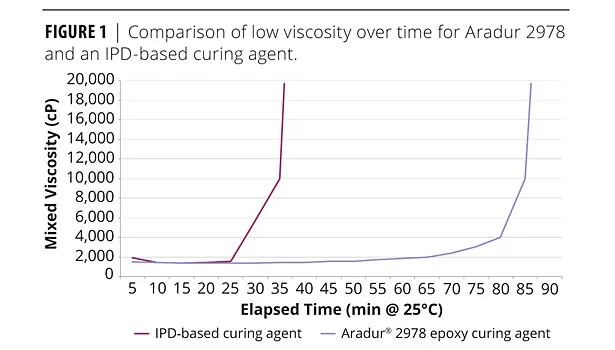
Comparatively, Aradur 2978 out-performs conventional IPD-based curing agents in many aspects. A key benefit is its longer pot life (or working time) and equivalent thin-film curing speed − a unique combination in two-component ambient-curing epoxies. This ideal combination greatly extends the time available to apply the coating, as the rate of viscosity increase is substantially slower. As depicted in Figure 1, Aradur 2978 in combination with a liquid epoxy resin (having an equivalent weight of 188 g/eq.) maintains a low viscosity for about 75 min compared to only 25 min for a similar curing agent based upon IPD. This longer window of time to apply the coating can have a dramatic effect on the reduction of waste and cost associated with discarding material that is unusable due to the rapid gelation of a typical IPD-based system.

In a solvent-free system, a large increase in working time is theorized to be the result of reduced reactivity of the curing agent; one would expect the thin film cure speed to be slower as well. However, Aradur 2978 epoxy curing agent does not suffer from low reactivity, as it offers a similar thin-film curing speed compared to IPD-based curing agents. In addition, the development of hardness is similarly rapid, reaching a shore D hardness of about 81 after 24 h of cure and 85 after seven days.

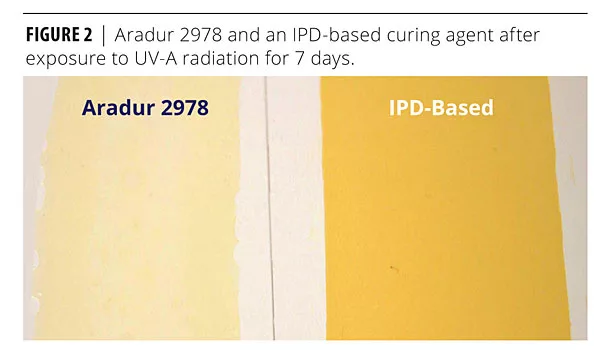
Coatings based on Aradur 2978 offer outstanding visual attributes, making it ideal for applications that require a low color with a high degree of color stability. Artificial weathering tests were performed by exposing the coating to UV-A radiation at 50 °C for a period of seven days. In this testing, a clear coating prepared using Aradur 2978 has considerably less yellowing, and better gloss retention, than that made using an IPD-based curing agent (Figure 2).

Exposure to low ambient temperature and high humidity during cure will frequently result in amine blush evidenced by poor gloss and/or a tacky surface after the coating is cured. Problems associated with blushing are difficult to correct, and removal and re-coating of the substrate may be required − a costly solution. Coatings based on Aradur 2978  can obtain a high-gloss finish even under less-than-ideal conditions. These coatings retain up to 95 percent of their typical gloss even when cured at 10 °C (50 °F) and 70 percent relative humidity. In situations that require coatings be applied in an open, or unfinished structure, the ability of coatings cured with Aradur 2978 to resist marring from water spray after only 8-9 h of cure can prove instrumental in keeping a project on schedule. Additionally, these coatings can be submerged in water after 24 h of cure without change in appearance.

Conclusion

For two-component, solvent-free epoxy coatings, Aradur 2978 offers an ideal combination of long pot life with rapid cure speed, lower neat and mixed viscosity, good color stability and superior gloss-retention properties. The rapid development of its properties allows its coatings to be unaffected by exposure to water spray soon after application and immersion in water after only 24 h. Comparatively, coatings cured with IPD-based curing agents typically require 2-3 days of cure to resist marring or staining by water spray.

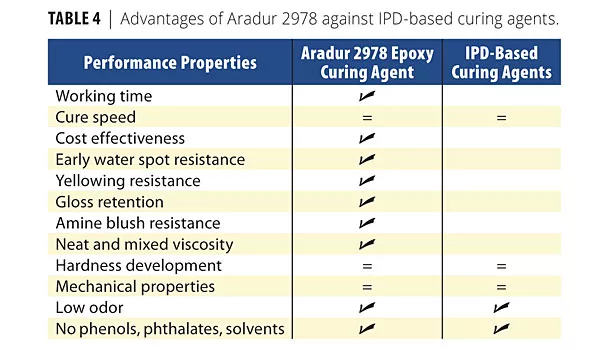
Its rapid hardness development, high mechanical properties and good resistance to chemicals make Aradur 2978 useful for decorative floor toppings such as clear sealers and stone carpets, and for monolithic floorings such as broadcast, mortars and self-leveling floors. The improvement in performance properties of coatings prepared using this new epoxy curing agent can provide an easy and cost-effective option for many applications. Its performance advantages in comparison to epoxy systems cured using IPD-based curing agents are summarized in Table 4. 

This paper is based on a presentation given at the 30th Biennial Western Coatings Symposium, October 23-26th 2011, Las Vegas, NV.

KEYWORDS: Concrete Coatings Curing Agents Epoxy Resins

Share This Story

Looking for a reprint of this article?
From high-res PDFs to custom plaques, order your copy today!


Scientist Sr., Coatings and Construction, Huntsman Advanced Materials, The Woodlands, TX

Recommended Content

JOIN TODAY
to unlock your recommendations.

Already have an account? Sign In

  • pci1022-Kinaltek-Lead-1170.jpg

    A Novel Pigment Production Technology

    Following an extensive R&D program that demonstrated...
    Paint and Coating Pigments
    By: Jawad Haidar and Nitin Soni
  • pci global top 10

    2025 Global Top 10: Top Paint and Coatings Companies

    The following is PCI’s annual ranking of the top 10...
    Global Top 10 and PCI 25
    By: Courtney Bassett
  • 2025 pci 25

    2025 PCI 25: Top Paint and Coatings Companies

    PCI's annual ranking of the top 25 North American paint...
    Paint and Coating Market Reports
    By: Courtney Bassett
You must login or register in order to post a comment.

Report Abusive Comment

Manage My Account
  • eMagazine
  • Newsletters
  • Online Registration
  • Subscription Customer Service

More Videos

Sponsored Content

Sponsored Content is a special paid section where industry companies provide high quality, objective, non-commercial content around topics of interest to the PCI audience. All Sponsored Content is supplied by the advertising company and any opinions expressed in this article are those of the author and not necessarily reflect the views of PCI or its parent company, BNP Media. Interested in participating in our Sponsored Content section? Contact your local rep!

close
  • colorful building exterior
    Sponsored byDow

    Insights into Exterior Architectural Coating Degradation: Bridging Accelerated and Natural Weathering

  • digital pigments
    Sponsored bySiltech

    The Fourth Dimension of Silicon: Siltech Q Resins

Popular Stories

Company News

What the AkzoNobel–Axalta Merger Means for the Future of Coatings

AkzoNobel and Axalta Headquarters

AkzoNobel and Axalta Announce $25 Billion Merger

Wacker logo

WACKER Plans More Than 1,500 Job Cuts


PCI Buyers Guide

Submit a Request for Proposal (RFP) to suppliers of your choice with details on what you need with a click of a button

Start your RFP

Browse our Buyers Guide for manufacturers and distributors of all types of coatings products and much more!

Find Suppliers

Events

September 4, 2025

N-Butylpyrrolidone (NBP) as a Green Solvent to Replace N-Methylpyrrolidone (NMP) in Industrial Coating Applications

ON DEMAND: EPA published a regulation proposal around N-methylpyrrolidone (NMP) in June 2024 to ban or limit NMP in many applications, such as paints and coatings and their removers. N-butylpyrrolidone (NBP) is a powerful and versatile solvent for a variety of industries looking for alternatives to substance of very high concern (SVHC)-listed solvents.

March 24, 2026

The Manufacturing & Automation eXchange (MAX)

MAX presents a rare opportunity to observe the full scope of manufacturing in one environment. From systems integration and materials handling to automation, quality, safety, and packaging, each discipline is represented through live, operational displays. By experiencing these technologies side by side, as they are on actual production floors, attendees gain a grounded understanding of how manufacturing functions align, overlap, and evolve in practice.

View All Submit An Event

Poll

Longest-running laboratory experiment

What is the longest-running laboratory experiment?
View Results Poll Archive

Products

Automotive Paints and Coatings, 2nd Edition

Automotive Paints and Coatings, 2nd Edition

Now in its second edition and still the only book of its kind, this is an authoritative treatment of all stages of the coating process.

See More Products
pci voices from the top ebook

PCI webinar

Related Articles

  • pci1017-Huntsman-831877810-900.jpg

    Bridging Long Pot Life with Fast Cure at Low Temperature

    See More
  • New Fast-Curing and UV-Resistant Epoxy Agent.jpg

    New Fast-Curing and UV-Resistant Epoxy Agent

    See More
  • Novel Epoxy-Cure Hardener Sets New Industry Standard in Ultra-Fast Curing for Protective Coatings.jpg

    Novel Epoxy-Cure Hardener Sets New Industry Standard in Ultra-Fast Curing for Protective Coatings

    See More

Related Products

See More Products
  • Cure On-Demand Coatings (Zoom course - 4/23/26)

  • pci january 2020

    PCI January 2020 Issue

  • social media

    Optimizing Social Media from a B2B Perspective

See More Products
×

Keep the info flowing with our eNewsletters!

Get the latest industry updates tailored your way.

JOIN TODAY!
  • RESOURCES
    • Advertise
    • Contact Us
    • Directories
    • Store
    • Want More
  • SIGN UP TODAY
    • Create Account
    • eMagazine
    • Newsletters
    • Customer Service
    • Manage Preferences
  • SERVICES
    • Marketing Services
    • Reprints
    • Market Research
    • List Rental
    • Survey & Sample
  • STAY CONNECTED
    • LinkedIn
    • Facebook
    • Youtube
    • X (Twitter)
  • PRIVACY
    • PRIVACY POLICY
    • TERMS & CONDITIONS
    • DO NOT SELL MY PERSONAL INFORMATION
    • PRIVACY REQUEST
    • ACCESSIBILITY

Copyright ©2025. All Rights Reserved BNP Media.

Design, CMS, Hosting & Web Development :: ePublishing