Painting & Coating Industry (PCI) logo Powder coating summit logo
search
cart
facebook twitter linkedin youtube
  • Sign In
  • Create Account
  • Sign Out
  • My Account
Painting & Coating Industry (PCI) logo Powder coating summit logo
  • NEWS
    • Latest News
    • Market Trends & Reports
    • Finishing News
    • Price Alerts
    • Subscribe to Newsletters
    • Global Top 10/ PCI 25
    • Weekly Featured Article
    • COATLE Word Game
  • PRODUCTS
    • Product News
    • Must See Products and Services
  • MATERIALS
    • Additives
    • Resins/Polymers
    • Pigments
    • Equipment
    • Distributors
  • TECHNOLOGIES
    • Adhesives
    • Architectural Coatings
    • Finishing Articles
    • Finishing Technologies
    • Finishing Equipment
    • Industrial Coatings
    • Nanotechnology
    • Powder Coatings
    • Solventborne
    • Special Purpose Coatings
    • Sustainability
    • UV Coatings
    • Waterborne
  • RESOURCES
    • Columns
      • Did you know?
      • Distribution Dive
      • Formulating With Mike
      • Innovation Insights
      • Powder Coating Perspectives
      • TiO2 Insider
    • Blogs
      • Editor's Viewpoint
      • Industry Insights
    • Coatings Supplier Handbook
    • Podcasts and Videos
      • COAT-IT! Podcast
      • Videos/PCI TV
    • PCI Store
    • Classifieds
    • eBooks
    • Sponsor Insights
    • White Papers
    • COATLE Word Game
  • EVENTS
    • Coatings Trends & Technologies Summit
    • Paint and Coatings Academy
    • Webinars
    • Calendar of Events
    • Lifetime Achievement Award
  • DIRECTORIES
    • Buyer's Guide
    • Equipment Directory
    • Materials Directory
  • EMAGAZINE
    • Current Issue
    • eMagazine Archive
    • China Issue Archive
    • Editorial Advisory Board
  • CONTACT
    • Contact Us
    • Advertise
    • Subscribe to eMagazine
    • Subscribe to Newsletters
  • SIGN UP!
Paint and Coating EquipmentTesting, Monitoring &Tools

Noncontact, Real-Time Detection and Analysis of Silicone Films on Surfaces

By Frederick Haibach
LaserScan Analyzer
Credit: Block Engineering
Silicon film
Credit: Block Engineering
surface concentration
Credit: Block Engineering
LaserScan Analyzer
Silicon film
surface concentration
November 1, 2012

This article focuses on the use of Block Engineering’s LaserScan™ analyzer (Figure 1) as a handheld spectrometer, based on quantum cascade laser (QCL) technology, for detecting and quantifying silicone film thicknesses.


Infrared spectroscopy is a well-established technique for detecting and identifying contaminants on surfaces, in particular metallic surfaces. Detection levels can be as low as fractions of a microgram, depending on factors such as viewing/measurement angles and use of a polarized infrared beam. Detection of silicone films is an important application. For example, silicone release coatings are applied to surfaces to facilitate the manufacture of carbon-fiber/epoxy laminating materials.

The silicone is supposed to remain on the fabricating equipment, but in some cases it will migrate in small quantities to the fabricated material, which becomes problematic. For example, if the fabricated material is subsequently painted or otherwise coated, this silicone residue will result in poor adhesion, affecting the quality, appearance and longevity of the coating. Also the silicon coating on the fabricating equipment must be monitored and maintained for the equipment to perform properly.

The Technology

The LaserScan analyzer is an ideal tool for inspecting surfaces to detect the presence of silicone, validate its removal or chemically analyze the properties of any films on the surface. For example, it can be used by a production engineer to examine metal surfaces and provide rapid feedback for the presence of residual silicone on surfaces that are being prepared for bonding or painting. In another potential application, this instrument can be used in a noncontact fashion to evaluate new silicone materials by analyzing adhesion properties and chemical composition changes during production or application.

The LaserScan analyzer is the result of many years of development and utilizes infrared spectroscopy. FTIR spectrometers have been used for decades in the laboratory to detect silicone, but these instruments use a diffuse infrared source, so for these to work effectively they either have to make contact with the surface (ATR methods) or the measurement head has to get very close (within a centimeter or so) to the surface, which creates a potential for further contamination due to accidental contact. Because the LaserScan QCL technology uses a collimated, but eye-safe laser, it can measure residue on surfaces from distances of six inches to several feet, depending on the application.

The fundamental principle behind this technology is that when infrared light reflects off of a substance, it gets absorbed or reflected at rates that are absolutely unique to, and characteristic of, the substance. Therefore, when the reflected light is collected by the LaserScan’s built-in detectors, a “fingerprint”-like pattern emerges, which contains all the necessary information for detecting or analyzing the substance. Built-in libraries are typically used to pattern and provide real-time detection or analysis. Furthermore, LaserScan is a lightweight, handheld unit that provides readings in seconds.

Experimental Results

Three samples of methyl silicone were dissolved in n-hexane 97%. Sample A was 26 mg/mL; B was 50 mg/mL; C was 70 mg/mL. A micro-syringe was used to apply 0.01 mL of each sample onto a diffused gold substrate. The hexane completely evaporated in 30 min, leaving concentrations of 173 µg/cm2 for sample A; 313 µg/cm2 for sample B; 438 µg/cm2 for sample C. The three samples were then examined with the LaserScan at a standoff distance of 6 inches.

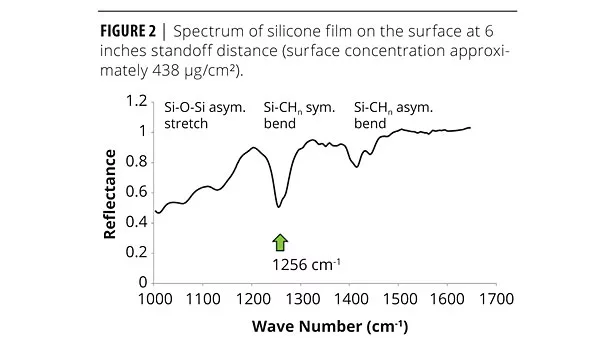
Figure 2 shows the silicone spectrum for Sample C. As can be seen, there are distinctive features, including a strong feature at 1256 cm-1.

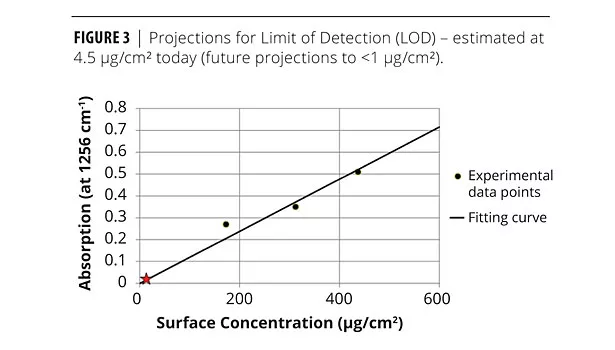
Figure 3 shows a plot of absorption at wavelength 1256 cm-1 for each sample. Extrapolating the data points implies a limit of detection of 4.5 µg/cm2, which is sufficient for most applications. Future versions of LaserScan currently under development should reduce the LOD to <1 µg/cm2, if needed.

Conclusions

The LaserScan is the optimal tool for the standoff measurement of silicone films on surfaces. LOD of 4.5 µg/cm2 on a metal surface has been demonstrated. LaserScan provides a new tool for production engineers and quality control departments tasked with ensuring the proper and effective use of silicone in important industrial applications. Future LaserScan devices will be much lighter (flashlight size) and more sensitive (projected LOD <1 µg/cm²). 

For more information, call 508/251.3105, visit www.blockeng.com or e-mail sales@blockeng.com.

KEYWORDS: Monitoring Equipment spectrometers

Share This Story

Looking for a reprint of this article?
From high-res PDFs to custom plaques, order your copy today!


Haibach is Director of Applications, Block Engineering, Marlborough, MA

Recommended Content

JOIN TODAY
to unlock your recommendations.

Already have an account? Sign In

  • pci1022-Kinaltek-Lead-1170.jpg

    A Novel Pigment Production Technology

    Following an extensive R&D program that demonstrated...
    Paint and Coating Pigments
    By: Jawad Haidar and Nitin Soni
  • pci global top 10

    2025 Global Top 10: Top Paint and Coatings Companies

    The following is PCI’s annual ranking of the top 10...
    Global Top 10 and PCI 25
    By: Courtney Bassett
  • 2025 pci 25

    2025 PCI 25: Top Paint and Coatings Companies

    PCI's annual ranking of the top 25 North American paint...
    Paint and Coating Market Reports
    By: Courtney Bassett
You must login or register in order to post a comment.

Report Abusive Comment

Manage My Account
  • eMagazine
  • Newsletters
  • Online Registration
  • Subscription Customer Service

More Videos

Sponsored Content

Sponsored Content is a special paid section where industry companies provide high quality, objective, non-commercial content around topics of interest to the PCI audience. All Sponsored Content is supplied by the advertising company and any opinions expressed in this article are those of the author and not necessarily reflect the views of PCI or its parent company, BNP Media. Interested in participating in our Sponsored Content section? Contact your local rep!

close
  • colorful building exterior
    Sponsored byDow

    Insights into Exterior Architectural Coating Degradation: Bridging Accelerated and Natural Weathering

  • digital pigments
    Sponsored bySiltech

    The Fourth Dimension of Silicon: Siltech Q Resins

Popular Stories

Company News

What the AkzoNobel–Axalta Merger Means for the Future of Coatings

AkzoNobel and Axalta Headquarters

AkzoNobel and Axalta Announce $25 Billion Merger

Wacker logo

WACKER Plans More Than 1,500 Job Cuts


PCI Buyers Guide

Submit a Request for Proposal (RFP) to suppliers of your choice with details on what you need with a click of a button

Start your RFP

Browse our Buyers Guide for manufacturers and distributors of all types of coatings products and much more!

Find Suppliers

Events

September 4, 2025

N-Butylpyrrolidone (NBP) as a Green Solvent to Replace N-Methylpyrrolidone (NMP) in Industrial Coating Applications

ON DEMAND: EPA published a regulation proposal around N-methylpyrrolidone (NMP) in June 2024 to ban or limit NMP in many applications, such as paints and coatings and their removers. N-butylpyrrolidone (NBP) is a powerful and versatile solvent for a variety of industries looking for alternatives to substance of very high concern (SVHC)-listed solvents.

March 24, 2026

The Manufacturing & Automation eXchange (MAX)

MAX presents a rare opportunity to observe the full scope of manufacturing in one environment. From systems integration and materials handling to automation, quality, safety, and packaging, each discipline is represented through live, operational displays. By experiencing these technologies side by side, as they are on actual production floors, attendees gain a grounded understanding of how manufacturing functions align, overlap, and evolve in practice.

View All Submit An Event

Poll

Longest-running laboratory experiment

What is the longest-running laboratory experiment?
View Results Poll Archive

Products

Automotive Paints and Coatings, 2nd Edition

Automotive Paints and Coatings, 2nd Edition

Now in its second edition and still the only book of its kind, this is an authoritative treatment of all stages of the coating process.

See More Products
pci voices from the top ebook

PCI webinar

Related Articles

  • Real-Time Characterization of Polymer Properties and Reaction Characteristics

    Real-Time Characterization of Polymer Properties and Reaction Characteristics

    See More
  • Lead image.jpg

    Measuring the Quality of Liquid Processes In Real-Time

    See More
  • Weathering Testing: Real-Time Temperature Measurement of Coatings

    See More

Related Products

See More Products
  • failiure-analysis-of-paints

    Failure Analysis of Paints and Coatings, Revised Edition

  • biopolymer.jpg

    Biopolymer-Based Films and Coatings Trends and Challenges

  • nanostructuredthinfilms.jpg

    Nanostructured Thin Films and Coatings: Mechanical Properties

See More Products
×

Keep the info flowing with our eNewsletters!

Get the latest industry updates tailored your way.

JOIN TODAY!
  • RESOURCES
    • Advertise
    • Contact Us
    • Directories
    • Store
    • Want More
  • SIGN UP TODAY
    • Create Account
    • eMagazine
    • Newsletters
    • Customer Service
    • Manage Preferences
  • SERVICES
    • Marketing Services
    • Reprints
    • Market Research
    • List Rental
    • Survey & Sample
  • STAY CONNECTED
    • LinkedIn
    • Facebook
    • Youtube
    • X (Twitter)
  • PRIVACY
    • PRIVACY POLICY
    • TERMS & CONDITIONS
    • DO NOT SELL MY PERSONAL INFORMATION
    • PRIVACY REQUEST
    • ACCESSIBILITY

Copyright ©2025. All Rights Reserved BNP Media.

Design, CMS, Hosting & Web Development :: ePublishing