Painting & Coating Industry (PCI) logo Powder coating summit logo
search
cart
facebook twitter linkedin youtube
  • Sign In
  • Create Account
  • Sign Out
  • My Account
Painting & Coating Industry (PCI) logo Powder coating summit logo
  • NEWS
    • Latest News
    • Market Trends & Reports
    • Finishing News
    • Price Alerts
    • Subscribe to Newsletters
    • Global Top 10/ PCI 25
    • Weekly Featured Article
    • COATLE Word Game
  • PRODUCTS
    • Product News
    • Must See Products and Services
  • MATERIALS
    • Additives
    • Resins/Polymers
    • Pigments
    • Equipment
    • Distributors
  • TECHNOLOGIES
    • Adhesives
    • Architectural Coatings
    • Finishing Articles
    • Finishing Technologies
    • Finishing Equipment
    • Industrial Coatings
    • Nanotechnology
    • Powder Coatings
    • Solventborne
    • Special Purpose Coatings
    • Sustainability
    • UV Coatings
    • Waterborne
  • RESOURCES
    • Columns
      • Did you know?
      • Distribution Dive
      • Formulating With Mike
      • Innovation Insights
      • Powder Coating Perspectives
      • TiO2 Insider
    • Blogs
      • Editor's Viewpoint
      • Industry Insights
    • Coatings Supplier Handbook
    • Podcasts and Videos
      • COAT-IT! Podcast
      • Videos/PCI TV
    • PCI Store
    • Classifieds
    • eBooks
    • Sponsor Insights
    • White Papers
    • COATLE Word Game
  • EVENTS
    • Coatings Trends & Technologies Summit
    • Paint and Coatings Academy
    • Webinars
    • Calendar of Events
    • Lifetime Achievement Award
  • DIRECTORIES
    • Buyer's Guide
    • Equipment Directory
    • Materials Directory
  • EMAGAZINE
    • Current Issue
    • eMagazine Archive
    • China Issue Archive
    • Editorial Advisory Board
  • CONTACT
    • Contact Us
    • Advertise
    • Subscribe to eMagazine
    • Subscribe to Newsletters
  • SIGN UP!
Paint and Coating EquipmentSpecial Purpose CoatingsTesting, Monitoring &Tools

Thin-Film Analysis Using UV-Vis Spectrophotometry
By Jeff Head, John Kinyanjui, Mark Talbott
Thin-Film Analysis Using UV-Vis Spectrophotometry
Credit: Shimadzu Scientific Instruments
Thin-Film Analysis Using UV-Vis Spectrophotometry
Credit: Shimadzu Scientific Instruments
Thin-Film Analysis Using UV-Vis Spectrophotometry
Credit: Shimadzu Scientific Instruments
Thin-Film Analysis Using UV-Vis Spectrophotometry
Credit: Shimadzu Scientific Instruments
Thin-Film Analysis Using UV-Vis Spectrophotometry
Credit: Shimadzu Scientific Instruments
Thin-Film Analysis Using UV-Vis Spectrophotometry
August 1, 2014

Thin films play a critical role in our lives as they are used, for example, in electronics, solar cells and coatings on eyeglasses in order to reduce glare and increase the amount of transmitted light through the lenses. For example, anti-reflection (AR) coatings are applied to lenses in order to reduce glare that would otherwise be present in uncoated lenses. This has become an attractive feature for many consumers and, therefore, measurement and control of AR coatings has become increasingly important.

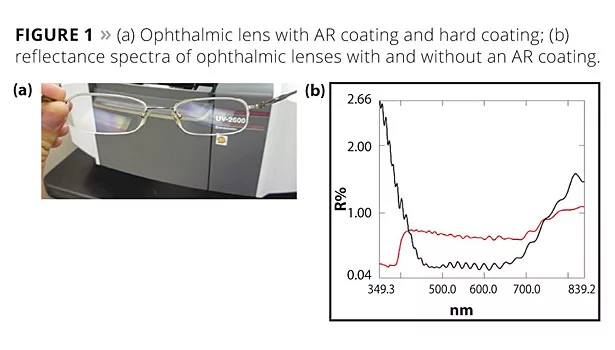
Figure 1 shows two reflectance spectra of ophthalmic lenses. The black spectrum is the reflectance spectrum of a lens that contains a hard coating as well as an AR coating, whereas the red spectrum is a lens that only has a hard coating.

Applying coatings as thin films relies heavily on the ability to determine the thickness of the coating for quality control purposes. In ophthalmics, spectral reflectance is used to measure AR as well as hard coating thickness. The ophthalmic industry takes advantage of the capability to add multiple coatings in various combinations in order to provide the best consumer products. Special film thickness software offers the ability to analyze a single film on a lens. In Figure 1, the area of interest for the hard coating is between 500 and 650 nm.

Film thickness, d, is determined from the wavelength between peaks and valleys in interference patterns. It is required that the refractive index of the coating and the incident angle are known prior to calculating film thickness, as given in Equation 1, where n is the refractive index of the film, q is the angle of incidence, λ1 and λ2 are wavelengths of two noticeable peaks (or valleys), and Dm is the number of peaks between λ1 and λ2.1

In ophthalmics, the area of interest lies in the ability to analyze multiple coatings that are comprised of hard coatings and AR coatings. Whether multiple or single coatings are being applied to a substrate, it is critically important that the individual coatings by themselves have been analyzed for film thickness prior to making a finished product.

This article focuses on the ability to measure a single protective coating on an acrylic substrate using a Shimadzu UV-2600 UV-Vis spectrophotometer with 5 degree relative specular reflectance accessory and film thickness software.

Method

Reflectance spectra of an acrylic lens with a single protective coating were acquired on the UV-2600 using the 5 degree relative specular reflectance accessory under the following scan conditions:

  • Wavelength range (nm): 350 to 850 nm
  • Scan speed: Fast
  • Slit width: 5.0
  • Sampling interval: 0.5
  • Auto sampling interval: Enabled
  • Scan mode: Single

A background scan was obtained by mounting the mirror assemblies on the sample and reference stages with the mirrors face down and then acquiring a baseline scan. It should be noted that for measuring lenses and other acrylic materials on the 5 degree relative specular reflectance accessory, the ideal background would be obtained by replacing the sample-side reference mirror with a blank, uncoated lens. However, for the purposes of this study, an aluminum mirror was used as a sample mirror during the baseline scan in order to acquire a baseline scan. The sample mirror was then removed and replaced with the acrylic lens in order to acquire a reflectance spectrum, as shown in Figure 2.

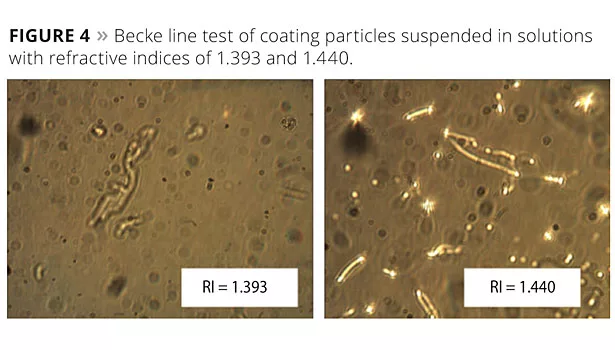
The refractive index of the protective coating on the acrylic lens was estimated by etching away a small layer of the coating and suspending it in solutions of various refractive indices and then using the Becke line test to estimate the refractive index of the coating. In analyzing the coating using the Becke line test, the refractive index was estimated to be between 1.393 and 1.440.

Results and Discussion

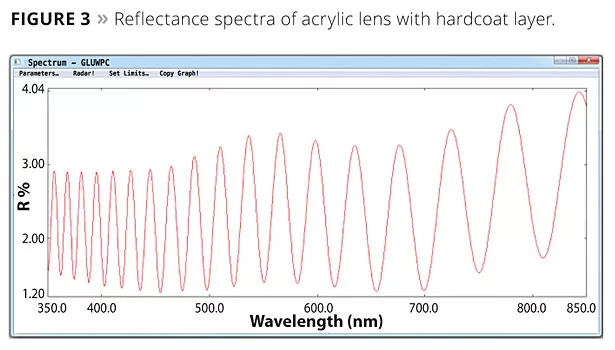
Reflectance spectra of the acrylic lens with protective coating are shown in Figure 3.

The thickness of the protective coating can be determined using the film thickness software. It is required to know the refractive index of the coating as well as the incident angle of light. Figure 4 shows the images acquired of the sample and estimating the refractive index using the Becke line test.

With an incident angle of 5 degrees, the thickness of the coating was calculated to be between 3.638 and 3.761 µm, as summarized in Figure 5.

Conclusion

 In conclusion, this article has demonstrated the ability to measure the thickness of a single coating so long as the refractive index and the incident angle of light are known prior to using the film thickness software from Shimadzu. The software allows for a quick and easy way to calculate the film thickness of various coatings.  

KEYWORDS: glass coatings spectrophotometers Testing Equipment

Share This Story

Looking for a reprint of this article?
From high-res PDFs to custom plaques, order your copy today!


Jeff Head, M.S., Product Specialist, Molecular Spectroscopy Group, Shimadzu Scientific Instruments, Columbia, MD

John Kinyanjui Ph.D., Product Specialist, Molecular Spectroscopy Group, Shimadzu Scientific Instruments, Columbia, MD

Mark Talbott, Ph.D., Product Manager, Molecular Spectroscopy Group, Shimadzu Scientific Instruments, Columbia, MD

Recommended Content

JOIN TODAY
to unlock your recommendations.

Already have an account? Sign In

  • pci1022-Kinaltek-Lead-1170.jpg

    A Novel Pigment Production Technology

    Following an extensive R&D program that demonstrated...
    Paint and Coating Pigments
    By: Jawad Haidar and Nitin Soni
  • pci global top 10

    2025 Global Top 10: Top Paint and Coatings Companies

    The following is PCI’s annual ranking of the top 10...
    Global Top 10 and PCI 25
    By: Courtney Bassett
  • 2025 pci 25

    2025 PCI 25: Top Paint and Coatings Companies

    PCI's annual ranking of the top 25 North American paint...
    Global Top 10 and PCI 25
    By: Courtney Bassett
You must login or register in order to post a comment.

Report Abusive Comment

Manage My Account
  • eMagazine
  • Newsletters
  • Online Registration
  • Subscription Customer Service

More Videos

Sponsored Content

Sponsored Content is a special paid section where industry companies provide high quality, objective, non-commercial content around topics of interest to the PCI audience. All Sponsored Content is supplied by the advertising company and any opinions expressed in this article are those of the author and not necessarily reflect the views of PCI or its parent company, BNP Media. Interested in participating in our Sponsored Content section? Contact your local rep!

close
  • colorful building exterior
    Sponsored byDow

    Insights into Exterior Architectural Coating Degradation: Bridging Accelerated and Natural Weathering

  • digital pigments
    Sponsored bySiltech

    The Fourth Dimension of Silicon: Siltech Q Resins

Popular Stories

Company News

What the AkzoNobel–Axalta Merger Means for the Future of Coatings

AkzoNobel and Axalta Headquarters

AkzoNobel and Axalta Announce $25 Billion Merger

Wacker logo

WACKER Plans More Than 1,500 Job Cuts


PCI Buyers Guide

Submit a Request for Proposal (RFP) to suppliers of your choice with details on what you need with a click of a button

Start your RFP

Browse our Buyers Guide for manufacturers and distributors of all types of coatings products and much more!

Find Suppliers

Events

September 4, 2025

N-Butylpyrrolidone (NBP) as a Green Solvent to Replace N-Methylpyrrolidone (NMP) in Industrial Coating Applications

ON DEMAND: EPA published a regulation proposal around N-methylpyrrolidone (NMP) in June 2024 to ban or limit NMP in many applications, such as paints and coatings and their removers. N-butylpyrrolidone (NBP) is a powerful and versatile solvent for a variety of industries looking for alternatives to substance of very high concern (SVHC)-listed solvents.

March 24, 2026

The Manufacturing & Automation eXchange (MAX)

MAX presents a rare opportunity to observe the full scope of manufacturing in one environment. From systems integration and materials handling to automation, quality, safety, and packaging, each discipline is represented through live, operational displays. By experiencing these technologies side by side, as they are on actual production floors, attendees gain a grounded understanding of how manufacturing functions align, overlap, and evolve in practice.

View All Submit An Event

Poll

Longest-running laboratory experiment

What is the longest-running laboratory experiment?
View Results Poll Archive

Products

Automotive Paints and Coatings, 2nd Edition

Automotive Paints and Coatings, 2nd Edition

Now in its second edition and still the only book of its kind, this is an authoritative treatment of all stages of the coating process.

See More Products
pci voices from the top ebook

PCI webinar

Related Articles

  • pci0819-FP-181132871-900.jpg

    UV-Vis-Resistant Acrylic Latexes for Wood Coating Applications

    See More
  • pci1118-Frontier-920038428-lead-900.jpg

    Failure Analysis of Synthetic Dyes Using Pyrolysis-GC/MS Technique

    See More
  • UV-Vis-NIR Spectrophotometer

    UV-Vis-NIR Spectrophotometer

    See More

Related Products

See More Products
  • thin film.jpg

    Thin Film Coatings Properties, Deposition, and Applications

  • nanostructured.jpg

    Nanostructured Thin Films and Coatings: Functional Properties

  • nanostructuredthinfilms.jpg

    Nanostructured Thin Films and Coatings: Mechanical Properties

See More Products

Related Directories

  • Keyland Polymer UV Powder LLC

    Keyland Polymer develops, formulates, manufactures and sells UV cured powder coatings for wood, plastic, metal, composites, and other substrates. Keyland Polymer has a complete resin synthesis lab with global reach and distribution capabilities for the development, formulation, testing, and manufacturing of UV/EB curable solid resins.
×

Keep the info flowing with our eNewsletters!

Get the latest industry updates tailored your way.

JOIN TODAY!
  • RESOURCES
    • Advertise
    • Contact Us
    • Directories
    • Store
    • Want More
    • Manufacturing Division
  • SIGN UP TODAY
    • Create Account
    • eMagazine
    • Newsletters
    • Customer Service
    • Manage Preferences
  • SERVICES
    • Marketing Services
    • Reprints
    • Market Research
    • List Rental
    • Survey & Sample
  • STAY CONNECTED
    • LinkedIn
    • Facebook
    • Youtube
    • X (Twitter)
  • PRIVACY
    • PRIVACY POLICY
    • TERMS & CONDITIONS
    • DO NOT SELL MY PERSONAL INFORMATION
    • PRIVACY REQUEST
    • ACCESSIBILITY

Copyright ©2025. All Rights Reserved BNP Media.

Design, CMS, Hosting & Web Development :: ePublishing