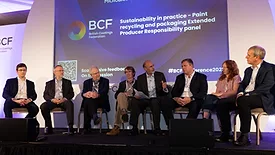
Over 150 senior decision makers from the UK's paints, coatings and printing ink sectors gathered in Birmingham for the annual British Coatings Federation (BCF) Annual Conference.
According to the J.D. Power 2022 U.S. Home Improvement Retailer Satisfaction StudySM, customer satisfaction with home improvement retailers has never been higher, despite high lumber prices and supply chain challenges.
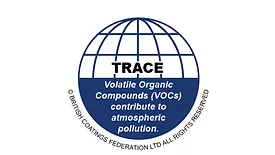
As of May 2022, decorative paint manufacturers in the U.K. will be able to adopt the use of the statement “TRACE” VOC as part of the British Coatings Federation’s VOC Globe scheme to improve communication about products that have the lowest levels of VOCs.
Historic paint specialist T&R Williamson, whose products are used across the British Royal Household, is ensuring a landmark project to mark the Queen’s platinum jubilee goes full steam ahead in a unique way.
The Association of International Metallizers, Coaters and Laminators (AIMCAL) honored 2022 Product of the Year, Technology of the Year and Sustainability Award winners at a ceremony during the 2022 AIMCAL Executive Leadership Conference.
A new paint recycling program that began May 1 in New York State invites households, schools and businesses to recycle leftover paint, stain and varnish conveniently and sustainably.
PPG announced that PPG board of directors member Steven A. Davis has been included in the 16th Annual Directorship 100™ list of the nation’s “Most Influential Corporate Directors and Governance Experts” by The National Association of Corporate Directors (NACD).

 RSS
RSS