
Painting & Coating Industry (PCI) logo Powder coating summit logo
search
cart
facebook twitter linkedin youtube
  • Sign In
  • Create Account
  • Sign Out
  • My Account
Painting & Coating Industry (PCI) logo Powder coating summit logo
  • NEWS
    • Latest News
    • Market Trends & Reports
    • Finishing News
    • Price Alerts
    • Subscribe to Newsletters
    • Global Top 10/ PCI 25
    • Weekly Featured Article
    • COATLE Word Game
  • PRODUCTS
    • Product News
    • Must See Products and Services
  • MATERIALS
    • Additives
    • Resins/Polymers
    • Pigments
    • Equipment
    • Distributors
  • TECHNOLOGIES
    • Adhesives
    • Architectural Coatings
    • Finishing Articles
    • Finishing Technologies
    • Finishing Equipment
    • Industrial Coatings
    • Nanotechnology
    • Powder Coatings
    • Solventborne
    • Special Purpose Coatings
    • Sustainability
    • UV Coatings
    • Waterborne
  • RESOURCES
    • Columns
      • Did you know?
      • Distribution Dive
      • Formulating With Mike
      • Innovation Insights
      • Powder Coating Perspectives
      • TiO2 Insider
    • Blogs
      • Editor's Viewpoint
      • Industry Insights
    • Coatings Supplier Handbook
    • Podcasts and Videos
      • COAT-IT! Podcast
      • Videos/PCI TV
    • PCI Store
    • Classifieds
    • eBooks
    • Sponsor Insights
    • White Papers
    • COATLE Word Game
  • EVENTS
    • Coatings Trends & Technologies Summit
    • Paint and Coatings Academy
    • Webinars
    • Calendar of Events
    • Lifetime Achievement Award
  • DIRECTORIES
    • Buyer's Guide
    • Equipment Directory
    • Materials Directory
  • EMAGAZINE
    • Current Issue
    • eMagazine Archive
    • China Issue Archive
    • Editorial Advisory Board
  • CONTACT
    • Contact Us
    • Advertise
    • Subscribe to eMagazine
    • Subscribe to Newsletters
  • SIGN UP!

Buying a pH Data Logger: Three Important Factors to Consider

Common Issues and Recommended Solutions

By CAS DataLoggers
IndustryInsights-CAS.jpg
December 15, 2022

pH Measurement is very common in industrial processes, plating, wastewater treatment, and environmental monitoring. Using a data logger to record pH provides information on long-term trends and the impact of various factors along with providing information for quality control, compliance reporting, and alarming. However, to capture accurate measurements there are three important considerations that can directly affect measurement accuracy. 


Basics of pH Measurement 

The pH value represents the hydrogen ion activity of a solution. The pH scale varies from 0 (strongly acidic with a high concentration of H+ ions) to 14 (strongly alkaline with a high concentration of OH− ions). The most common pH measurement method utilizes a special hydrogen ion selective electrode (pH probe) immersed in the solution along with a second reference electrode. This ion-selective electrode provides a voltage output relative to the reference electrode that varies with the concentration ratio of hydrogen ions inside the electrode to those outside the electrode. The reference electrode output is independent of the ion ratio. By measuring the voltage between these two electrodes, you can find the pH of the solution. However, the measurement of the pH of a solution is not as simple as it may first appear.


Considerations for Accurate pH Measurements 

Using a simple voltage input data logger to record the potential between the two electrodes creates several challenges that must be taken into account to obtain accurate pH measurements. 
Buying a pH Data Logger: Three Important Factors to Consider
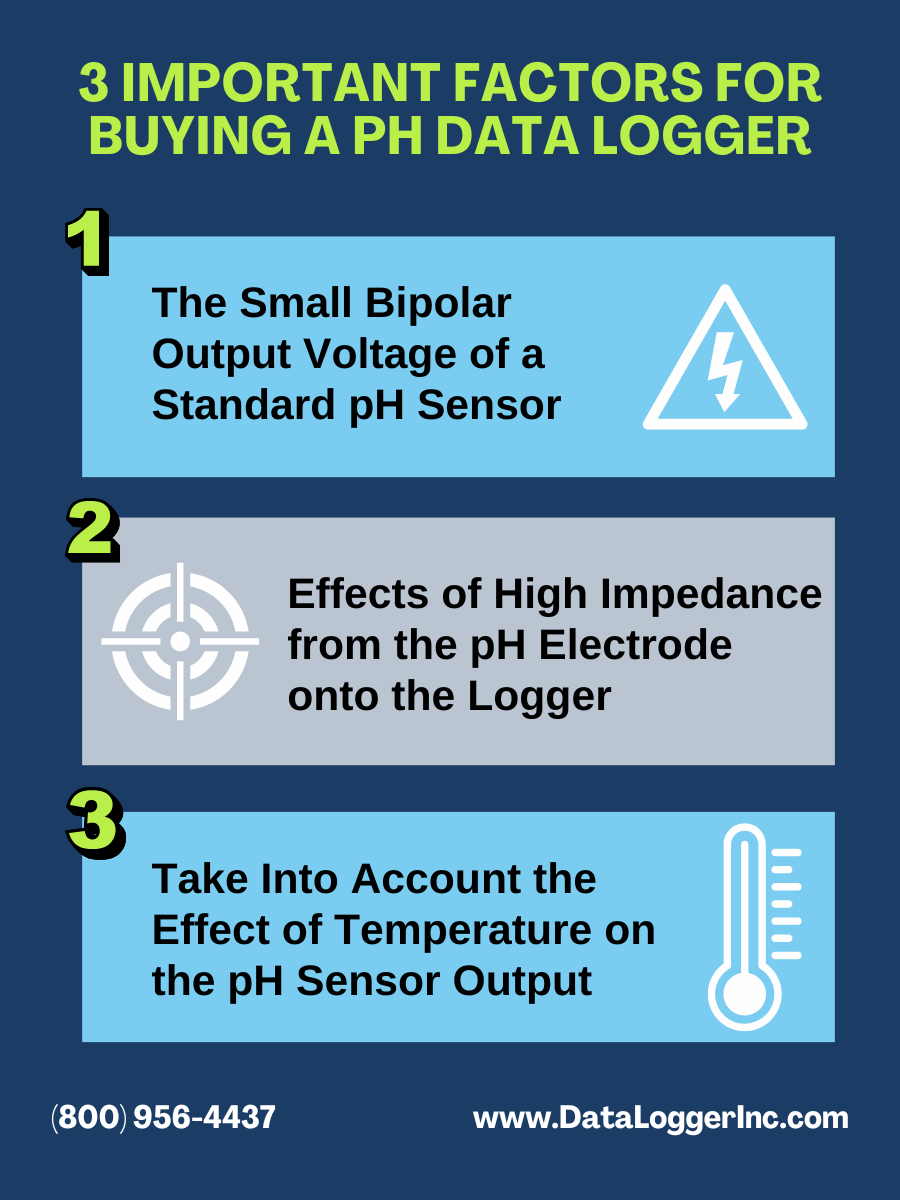
  1. The voltage range provided by a standard pH sensor is in the range of +400 mV to -400 mV, corresponding to a pH range of 0 to 14, at room temperature. Any data logger intended for pH measurements must be capable of accepting positive and negative voltages. Also, the device must be sensitive enough to be able to accurately measure small changes in voltage. A data logger that provides a full-scale input range of ± 1 to 2 volts will ensure adequate accuracy and resolution to detect changes in pH of 0.1 or less. A logger designed for 10 volts full scale may not be able to provide the required accuracy.
  2. The pH electrode has a very high impedance. Effectively, the pH electrode produces a voltage, but because this voltage develops across an ion-selective glass membrane, the amount of current that the electrode supplies to the measuring circuit are very small. A standard voltage data logger may have an input impedance of 1 megohm, which is fine for typical voltage measurements. However, when taking pH measurements, the amount of current drawn by this resistance causes loading effects which will produce large errors in the measured voltage. It is very important to choose a data logger with a high impedance input amplifier, typically about 1 gigohm or higher, such as the Delphin Expert Logger, to allow direct measurement from the pH electrode with negligible current draw. If this is not possible, pH measurements can be made using standard voltage data loggers using an external preamplifier or pH probe with an internal amplifier to provide a buffered output signal and avoid the negative effects of input loading. The most common amplifier is a small battery-powered unit that just provides buffering without voltage gain. Because the currents are very small, these amplifiers can run for months on a single battery. Other amplifiers are available that can operate from an external DC power supply to provide continuous operation for extended periods. If the data logger and pH electrode are going to be spaced far apart, it is best to use an amplifier with a 4-20 mA current output. This allows the signal to be transmitted hundreds of feet with very little loss of accuracy or increase noise.
  3. The last consideration when measuring pH is the effect of temperature on the output voltage of the sensor. The error in the output voltage becomes worse as you move away from a pH value of 7 and as the temperature deviates from 25 °C. For example, without considering temperature, simply measuring the voltage output of a probe immersed in a solution of pH of 2 at a temperature of 85 °C can lead to errors as high as .9 pH. In this case, choosing a multi-channel data logger capable of temperature, as well as voltage, provides the ability to measure and correct for temperature.
Buying a pH Data Logger: Three Important Factors to Consider


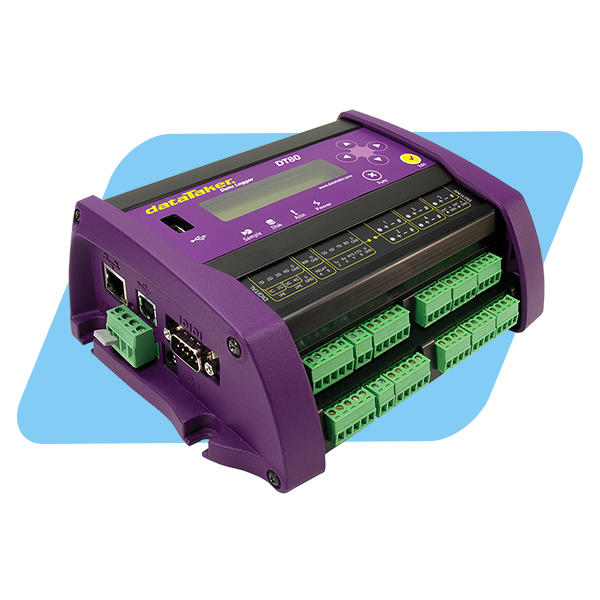
Intelligent, universal input data loggers such as the dataTaker DT80 or Grant Instruments SQ16 can be programmed to measure both the voltage and temperature, and then automatically apply the appropriate temperature correction factor to supply an accurate pH value. An alternative, if the data logger cannot measure temperature, is to use a pre-amplifier as described above that also incorporates an automatic internal temperature compensation circuit. These devices use an external sensor to measure the solution’s temperature and provide the appropriate correction to the buffered output voltage.


Conclusion 

Using an intelligent data logger with the appropriate input range and input impedance, which also allows a temperature measurement and application of a correction factor, allows accurate, reliable pH measurements.

Share This Story

By CAS DataLoggers
You must login or register in order to post a comment.

Report Abusive Comment

Blog Topics

Editor's Viewpoint

Journey to Sustainability

Industry Insights

Recent Comments

Great

Great

Enjoy watching your favorite Asian dramas and anime clearly.

Searching through your blog moviebox is always so...

steal a brainrot is a fast-paced and...

Manage My Account
  • eMagazine
  • Newsletters
  • Online Registration
  • Subscription Customer Service

More Videos

Sponsored Content

Sponsored Content is a special paid section where industry companies provide high quality, objective, non-commercial content around topics of interest to the PCI audience. All Sponsored Content is supplied by the advertising company and any opinions expressed in this article are those of the author and not necessarily reflect the views of PCI or its parent company, BNP Media. Interested in participating in our Sponsored Content section? Contact your local rep!

close
  • colorful building exterior
    Sponsored byDow

    Insights into Exterior Architectural Coating Degradation: Bridging Accelerated and Natural Weathering

  • digital pigments
    Sponsored bySiltech

    The Fourth Dimension of Silicon: Siltech Q Resins

Popular Stories

Company News

What the AkzoNobel–Axalta Merger Means for the Future of Coatings

AkzoNobel and Axalta Headquarters

AkzoNobel and Axalta Announce $25 Billion Merger

Wacker logo

WACKER Plans More Than 1,500 Job Cuts


PCI Buyers Guide

Submit a Request for Proposal (RFP) to suppliers of your choice with details on what you need with a click of a button

Start your RFP

Browse our Buyers Guide for manufacturers and distributors of all types of coatings products and much more!

Find Suppliers

Events

September 4, 2025

N-Butylpyrrolidone (NBP) as a Green Solvent to Replace N-Methylpyrrolidone (NMP) in Industrial Coating Applications

ON DEMAND: EPA published a regulation proposal around N-methylpyrrolidone (NMP) in June 2024 to ban or limit NMP in many applications, such as paints and coatings and their removers. N-butylpyrrolidone (NBP) is a powerful and versatile solvent for a variety of industries looking for alternatives to substance of very high concern (SVHC)-listed solvents.

March 24, 2026

The Manufacturing & Automation eXchange (MAX)

MAX presents a rare opportunity to observe the full scope of manufacturing in one environment. From systems integration and materials handling to automation, quality, safety, and packaging, each discipline is represented through live, operational displays. By experiencing these technologies side by side, as they are on actual production floors, attendees gain a grounded understanding of how manufacturing functions align, overlap, and evolve in practice.

View All Submit An Event

Poll

Longest-running laboratory experiment

What is the longest-running laboratory experiment?
View Results Poll Archive

Products

Automotive Paints and Coatings, 2nd Edition

Automotive Paints and Coatings, 2nd Edition

Now in its second edition and still the only book of its kind, this is an authoritative treatment of all stages of the coating process.

See More Products
pci voices from the top ebook

PCI webinar
×

Keep the info flowing with our eNewsletters!

Get the latest industry updates tailored your way.

JOIN TODAY!
  • RESOURCES
    • Advertise
    • Contact Us
    • Directories
    • Store
    • Want More
    • Manufacturing Division
  • SIGN UP TODAY
    • Create Account
    • eMagazine
    • Newsletters
    • Customer Service
    • Manage Preferences
  • SERVICES
    • Marketing Services
    • Reprints
    • Market Research
    • List Rental
    • Survey & Sample
  • STAY CONNECTED
    • LinkedIn
    • Facebook
    • Youtube
    • X (Twitter)
  • PRIVACY
    • PRIVACY POLICY
    • TERMS & CONDITIONS
    • DO NOT SELL MY PERSONAL INFORMATION
    • PRIVACY REQUEST
    • ACCESSIBILITY

Copyright ©2025. All Rights Reserved BNP Media.

Design, CMS, Hosting & Web Development :: ePublishing