
Robotic Testing Powers AkzoNobel’s New R&D Centre in Malaysia

AkzoNobel recently launched a new research and development center in Nilai, Malaysia, reinforcing its long-term commitment to innovation, sustainability and growth in Southeast Asia. The site will serve as a regional innovation hub for advanced decorative paint technologies, emphasizing eco-friendly and sustainable solutions. The facility is one of about 70 R&D laboratories in AkzoNobel’s global network and is designed to accelerate market-relevant product development across the region.
You can read our original news coverage of the launch here.
To provide further insights into the new center and its role in AkzoNobel’s strategy, PCI spoke with My Lan Nguyen, Business Unit Director for Decorative Paints, ASEAN.
 Credit: AkzoNobel 1. What is the new R&D Centre in Nilai all about? How does it play into the global and regional strategy for Decorative Paints?
The newly launched Research and Development Centre in Nilai, Malaysia, is an important step forward in our commitment to innovation and sustainability. It focuses on developing advanced decorative paint technologies, with particular emphasis on eco-friendly and sustainable solutions that meet the evolving needs of consumers in the region.
This facility serves as a regional innovation hub, helping to bring our R&D capabilities closer to key Southeast Asian markets. By doing so, we are able to respond more quickly to local demands, climate conditions and regulatory requirements. It plays a vital role in supporting our regional strategy to offer high-performance, relevant and responsible products.
As part of AkzoNobel’s global R&D network, the Nilai Centre strengthens our ability to collaborate across regions and bring forward solutions that are both globally aligned and locally relevant for the Decorative Paints business.
2. How do you define ‘sustainable innovation’ in relation to decorative paints? And how is this principle being applied at the Nilai facility?
To me, sustainable innovation in decorative paints means developing solutions that reduce environmental impact across the entire product lifecycle—without compromising on performance or design. It’s about creating paints that are safer, more durable and more resource-efficient, while also supporting healthier and more sustainable living environments.
At AkzoNobel, this starts with prioritizing low-VOC formulations, increasing the use of bio-based and responsibly sourced materials and integrating circular design principles that promote longer-lasting finishes. We are also using data-driven technologies to formulate high-performance coatings that meet both functional and sustainability goals. This approach ensures that our innovations not only address consumer needs, but also contribute positively to broader environmental objectives.
These principles are fully reflected in our new R&D Centre in Nilai, Malaysia. The facility specializes in advanced decorative paint technologies, with a clear focus on eco-friendly solutions. It’s equipped with state-of-the-art laboratories, including advanced analytical tools and automated robotic testing systems that enable high-throughput experimentation and data-driven formulation. This enhances our ability to develop sustainable products more quickly and effectively, tailored to the specific needs of the ASEAN market.
Beyond its research capabilities, the Nilai facility was built with sustainability at its core. From energy-efficient systems to the use of environmentally responsible construction materials, the centre itself is a reflection of our long-term commitment to responsible innovation. It plays a key role in our regional and global strategy by strengthening our ability to deliver high-impact, sustainable solutions that are relevant to local conditions—whether it’s through heat-reflective paints, low-emission products, or finishes that support healthier indoor spaces.
Sustainable innovation is not a separate initiative; it’s how we operate and how we lead. Through facilities like Nilai, we’re reinforcing that commitment, ensuring our decorative paints contribute to both a better environment and improved quality of life.
3. What are the benefits of the use of the robotic testing system at your facility and how does its use support sustainable product development?
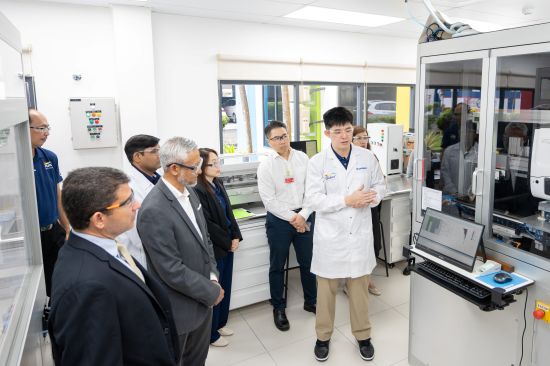
The robotic testing system at our Nilai R&D Centre is a significant advancement in how we approach product development — especially when it comes to driving sustainable innovation. This fully automated system enables high-throughput testing of a large number of paint formulations with greater speed, consistency and precision than traditional methods. It can operate around the clock, which greatly enhances our overall efficiency and productivity.
What sets the system apart is how it’s integrated with advanced data analysis tools and design-of-experiment modelling. This allows our chemists to test a wider range of variables more effectively and optimize formulations much faster. As a result, we can accelerate the development of new technologies that are not only high-performing but also aligned with our sustainability goals.
 Credit: AkzoNobel
Beyond improving speed and accuracy, the robotic testing process also supports more responsible use of resources. It helps reduce material waste, minimizes energy consumption and shortens development cycles—contributing directly to more environmentally friendly and efficient innovation practices.
In essence, the robotic system is a tool that enables smarter, cleaner and faster product development. It supports our ongoing commitment to create sustainable solutions that meet the needs of today’s consumers while protecting the environment for the future.
4. Why was Malaysia chosen as the location for this R&D Centre, and what advantages does the country offer in terms of talent pool, infrastructure, or market relevance?
Malaysia was chosen as the location for our new R&D Centre because of its strategic position in Southeast Asia, which makes it an ideal hub to serve the region’s fast-growing and diverse decorative paints market. Establishing the centre here allows us to bring R&D closer to our key ASEAN customers and operations, improving both responsiveness and relevance.
The country offers access to a highly educated and technically skilled talent pool, supported by world-class infrastructure and reliable logistics. This strengthens our ability to align local consumer insights with product innovation, ensuring our solutions are well-suited to market needs.
Malaysia’s growing focus on eco-friendly technologies also aligns strongly with AkzoNobel’s global sustainability ambitions. In addition, the supportive role of government agencies such as InvestKL reinforces the country’s attractiveness for innovation-led investments. All of these factors combined make Malaysia the right choice to power our next chapter of sustainable growth and innovation in the region.
5. How will this center enhance AkzoNobel’s ability to meet the evolving needs of ASEAN consumers?
The Nilai Centre strengthens AkzoNobel’s ability to respond to the evolving needs of Southeast Asian consumers by bringing global innovation capabilities closer to the region. As part of our network of 70 R&D labs worldwide, this facility reinforces a globally connected ecosystem where innovations developed locally can also scale and contribute to our broader Decorative Paints strategy.
By embedding R&D in the region, we’re able to accelerate innovation cycles, improve responsiveness and tailor solutions more effectively to local conditions and preferences. The centre enables us to address specific regional needs—such as developing weather-resistant paints suited for tropical climates, or heat-reflective coatings like our KeepCool Technology, which can reduce surface temperatures by up to 5°C and help lower energy consumption.
The Nilai Centre will also work closely with our global hubs to ensure knowledge-sharing and alignment with international standards, while leveraging local insights to create more relevant and impactful products. With a strong focus on low-VOC and bio-based solutions, the centre supports growing consumer demand for greener, healthier alternatives—positioning AkzoNobel to lead with sustainable innovation in ASEAN.
6. How does the Nilai R&D Centre tap into local expertise and talent in Malaysia? Where will it go from now?
The Nilai R&D Centre is powered by a team of 35 R&D professionals, with a strong emphasis on tapping into Malaysia’s local talent. By drawing on regional expertise and insights, we are better equipped to develop coatings that are truly tailored to Southeast Asian conditions—whether it’s extreme heat, heavy monsoons, or algae-prone environments.
Being located in Nilai’s industrial area places the centre close to our manufacturing operations and key infrastructure, which supports faster decision-making and smoother integration between R&D and business teams. This setup not only enhances collaboration but also strengthens our ability to deliver market-ready, relevant innovations more efficiently.
Looking ahead, the centre is well-positioned to lead regional R&D for Decorative Paints. With advanced lab technologies and access to AkzoNobel’s global network of over 70 labs, the solutions developed here can be scaled globally while staying rooted in local relevance. We will continue to invest in nurturing local talent and advancing our sustainability goals—cutting emissions, promoting circular use of materials and supporting the communities we operate in.
7. Are there plans for knowledge sharing or cross-functional collaboration between this facility and other AkzoNobel R&D hubs globally?
Yes, absolutely. The Nilai R&D Centre is an integral part of AkzoNobel’s global network of around 70 laboratories and is designed to collaborate closely with our established hubs in the Netherlands, the UK, Dubai, Poland and beyond. This connection enables active knowledge sharing across regions, allowing innovations developed in one location—such as KeepCool Technology, Silver Ion antibacterial paints and low-VOC or bio-based formulations — to be adapted and scaled for other markets.
Beyond global collaboration, the Nilai Centre also plays a key role in fostering cross-functional teamwork within the region. By bringing together R&D, marketing, sales and supply chain teams, we’re able to accelerate innovation cycles and ensure greater alignment between product development and market needs. The centre supports consistent product quality across different countries and climates, contributing both as a regional innovation hub and a critical part of our global strategy.
This is not an isolated facility. It is deeply embedded in AkzoNobel’s innovation ecosystem, contributing through shared technologies, talent and best practices to deliver sustainable, scalable solutions that meet evolving consumer expectations.