Painting & Coating Industry (PCI) logo Powder coating summit logo
search
cart
facebook twitter linkedin youtube
  • Sign In
  • Create Account
  • Sign Out
  • My Account
Painting & Coating Industry (PCI) logo Powder coating summit logo
  • NEWS
    • Latest News
    • Market Trends & Reports
    • Finishing News
    • Price Alerts
    • Subscribe to Newsletters
    • Global Top 10/ PCI 25
    • Weekly Featured Article
    • COATLE Word Game
  • PRODUCTS
    • Product News
    • Must See Products and Services
  • MATERIALS
    • Additives
    • Resins/Polymers
    • Pigments
    • Equipment
    • Distributors
  • TECHNOLOGIES
    • Adhesives
    • Architectural Coatings
    • Finishing Articles
    • Finishing Technologies
    • Finishing Equipment
    • Industrial Coatings
    • Nanotechnology
    • Powder Coatings
    • Solventborne
    • Special Purpose Coatings
    • Sustainability
    • UV Coatings
    • Waterborne
  • RESOURCES
    • Columns
      • Did you know?
      • Distribution Dive
      • Formulating With Mike
      • Innovation Insights
      • Powder Coating Perspectives
      • TiO2 Insider
    • Blogs
      • Editor's Viewpoint
      • Industry Insights
    • Coatings Supplier Handbook
    • Podcasts and Videos
      • COAT-IT! Podcast
      • Videos/PCI TV
    • PCI Store
    • Classifieds
    • eBooks
    • Sponsor Insights
    • White Papers
    • COATLE Word Game
  • EVENTS
    • Coatings Trends & Technologies Summit
    • Paint and Coatings Academy
    • Webinars
    • Calendar of Events
    • Lifetime Achievement Award
  • DIRECTORIES
    • Buyer's Guide
    • Equipment Directory
    • Materials Directory
  • EMAGAZINE
    • Current Issue
    • eMagazine Archive
    • China Issue Archive
    • Editorial Advisory Board
  • CONTACT
    • Contact Us
    • Advertise
    • Subscribe to eMagazine
    • Subscribe to Newsletters
  • SIGN UP!
UV Coatings

UV Cure, TSCA Registration and SNURs

By James Monroe, Rachel Staran
pci0319-BASF-960222432.jpg
March 7, 2019

In today’s manufacturing environment UV-curable coatings are king in regard to performance and productivity. However, the industry is facing new hurdles bringing innovations to the market. While UV-curable coatings started off with many challenges, they have been embraced by manufacturers of wood products, and the printing and packaging industry.

Today we face a new regulatory environment as a result of the Frank R. Lautenberg Chemical Safety Act (CSA), which went into effect in June of 2016. The new law amends the Toxic Substances Control Act (TSCA) with many changes that include risk-based assessments, public transparency and cost structure for funding activities under the new law. With the new law in place how does this affect the development and use of UV-curable coatings, inks, etc.? 

First let’s talk about developing a new chemical for use in a UV-curable coating. Without going into details, a company allocates time, resources and funding to develop a new chemical to be used as a resin to formulate a UV-curable material. Potential improvements vary depending on what the application and requirements are. One trend in development is the need for low VOCs and a sustainable or “green” attribute. Once the development is complete, information is put together and submitted to the EPA for review. It is unlikely the submission goes without some questions and answers, but in the end the EPA will provide you an assessment with a few options to move forward. The best option is the approval to commercialize without restrictions. However, it is likely you might only be able to commercialize with restrictions. A significant new use rule (SNUR) would be assigned to the chemical with details about the SNUR spelled out by the EPA. For the players in the value chain to make this new material successful they will need to understand the SNUR and any requirements associated with it. Many, if not all, raw material suppliers have encountered this situation by now. The challenge now becomes how to convey the value of a new product while also convincing the market that the value is greater than the SNUR assigned by the EPA. Figure 1 is a picture of the current situation.
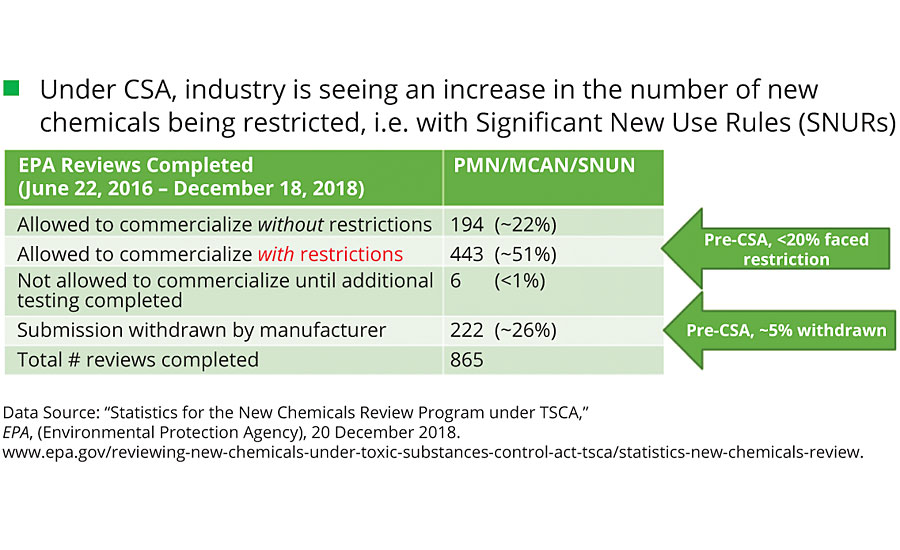
The challenge now becomes how to convey the value of a new product while also convincing the market that the value is greater than the SNUR assigned by the EPA
FIGURE 1

As a new material is presented to the users, the players in the value chain must communicate the SNUR and associated requirements. This is where the new regulatory environment affects the use of UV-curable materials. Depending on the severity of the SNUR or how impactful it is, companies must communicate and help manage the process of bringing innovation to the market. This becomes a very difficult situation. A manufacturer using an existing UV coating may ask, “Why should I look at this new material that is a stepwise innovation when I must implement processes, procedures or documentation to comply with the associated SNUR?” Often the easy route is to just continue with existing materials and forgo innovation and SNURs. As an industry we can coach, guide, communicate and help the end users of coatings put innovation in front of the consumers. A SNUR is not necessarily a bad thing. We just need to understand how to work with them. It will take time and resources, but the raw material suppliers (developers) can start at the top and work along the value chain coaching and guiding coatings end users. Often this means identifying existing processes, procedures and documentation systems that could be used to comply with a SNUR. Figure 2 gives a brief overview of a SNUR impact.
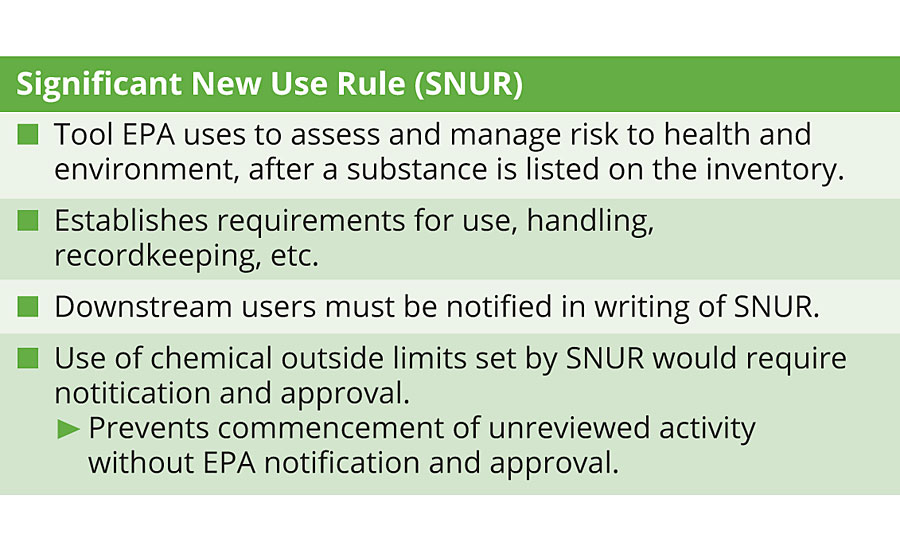
overview of a SNUR impact.
FIGURE 2

Looking specifically at UV-curable materials, they are developed for various applications in both 100% solids and waterborne formulations. Formulations could be for fillers, adhesives, coatings, inks, etc. Application is achieved by many methods such as roll, vacuum, spray and even 3D print, but one thing remains common, the resin in the coating is functionalized to be cured by free radical polymerization with UV light and a photoinitiator. Due to the functionality of photoinitiators, additives and monomers/oligomers, developers and users of UV-curable coatings must take into consideration how these materials can be used and disposed of safely. An area of concern with the EPA is potential release into the environment, particularly aquatic release. This is an area of opportunity for industry to work with end users to build robust procedures and documentation to manage a potential SNUR. Another area of concern specifically with waterborne UV coatings for spray applications is inhalation and lung toxicity. Even though waterborne UV coatings are applied in automated systems or spray booths, the design and function of the filtering media and exhaust system will come into question regarding fugitive release that could result in inhalation exposure. These areas of concern are great starting points for proactively addressing questions and managing potential SNURs on new innovative products.


Conclusion

Overall the regulatory landscape has changed. The goal is to modernize with health and safety in mind. At BASF we strive to develop innovative products that focus on end-user needs while driving sustainability, safety, health and performance. We understand the impact on innovation these regulatory changes have and focus on customers’ success. We can help understand the changes and provide guidance toward managing compliance to restrictions. Ultimately BASF is creating chemistry in UV technology, providing customers with solutions that deliver higher performance and manufacturing efficiency, while meeting sustainability, health and safety initiatives.


To review statistics on EPA chemical registrations please view their website:

https://www.epa.gov/reviewing-new-chemicals-under-toxic-substances-control-act-tsca/statistics-new-chemicals-review

KEYWORDS: Regulations Sustainability in Coatings

Share This Story

Looking for a reprint of this article?
From high-res PDFs to custom plaques, order your copy today!


James Monroe, Market Segment Manager Furniture & Flooring; BASF, Southfield, MI
Rachel Staran, Product Steward – Dispersions & Resins NA, BASF, Southfield, MI

Recommended Content

JOIN TODAY
to unlock your recommendations.

Already have an account? Sign In

  • pci1022-Kinaltek-Lead-1170.jpg

    A Novel Pigment Production Technology

    Following an extensive R&D program that demonstrated...
    Paint and Coating Pigments
    By: Jawad Haidar and Nitin Soni
  • pci global top 10

    2025 Global Top 10: Top Paint and Coatings Companies

    The following is PCI’s annual ranking of the top 10...
    Global Top 10 and PCI 25
    By: Courtney Bassett
  • 2025 pci 25

    2025 PCI 25: Top Paint and Coatings Companies

    PCI's annual ranking of the top 25 North American paint...
    Paint and Coating Market Reports
    By: Courtney Bassett
You must login or register in order to post a comment.

Report Abusive Comment

Manage My Account
  • eMagazine
  • Newsletters
  • Online Registration
  • Subscription Customer Service

More Videos

Sponsored Content

Sponsored Content is a special paid section where industry companies provide high quality, objective, non-commercial content around topics of interest to the PCI audience. All Sponsored Content is supplied by the advertising company and any opinions expressed in this article are those of the author and not necessarily reflect the views of PCI or its parent company, BNP Media. Interested in participating in our Sponsored Content section? Contact your local rep!

close
  • colorful building exterior
    Sponsored byDow

    Insights into Exterior Architectural Coating Degradation: Bridging Accelerated and Natural Weathering

  • digital pigments
    Sponsored bySiltech

    The Fourth Dimension of Silicon: Siltech Q Resins

Popular Stories

Company News

What the AkzoNobel–Axalta Merger Means for the Future of Coatings

AkzoNobel and Axalta Headquarters

AkzoNobel and Axalta Announce $25 Billion Merger

Wacker logo

WACKER Plans More Than 1,500 Job Cuts


PCI Buyers Guide

Submit a Request for Proposal (RFP) to suppliers of your choice with details on what you need with a click of a button

Start your RFP

Browse our Buyers Guide for manufacturers and distributors of all types of coatings products and much more!

Find Suppliers

Events

September 4, 2025

N-Butylpyrrolidone (NBP) as a Green Solvent to Replace N-Methylpyrrolidone (NMP) in Industrial Coating Applications

ON DEMAND: EPA published a regulation proposal around N-methylpyrrolidone (NMP) in June 2024 to ban or limit NMP in many applications, such as paints and coatings and their removers. N-butylpyrrolidone (NBP) is a powerful and versatile solvent for a variety of industries looking for alternatives to substance of very high concern (SVHC)-listed solvents.

March 24, 2026

The Manufacturing & Automation eXchange (MAX)

MAX presents a rare opportunity to observe the full scope of manufacturing in one environment. From systems integration and materials handling to automation, quality, safety, and packaging, each discipline is represented through live, operational displays. By experiencing these technologies side by side, as they are on actual production floors, attendees gain a grounded understanding of how manufacturing functions align, overlap, and evolve in practice.

View All Submit An Event

Poll

Longest-running laboratory experiment

What is the longest-running laboratory experiment?
View Results Poll Archive

Products

Automotive Paints and Coatings, 2nd Edition

Automotive Paints and Coatings, 2nd Edition

Now in its second edition and still the only book of its kind, this is an authoritative treatment of all stages of the coating process.

See More Products
pci voices from the top ebook

PCI webinar

Related Articles

  • pci0518-Allnex-478100980-900.jpg

    Use of Amino Acrylates to Reduce Photoinitiator Concentration or Increase Cure Speed in UV LED-Curable OPVs and Flexo Inks

    See More
  • pci0518-CSI-Lead-900.jpg

    Trends in UV-Cure Coating Formulations, Production Coating Methods and Apparatus

    See More
  • Phoseon

    Why Cure Wood With UV LED Lamps? Because It’s Cool.

    See More

Related Products

See More Products
  • Cure On-Demand Coatings (Zoom course - 4/23/26)

  • organic coatings.jpg

    Organic Coatings: Science and Technology, 4th Edition

See More Products

Related Directories

  • Keyland Polymer UV Powder LLC

    Keyland Polymer develops, formulates, manufactures and sells UV cured powder coatings for wood, plastic, metal, composites, and other substrates. Keyland Polymer has a complete resin synthesis lab with global reach and distribution capabilities for the development, formulation, testing, and manufacturing of UV/EB curable solid resins.
  • American Ultraviolet

    Ultraviolet curing systems, ultraviolet lamps, roll coaters, feeders, stackers, custom ultraviolet equipment, spot-curing equipment, shutter equipment.
×

Keep the info flowing with our eNewsletters!

Get the latest industry updates tailored your way.

JOIN TODAY!
  • RESOURCES
    • Advertise
    • Contact Us
    • Directories
    • Store
    • Want More
    • Manufacturing Division
  • SIGN UP TODAY
    • Create Account
    • eMagazine
    • Newsletters
    • Customer Service
    • Manage Preferences
  • SERVICES
    • Marketing Services
    • Reprints
    • Market Research
    • List Rental
    • Survey & Sample
  • STAY CONNECTED
    • LinkedIn
    • Facebook
    • Youtube
    • X (Twitter)
  • PRIVACY
    • PRIVACY POLICY
    • TERMS & CONDITIONS
    • DO NOT SELL MY PERSONAL INFORMATION
    • PRIVACY REQUEST
    • ACCESSIBILITY

Copyright ©2025. All Rights Reserved BNP Media.

Design, CMS, Hosting & Web Development :: ePublishing