Painting & Coating Industry (PCI) logo Powder coating summit logo
search
cart
facebook twitter linkedin youtube
  • Sign In
  • Create Account
  • Sign Out
  • My Account
Painting & Coating Industry (PCI) logo Powder coating summit logo
  • NEWS
    • Latest News
    • Market Trends & Reports
    • Finishing News
    • Price Alerts
    • Subscribe to Newsletters
    • Global Top 10/ PCI 25
    • Weekly Featured Article
    • COATLE Word Game
  • PRODUCTS
    • Product News
    • Must See Products and Services
  • MATERIALS
    • Additives
    • Resins/Polymers
    • Pigments
    • Equipment
    • Distributors
  • TECHNOLOGIES
    • Adhesives
    • Architectural Coatings
    • Finishing Articles
    • Finishing Technologies
    • Finishing Equipment
    • Industrial Coatings
    • Nanotechnology
    • Powder Coatings
    • Solventborne
    • Special Purpose Coatings
    • Sustainability
    • UV Coatings
    • Waterborne
  • RESOURCES
    • Columns
      • Did you know?
      • Distribution Dive
      • Formulating With Mike
      • Innovation Insights
      • Powder Coating Perspectives
      • TiO2 Insider
    • Blogs
      • Editor's Viewpoint
      • Industry Insights
    • Coatings Supplier Handbook
    • Podcasts and Videos
      • COAT-IT! Podcast
      • Videos/PCI TV
    • PCI Store
    • Classifieds
    • eBooks
    • Sponsor Insights
    • White Papers
    • COATLE Word Game
  • EVENTS
    • Coatings Trends & Technologies Summit
    • Paint and Coatings Academy
    • Webinars
    • Calendar of Events
    • Lifetime Achievement Award
  • DIRECTORIES
    • Buyer's Guide
    • Equipment Directory
    • Materials Directory
  • EMAGAZINE
    • Current Issue
    • eMagazine Archive
    • China Issue Archive
    • Editorial Advisory Board
  • CONTACT
    • Contact Us
    • Advertise
    • Subscribe to eMagazine
    • Subscribe to Newsletters
  • SIGN UP!
Paint and Coatings Additives

Stabilizer Solutions: Methods to Improve Resistance of BPA/BPF-Based Epoxy Resins to Light and Heat Damage

By Sangjoon Park, Benno Blickenstorfer, Rosanna Telesca
pci1222-Songwon-471967941-1170.jpg

costasss, iStock / Getty Images Plus, via Getty Images

December 20, 2022

Coatings can be applied to various materials to give unprecedented functions or to prevent damage to the underlying surface caused by external factors. They can also enhance the value of objects through a variety of color and gloss characteristics. Appropriate resin selection is essential to meet specific application requirements. Epoxy resins, the main subject of this article, are widely used in coatings thanks to their excellent adhesion to materials and their durability. Bisphenol A- and bisphenol F-based epoxy resins and amine hardeners are common components of epoxy coatings. However, epoxy resins typically contain aromatic groups with strong absorption in the UV range. This makes epoxy structures vulnerable to UV degradation. Their poor UV light resistance limits their suitability for exterior applications. Light stabilizers retard the effects of UV degradation such as yellowing by screening UV light and by slowing down the rate of radical degradation reactions. Antioxidants further reduce the yellowing caused by heat. The performance of SONGWON stabilizers in a typical commercial epoxy resin with hardeners was tested and reviewed below.


Experiment

Materials and Preparation

The formulation incorporating a 50:50 resin mixture of BPA/BPF (Table 1) was designed to evaluate the performance of stabilizers. Cycloaliphatic diamine was reacted with the resin to initiate curing. The amounts of resin and hardener were calculated according to the stoichiometric ratio. Diluents and solvents were added to control viscosity and improve workability. Stabilizers were classified as UV absorber, HALS, and antioxidant to test their performance. The film thickness was adjusted to 2 mm through weighing and actual measurement in an aluminum dish used as a molder. The prepared specimens were placed in an air circulation oven (Memmerts UF110) set at 30% fan speed, 100% ventilation, and 40 °C, and cured for 12 hours. After conditioning for 7 days at 23 °C and 50% relative humidity, the specimens were exposed to weathering as described below.
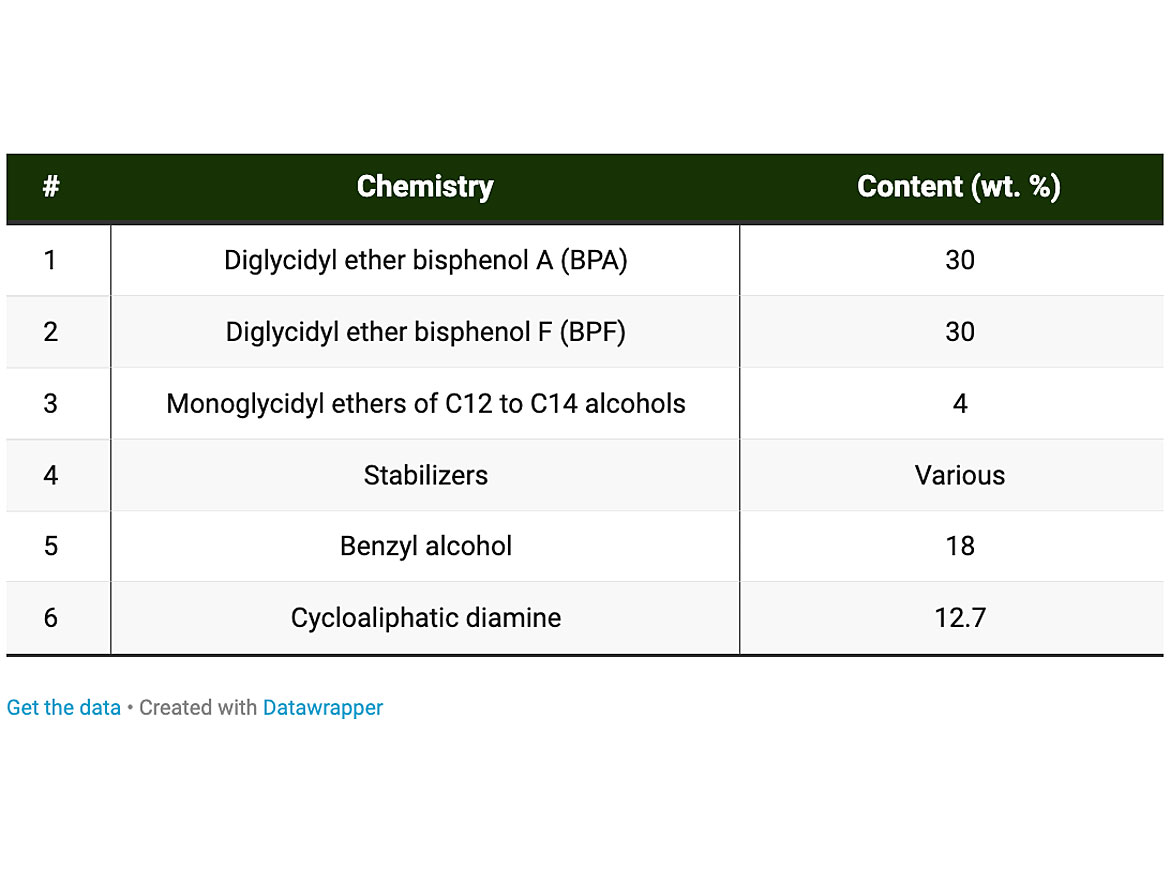
Solvent-based epoxy formulation.
TABLE 1 » Solvent-based epoxy formulation.


Artificial Weathering

The specimens were exposed to photo-aging in a Bandol Wheel® H400 developed by SEVAR/SEVN Bandol. The specimens were mounted on a circular rack around the horizontal axis. The rack rotates around a medium-pressure UV mercury lamp whose bulb is enclosed in a borosilicate envelope. The lamp provides an irradiance of 95 W/m2 at wavelengths between 300 and 400 nm. The Bandol Wheel reproduces the main natural phenomena responsible for chemical alterations on polymer matrices and additives. It considerably accelerates the kinetics of alteration that would occur naturally. The samples were exposed to a nominal UV radiation level corresponding to about “2 suns”. Degradation effects become visible after shorter periods than with other methods.

The programmed protocol was set to a black panel temperature of 60 ℃. The rack speed of six rounds per day ensured that the specimens were immersed in water for 17% of the time. The Bandol Wheel meets the requirements specified by the EN 16472 standard. Exposed specimens were withdrawn every 20 hours for color data measurement by spectrophotometer.


Color Measurement

Color development on the exposed specimens was determined using a HunterLab MiniScan EZ spectrophotometer (geometry; diffuse/8°) with a 2.5 cm diameter aperture (illuminant 65, and 10° standard observer). The color was measured on a standard white tile (Hunterlab, 11-0108-50), taking into account the transparency of the specimens.

To express the discoloration ΔE (color difference), the Euclidean distance between two coordinates profiled as L*, a*, and b*, and ΔYI (Yellowness Index) were adopted according to:

      ∆E*ab = [(∆L2) + (∆a2) + (∆b2)]1/2.

Yellowness Index was expressed as the number calculated from spectrophotometric data in accordance with ASTM E313:

      YI = 100(CXX-CZZ)/Y

CX,CZ: coefficients of the equations for Yellowness Index.

X, Y, and Z: CIE tristimulus values.

The higher the color difference values  (ΔE, ΔYI), the stronger the color change. Three measurements were taken for each specimen and the average was calculated in each case.
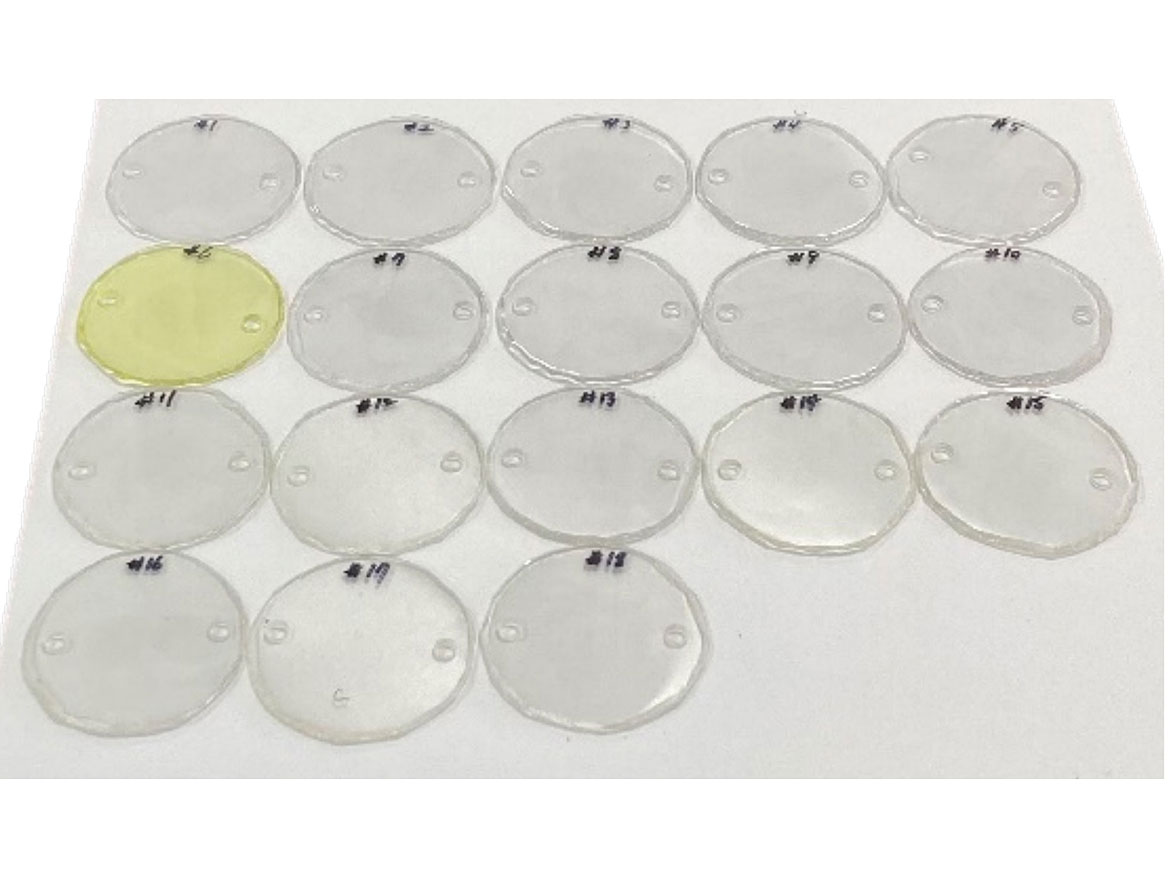
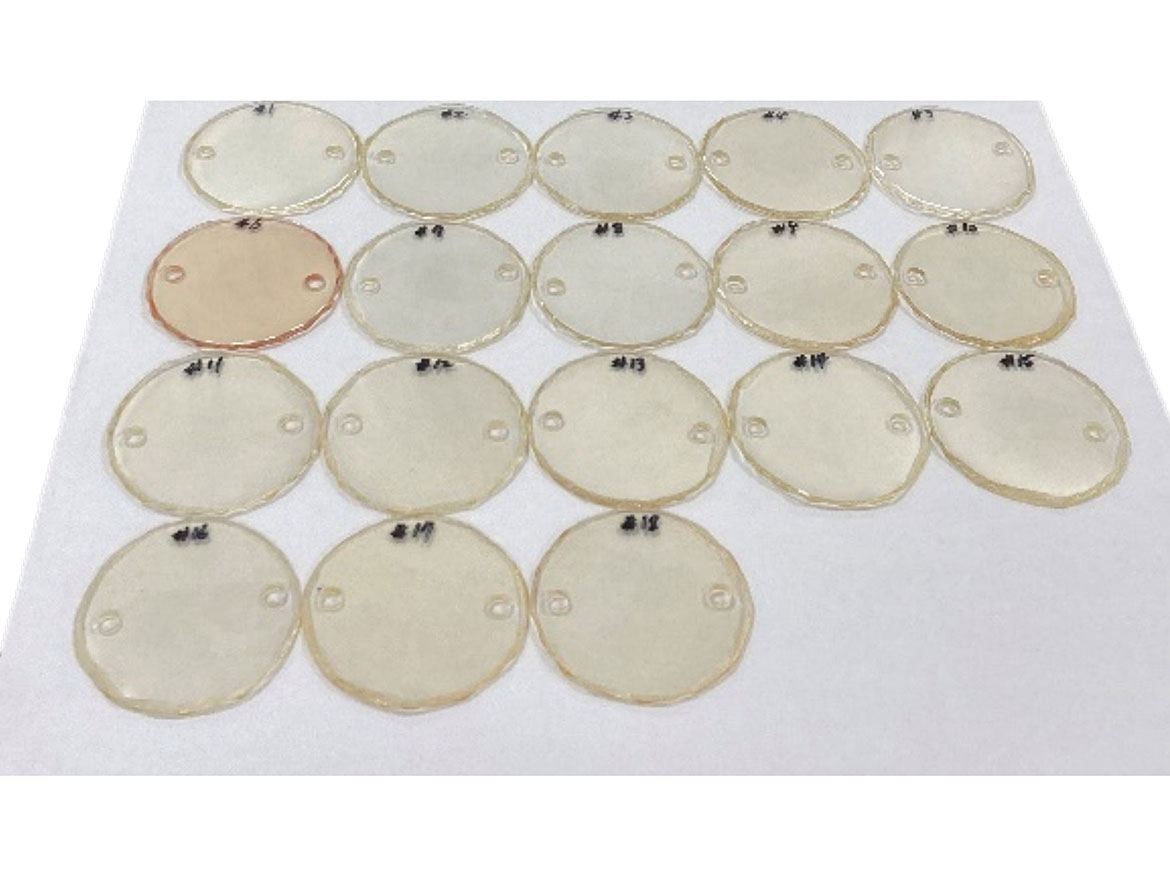
Exemplary cured epoxy coatings specimens Exemplary cured epoxy coatings specimens
FIGURES 1-2 » Exemplary cured epoxy coatings specimens: initial stage (top) and after 80 hours weathering in Bandol Wheel® H400 (bottom).


Light and Heat Stabilizers

SONGWON develops and manufactures both light and heat stabilizers. SONGSORB® CS light stabilizers retard the damaging effects caused by UV light. UV absorbers (UVAs) absorb ultraviolet energy and convert it into harmless heat. Hindered amine light stabilizers (HALS) trap the radicals that form and deactivate them. SONGNOX® CS heat stabilizers or antioxidants interrupt the auto-oxidation process caused by the effects of elevated temperatures.

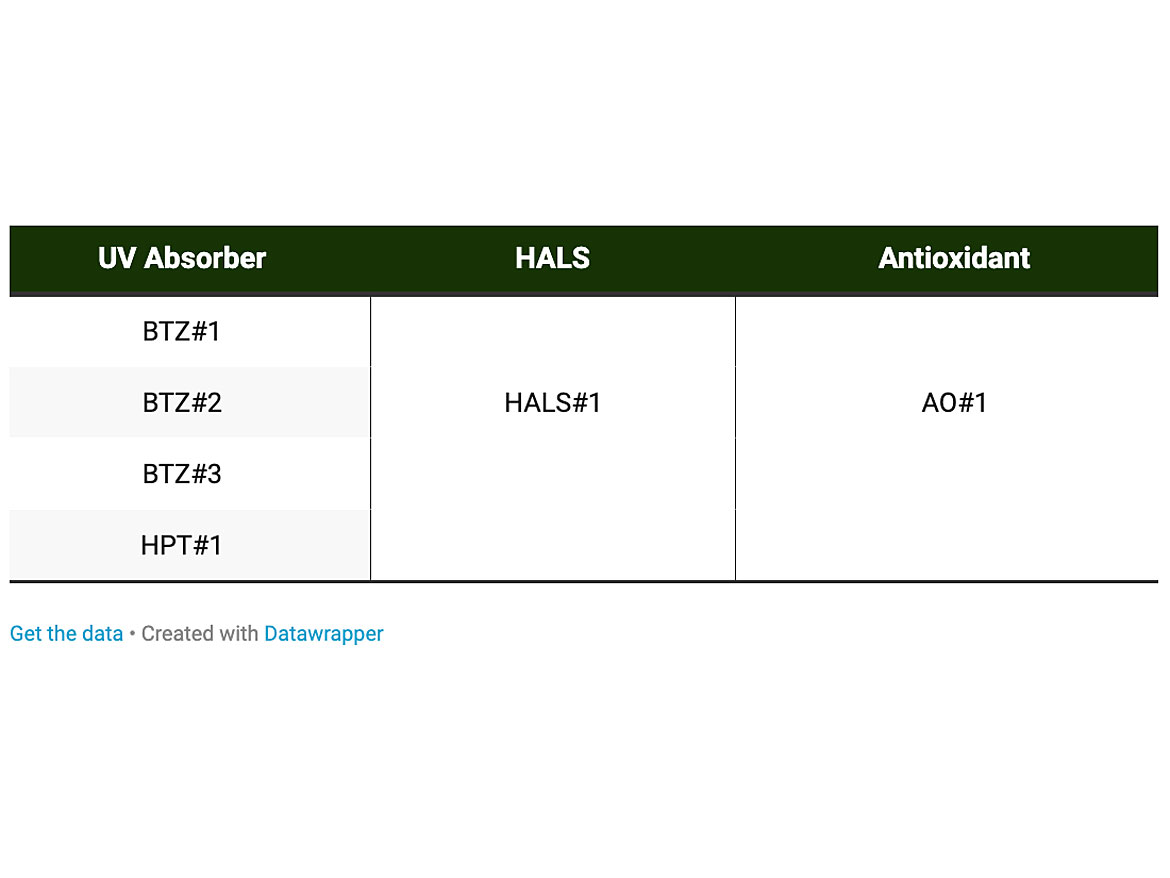
The study includes a performance comparison of three benzotriazole (BTZ) and one hydroxyphenyl triazine (HPT) UV absorber as well as the combined effects at various HALS ratios and with an additional antioxidant. Added stabilizers are listed in Table 2 and their dosage is given in the following figures, expressed as wt. % based on resin.
Stabilizers.
TABLE 2 » Stabilizers.


Results

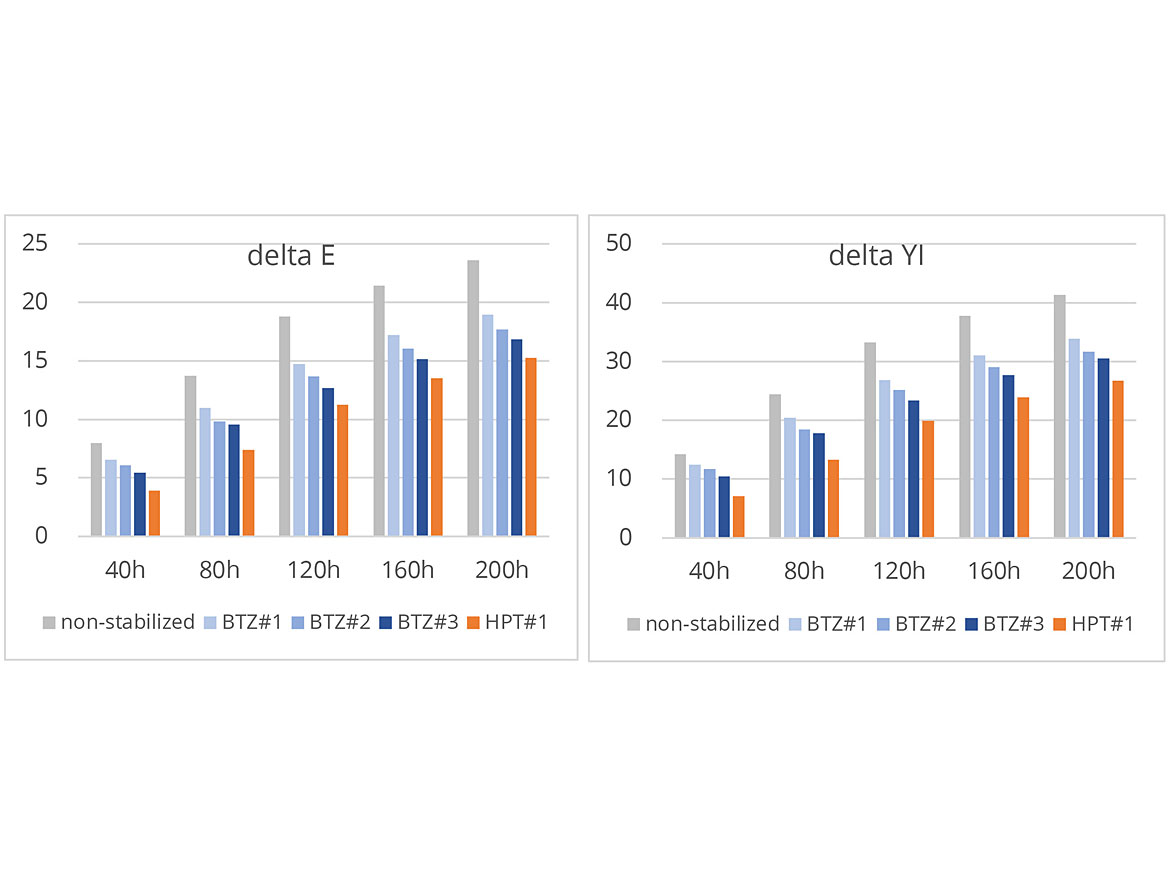
Figure 3 shows ΔE color change and ΔYI results over an aging period of 200 hours. All three benzotriazole UVAs show a positive effect on the light stabilization of the epoxy coating. The hydroxyphenyl triazine UVA outperforms the BTZ materials by at least 4 ΔYI units. HPT#1 shows a lower color difference of 8 ΔE units than the non-stabilized formulation.  
Comparison of UV absorbers: color change (ΔE, ΔYI) of specimens after different accelerated aging periods on Bandol Wheel H in accordance with DIN EN 16472.
FIGURE 3 » Comparison of UV absorbers: color change (ΔE, ΔYI) of specimens after different accelerated aging periods on Bandol Wheel H in accordance with DIN EN 16472.

The HPT#1-containing coating was further modified with a HALS and an antioxidant. The aging results are shown in Figure 4. Both additions further improve the light stability of the epoxies. The formulation containing all three stabilizer chemistries results in a further ΔE reduction of 2.5 units. This combination shows ΔYI to be 20 units lower than the non-stabilized formulation.
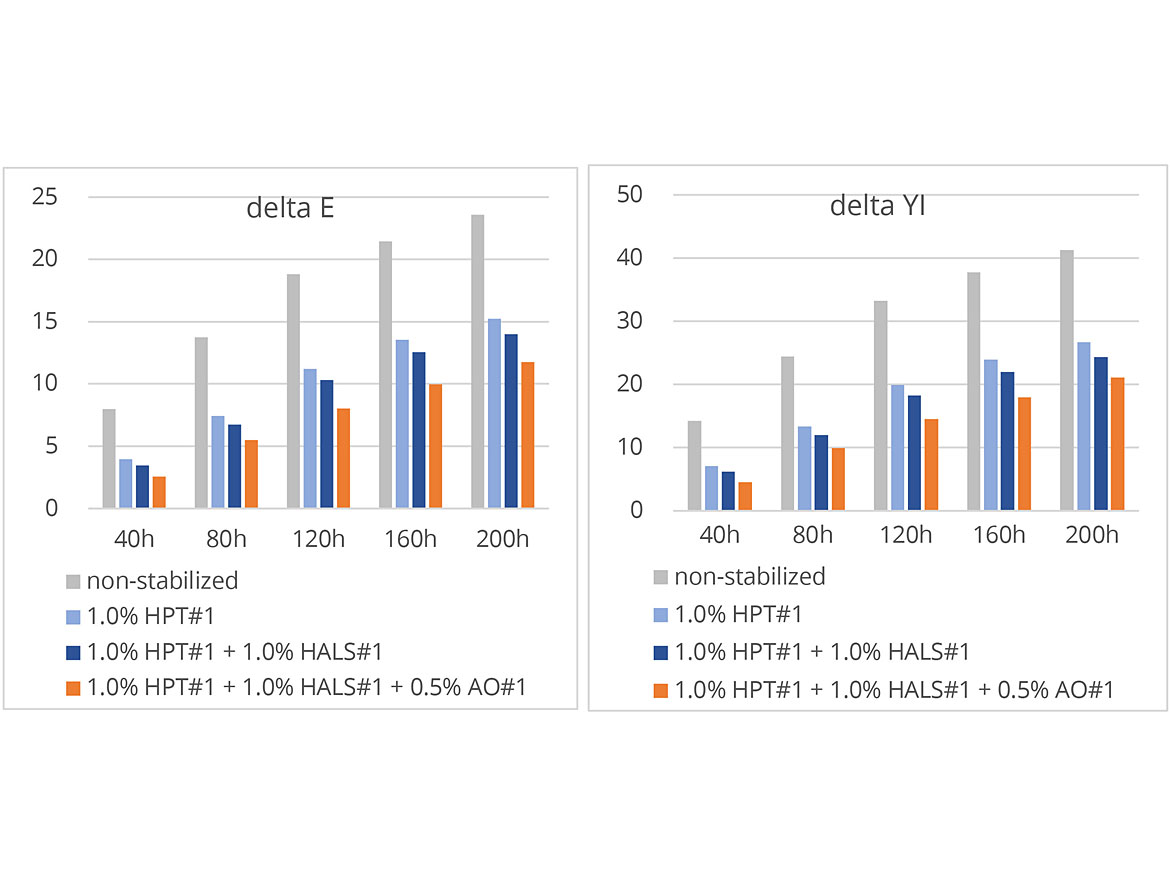
Combination of stabilizers (UVA, HALS, and AO): color change (ΔE, ΔYI) of specimens after different accelerated aging periods on Bandol Wheel H in accordance with DIN EN 16472.
FIGURE 4 » Combination of stabilizers (UVA, HALS, and AO): color change (ΔE, ΔYI) of specimens after different accelerated aging periods on Bandol Wheel H in accordance with DIN EN 16472.

The effects on protection of varying UVA:HALS ratios are shown in Figure 5. Being a non-pigmented model coatings system, the 3:1 ratio of HPT#1 to HALS provides another approximately 2 ΔE-unit improvement, while keeping the overall stabilizer quantity constant.  
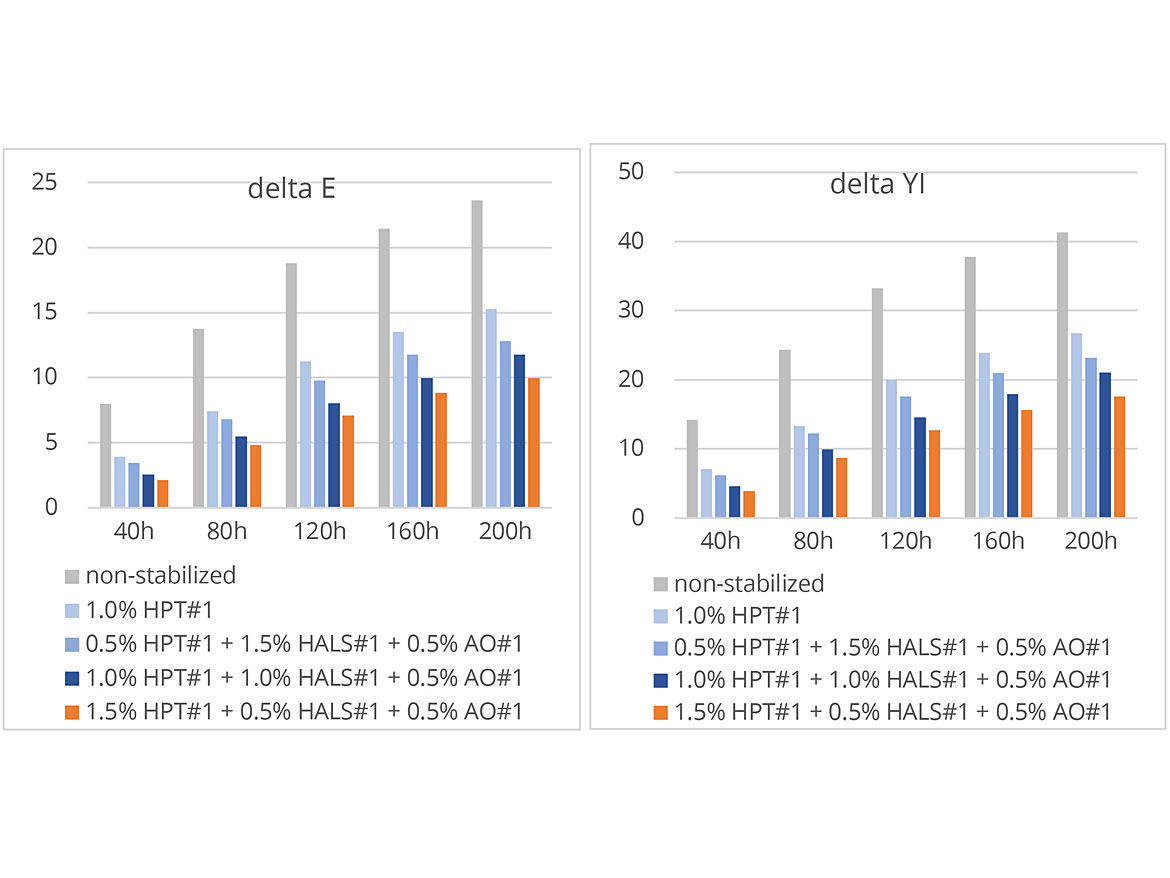
Color change (ΔE, ΔYI) of specimens with different ratios of UVA to HALS and after different accelerated aging periods on Bandol Wheel H as specified in DIN EN 16472.
FIGURE 5 » Color change (ΔE, ΔYI) of specimens with different ratios of UVA to HALS and after different accelerated aging periods on Bandol Wheel H as specified in DIN EN 16472.


Conclusion

Yellowing of epoxy coatings is caused by photo- and thermochemical oxidation. These degradation processes can also lead to deterioration of a coating’s physical and mechanical properties. The inherent tendency to discoloration of epoxy coatings can be minimized by suitable selection of preferably aliphatic amines or by initially setting the color of the system to yellowish or dark shades. For this reason, epoxy coatings are frequently top coated with more weather-resistant materials.

To respond more fundamentally, SONGWON’s stabilizers help to retard the degradation of epoxy coatings caused by both oxidation processes. The study shows that the combination of hydroxyphenyl triazine UV absorber, hindered amine light stabilizer (HALS) and phenolic antioxidant provides substantial benefits as regards discoloration. Optimization and adjustment of UVA:HALS ratio can further improve performance, depending on the specific characteristics of the epoxy coating. With light or white pigmented systems in particular, stabilizer combination and add-on quantity needs to be further balanced with a view to initial color.

For further information or technical support, contact coatings@songwon.com or visit www.songwon.com.

KEYWORDS: BPA-free Epoxy Resins stabilizers

Share This Story

Looking for a reprint of this article?
From high-res PDFs to custom plaques, order your copy today!


Sangjoon Park, Global Application Manager SONGWON Industrial Co., Ltd., Ulsan, Korea
Benno Blickenstorfer, Global Business Development Manager, SONGWON Industrial Group, Frauenfeld, Switzerland
Rosanna Telesca, Leader Market Center Coatings, SONGWON Industrial Group, Switzerland

Recommended Content

JOIN TODAY
to unlock your recommendations.

Already have an account? Sign In

  • pci1022-Kinaltek-Lead-1170.jpg

    A Novel Pigment Production Technology

    Following an extensive R&D program that demonstrated...
    Paint and Coating Pigments
    By: Jawad Haidar and Nitin Soni
  • pci global top 10

    2025 Global Top 10: Top Paint and Coatings Companies

    The following is PCI’s annual ranking of the top 10...
    Global Top 10 and PCI 25
    By: Courtney Bassett
  • 2025 pci 25

    2025 PCI 25: Top Paint and Coatings Companies

    PCI's annual ranking of the top 25 North American paint...
    Paint and Coating Market Reports
    By: Courtney Bassett
You must login or register in order to post a comment.

Report Abusive Comment

Manage My Account
  • eMagazine
  • Newsletters
  • Online Registration
  • Subscription Customer Service

More Videos

Sponsored Content

Sponsored Content is a special paid section where industry companies provide high quality, objective, non-commercial content around topics of interest to the PCI audience. All Sponsored Content is supplied by the advertising company and any opinions expressed in this article are those of the author and not necessarily reflect the views of PCI or its parent company, BNP Media. Interested in participating in our Sponsored Content section? Contact your local rep!

close
  • colorful building exterior
    Sponsored byDow

    Insights into Exterior Architectural Coating Degradation: Bridging Accelerated and Natural Weathering

  • digital pigments
    Sponsored bySiltech

    The Fourth Dimension of Silicon: Siltech Q Resins

Popular Stories

Company News

What the AkzoNobel–Axalta Merger Means for the Future of Coatings

AkzoNobel and Axalta Headquarters

AkzoNobel and Axalta Announce $25 Billion Merger

Wacker logo

WACKER Plans More Than 1,500 Job Cuts


PCI Buyers Guide

Submit a Request for Proposal (RFP) to suppliers of your choice with details on what you need with a click of a button

Start your RFP

Browse our Buyers Guide for manufacturers and distributors of all types of coatings products and much more!

Find Suppliers

Events

September 4, 2025

N-Butylpyrrolidone (NBP) as a Green Solvent to Replace N-Methylpyrrolidone (NMP) in Industrial Coating Applications

ON DEMAND: EPA published a regulation proposal around N-methylpyrrolidone (NMP) in June 2024 to ban or limit NMP in many applications, such as paints and coatings and their removers. N-butylpyrrolidone (NBP) is a powerful and versatile solvent for a variety of industries looking for alternatives to substance of very high concern (SVHC)-listed solvents.

March 24, 2026

The Manufacturing & Automation eXchange (MAX)

MAX presents a rare opportunity to observe the full scope of manufacturing in one environment. From systems integration and materials handling to automation, quality, safety, and packaging, each discipline is represented through live, operational displays. By experiencing these technologies side by side, as they are on actual production floors, attendees gain a grounded understanding of how manufacturing functions align, overlap, and evolve in practice.

View All Submit An Event

Poll

Longest-running laboratory experiment

What is the longest-running laboratory experiment?
View Results Poll Archive

Products

Automotive Paints and Coatings, 2nd Edition

Automotive Paints and Coatings, 2nd Edition

Now in its second edition and still the only book of its kind, this is an authoritative treatment of all stages of the coating process.

See More Products
pci voices from the top ebook

PCI webinar

Related Articles

  • Thermal Stabilization of Powder Coatings

    Thermal Stabilization of Powder Coatings

    See More
  • Thermal Stabilization of Powder Coatings

    Thermal Stabilization of Powder Coatings

    See More
  • additives for coatings

    BASF Implements Processes to Improve the Supply of Attapulgite-Based Additives

    See More

Related Products

See More Products
  • biopolymer.jpg

    Biopolymer-Based Films and Coatings Trends and Challenges

  • princ-&-apps-of-emulsion-po

    Principles and Applications of Emulsion Polymerization

See More Products

Related Directories

  • BASF Corp., Dispersions, Resins & Additives

    BASF offers a strong portfolio of industry-leading additives for the Coatings Industry to deliver eco-efficient solutions that meet performance requirements. The BASF Performance and Formulation additives portfolio encompasses a technology base of dispersing agents, wetting agents and surface modifiers, defoamers, rheology modifiers, film forming agents, antioxidants, light stabilizers and UV absorbers.
×

Keep the info flowing with our eNewsletters!

Get the latest industry updates tailored your way.

JOIN TODAY!
  • RESOURCES
    • Advertise
    • Contact Us
    • Directories
    • Store
    • Want More
  • SIGN UP TODAY
    • Create Account
    • eMagazine
    • Newsletters
    • Customer Service
    • Manage Preferences
  • SERVICES
    • Marketing Services
    • Reprints
    • Market Research
    • List Rental
    • Survey & Sample
  • STAY CONNECTED
    • LinkedIn
    • Facebook
    • Youtube
    • X (Twitter)
  • PRIVACY
    • PRIVACY POLICY
    • TERMS & CONDITIONS
    • DO NOT SELL MY PERSONAL INFORMATION
    • PRIVACY REQUEST
    • ACCESSIBILITY

Copyright ©2025. All Rights Reserved BNP Media.

Design, CMS, Hosting & Web Development :: ePublishing