Painting & Coating Industry (PCI) logo Powder coating summit logo
search
cart
facebook twitter linkedin youtube
  • Sign In
  • Create Account
  • Sign Out
  • My Account
Painting & Coating Industry (PCI) logo Powder coating summit logo
  • NEWS
    • Latest News
    • Market Trends & Reports
    • Finishing News
    • Price Alerts
    • Subscribe to Newsletters
    • Global Top 10/ PCI 25
    • Weekly Featured Article
    • COATLE Word Game
  • PRODUCTS
    • Product News
    • Must See Products and Services
  • MATERIALS
    • Additives
    • Resins/Polymers
    • Pigments
    • Equipment
    • Distributors
  • TECHNOLOGIES
    • Adhesives
    • Architectural Coatings
    • Finishing Articles
    • Finishing Technologies
    • Finishing Equipment
    • Industrial Coatings
    • Nanotechnology
    • Powder Coatings
    • Solventborne
    • Special Purpose Coatings
    • Sustainability
    • UV Coatings
    • Waterborne
  • RESOURCES
    • Columns
      • Did you know?
      • Distribution Dive
      • Formulating With Mike
      • Innovation Insights
      • Powder Coating Perspectives
      • TiO2 Insider
    • Blogs
      • Editor's Viewpoint
      • Industry Insights
    • Coatings Supplier Handbook
    • Podcasts and Videos
      • COAT-IT! Podcast
      • Videos/PCI TV
    • PCI Store
    • Classifieds
    • eBooks
    • Sponsor Insights
    • White Papers
    • COATLE Word Game
  • EVENTS
    • Coatings Trends & Technologies Summit
    • Paint and Coatings Academy
    • Webinars
    • Calendar of Events
    • Lifetime Achievement Award
  • DIRECTORIES
    • Buyer's Guide
    • Equipment Directory
    • Materials Directory
  • EMAGAZINE
    • Current Issue
    • eMagazine Archive
    • China Issue Archive
    • Editorial Advisory Board
  • CONTACT
    • Contact Us
    • Advertise
    • Subscribe to eMagazine
    • Subscribe to Newsletters
  • SIGN UP!
Formulating with Mike

Selecting the Right Resin for Your Coating

By Mike Praw, Technical Service & Development Manager – Coatings and Performance Products, Indorama Ventures, The Woodlands, TX
pci0123-Formulating-874157664-1170.jpg

Davizro / iStock / Getty Images Plus, via Getty Images.

January 6, 2023

A resin is the vehicle that maintains the suspension of the paint components. It also gives the coating its desired properties. The material encapsulates the pigment particles and binds them together, forming a continuous film.

In short, a resin:

  • Is a polymer that, through a curing or film-forming mechanism, forms the coating’s film;
  • Imparts most of the final properties of the coating;
  • Is the critical raw material choice when formulating a coating;
  • Affects physical and chemical properties such as drying, durability, and flexibility.


Resin Properties

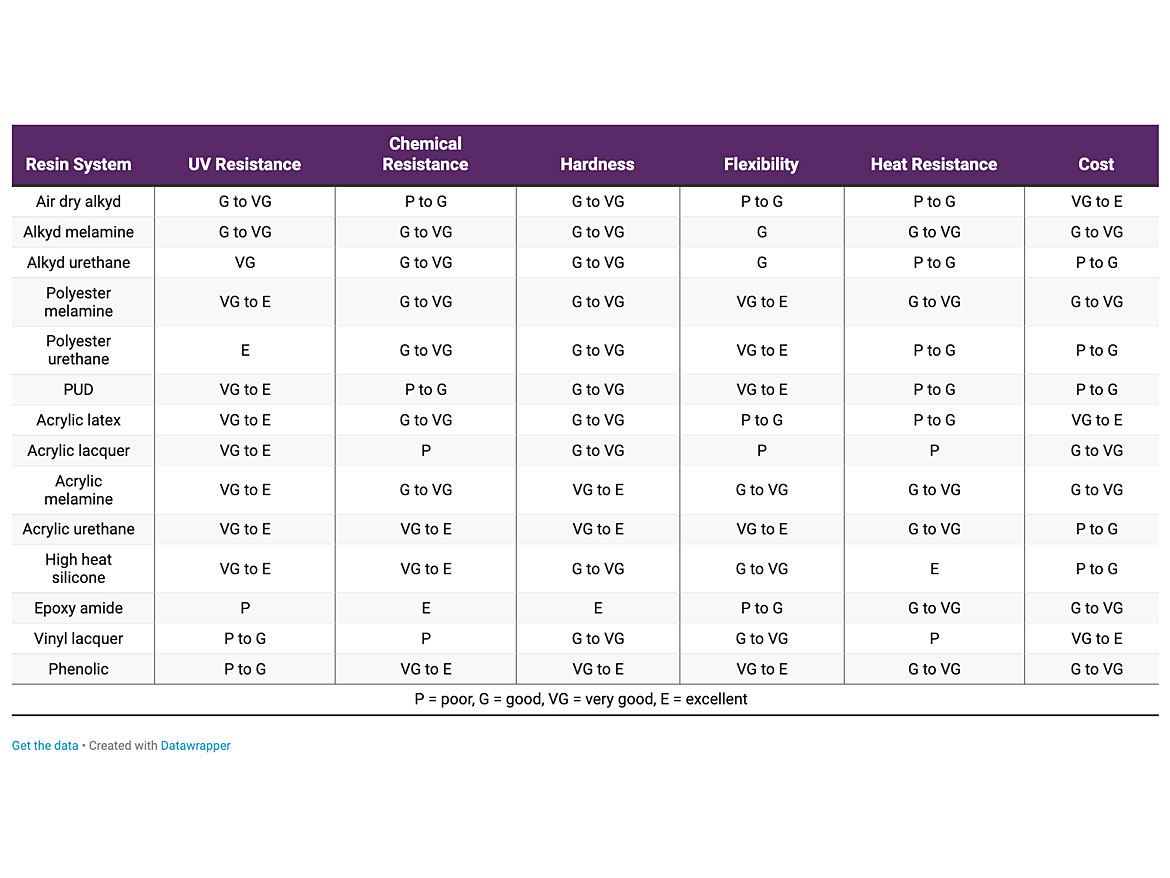
Table 1 contains information comparing the various resin systems.
Resin system properties.
TABLE 1 » Resin system properties.

TABLE 1 ǀ Resin system properties.

Some of the terms used to differentiate resins include thermoplastic versus thermoset polymers, glass transition temperature, and minimum film forming temperature, among others.


Thermoplastic vs. Thermoset Resins

A thermoplastic resin will form a film and not undergo any change in physical or chemical properties. A thermoplastic film retains the properties of the original polymer. Acrylic emulsions and polyurethane dispersions are examples of thermoplastic polymers. A thermoset or reactive system will chemically react or crosslink during film formation and have different properties upon cure. A thermoset, upon cure, forms a new polymer with significantly improved performance.

Binary curing or two-component (2K, as K is from "komponent" in German) systems, such as two-part epoxy or urethane systems are some of the common-cure mechanisms of thermoset systems. Once you mix the two components together, a non-reversible chemical reaction will occur. Because of this reactivity, they come in two or more separate containers and, once mixed, the irreversible reaction commences. Thermoset resins are not limited to binary systems, and are known as one-component (1K) systems because they are in only one container. They can use oxidative cure, such as an alkyd, or be radiation cured like baking or ultraviolet-cured coatings. These are the most common curing methods, but new curing systems are constantly coming out to improve film properties or lower environmental impact of the coating process.

There are also one-and-a-half component systems; these are one-component thermoplastic systems that can also be two-component thermoset systems. An example would be an acrylic copolymer system, which will form a thermoplastic coating if applied alone, but if crosslinked with an isocyanate will form a thermoset system with improved properties, thus giving the applicator options.


Glass Transition Temperature

All polymers have a Glass Transition Temperature (Tg). The temperature (usually measured in °C) at which a polymer transitions between crystalline “glassy” and amorphous “rubbery” states. In thermoplastic systems, the Tg of the cured film and that of the resin are the same. In thermoset systems, the Tg of the cured system is normally significantly higher than that of the uncured system. This allows a low Tg for application and high Tg for a harder final film. If the coating is applied at a temperature below the Tg, proper film formation may not occur and will result in a loss of properties. In extreme cases, there will be a complete absence of film formation and the coating will resemble dried milk.


Minimum Film Forming Temperature

The Minimum Film Forming Temperature (MFFT) is the minimum temperature (usually measured in °C) at which a polymer forms a film. Poor film formation will result if the curing temperature is below the MFFT of the resin. While the Tg and MFFT start about the same in thermoplastic systems, the MFFT can be lowered with coalescing solvents, surfactants, or plasticizers to allow a hard resin to form a film at temperatures well below the Tg. This allows a low application temperature and high film hardness. For example, a polymer with a Tg of 50 °C can have its MFFT lowered to 10 °C with cosolvents and allow it to be applied at room temperature. As the solvent evaporates, the MFFT rises to eventually return to the Tg of the system. As the amount of solvent used in coatings is reduced from environmental concerns, other methods of lowering MFFT, such as with surfactants and plasticizers have become common.


Single vs. Multi-Phase Thermoplastic Polymers

For single-phase resins, the MFFT and Tg are similar, and either can be used to formulate a coating. With the proliferation of multi-phase resins (core shell as well as other morphologies), a resin will not have one Tg, but have multiple-to-infinite Tgs as each phase will have its own Tg. The MFFT will be the temperature at which the resin will form a continuous film. With some or all of the resin in the continuous phase, there may be some higher Tg fractions of the resin that act as polymer filler in the resin matrix. In this case, there may be a loss of some properties, as only the continuous phase contributes to the cohesiveness of the film. The best way to think of this is honey and marbles. When you pour a mixture of the two, the honey will form the continuous film while the marbles will give hard independent domains, which can help properties like block resistance.

Hydroxyl, carboxyl, or amine value are defined as the amount of free hydroxyl, carboxyl, or amine groups that react in thermosetting systems. Volatile organic content (VOC) is the current driving force in resin development. With the implementation of regulations limiting solvents used in coatings, newer technologies have replaced traditional low-solids solventborne resins. Regulations regarding VOC content are constantly lowering the amount of photoreactive solvents used in coatings that lead to low-level ozone or smog.

Newer technology has both advantages and disadvantages compared to traditional coatings, and it is up to the coatings formulator to balance these to produce a coating that meets the needs of the end users.


Conclusion

With resin selection being the most important criteria for the final coating’s properties, selecting the right one is extremely important. See Table 1 for the properties of various resin systems.

As newer environmental regulations limiting VOC come into effect, many time-proven resins are facing extinction. Therefore, the only way to stay competitive is to move to newer technologies. The future is zero-VOC. Formulators need to adapt to this new reality.


All information contained herein is provided "as is" without any warranties, express or implied, and under no circumstances shall the author or Indorama be liable for any damages of any nature whatsoever resulting from the use or reliance upon such information. Nothing contained in this publication should be construed as a license under any intellectual property right of any entity, or as a suggestion, recommendation, or authorization to take any action that would infringe any patent. The term "Indorama" is used herein for convenience only, and refers to Indorama Ventures Oxides LLC, its direct and indirect affiliates, and their employees, officers, and directors.

KEYWORDS: paint and coating resins

Share This Story

Looking for a reprint of this article?
From high-res PDFs to custom plaques, order your copy today!


Mike Praw, Technical Service & Development Manager – Coatings and Performance Products, Indorama Ventures, The Woodlands, TX

Recommended Content

JOIN TODAY
to unlock your recommendations.

Already have an account? Sign In

  • pci1022-Kinaltek-Lead-1170.jpg

    A Novel Pigment Production Technology

    Following an extensive R&D program that demonstrated...
    Paint and Coating Pigments
    By: Jawad Haidar and Nitin Soni
  • pci global top 10

    2025 Global Top 10: Top Paint and Coatings Companies

    The following is PCI’s annual ranking of the top 10...
    Global Top 10 and PCI 25
    By: Courtney Bassett
  • 2025 pci 25

    2025 PCI 25: Top Paint and Coatings Companies

    PCI's annual ranking of the top 25 North American paint...
    Global Top 10 and PCI 25
    By: Courtney Bassett
You must login or register in order to post a comment.

Report Abusive Comment

Manage My Account
  • eMagazine
  • Newsletters
  • Online Registration
  • Subscription Customer Service

More Videos

Sponsored Content

Sponsored Content is a special paid section where industry companies provide high quality, objective, non-commercial content around topics of interest to the PCI audience. All Sponsored Content is supplied by the advertising company and any opinions expressed in this article are those of the author and not necessarily reflect the views of PCI or its parent company, BNP Media. Interested in participating in our Sponsored Content section? Contact your local rep!

close
  • colorful building exterior
    Sponsored byDow

    Insights into Exterior Architectural Coating Degradation: Bridging Accelerated and Natural Weathering

  • digital pigments
    Sponsored bySiltech

    The Fourth Dimension of Silicon: Siltech Q Resins

Popular Stories

Company News

What the AkzoNobel–Axalta Merger Means for the Future of Coatings

AkzoNobel and Axalta Headquarters

AkzoNobel and Axalta Announce $25 Billion Merger

Wacker logo

WACKER Plans More Than 1,500 Job Cuts


PCI Buyers Guide

Submit a Request for Proposal (RFP) to suppliers of your choice with details on what you need with a click of a button

Start your RFP

Browse our Buyers Guide for manufacturers and distributors of all types of coatings products and much more!

Find Suppliers

Events

September 4, 2025

N-Butylpyrrolidone (NBP) as a Green Solvent to Replace N-Methylpyrrolidone (NMP) in Industrial Coating Applications

ON DEMAND: EPA published a regulation proposal around N-methylpyrrolidone (NMP) in June 2024 to ban or limit NMP in many applications, such as paints and coatings and their removers. N-butylpyrrolidone (NBP) is a powerful and versatile solvent for a variety of industries looking for alternatives to substance of very high concern (SVHC)-listed solvents.

March 24, 2026

The Manufacturing & Automation eXchange (MAX)

MAX presents a rare opportunity to observe the full scope of manufacturing in one environment. From systems integration and materials handling to automation, quality, safety, and packaging, each discipline is represented through live, operational displays. By experiencing these technologies side by side, as they are on actual production floors, attendees gain a grounded understanding of how manufacturing functions align, overlap, and evolve in practice.

View All Submit An Event

Poll

Longest-running laboratory experiment

What is the longest-running laboratory experiment?
View Results Poll Archive

Products

Automotive Paints and Coatings, 2nd Edition

Automotive Paints and Coatings, 2nd Edition

Now in its second edition and still the only book of its kind, this is an authoritative treatment of all stages of the coating process.

See More Products
pci voices from the top ebook

PCI webinar

Related Articles

  • selecting-the-best-resin-for-your-recipe

    Selecting the Best Resin for Your Recipe

    See More
  • Kett mixer

    Choosing the Right Lab Mixer for Your Coating

    See More
  • pci0219-PCK-838578926-900.jpg

    Choosing the Right Pasta for Your Powder Coating Dish

    See More

Related Products

See More Products
  • Kevin-Biller-PC-BOOK.jpg

    Powder Coatings - Foundation for the Novice Formulator (ebook)

  • marketsandmarketslogo.jpg

    Protective Coatings Market by Resin Type...

See More Products
×

Keep the info flowing with our eNewsletters!

Get the latest industry updates tailored your way.

JOIN TODAY!
  • RESOURCES
    • Advertise
    • Contact Us
    • Directories
    • Store
    • Want More
  • SIGN UP TODAY
    • Create Account
    • eMagazine
    • Newsletters
    • Customer Service
    • Manage Preferences
  • SERVICES
    • Marketing Services
    • Reprints
    • Market Research
    • List Rental
    • Survey & Sample
  • STAY CONNECTED
    • LinkedIn
    • Facebook
    • Youtube
    • X (Twitter)
  • PRIVACY
    • PRIVACY POLICY
    • TERMS & CONDITIONS
    • DO NOT SELL MY PERSONAL INFORMATION
    • PRIVACY REQUEST
    • ACCESSIBILITY

Copyright ©2025. All Rights Reserved BNP Media.

Design, CMS, Hosting & Web Development :: ePublishing