Painting & Coating Industry (PCI) logo Powder coating summit logo
search
cart
facebook twitter linkedin youtube
  • Sign In
  • Create Account
  • Sign Out
  • My Account
Painting & Coating Industry (PCI) logo Powder coating summit logo
  • NEWS
    • Latest News
    • Market Trends & Reports
    • Finishing News
    • Price Alerts
    • Subscribe to Newsletters
    • Global Top 10/ PCI 25
    • Weekly Featured Article
    • COATLE Word Game
  • PRODUCTS
    • Product News
    • Must See Products and Services
  • MATERIALS
    • Additives
    • Resins/Polymers
    • Pigments
    • Equipment
    • Distributors
  • TECHNOLOGIES
    • Adhesives
    • Architectural Coatings
    • Finishing Articles
    • Finishing Technologies
    • Finishing Equipment
    • Industrial Coatings
    • Nanotechnology
    • Powder Coatings
    • Solventborne
    • Special Purpose Coatings
    • Sustainability
    • UV Coatings
    • Waterborne
  • RESOURCES
    • Columns
      • Did you know?
      • Distribution Dive
      • Formulating With Mike
      • Innovation Insights
      • Powder Coating Perspectives
      • TiO2 Insider
    • Blogs
      • Editor's Viewpoint
      • Industry Insights
    • Coatings Supplier Handbook
    • Podcasts and Videos
      • COAT-IT! Podcast
      • Videos/PCI TV
    • PCI Store
    • Classifieds
    • eBooks
    • Sponsor Insights
    • White Papers
    • COATLE Word Game
  • EVENTS
    • Coatings Trends & Technologies Summit
    • Paint and Coatings Academy
    • Webinars
    • Calendar of Events
    • Lifetime Achievement Award
  • DIRECTORIES
    • Buyer's Guide
    • Equipment Directory
    • Materials Directory
  • EMAGAZINE
    • Current Issue
    • eMagazine Archive
    • China Issue Archive
    • Editorial Advisory Board
  • CONTACT
    • Contact Us
    • Advertise
    • Subscribe to eMagazine
    • Subscribe to Newsletters
  • SIGN UP!
Paint and Coatings AdditivesFormulating with Mike

Improving Water Resistance of Water-Based Coatings Using Reactive Surfactants, Part 3

By Mike Praw, Technical Service & Development Manager – Coatings and Performance Products, Indorama Ventures, The Woodlands, TX
pci0423-Formulating-874157664-1170.jpg

Davizro / iStock / Getty Images Plus, via Getty Images.

June 10, 2024

Continuing from the previous two articles, we will look at the first polymerization process, how the reactive non-ionic surfactant was incorporated, and how it affected the properties of the emulsion. In next month’s article we will look at additional processes and conclude.


Process 1

Process 1 is a typical semi-batch used in the production of styrene-acrylic emulsions. Formulations 1 and 2 were performed according to this process and contain a conventional anionic surfactant and REACT N1 in a ratio of 1:2. Formulation 1 contains 5 phm (parts per hundred of monomer) of REACT N1, while Formulation 2 contains 3 phm of REACT N1 (Table 1).
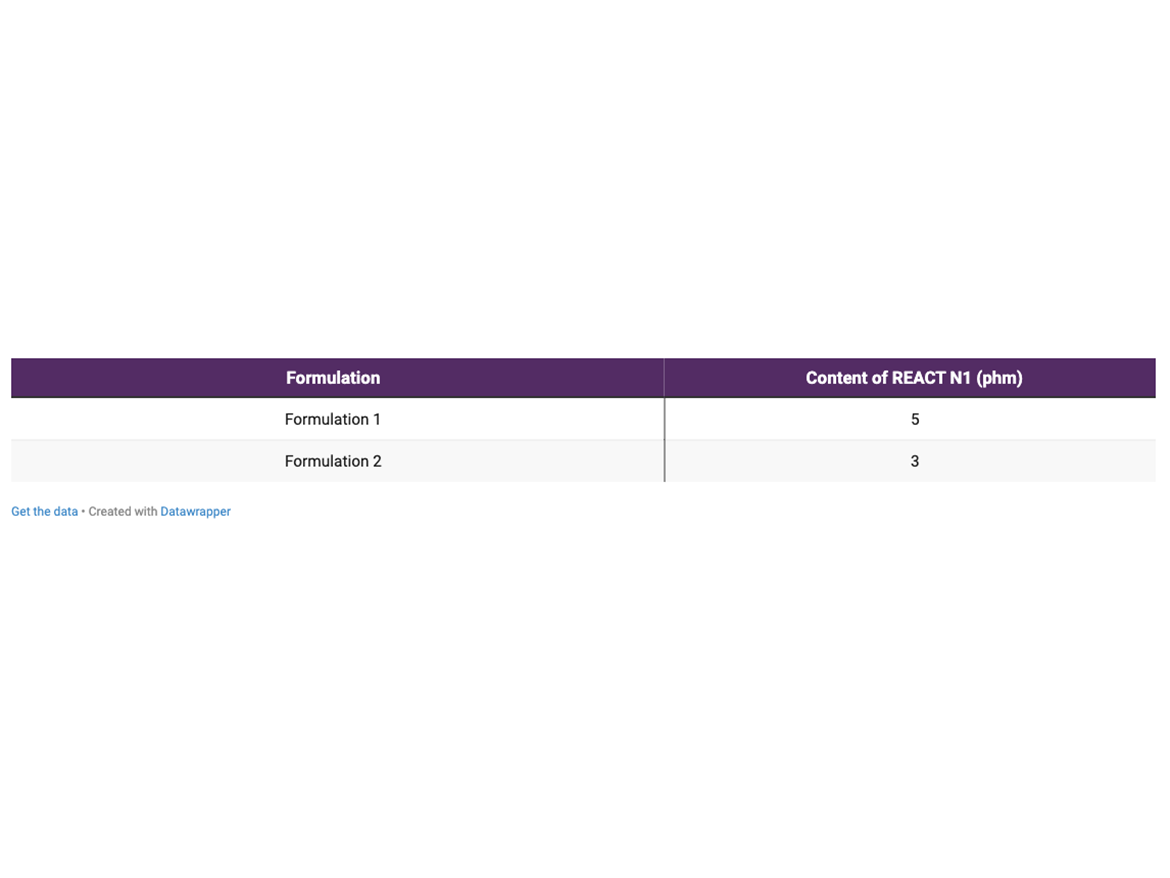
Content of REACT N1 used in Formulations 1 and 2.
TABLE 1 » Content of REACT N1 used in Formulations 1 and 2.

The evolution of solid content, particle size, and particle number of Formulations 1 and 2 are presented in Figures 1, 2, and 3, respectively. Figure 1 shows that both formulations containing REACT N1 presented an evolution of solid content typical of styrene-acrylic latexes, suggesting that REACT N1 performed as well as a conventional non-ionic surfactant and did not hamper the conversion of monomers into polymer.
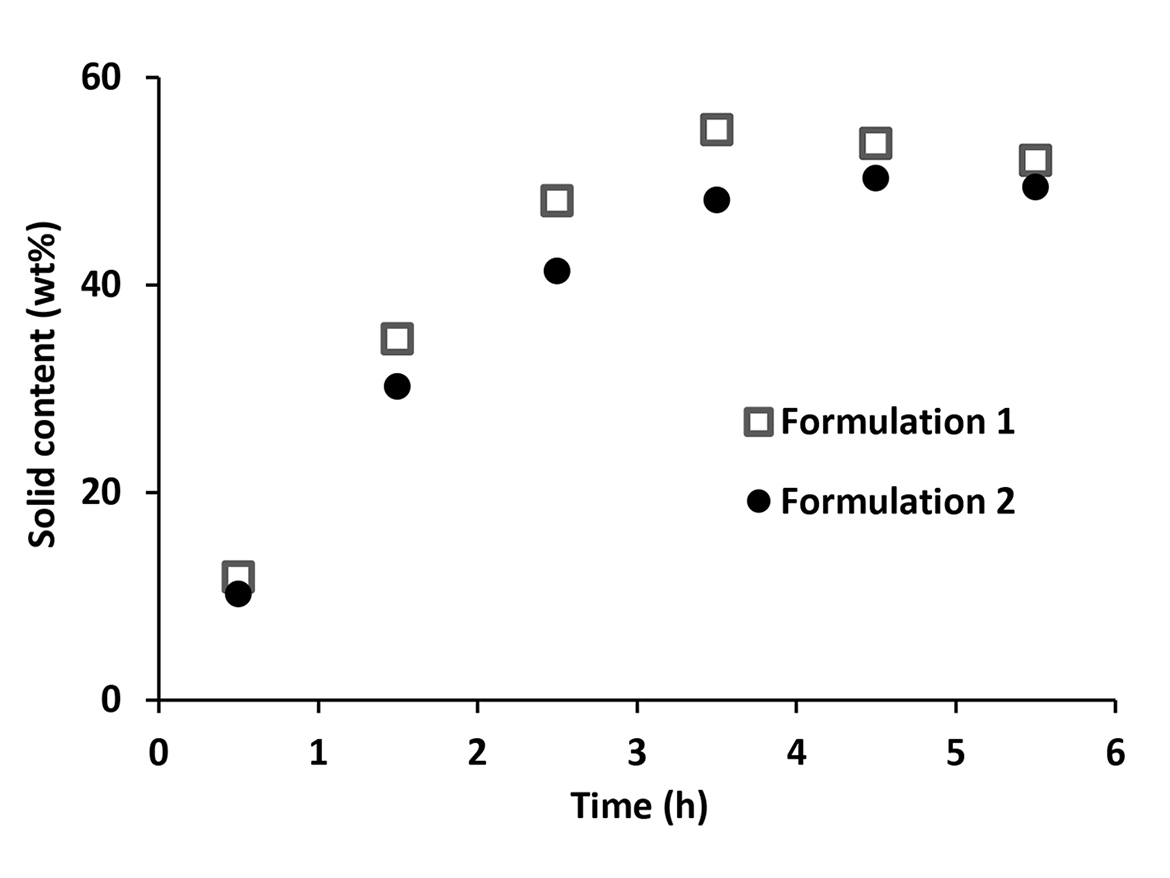
Solid content as a function of time of polymerization.
FIGURE 1 » Solid content as a function of time of polymerization.

Figure 2 shows that both formulations containing REACT N1 presented particle size evolution typical of latexes nucleated through micellar mechanism. Due to this, Formulation 1, which has higher content of surfactant, generated emulsions with particle size smaller than Formulation 2.
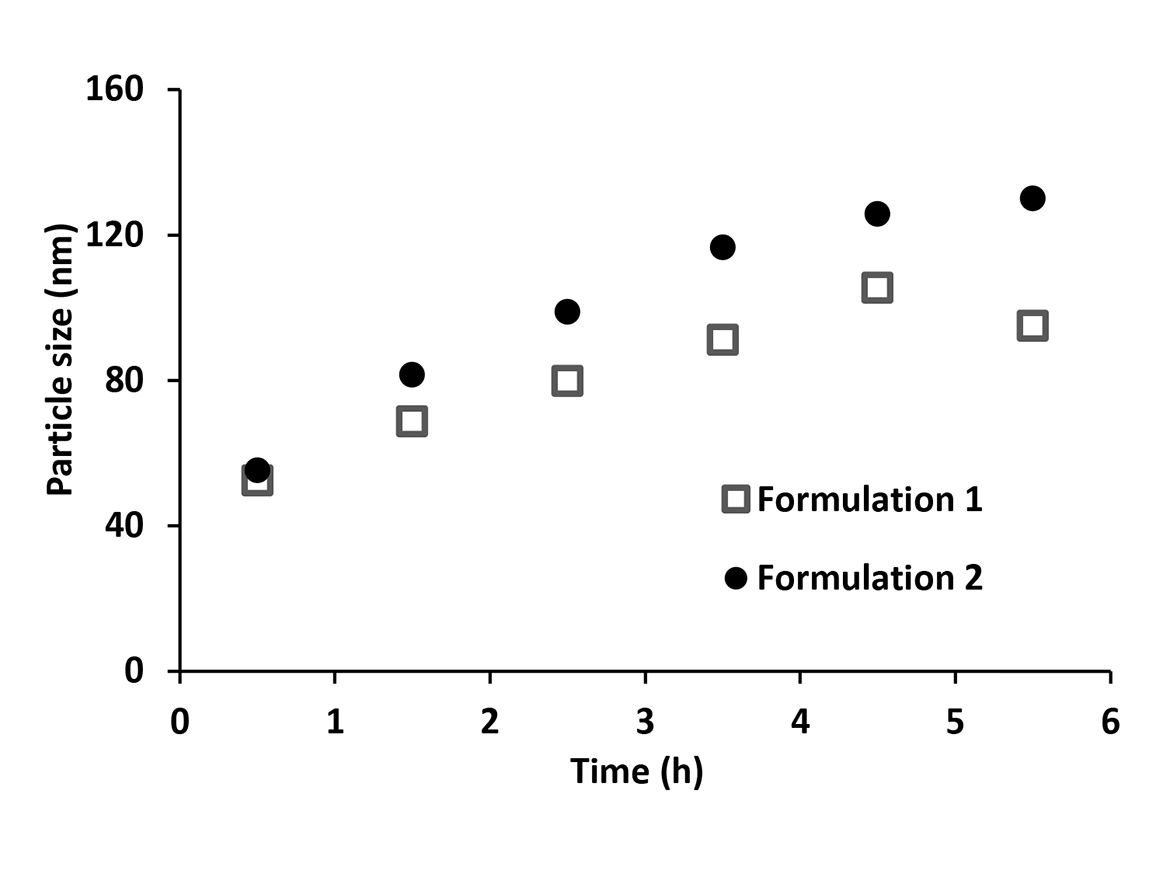
Particle size as a function of time of polymerization.
FIGURE 2 » Particle size as a function of time of polymerization.

As expected, according to Figure 3, Formulation 1 generated more particles than Formulation 2. These results of evolution of particle number suggest that REACT N1 was effective for stabilizing the latex particles along the polymerization.
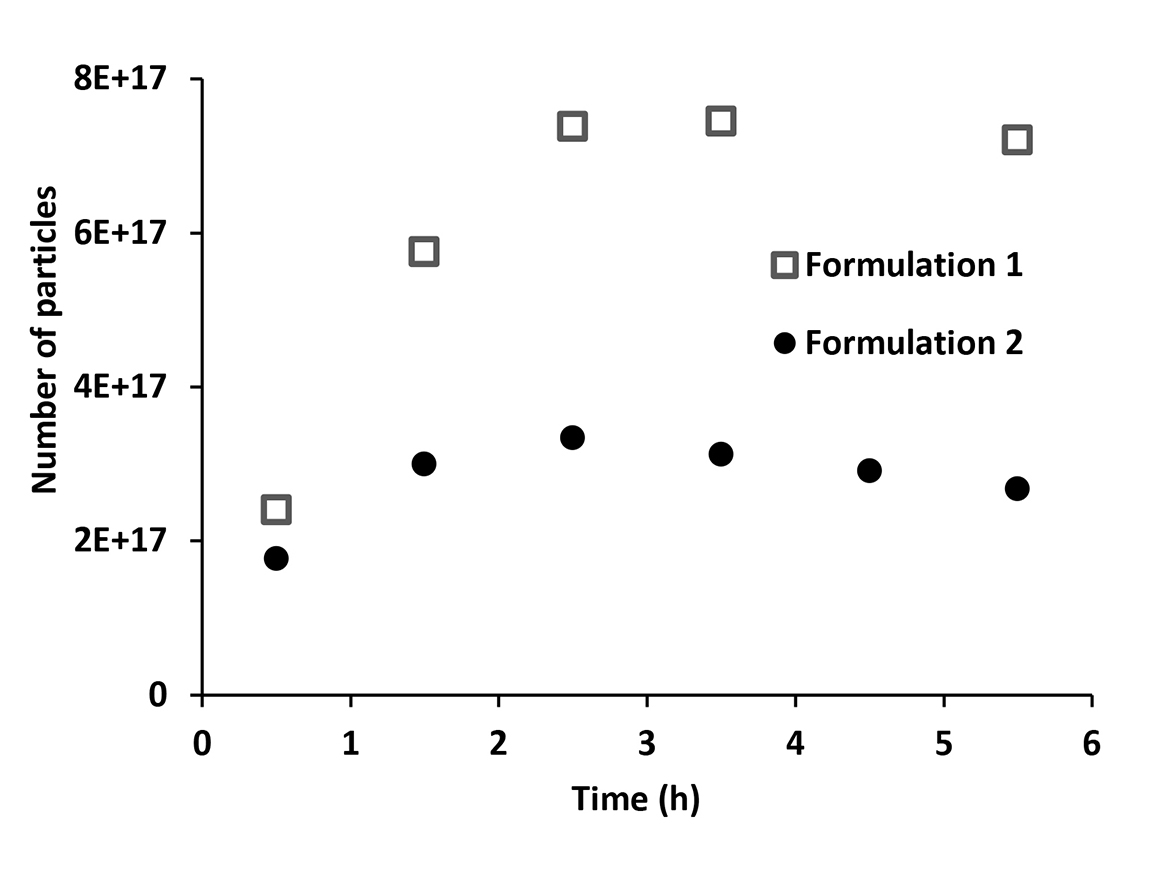
Particle number as a function of time of polymerization.
FIGURE 3 » Particle number as a function of time of polymerization.

The main properties of latexes generated from Formulations 1 and 2 are presented in Table 2. The table shows that the latexes obtained from Formulations 1 and 2 presented similar pH, solid content ranging from 46 to 50 wt%, viscosity lower than 300 cP at 25 °C, and surface tension of about 40 mN/m. As expected, the latexes containing 5 phm of REACT N1 obtained from Formulation 1 had particle size close to 100 nm while the emulsion containing 3 phm of REACT N1 obtained from Formulation 2 had particle size about 130 nm.
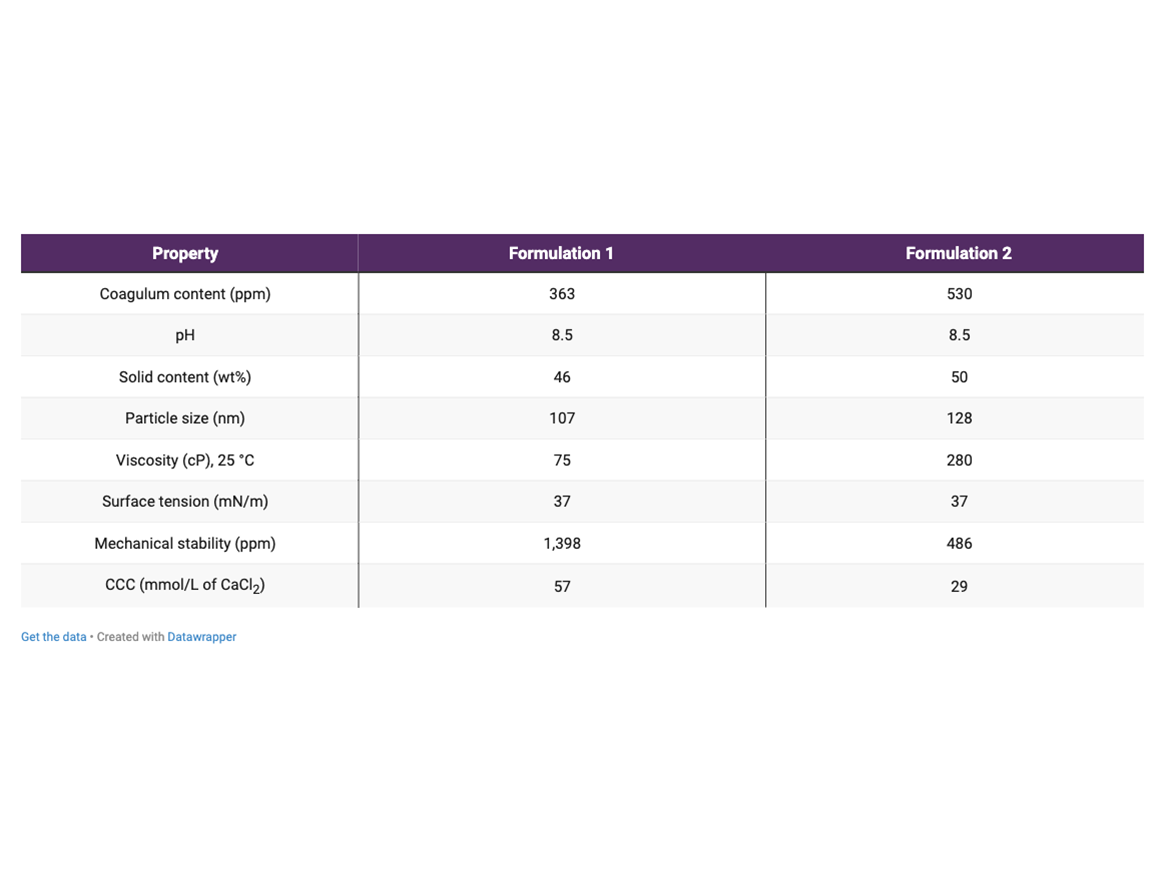
Properties of latexes obtained from Formulation 1 and Formulation 2.
TABLE 2 » Properties of latexes obtained from Formulation 1 and Formulation 2.

The latex with 5 phm of REACT N1 (obtained from Formulation 1), and the latex polymerized with 3 phm of REACT N1 from Formulation 2 formed similar level of coagulum in the reactor during the polymerization. However, the latex from Formulation 1 formed more coagulum in the mechanical stability test than the one polymerized from Formulation 2.

On the other hand, based on CCC data, the latex polymerized with 5 phm of REACT N1 presented higher electrolytic stability than the one polymerized with 3 phm of REACT N1 suggesting that the former latex had higher content of non-ionic surfactant on particle surface than the later latex. Figure 4 shows the content of REACT N1 incorporated into latex particles.
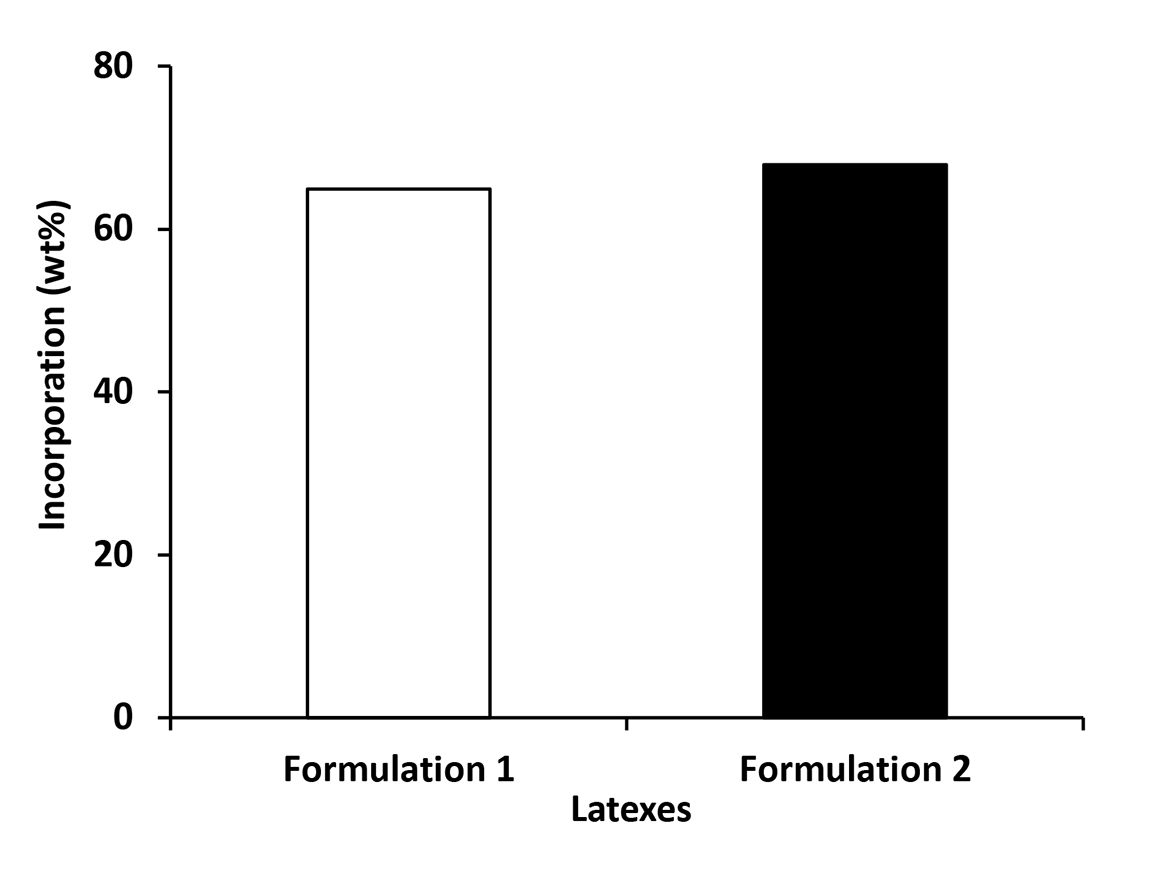
Contents of REACT N1 incorporated into the latexes from Formulation 1 and Formulation 2.
FIGURE 4 » Contents of REACT N1 incorporated into the latexes from Formulation 1 and Formulation 2.

Figure 4 shows that both emulsions of Formulation 1 and Formulation 2 had an incorporation of REACT N1 close to 70 wt%. This level of incorporation is very good and similar to the ones observed for reactive non-ionic surfactants used in combination with conventional anionic surfactants.2 - 4 However, for all types of reactive surfactants, it is known that its incorporation will be lower than 100%. Due to this, REACT N1 was also designed for being more compatible with emulsions used in architectural coatings than the conventional non-ionic surfactants typically used in emulsion polymerization.

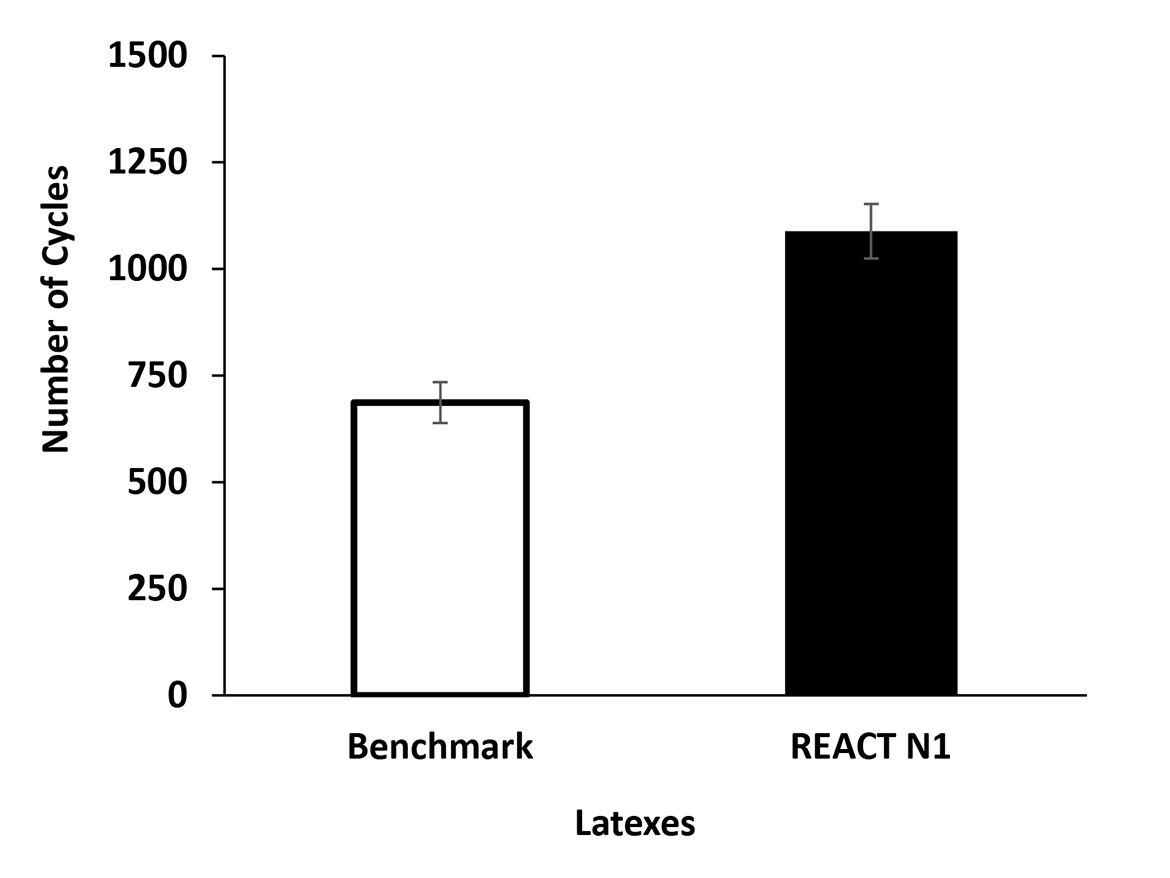
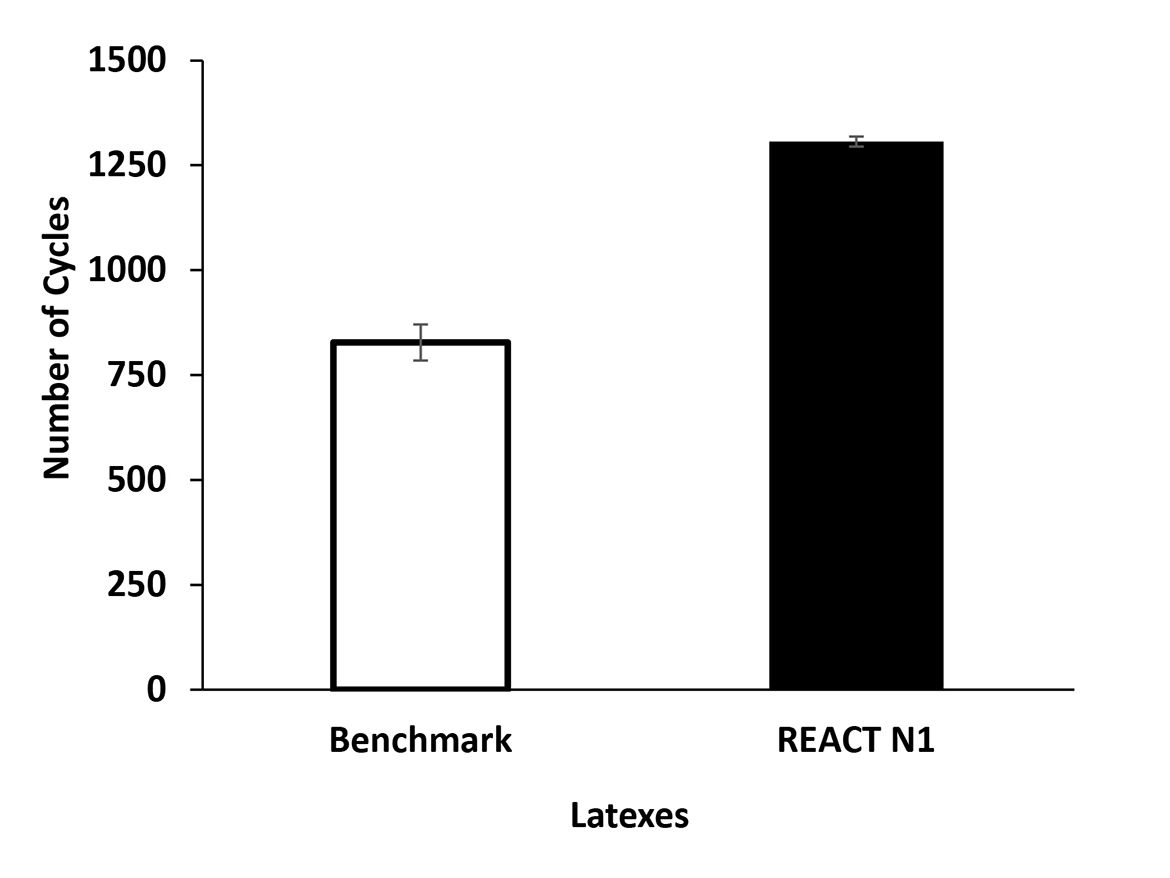
The wet scrub resistance of paints with PVC of 30% formulated with latexes containing 5 phm of REACT N1 (Formulation 1) and 3 phm of REACT N1 (Formulation 2) is presented in Figures 5 and 6, respectively. Paints formulated with latexes from Formulation 1 and Formulation 2 presented wet scrub resistance 60% higher than the styrene-acrylic latex (considered a benchmark in water resistance among styrene-acrylic latexes). These results are interesting because they showed that the wet scrub resistance of those paints was not only up to the content of surfactants used in the emulsion polymerization, but other factors such as quality of film formation, distribution of hydrophilic species such as additives, conventional anionic surfactant, and molecular weight may be affecting the wet scrub resistance.
Wet scrub resistance of paints with PVC 30% formulated with benchmark styrene-acrylic latex and latex from Formulation 1.
FIGURE 5 » Wet scrub resistance of paints with PVC 30% formulated with benchmark styrene-acrylic latex and latex from Formulation 1.
Wet scrub resistance of paints with PVC 30% formulated with benchmark styrene-acrylic latex and latex from Formulation 2.
FIGURE 6 » Wet scrub resistance of paints with PVC 30% formulated with benchmark styrene-acrylic latex and latex from Formulation 2.


References

1 Vanderhoff, J. W.; Bradford, E. B.; Carrington, W. K. The Transport of Water through Latex Films, J. Polym. Sci. 1973, 41, 155 - 174.

2 Aramendia, E.; Mallégol, J.; Jeynes, C.; Barandiaran, M. J.; Keddie, J. L.; Asua, J. M. Distribution of Surfactants near Acrylic Latex Film Surfaces: A Comparison of Conventional and Reactive Surfactants (Surfmers), Langmuir 2003, 19, 3212 - 3221.

3 Aramendia, E.; Barandiaran, M. J.; Grade, J.; Blease, T.; Asua, J. M. Improving Water Sensitivity in Acrylic Films Using Surfmers, Langmuir 2005, 21, 1428 - 1435.

4 Noyes, N. Non-Leaching Reactive Surfactants for Architectural Latex Binder, PCI, 2018, 34, 36 - 41.

5 Fithian, P.; O’Shaughnessy, M.; Lubik, M.; Mark, S. Redox for Main Polymerization of Emulsion Polymers, PCI, August2017.

All information contained herein is provided "as is" without any warranties, express or implied, and under no circumstances shall the author or Indorama be liable for any damages of any nature whatsoever resulting from the use or reliance upon such information. Nothing contained in this publication should be construed as a license under any intellectual property right of any entity, or as a suggestion, recommendation, or authorization to take any action that would infringe any patent. The term "Indorama" is used herein for convenience only, and refers to Indorama Ventures Oxides LLC, its direct and indirect affiliates, and their employees, officers, and directors.


KEYWORDS: Emulsions formulating tips Latex Resins Paint film polymerization reducing agents Surfactants water repellents

Share This Story

Looking for a reprint of this article?
From high-res PDFs to custom plaques, order your copy today!


Mike Praw, Technical Service & Development Manager – Coatings and Performance Products, Indorama Ventures, The Woodlands, TX

Recommended Content

JOIN TODAY
to unlock your recommendations.

Already have an account? Sign In

  • pci1022-Kinaltek-Lead-1170.jpg

    A Novel Pigment Production Technology

    Following an extensive R&D program that demonstrated...
    Paint and Coating Pigments
    By: Jawad Haidar and Nitin Soni
  • pci global top 10

    2025 Global Top 10: Top Paint and Coatings Companies

    The following is PCI’s annual ranking of the top 10...
    Global Top 10 and PCI 25
    By: Courtney Bassett
  • 2025 pci 25

    2025 PCI 25: Top Paint and Coatings Companies

    PCI's annual ranking of the top 25 North American paint...
    Global Top 10 and PCI 25
    By: Courtney Bassett
You must login or register in order to post a comment.

Report Abusive Comment

Manage My Account
  • eMagazine
  • Newsletters
  • Online Registration
  • Subscription Customer Service

More Videos

Sponsored Content

Sponsored Content is a special paid section where industry companies provide high quality, objective, non-commercial content around topics of interest to the PCI audience. All Sponsored Content is supplied by the advertising company and any opinions expressed in this article are those of the author and not necessarily reflect the views of PCI or its parent company, BNP Media. Interested in participating in our Sponsored Content section? Contact your local rep!

close
  • colorful building exterior
    Sponsored byDow

    Insights into Exterior Architectural Coating Degradation: Bridging Accelerated and Natural Weathering

  • digital pigments
    Sponsored bySiltech

    The Fourth Dimension of Silicon: Siltech Q Resins

Popular Stories

Company News

What the AkzoNobel–Axalta Merger Means for the Future of Coatings

AkzoNobel and Axalta Headquarters

AkzoNobel and Axalta Announce $25 Billion Merger

Wacker logo

WACKER Plans More Than 1,500 Job Cuts


PCI Buyers Guide

Submit a Request for Proposal (RFP) to suppliers of your choice with details on what you need with a click of a button

Start your RFP

Browse our Buyers Guide for manufacturers and distributors of all types of coatings products and much more!

Find Suppliers

Events

September 4, 2025

N-Butylpyrrolidone (NBP) as a Green Solvent to Replace N-Methylpyrrolidone (NMP) in Industrial Coating Applications

ON DEMAND: EPA published a regulation proposal around N-methylpyrrolidone (NMP) in June 2024 to ban or limit NMP in many applications, such as paints and coatings and their removers. N-butylpyrrolidone (NBP) is a powerful and versatile solvent for a variety of industries looking for alternatives to substance of very high concern (SVHC)-listed solvents.

March 24, 2026

The Manufacturing & Automation eXchange (MAX)

MAX presents a rare opportunity to observe the full scope of manufacturing in one environment. From systems integration and materials handling to automation, quality, safety, and packaging, each discipline is represented through live, operational displays. By experiencing these technologies side by side, as they are on actual production floors, attendees gain a grounded understanding of how manufacturing functions align, overlap, and evolve in practice.

View All Submit An Event

Poll

Longest-running laboratory experiment

What is the longest-running laboratory experiment?
View Results Poll Archive

Products

Automotive Paints and Coatings, 2nd Edition

Automotive Paints and Coatings, 2nd Edition

Now in its second edition and still the only book of its kind, this is an authoritative treatment of all stages of the coating process.

See More Products
pci voices from the top ebook

PCI webinar

Related Articles

  • pci0423-Formulating-874157664-1170.jpg

    Improving Water Resistance of Water-Based Coatings Using Reactive Surfactants, Part 4

    See More
  • pci0423-Formulating-874157664-1170.jpg

    Improving Water Resistance of Water-Based Coatings Using Reactive Surfactants, Part 5

    See More
  • pci0423-Formulating-874157664-1170.jpg

    Improving Water Resistance of Water-Based Coatings Using Reactive Surfactants, Part 2

    See More

Related Products

See More Products
  • Surfactants and Rheology: Chemistry, Theory, Mechanism and Application (Zoom course 3/26/26)

  • biopolymer.jpg

    Biopolymer-Based Films and Coatings Trends and Challenges

See More Products
×

Keep the info flowing with our eNewsletters!

Get the latest industry updates tailored your way.

JOIN TODAY!
  • RESOURCES
    • Advertise
    • Contact Us
    • Directories
    • Store
    • Want More
    • Manufacturing Division
  • SIGN UP TODAY
    • Create Account
    • eMagazine
    • Newsletters
    • Customer Service
    • Manage Preferences
  • SERVICES
    • Marketing Services
    • Reprints
    • Market Research
    • List Rental
    • Survey & Sample
  • STAY CONNECTED
    • LinkedIn
    • Facebook
    • Youtube
    • X (Twitter)
  • PRIVACY
    • PRIVACY POLICY
    • TERMS & CONDITIONS
    • DO NOT SELL MY PERSONAL INFORMATION
    • PRIVACY REQUEST
    • ACCESSIBILITY

Copyright ©2025. All Rights Reserved BNP Media.

Design, CMS, Hosting & Web Development :: ePublishing