Painting & Coating Industry (PCI) logo Powder coating summit logo
search
cart
facebook twitter linkedin youtube
  • Sign In
  • Create Account
  • Sign Out
  • My Account
Painting & Coating Industry (PCI) logo Powder coating summit logo
  • NEWS
    • Latest News
    • Market Trends & Reports
    • Finishing News
    • Price Alerts
    • Subscribe to Newsletters
    • Global Top 10/ PCI 25
    • Weekly Featured Article
    • COATLE Word Game
  • PRODUCTS
    • Product News
    • Must See Products and Services
  • MATERIALS
    • Additives
    • Resins/Polymers
    • Pigments
    • Equipment
    • Distributors
  • TECHNOLOGIES
    • Adhesives
    • Architectural Coatings
    • Finishing Articles
    • Finishing Technologies
    • Finishing Equipment
    • Industrial Coatings
    • Nanotechnology
    • Powder Coatings
    • Solventborne
    • Special Purpose Coatings
    • Sustainability
    • UV Coatings
    • Waterborne
  • RESOURCES
    • Columns
      • Did you know?
      • Distribution Dive
      • Formulating With Mike
      • Innovation Insights
      • Powder Coating Perspectives
      • TiO2 Insider
    • Blogs
      • Editor's Viewpoint
      • Industry Insights
    • Coatings Supplier Handbook
    • Podcasts and Videos
      • COAT-IT! Podcast
      • Videos/PCI TV
    • PCI Store
    • Classifieds
    • eBooks
    • Sponsor Insights
    • White Papers
    • COATLE Word Game
  • EVENTS
    • Coatings Trends & Technologies Summit
    • Paint and Coatings Academy
    • Webinars
    • Calendar of Events
    • Lifetime Achievement Award
  • DIRECTORIES
    • Buyer's Guide
    • Equipment Directory
    • Materials Directory
  • EMAGAZINE
    • Current Issue
    • eMagazine Archive
    • China Issue Archive
    • Editorial Advisory Board
  • CONTACT
    • Contact Us
    • Advertise
    • Subscribe to eMagazine
    • Subscribe to Newsletters
  • SIGN UP!
Did You Know?

Redox Chemistries for Use in Aqueous-Based Polymer Dispersions, Part 3

By Emulsion Polymers Consulting and Education (EPCEd)
PCI0224DidYouKnow_Video.png

Volodymyr Konko, Creatas Video+ / Getty Images Plus, via Getty Images

August 1, 2024

Did you know there is valuable information available about the use of redox sy­­stems for effective reduction of residual monomers/VOCs after the main emulsion polymerization? EPCEd is partnering with Brüggemann for this third in a series of Did You Know columns to highlight best practices for redox application in emulsion polymers, including reaction kinetic data and guidelines for best practices. This issue focuses on preferred redox methods and optimization.

Previous articles in this series highlighted the fundamentals of redox systems typically used for the emulsion polymer chase, discussing dosage, rate of addition, rate of reduction of residual monomers, and initial screening tests for selection of the best reducing agent/oxidizer for the polymer recipe. Now that we have selected which redox pair to use, let’s optimize it to minimize residual monomers, dosage, and cycle time for the chase.

Theoretically, every radical generated by a reducing agent/oxidizer combination is capable of reacting with C=C bonds in residual monomers, converting them to dimers, oligomers, or short polymer chains. This eliminates VOCs and odor. However, the radical must find a C=C bond before it finds another radical, or other species to react with such as transition metals. Getting radicals to the C=C bonds to convert monomers instead of recombination with other radicals/termination is the challenge.

We know that continuous simultaneous dosing of the redox pair over time is more effective than feeding all of the components at once (“dumping”). Dumping creates a high radical flux in a small space, increasing the potential for recombination or termination rather than reaction with residual monomer. Below is an example showing residual monomer level (via GC) decline over time during a redox chase with continuous feed vs. a one-shot process. Redox dosages are weight percentages of each component on a solids basis vs. total latex weight.
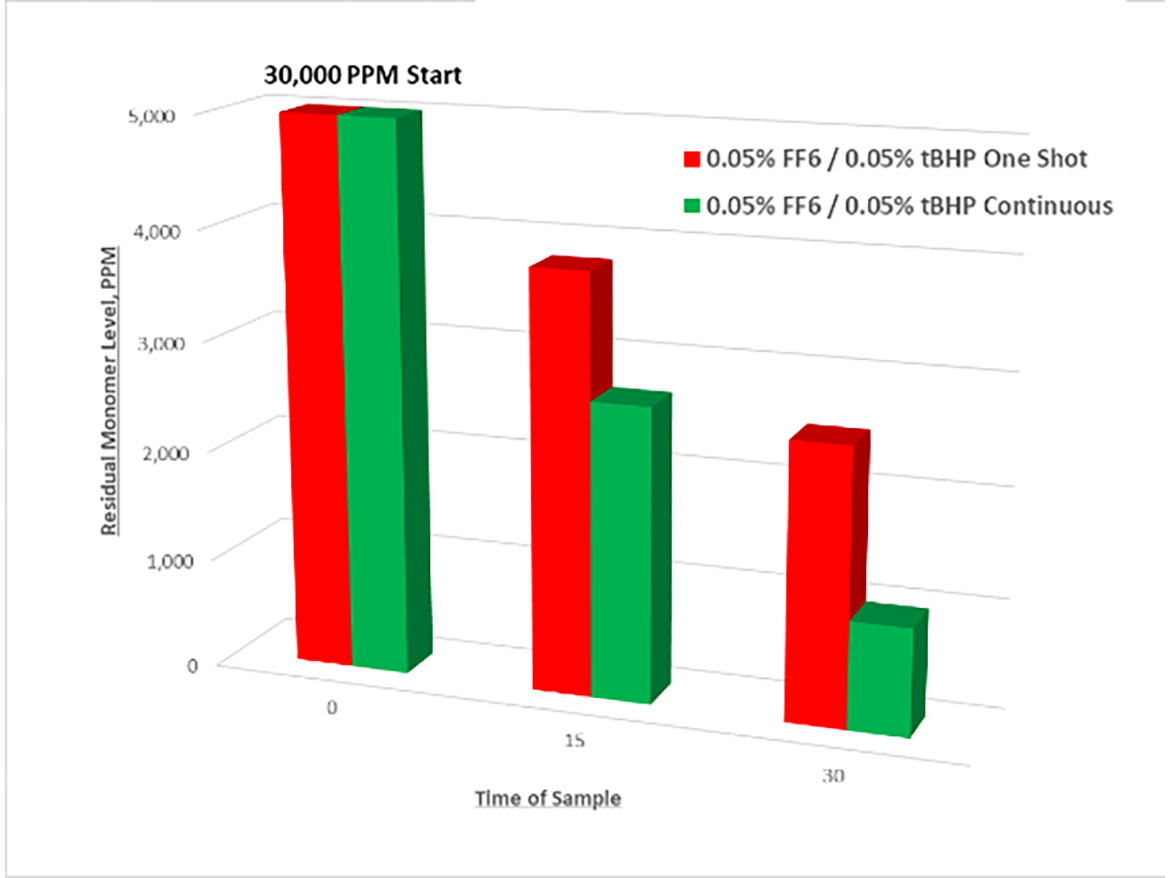
0.05% FF6/tBHP one shot vs. 30-minute feed.
FIGURE 1 » 0.05% FF6/tBHP one shot vs. 30-minute feed.

From a previous study, we learned that rate of redox addition is related to the propensity of radicals to find residual monomers before they find another radical.
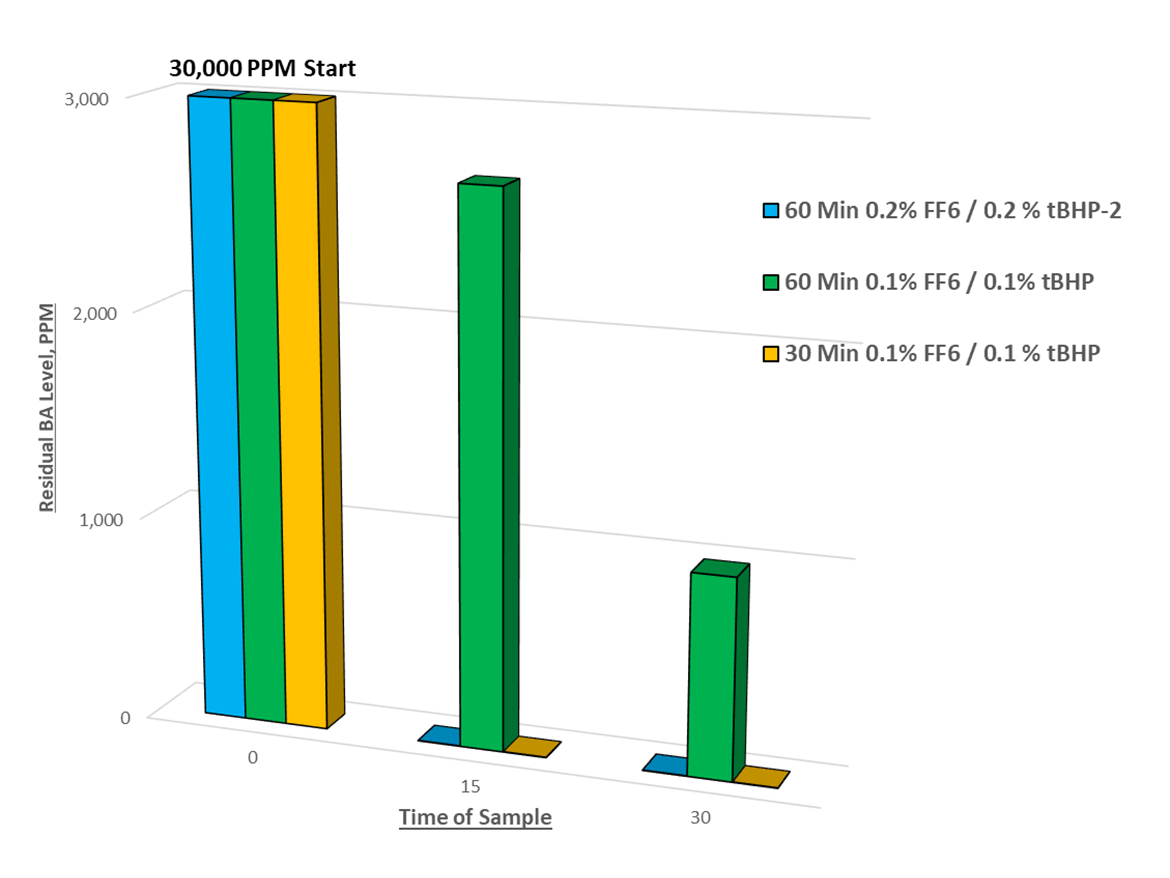
60-minute vs. 30-minute post-polymerization results after 30 minutes.
FIGURE 2 » 60-minute vs. 30-minute post-polymerization results after 30 minutes.

In the above example, we see three kinetic data sets of residual BA monomer levels during the chase:

  1. Blue: 0.2% FF6/tBHP total dosage added over 60 minutes.
  2. Green: 0.1% FF6/tBHP total dosage added over 60 minutes.
  3. Yellow: 0.1% FF6/tBHP total dosage added over 30 minutes.

Note the blue and yellow columns show undetectable BA levels after 15 minutes, which are expected since it is the same rate of redox dosage: 0.2% added over 60 minutes = 0.1% added over 30 minutes = 0.05% added over 15 minutes. This example could be further optimized to find the minimum total redox dosage and time period of addition to obtain target residual BA level.

With further optimization, we might find that BA levels could be reduced to <500 ppm in 10 minutes with 0.05% or lower total redox dosage. Adding 0.1% over 60 minutes wasted time and redox ingredients with substantially worse results; over 1,000 ppm of free monomer after the chase.

Some key takeaways for optimizing redox in an emulsion polymer chase:

  • Run simple screening tests to find the best combination of reducing agent and oxidizer compounds.
  • Use continuous, simultaneous dilute feed streams of reducing agent and oxidizer.
  • Faster rate of redox addition will minimize redox dosage and time to reach the residual monomer target.
  • One-shot “dumping” of redox ingredients all at once increases potential for radical recombination vs. reacting with C=C bonds.

As always, we invite your questions and comments by going to info@epced.com. Additionally, we invite you to go to Brüggemann’s Institute of Redox Chemistry – a collection of tutorials on redox chemistry for emulsion polymerization, providing greater detail of redox combinations and process optimization techniques. For more information, contact Brüggemann, BCUS_Sales@brueggemann.com.

The “Did You Know….?” series is a bi-monthly note from Emulsion Polymers Consulting and Education (EPCEd) that is intended to present simple questions about topics that are important to those working in the emulsion polymers area. Short and concise answers to those questions are presented to educate readers and to elicit comments and further discussion. Some readers will already know the answers and be familiar with the topic, while others, especially those newer to the field, will benefit from the answers and discussion. Experienced practitioners may also find new insights in the discussion. Paint & Coatings Industry magazine has partnered with EPCEd to share the “Did You Know” notes with our readers throughout the year.

KEYWORDS: formulating tips Low-VOC Paint and Coatings polymer dispersions reducing agents water-based coatings

Share This Story

Looking for a reprint of this article?
From high-res PDFs to custom plaques, order your copy today!


By Emulsion Polymers Consulting and Education (EPCEd)

Recommended Content

JOIN TODAY
to unlock your recommendations.

Already have an account? Sign In

  • pci1022-Kinaltek-Lead-1170.jpg

    A Novel Pigment Production Technology

    Following an extensive R&D program that demonstrated...
    Paint and Coating Pigments
    By: Jawad Haidar and Nitin Soni
  • pci global top 10

    2025 Global Top 10: Top Paint and Coatings Companies

    The following is PCI’s annual ranking of the top 10...
    Global Top 10 and PCI 25
    By: Courtney Bassett
  • 2025 pci 25

    2025 PCI 25: Top Paint and Coatings Companies

    PCI's annual ranking of the top 25 North American paint...
    Paint and Coating Market Reports
    By: Courtney Bassett
You must login or register in order to post a comment.

Report Abusive Comment

Manage My Account
  • eMagazine
  • Newsletters
  • Online Registration
  • Subscription Customer Service

More Videos

Sponsored Content

Sponsored Content is a special paid section where industry companies provide high quality, objective, non-commercial content around topics of interest to the PCI audience. All Sponsored Content is supplied by the advertising company and any opinions expressed in this article are those of the author and not necessarily reflect the views of PCI or its parent company, BNP Media. Interested in participating in our Sponsored Content section? Contact your local rep!

close
  • colorful building exterior
    Sponsored byDow

    Insights into Exterior Architectural Coating Degradation: Bridging Accelerated and Natural Weathering

  • digital pigments
    Sponsored bySiltech

    The Fourth Dimension of Silicon: Siltech Q Resins

Popular Stories

Company News

What the AkzoNobel–Axalta Merger Means for the Future of Coatings

AkzoNobel and Axalta Headquarters

AkzoNobel and Axalta Announce $25 Billion Merger

Wacker logo

WACKER Plans More Than 1,500 Job Cuts


PCI Buyers Guide

Submit a Request for Proposal (RFP) to suppliers of your choice with details on what you need with a click of a button

Start your RFP

Browse our Buyers Guide for manufacturers and distributors of all types of coatings products and much more!

Find Suppliers

Events

September 4, 2025

N-Butylpyrrolidone (NBP) as a Green Solvent to Replace N-Methylpyrrolidone (NMP) in Industrial Coating Applications

ON DEMAND: EPA published a regulation proposal around N-methylpyrrolidone (NMP) in June 2024 to ban or limit NMP in many applications, such as paints and coatings and their removers. N-butylpyrrolidone (NBP) is a powerful and versatile solvent for a variety of industries looking for alternatives to substance of very high concern (SVHC)-listed solvents.

March 24, 2026

The Manufacturing & Automation eXchange (MAX)

MAX presents a rare opportunity to observe the full scope of manufacturing in one environment. From systems integration and materials handling to automation, quality, safety, and packaging, each discipline is represented through live, operational displays. By experiencing these technologies side by side, as they are on actual production floors, attendees gain a grounded understanding of how manufacturing functions align, overlap, and evolve in practice.

View All Submit An Event

Poll

Longest-running laboratory experiment

What is the longest-running laboratory experiment?
View Results Poll Archive

Products

Automotive Paints and Coatings, 2nd Edition

Automotive Paints and Coatings, 2nd Edition

Now in its second edition and still the only book of its kind, this is an authoritative treatment of all stages of the coating process.

See More Products
pci voices from the top ebook

PCI webinar

Related Articles

  • PCI0224DidYouKnow_Video.png

    Redox Chemistries for Use in Aqueous-Based Polymer Dispersions, Part II

    See More
  • PCI0224DidYouKnow_Video.png

    Redox Chemistries for Use in Aqueous-Based Polymer Dispersions, Part IV

    See More
  • PCI0224DidYouKnow_Video.png

    Redox Chemistries for Use in Aqueous-Based Polymer Dispersions

    See More

Related Products

See More Products
  • polymer.jpg

    Polymer Nanocomposite Coatings

  • polymer coatings.jpg

    Polymer Coatings: Technologies and Applications

See More Products
×

Keep the info flowing with our eNewsletters!

Get the latest industry updates tailored your way.

JOIN TODAY!
  • RESOURCES
    • Advertise
    • Contact Us
    • Directories
    • Store
    • Want More
  • SIGN UP TODAY
    • Create Account
    • eMagazine
    • Newsletters
    • Customer Service
    • Manage Preferences
  • SERVICES
    • Marketing Services
    • Reprints
    • Market Research
    • List Rental
    • Survey & Sample
  • STAY CONNECTED
    • LinkedIn
    • Facebook
    • Youtube
    • X (Twitter)
  • PRIVACY
    • PRIVACY POLICY
    • TERMS & CONDITIONS
    • DO NOT SELL MY PERSONAL INFORMATION
    • PRIVACY REQUEST
    • ACCESSIBILITY

Copyright ©2025. All Rights Reserved BNP Media.

Design, CMS, Hosting & Web Development :: ePublishing