
Water-Based Polyester Polyol Dispersion for VOC-Compliant, Ambient-Cure Polyurethane Floor Coatings

Credit: baona / iStock via Getty Images Plus
The coatings industry continues to adapt to stricter VOC regulations, particularly in the architectural and industrial maintenance (AIM) sector. HYDROEXTER® I64-145, a water-based polyester polyol dispersion, has been developed to meet these challenges for VOC-compliant, ambient-cure, 2K polyurethane (PU) coatings. The primary goal of this study was to investigate the performance and applicability of the dispersion for thin coatings, with a focus on floor applications. This paper discusses the performance characteristics of formulations for pigmented basecoats and clear topcoats, tested under real-world conditions. The results demonstrate excellent film properties, chemical resistance, abrasion resistance and a fast return-to-service time.
With increasing environmental regulations, especially in regions like California's South Coast Air Quality Management District (SCAQMD), the need for ultralow-VOC coatings has intensified. Conventional high-solvent coatings are no longer viable for markets requiring high performance and low environmental impact. COIM-USA has developed HYDROEXTER I64-145, a high-solids resin specifically designed for ambient-cure waterborne 2K polyurethane systems.
The polyol dispersion boasts several key features that make it an ideal choice for waterborne 2K polyurethane coatings and adhesives. With a pourable viscosity at a high solids content of 64% in water, it eliminates the need for cosolvents, including exempt solvents, while also being surfactant-free and HAPs-free, and thus, low odor. It is neutralized with reactive amines to maintain a stable pH of ~7.3. Its specialized polyester backbone, combined with its compatibility with hydrophobic HDI-trimer, plus high functionality for increased crosslink density, results in a level of cost effectiveness, adhesion, toughness and durability that we believe to be on par with solvent-based polyurethane-polyester coatings. We are planning future lab work in the near term that will showcase this comparison.
The waterborne resins offers significant ease of use, with a long working time of over 1 hour and a fast dry time of less than 6 hours, which can be further accelerated with the use of catalysts. It allows for recoating in less than 12 hours, providing flexibility for multilayer applications. Its wide ratio latitude enables formulators to adjust hardness and performance as needed. Additionally, this dispersion can compatibilize low levels of modifying resin, such as acrylic emulsions and aspartic amines, with water, allowing for the creation of hybrid systems tailored to specific performance requirements.
We chose to test the pigmented basecoat with a clear topcoat system on a real-world garage floor to demonstrate the practicality and performance of the resin in a common application scenario. Garage floors are subjected to various stresses, including vehicular traffic, chemical spills and abrasion, making them ideal for assessing the durability, chemical resistance and overall effectiveness of the coating system. By applying the coatings in a DIY setting, we also aimed to evaluate the ease of use, drying times and low-odor properties under real-world conditions, providing a robust validation of the product’s suitability for both professional and consumer markets.
Experimental
Raw Materials and Coating Formulations
Coating formulations for the pigmented basecoat are shown in Tables 1 and 2. The formulations for the clearcoat are shown in Tables 3 and 4. Both waterborne coating systems were prepared using a high-speed mixer at a mixing speed of 500-1,200 RPM. The order of addition and mixing time are given in Tables 1 and 3.
The pigmented basecoat was formulated to achieve full hiding with TiO₂, which we were able to grind easily in the HYDROEXTER resin without dispersant. The pigment-to-binder ratio was 1.05. Two defoamers were included to help minimize microfoam generated during high-speed dispersing.
TABLE 1 ǀ Waterborne 2K PU-HYDROEXTER white basecoat Part A.
Credit: Data courtesy of COIM USA.
For both the basecoat and clearcoat, the crosslinker used was a standard hydrophobic aliphatic isocyanate based on HDI trimer. The pigmented system used a 3:1 ratio by weight of Part A to Part B (formulated polyol-to-isocyanate ratio). At that ratio, the NCO-to-OH ratio was 2.3:1.0. For better leveling and air release, the system was further reduced after the initial A/B mixing with 20 pbw water. Despite the additional water reduction, the formula remained high solids with an ultralow VOC of just 6 g/L.
TABLE 2 ǀ White Part A + Part B mixed — NCO:OH 2.3:1.0.
Credit: Data courtesy of COIM USA.
The clear topcoat was formulated for durability and chemical resistance. AMP-95 was added for pH control, as higher pH promotes phase stability. A catalyst, K-Kat XK-614, was used to ensure fast drying and return-to-service times while maintaining a pot life of at least 1 hour. Tinuvin 1130 was included in the formulation to promote UV light stability.
TABLE 3 ǀ Waterborne 2K PU-HYDROEXTER clear topcoat Part A.
Credit: Data courtesy of COIM USA.
The clear topcoat system used a 1:1 ratio by weight of Part A to Part B. At that ratio, the NCO-to-OH ratio was 3.0:1.0. At this higher index, the extra isocyanate moisture-cures, increasing hardness and chemical resistance. Additionally, despite a high hydrophobic isocyanate dosage, the HYDROEXTER resin still compatibilizes the HDI trimer, maintaining high gloss. To control viscosity, the system was further reduced after the initial A/B mixing with 10 pbw water. Despite the additional water reduction, the formula remained high solids with an ultralow VOC of just 11 g/L.
TABLE 4 ǀ Clear Part A + Part B mixed — NCO:OH 3.0:1.0.
Credit: Data courtesy of COIM USA.
Performance Testing Methods
Viscosities were measured on a Brookfield RVDV-II+ Pro viscometer. The full formulation Part A + B viscosities were measured immediately after mixing. Coating drawdowns were made on Leneta charts (Byko-charts penopac charts with coated black and white surfaces and uncoated white surfaces), as well as rectangular 6 x 12-inch and 4 x 18-inch steel Q-panels, using a 6-mil drawdown bird bar and on Taber S-16 square steel panels using a 6-mil wire-wound rod applicator. The theoretical dry film thickness was 4 mil.
The coating drawdowns for both formulations dried within 5 hours under ambient conditions but were tested only after 7 days to ensure full curing. Gloss was measured at 20°, 60° and 85° using a micro-TRI-glossmeter on Leneta charts. Coating hardness was measured using a Wolff-Wilborn pencil hardness tester (ASTM D3363-22) and a Byko-swing pendulum hardness tester (ASTM 4366-16). Pencil hardness was measured on the drawdowns made on steel Q-panels. Pendulum hardness was measured on the steel panels in 4° Persoz mode. Both the number of swings and the time were recorded.
Chemical resistance was measured using the MEK double rub test to 100 2x-rubs (ASTM D4752-20) and chemical spot testing (ASTM D1308-20) on coated steel Q-panels. The spot tests were done with Skydrol LD-10, 95% ethanol, motor oil, antifreeze and vehicle window washer fluid, with 24 hours of chemical contact to the coating. Crosshatch adhesion was measured using a crosscut adhesion tester, 2 mm, on steel panels (ASTM D3359-22). Impact resistance was measured using a heavy-duty impact tester at 4 lb drop weight. Impact resistance was measured on coated steel Q-panels, both direct and reverse. Taber abrasion was measured using a rotary abrader model 1700. The abrading wheel used was a CS-17 resilient wheel, and the weight used was 1,000 grams. Weight loss was reported in mg for 1,000 cycles.
Garage Floor Coating Restoration Demonstration
The procedure followed during preparation and application was as follows:
- Prep the floor (i.e., clean and mask baseboards)
- Gray HYDROEXTER-based basecoat
- Flake broadcast
- First HYDROXTER clear topcoat (for sealing)
- Second HYDROEXTER clear topcoat (for durability)
The paint mixing procedure was as follows:
- Lightly mix Part A (pigmented only; not necessary for clear)
- Pour Part B (100% solids hydrophobic HDI trimer) into the Part A can
- Drill mix for about 1 minute
- Pour some of the mix back into the Part B can, swirl around and pour it back into the Part A can
- Drill mix for about 1 minute
- Reduce by adding tap water — 0 to 20% (i.e., 0 to 20 oz of H₂O). Reduce less for vertical surfaces, pigmented coatings, high ambient humidity and porous substrates. Reduce more for horizontal surfaces, clearcoats, low ambient humidity and smooth substrates
- Drill mix carefully for about 1 minute (paint may splash due to viscosity reduction)
- Continue to occasionally mix A+B lightly during the first 30 minutes of application (pigmented only; not necessary for clear)
- Apply the entire mix as quickly as possible but within 1 hour
- Unused mix will cure into a foam that can be discarded in the trash (do NOT use only part of the kit and try to save for later use)
If A+B kits are combined to increase the size of the mix, there can be a significant reduction in working time due to the mass effect on the reaction exotherm. Larger mixes would require a different Part A formulation (e.g., with a lower catalyst level) to achieve equal working time. The coating mix can be pressure sprayed, but the pot life will be shorter.
The application schedule was as follows:
Prework:
- Washed and swept the floor (did not sand)
- Masked baseboards
Day 1:
- Re-swept the floor (morning)
- Applied gray basecoat (afternoon)
- Immediate flake croadcast while the gray paint was still wet
Day 2:
- Swept the floor of debris and loose flakes (morning)
- Applied the first clearcoat (~12 hours after the basecoat was applied)
- Applied the second clearcoat (~8 hours after the first clearcoat was applied
Day 3:
- Fully dry and tack-free
Day 4:
- Fully cured and could be parked on
It was not determined whether a vehicle could be parked on the newly coated garage floor on Day 3. It is possible this could have been feasible.
Results and Discussion
The pigmented basecoat’s film properties are shown in Table 5 at two different film thicknesses.
TABLE 5 ǀ Waterborne 2K PU-HYDROEXTER white basecoat.
Credit: Data courtesy of COIM USA.
The pigmented basecoat’s chemical resistance performance is shared in Table 6 at two different film thicknesses.
TABLE 6 ǀ Waterborne 2K PU-HYDROEXTER white basecoat.
Credit: Data courtesy of COIM USA.
The pigmented basecoat showed excellent performance and hiding. It achieved high gloss, along with outstanding flexibility, adhesion and abrasion resistance. The chemical resistance tests showed no effects after exposure to MEK, Skydrol, ethanol, motor oil, antifreeze or washer fluid. The calculated VOC of the formulation was 6.1 g/L, well below the most stringent regulatory limits.
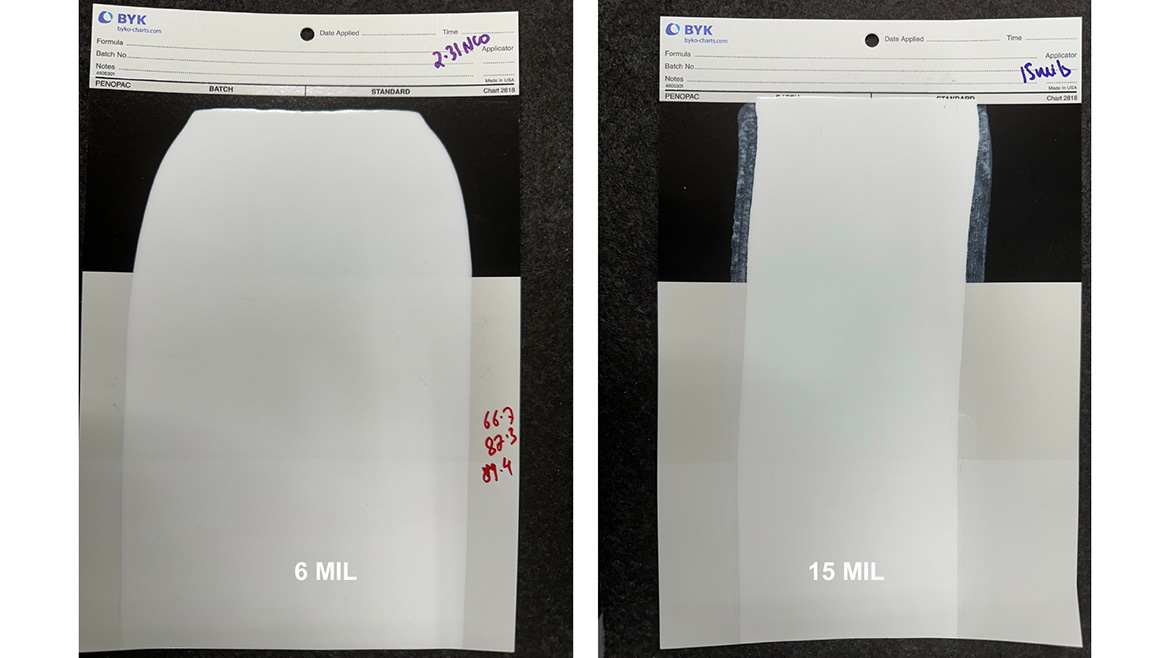
The clear topcoat’s film properties are shared in Table 7 at 4 mil DFT.
TABLE 7 ǀ Waterborne 2K PU-HYDROEXTER clear topcoat.
Credit: Data courtesy of COIM USA.
The clear topcoat’s chemical resistance performance is shared in Table 8 at 4 mil DFT.
The clear topcoat, when applied at 6 mil WFT, exhibited high gloss, clarity and durability. It demonstrated excellent chemical resistance and abrasion resistance, along with outstanding adhesion and flexibility despite its high hardness. These results suggest that a multilayer coating system for floors, consisting of a waterborne resin-based pigmented basecoat applied at 3 to 8 mil DFT and top coated with one or two layers of HYDROEXTER-based clearcoat, would be effective. This combination was successfully used for the real-world garage floor demonstration. Based on that demonstration, we recommend applying two clear topcoats, each at 1 to 5 mil DFT, to maximize durability. The first clearcoat should be formulated at a 2:1 A/B weight ratio for sealing and adhesion to the basecoat. The second clearcoat should be formulated at a 1:1 A/B weight ratio for durability and to maximize hardness and chemical resistance.
TABLE 8 ǀ Waterborne 2K PU-HYDROEXTER clear topcoat.
Credit: Data courtesy of COIM USA.
Garage Floor Coating Restoration Demonstration
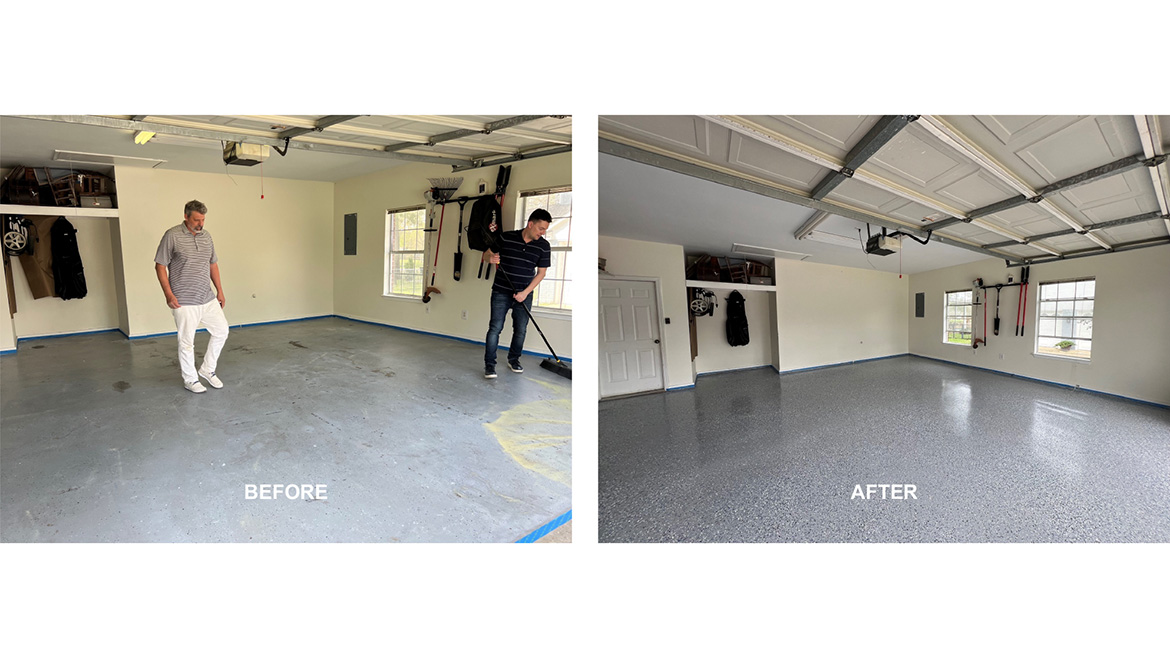
A DIY garage floor restoration was conducted using the pigmented basecoat followed by two coats of clear topcoat. The basecoat dried in less than 4 hours under high-humidity conditions, with the clear topcoat applied the following day. After 5 days, the floor was fully cured and could withstand heavy traffic, including parked vehicles. There was no discernible odor during curing, and the coating showed no signs of wear after initial use.
This DIY garage floor coating application provided a real-world validation of the ease of use and performance of the waterborne system. Despite this being our first floor-coating project with no prior experience, the process was straightforward. Paint cans were conveniently pre-packaged at the required A/B ratios, simplifying the mixing process. During mixing and application, only a very light sweet polyester smell was noticeable, but there was no odor during drying or after the application was completed. Each A+B mix had a working time of approximately 1 hour, and we finished applying each mix within 45 minutes. With a coverage rate of 300 to 400 square feet per gallon of paint kit, we used a nap roller on an extension pole and ensured each layer was applied as thinly as possible. Despite the humid conditions, the coating dried in under 4 hours, highlighting its efficiency and suitability for DIY applications. The before-and-after images capture the significant improvement in floor appearance after the job.
Conclusion
HYDROEXTER-based Part A combined with a hydrophobic aliphatic isocyanate trimer in Part B forms a cost-effective, high-performance, near-zero-VOC and low-odor 2K polyurethane-polyester system. This ambient-cure coating is particularly suited for floor applications where both environmental compliance and fast return-to-service are critical. The combination of a waterborne resin-based pigmented basecoat with a clear topcoat provides a decorative and highly durable floor coating system. These coatings deliver excellent toughness, chemical resistance and abrasion resistance, making them ideal for both industrial and consumer markets. The system not only meets stringent VOC regulations but also offers long-lasting aesthetic and functional benefits for real-world applications such as garage floors.
For more information, click here.
References
1 Zore, A.; Scicchitano, T.; Thomas, C.D. New Polyester Polyol Dispersion for VOC-Compliant 2-Component Waterborne Coatings: Comparison of High-Performance Near-Zero-VOC Aliphatic Polyurethane/Urea Floor Coating Technologies, CPI Polyurethanes Conference, 2023.
This paper may contain copyrighted material, the use of which may not have been specifically authorized by the copyright holder. To the extent this paper contains any such copyrighted material, the material is being used for nonprofit educational purposes reflecting a permitted “fair use” thereof as authorized under Title 17 U.S.C. Section 107. If any copyrighted material included in this paper is further used for purposes that go beyond “fair use,” the copyright holder’s permission is required.
Reproduced by CPI with permission of Owner for the 2024 Polyurethanes Technical Conference.
Looking for a reprint of this article?
From high-res PDFs to custom plaques, order your copy today!