Why the 15-Minute Powder Shop is Closer than Expected
Inside this Article
- Powder coating operations face ongoing pressure to improve throughput while reducing footprint, energy use and capital costs.
- Laser cleaning and laser curing technologies are emerging as practical tools to compress traditional powder coating timelines.
- By replacing conventional pretreatment and curing systems, manufacturers can move closer to fully integrated 15-minute powder coating lines.
- Modular laser systems also offer greater flexibility and scalability for evolving production demands.
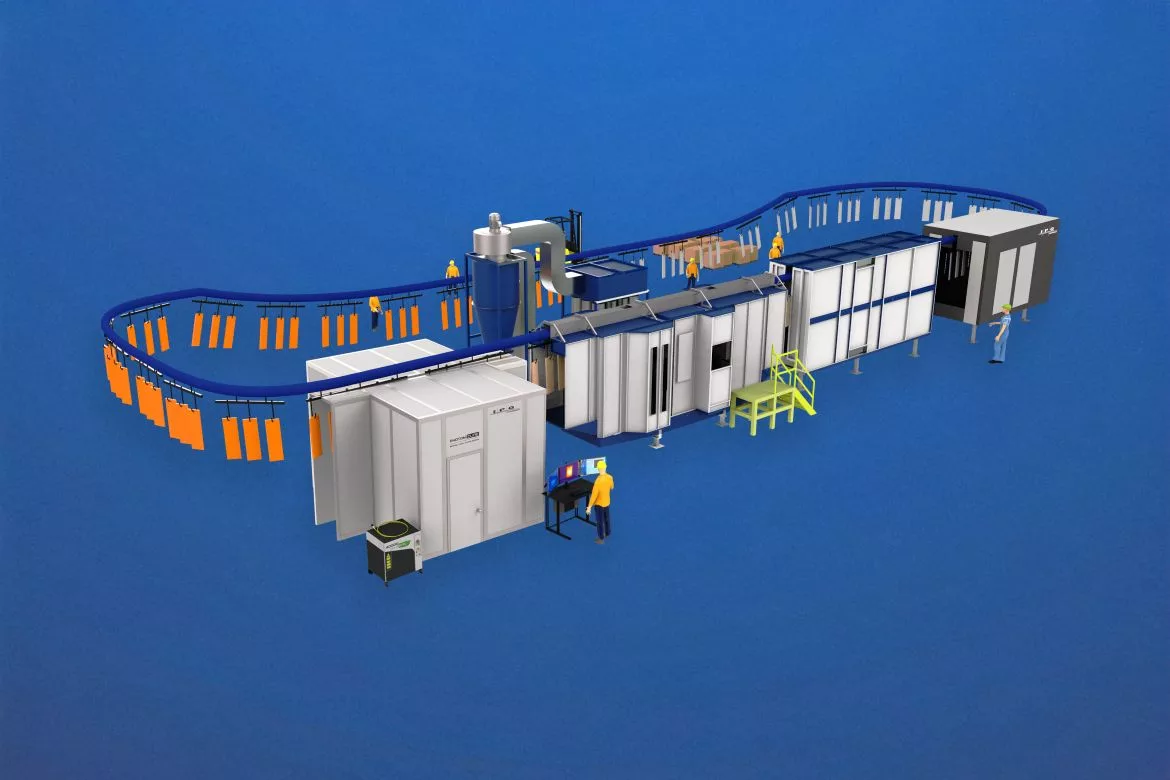
The concept of an end-to-end 15-minute powder coating line is rapidly becoming a commercial reality. Enabled by compact, high-speed laser cleaning and curing systems, this streamlined process replaces painfully slow traditional systems with a modular alternative that delivers superior throughput, quality and efficiency. Laser cleaning and curing technologies can execute the same functions in just 10–20% of the time and space of the traditional process. These laser systems are no longer theoretical; the hardware is commercially available, cost-effective and proven. Global powder suppliers have already certified laser curing; certification of powder performance on laser-cleaned surfaces is anticipated, bringing the vision of a fully integrated 15-minute powder line closer to commercial reality.
Laser Cleaning: The Bottleneck Breaker
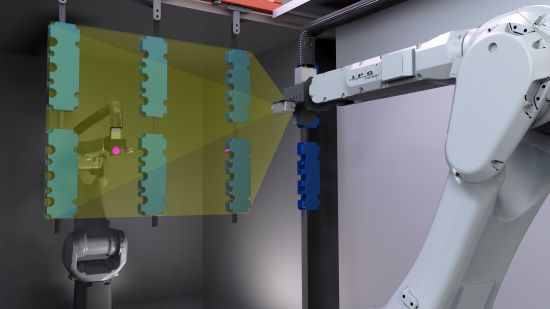
Laser technology directly addresses one of the most persistent bottlenecks in powder coating: surface preparation. Traditional methods require multiple steps—degreasing, phosphate treatment, rinsing and drying—executed across extensive wash lines that demand significant time, maintenance, utilities and factory space. Laser cleaning eliminates these inefficiencies by condensing the entire pretreatment operation into a few linear feet. Large components can be cleaned in seconds, while smaller parts are processed in the literal blink of an eye. The outcome is a compact, precisely controlled, repeatable pretreatment system that is faster, more predictable and enables better schedule optimization strategies.
Unlike chemical-based processes, laser cleaning does not rely on titration schedules and regular maintenance; the process is digitally calibrated, eliminating maintenance complexity. Laser cleaning supports lean manufacturing goals, minimizes environmental impact and drives substantial CapEx and OpEx savings. With its dramatically reduced footprint, a complete laser-enabled powder coating line can be deployed within the space previously required for just the wash system, making the vision of a 15-minute, end-to-end powder coating line not only practical but strategically compelling.
 Credit: IPG Photonics
Unlike laser curing, which is relatively new to powder operations, laser cleaning is already a mature industrial solution. For more than a decade, manufacturers have used it in high-stakes applications such as jet engine component preparation, automotive A-surface pretreatment and heavy-duty rust removal on marine and water heater components. A single laser system can thoroughly clean more than 1,000 square meters of metal surface per hour. The energy is tightly focused and applied selectively to the surface, energy consumption is minimal and there is zero abrasive wear. Removed oxides and volatiles are captured via an integrated vacuum, eliminating the need for chemical consumables and hazardous waste disposal.
The economic benefits of laser cleaning are particularly strong for direct-to-metal operations where chemical pretreatment can be eliminated altogether. Even in lines where anticorrosion coating or zirconium treatment is required, laser cleaning can displace more caustic and consumable-heavy stages such as detergent degreasing or acid etching. Additionally, a laser-assisted drying process can further streamline operations and prevent overheating the expensive pretreatment coating. In these hybrid scenarios, manufacturers can realize significant cost and performance improvements while retaining the corrosion resistance required in demanding applications.
CapEx and Operational Agility
While evidence of capital expenditure reductions in curing operations already exists, the CapEx benefits of laser cleaning are still being quantified; however, the potential is significant. With a 95% reduction in floor space compared to traditional wash systems, capital savings are likely to mirror or even exceed those observed in curing. Moreover, this reduction enables the design of coating lines that are not only smaller but also more modular and adaptable to evolving production needs.
Laser Curing: Speed and Scalability
Laser curing economics compare favorably when using standard powders offered today, but optimized powders expected in 2026 are anticipated to tilt the economics further in favor of laser-based systems.
With cycle times as short as two to three minutes in a cold, compact oven, laser curing eliminates the persistent heat and long cool-down periods associated with conventional systems. As a result, customers report up to 50% reductions in total capital expenditure when comparing laser-based systems to traditional powder lines. These savings stem from smaller oven requirements, reduced building and mezzanine needs, shorter conveyors and the elimination of cooling tunnels and associated HVAC infrastructure. Importantly, however, these benefits can only be fully realized if upstream bottlenecks—namely pretreatment—are similarly optimized through laser cleaning.
Beyond speed, energy efficiency and footprint reduction, one of the most strategic advantages of laser systems is flexibility. Traditional wash lines and ovens are massive, permanent installations that are costly to relocate or scale. In contrast, laser cleaning and curing modules are compact, mobile and easily upgradable. This adaptability compounds earlier CapEx savings and makes a compelling case for manufacturers seeking both operational resilience and long-term scalability.
Laser-enabled processing continues to influence throughput, efficiency and equipment strategies across powder coatings and industrial finishing operations.
Looking for a reprint of this article?
From high-res PDFs to custom plaques, order your copy today!