Hybrid Coating Systems: Combining Powder Coatings and Liquid Paint for Performance and Aesthetics
Image credit: cgtoolbox / Creatas Video via Getty Images.
Need to Know
- Powder coatings and liquid paints often function as complementary technologies rather than direct competitors, especially in multi-coat systems.
- Liquid coatings enable higher loadings of metallic and effect pigments, making them essential for achieving complex visual finishes.
- Powder coatings provide superior durability, corrosion resistance and environmental benefits in many one-coat or basecoat applications.
- Hybrid coating strategies are commonly used across automotive, appliance and industrial applications to balance aesthetics and performance.
- Heat-sensitive substrates and field repairs often require liquid coatings, reinforcing their role alongside powder systems.
Powder coatings and liquid paints are often perceived as competing finishing solutions in a zero-sum game wherein one technology is the victor and the other is displaced. Although there are numerous examples of one or the other approach being declared the winner in a particular market segment, many applications involve both types of coating systems complementing each other and bringing their unique advantages to deliver the most effective solution.
Multi-Coat Systems
A powder or liquid coating is often selected because the desired appearance can only be achieved by one or the other. In many cases, however, a system approach can offer the same appearance with improved durability.
Alloy wheels for automobiles represent a strong example of this approach. Many OEM wheels use an epoxy-based powder primer to promote adhesion and corrosion resistance, a liquid color coat to achieve the desired appearance, and an acrylic powder clear coat to deliver a high-gloss, chip-resistant finish (see Figure 1).
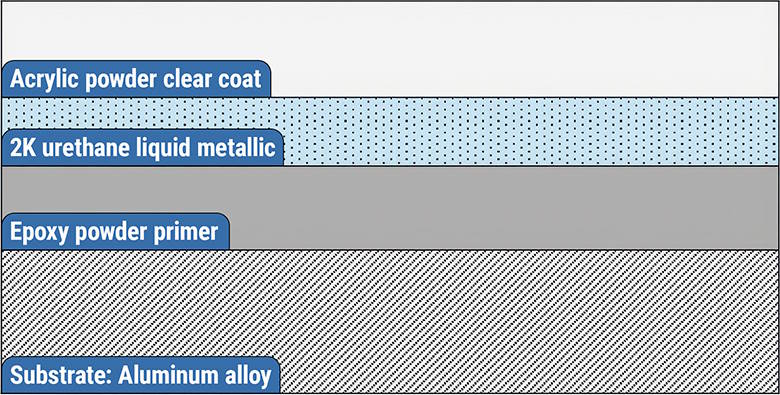
A liquid coating is used as the color coat because wet paint can normally support a much higher loading level of aluminum or pearlescent effect pigments than a powder coating. To achieve a visually striking sparkle finish, the pigmented color coat may contain 15–20% aluminum by weight. However, concentrations of 5% or higher of the same type of pigments can cause powder coatings to become textured, as their flow is restricted by the high surface area of these materials. In this case, using a liquid coating to achieve the desired color effects and powder coatings to achieve the required durability is an optimal solution.
Touchup
Another example of powder coatings and liquid paint working together is the use of touchup paint for scratches and dings that can occur in a powder-coated surface. Powder coatings are highly efficient for coating large areas on parts in a factory setting and can offer superior protection for a variety of applications, but they are not ideal for touching up small areas. Powder also requires uninterrupted exposure to heat for a prolonged duration to cure, making it difficult to apply and cure in the field.
Due to these limitations, powder coating manufacturers often supply color-matched liquid paints in a pen or bottle. The user can then easily apply the liquid paint to fill in chips and scratches that occasionally result from handling or use in the field.
Custom Colors
As previously mentioned, powder coatings excel at finishing large surfaces in a factory setting. However, changing from one color to another often requires a lengthy cleaning process if the application system is not equipped with the latest quick color-change spray guns and booths.
In these situations, it can be beneficial to install a liquid paint spray booth for one-offs or short runs of a custom color for a customer who requests it. It may even be beneficial in such cases to powder coat all parts with the most popular color and segregate and overcoat parts with a custom-matched liquid paint for units that require a special color.
Heat-Sensitive and Mixed-Material Parts
Many manufactured goods comprise multiple components fabricated from different materials, each with different coating requirements. For instance, washers and dryers are typically made of several different substrates that are later assembled into the finished unit.
The washer cabinet may be powder coated or sometimes even coil coated. Plastic trim parts are often coated with liquid paint because these substrates cannot withstand the higher temperatures required to cure powder coatings. The deck and internal components (such as a dryer drum) normally require high levels of chip and detergent resistance, which are best provided by using a powder coating such as an epoxy-containing hybrid. In these situations, each component receives the proper coating based on its specific aesthetic and performance requirements, with both powder coatings and liquid paints contributing to the performance of the finished product.
Complementary Technologies
Consumer-driven design trends can have a major influence on the chosen coating technology. As with the automotive wheel example, liquid paint systems can offer special effects and aesthetics that are not possible with powder coatings alone. In other cases, powder coatings are the optimal choice due to the superior durability properties they can offer in a one-coat system, as well as their environmentally friendly profile.
In many cases, powder coatings and liquid paints are perceived to be competing technologies with one winner and one loser. In reality, different application techniques, chemistries, and formulating platforms each offer distinct advantages. The solution to a problem should always be selected based on how effectively it resolves the issue rather than how many points it scores for one team or another.
To learn more, reach out to the author at nbiller@chemquest.com or visit https://chemquest.com.
Explore more insights into industrial coatings and how hybrid systems are shaping performance-driven finishing strategies.
Looking for a reprint of this article?
From high-res PDFs to custom plaques, order your copy today!