Resins/Polymers
Optimizing Exterior Durability of Waterborne Coatings Through Advanced Polymer Design
Core–shell morphology, functional monomers and polymer–pigment composite technology offer targeted approaches to improving adhesion, hiding and long-term weathering performance.
Need to Know
- Core–shell polymer morphology can balance film formation and durability by combining a softer phase with a harder or more hydrophobic phase.
- Functional monomers can improve adhesion by strengthening the dried polymer network and increasing interactions with substrates and pigments.
- Composite polymers adsorb onto TiO₂ particles, improving pigment spacing, hiding efficiency and coating uniformity while supporting longer-term gloss and color retention.
Exterior architectural coatings serve a dual role: protecting and enhancing the appearance of architectural surfaces exposed to harsh environmental conditions. These coatings must withstand continuous exposure to ultraviolet (UV) radiation, temperature fluctuations, moisture and environmental contaminants, all of which can drive chemical and physical degradation of the coating film over time. These stressors can lead to common failure modes such as cracking, peeling, chalking, gloss loss and color change, ultimately compromising both the aesthetic and protective functions of the coating.
Because of these challenges, designing coatings with durability in mind is critical. Durability directly affects long-term performance, maintenance frequency and life cycle cost. High-durability coatings extend service life by resisting environmental degradation, maintaining adhesion and preserving appearance, thereby reducing repainting cycles and enabling more sustainable material use. Achieving this level of performance is heavily influenced by the polymer in the coating, which affects film formation, mechanical integrity and resistance to weathering. Therefore, tailoring the polymer is a key strategy for enhancing exterior coating durability.
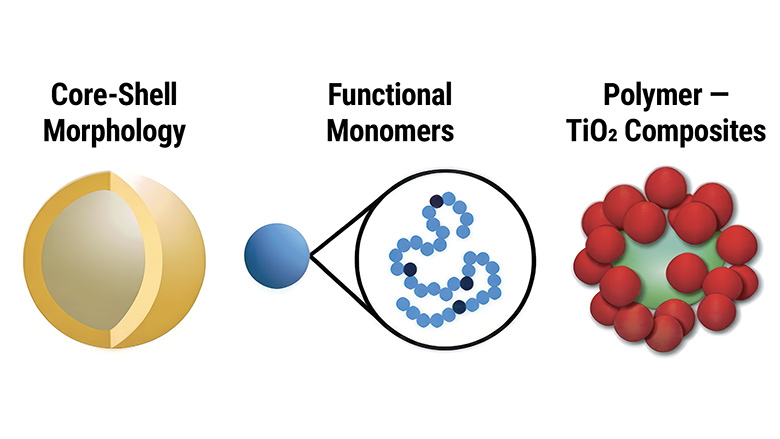
In this discussion, we examine three parameters that govern polymer design and, ultimately, coating performance: morphology, composition and polymer–pigment interaction. Specifically, we focus on improving performance through core–shell morphology, incorporating functional monomers into the polymer composition and leveraging composite technology in which the polymer forms composites with titanium dioxide (TiO₂) in the coating (Figure 1). By understanding and tuning these parameters, coatings can be designed to provide long-term durability under increasingly demanding environmental conditions.
Core–Shell Morphology
The transition from solventborne to waterborne systems in architectural coatings is one of the most recognized transformations in the coatings industry. Although considered more environmentally friendly, the shift to waterborne coatings has created challenges for polymer design, particularly in matching the performance of solventborne formulations. One of the most notable differences between the two systems is film formation. For a neat emulsion polymer latex, even though particles begin to pack together as water evaporates, the surfactant boundary layer often does not completely disappear after drying. Traditionally, solvents were added to paint formulations as coalescents to enhance the ability of polymer particles to wet pigment surfaces and facilitate film formation. As the regulatory landscape continues to shift toward lower volatile organic compound (VOC) content, the amount of traditional coalescents that can be used becomes increasingly limited. This, in turn, requires the use of softer polymers to enable proper film formation; however, softer polymers may be more susceptible to reduced durability.
Core–shell morphology can be used to address this challenge. For example, a hard core can be combined with a soft shell, allowing film formation to be facilitated by the soft phase while the hard phase provides durability. Variations of this strategy include gradient particle morphologies with gradual changes in hardness or lobed structures. Another highly efficient approach is to increase the hydrophobicity of the shell to improve durability without significantly altering polymer softness. This enables coalescent demand to remain constant while reducing the risk of increased dirt pickup associated with a softer shell. A more hydrophobic shell can help reduce local water retention during film formation, which can improve early rain resistance. It may also limit surfactant mobility and extraction, factors that contribute to surfactant leaching.
An example of engineering a more hydrophobic shell is shown in Figure 2. Polymer A and Polymer B are all-acrylic systems with similar overall compositions. Both polymers have a glass transition temperature (Tg) of approximately 10 °C, as measured by differential scanning calorimetry (DSC), as well as a minimum film formation temperature (MFFT) of approximately 6 °C. The main difference is that Polymer B has a core–shell morphology with a more hydrophobic shell. When formulated into a premium semigloss white formulation, both coatings exhibited similar dirt pickup resistance after up to three years of accelerated natural exposure at a 45° south-facing orientation on primed cedar. However, Polymer B demonstrated reduced fading in blue-tinted paint after approximately two years of accelerated natural exposure under the same conditions. This example highlights the importance of tuning polymer particle morphology to improve the long-term durability of the paint film.
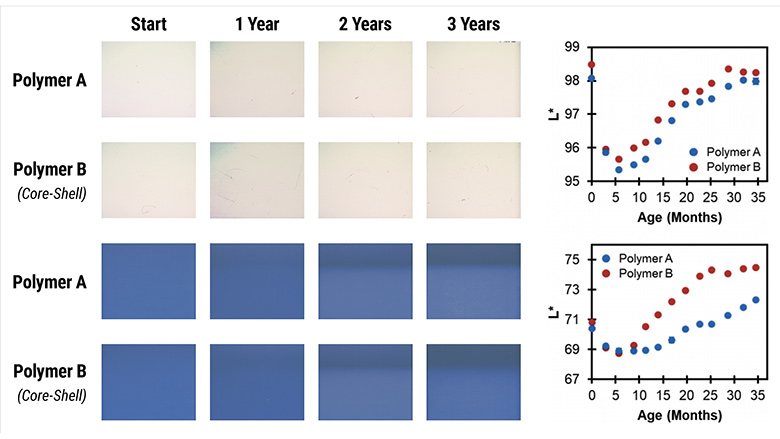
Figure 2. Comparison of a semigloss white formulation made with a conventional acrylic, Polymer A, and an acrylic with core–shell morphology, Polymer B. The top panels show the white paints at different intervals following natural exposure (left) and the associated lightness readings, L*, (right). The bottom panels show results for the blue-tinted paints. Credit: Courtesy of Dow
Functional Monomers
As the coatings industry continues to strive for improved performance, adhesion remains one of the most critical requirements for exterior coatings. This need has become even more important with the trend toward paint-and-primer-in-one products, in which a single coating is expected to provide both topcoat appearance and primer-level bonding, along with other primer-related properties, across a range of substrates. Strong adhesion allows the coating to remain firmly bonded to the substrate despite repeated exposure to various environmental factors. When adhesion is compromised, premature failures such as blistering, peeling and flaking can occur, reducing both protection and appearance. Polymer designs that enhance interfacial bonding and help maintain adhesion over time are therefore essential to achieving long-term exterior durability.
Functional monomers can strengthen adhesion by improving both interfacial interactions and the integrity of the dried film. Ambient crosslinking monomers help form a more cohesive polymer network as the coating cures, increasing resistance to water, swelling and mechanical stress that can otherwise weaken the bond to the substrate. Acid-containing monomers can further enhance adhesion by introducing polar groups that interact more strongly with surface functionalities on substrates and pigments, improving wetting and interfacial attraction. Together, these chemistries provide an effective route to maintaining adhesion and durability in demanding exterior environments.
To understand how these functional monomer strategies translate into practical coating performance, adhesion must be evaluated across a range of relevant exterior substrates. Laboratory application testing provides an efficient way to assess how well these polymers promote bonding under different surface conditions and levels of substrate difficulty. An example of enhancing adhesion across various substrates through the judicious incorporation of functional monomers is illustrated in Table 1. Polymer D is an all-acrylic polymer designed for the premium segment, enabling paint formulations with excellent dirt pickup resistance as well as best-in-class gloss and color retention. Polymer C is structurally similar to Polymer D but incorporates additional functionality to improve adhesion to metal and chalky wood boards, meeting the requirements of paint-and-primer-in-one formulations, particularly for the modern do-it-yourself (DIY) market.
| Semigloss White Paint | Polymer C | Polymer D |
|---|---|---|
| 60° gloss | 50.6 | 43.9 |
| Contrast ratio | 98.2 | 97.8 |
| Untreated aluminum 1 day (dry/wet) | 4B/4B | 0B/0B |
| Untreated aluminum 7 day (dry/wet) | 4B/4B | 0B/0B |
| Cold-rolled steel 1 day (dry/wet) | 5B/5B | 0B/0B |
| Cold-rolled steel 7 day (dry/wet) | 5B/4B | 0B/0B |
| Alkyd 1 day (dry/wet) | 5B/5B | 5B/4B |
| Alkyd 7 day (dry/wet) | 5B/3B | 5B/5B |
| Chalky wood board 7 day (dry/wet) | 4B/3B | 4B/0B |
Composite Technology
Composite polymers were developed to improve the efficiency of titanium dioxide (TiO₂) and other pigments in architectural coatings. Unlike conventional acrylic polymers, composite polymers are designed to interact directly with pigments during dispersion and film formation rather than acting as a passive matrix. This fundamental difference enables the formation of polymer–pigment composites that enhance light scattering and, ultimately, hiding.
The key mechanism begins with adsorption of the composite polymer onto the surface of TiO₂ particles. The polymer contains functional groups that enable strong affinity for the pigment, resulting in coating or partial encapsulation of TiO₂ and modifying interparticle interactions. This interaction is critical because conventional TiO₂ efficiency is often limited by “crowding.” In typical coatings, TiO₂ particles are distributed nonhomogeneously, leading to regions of high local concentration where scattering volumes overlap, thereby reducing overall scattering efficiency. Composite polymers mitigate this effect by enabling a more uniform spatial distribution of pigment. Polymer-adhered pigment particles are less prone to direct contact or clustering, leading to improved spacing between TiO₂ particles and increased wet and dry hiding efficiency. As a result, the same level of hiding achieved with a non-composite-forming polymer can be attained using a composite polymer with lower TiO₂ loading.
Furthermore, enhanced exterior durability has been observed with composite polymers (Figure 3). Through adsorption onto TiO₂ and the formation of a more uniform polymer–pigment composite, these polymers promote a more homogeneous film, reducing localized pigment–polymer defects that can act as initiation sites for degradation and improving durability. Paints formulated with noncomposite and composite polymers were subjected to QUV accelerated weathering and imaged at various time points using scanning electron microscopy (SEM). Coatings containing composite polymers retained gloss and color longer, correlating with a more uniform surface observed by SEM.
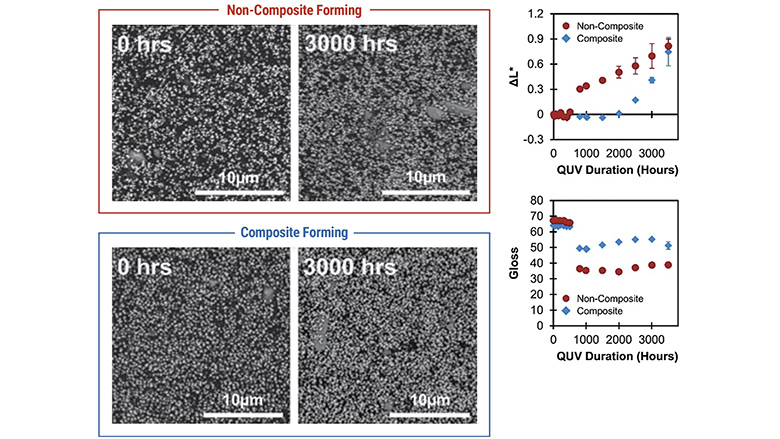
Composite polymers interact with TiO₂ through surface adsorption, improving dispersion and particle spacing. This reduces crowding, increases light-scattering efficiency and results in significantly improved hiding performance at reduced pigment loading, representing a shift from conventional formulation approaches toward engineered polymer–pigment systems.
Conclusion
Optimizing exterior coating durability relies on polymer design that extends beyond traditional approaches. Coating performance can be enhanced by tuning polymer morphology, composition and pigment interaction. Core–shell morphology provides an effective means of balancing film formation and durability, allowing softer domains to coalesce while maintaining a durable, hydrophobic shell that enhances resistance to weathering and surfactant leaching.
The incorporation of functional monomers expands the polymer design toolbox and enables a targeted approach to improving exterior durability properties, such as adhesion across a range of substrates. Composite polymer technology allows for the targeted placement of polymer within the coating. Through controlled adsorption onto TiO₂, composite-forming polymers improve pigment spacing, enhance light-scattering efficiency and reduce defects within the film, resulting in improved hiding, gloss retention and delayed degradation, as observed during accelerated weathering.
Collectively, these polymer design levers highlight the complexity of exterior durability. By combining innovations in morphology, composition and polymer–pigment interaction, the durability of next-generation exterior coatings can be improved. As regulatory pressures and performance expectations continue to rise, and critical durability properties such as color retention, surfactant leaching, adhesion and early rain resistance gain importance, advanced polymer architecture provides a versatile platform to meet these challenges.
For more information on binder technologies used to improve coating performance, visit PCI’s Resins and Polymers topic page.
Looking for a reprint of this article?
From high-res PDFs to custom plaques, order your copy today!