Method Detects Pigment Aggregation Before a Coating Film Forms
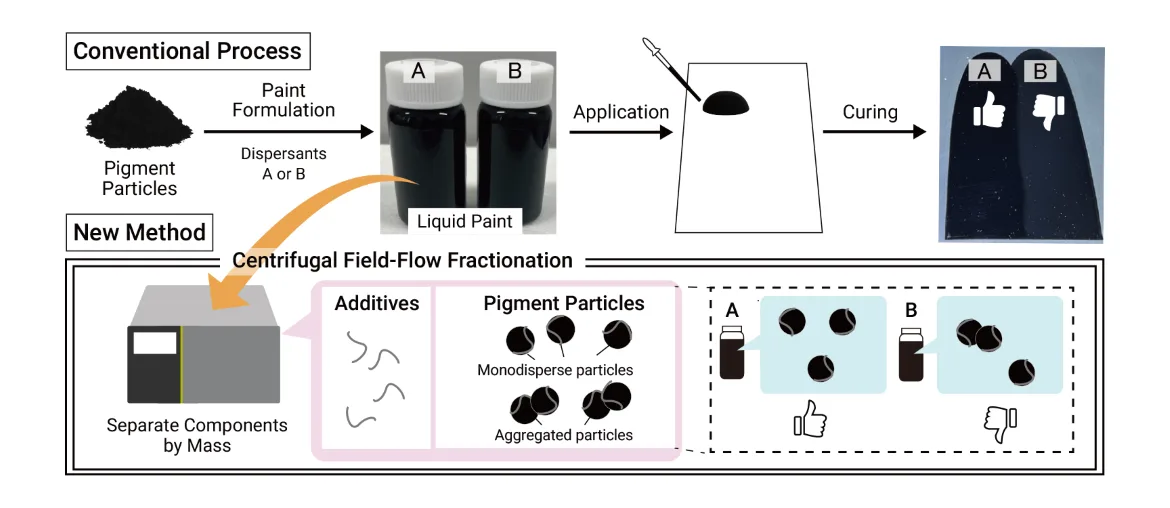
Researchers at the University of Tokyo and Nippon Paint have developed an analytical method for evaluating pigment aggregation in liquid paint before film formation.
The work uses centrifugal field-flow fractionation, which separates particles according to differences in mass. The researchers applied the technique to complex paint formulations containing pigments, resins, dispersants and other components.
Pigment dispersion plays a major role in the final color and appearance of a coating. Conventional development therefore often requires researchers to produce films, measure their appearance and then revise the formulation.
The research team compared paints containing the same amount of carbon black but different dispersants. The resulting coating films showed different levels of jet-black appearance.
Dynamic light scattering did not reveal a clear difference in carbon black aggregation between the formulations. Centrifugal field-flow fractionation, however, detected aggregation in the paint that produced the weaker black appearance. Cryogenic transmission electron microscopy was used to confirm the aggregation.
The researchers said the findings show that pigment aggregation affecting final color development can be evaluated before the coating film is produced.
Reducing the number of prototype films could shorten formulation development while reducing paint and substrate consumption, drying and curing energy and waste generation.
The findings were published July 22 in Langmuir, an American Chemical Society journal. Read the release and details here.
The method gives formulators another way to connect pigment dispersion in the liquid formulation with final appearance. It is directly relevant to PCI's Pigment Dispersions coverage and to R&D teams looking to reduce iterative spray-out and drawdown work.
Looking for a reprint of this article?
From high-res PDFs to custom plaques, order your copy today!