Nippon Paint Research Reveals New Clues to Coating-Film Strength
Nippon Paint Holdings Co., Ltd. and the University of Tokyo have reported new findings on the relationship between polymer crosslinking and coating-film strength, offering potential guidance for developing stronger waterborne coatings while using crosslinkers more efficiently.
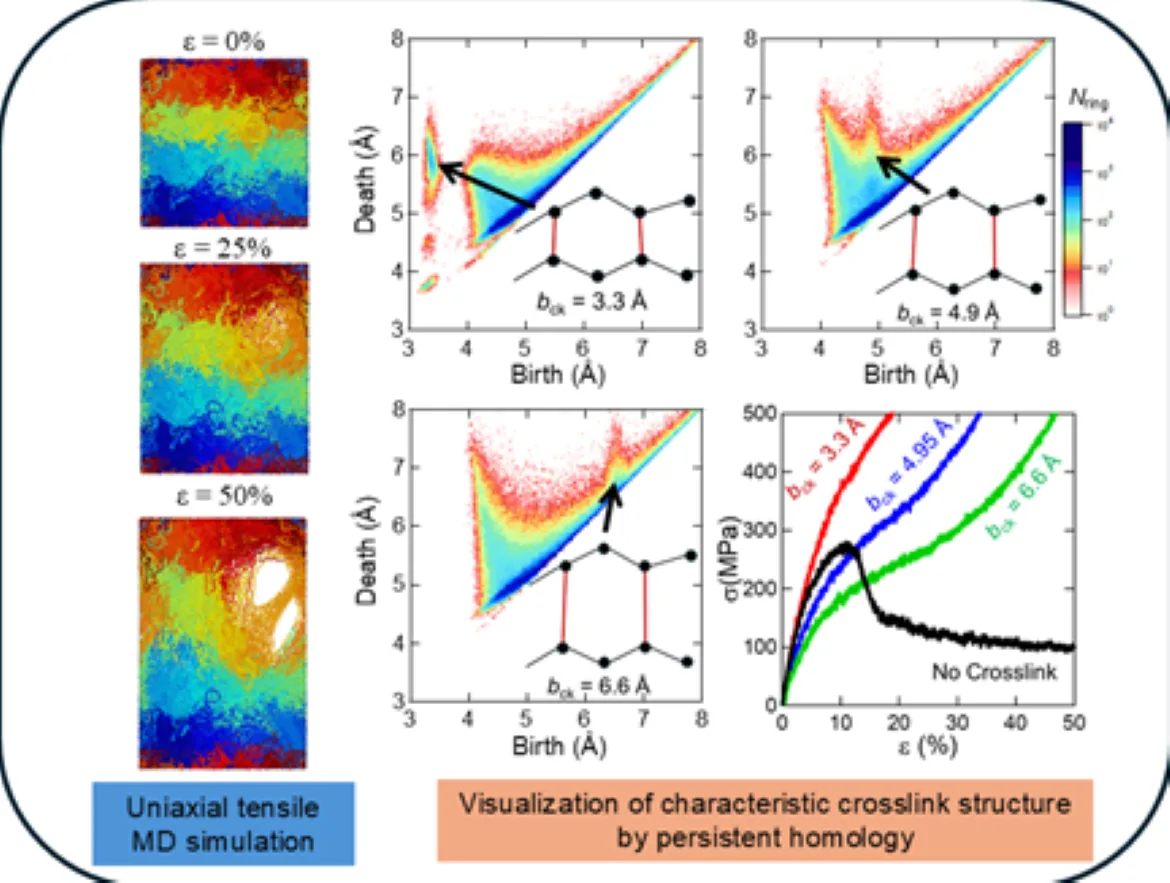
The research team used molecular dynamics simulations to study how crosslinked polymer films respond to tensile deformation. The researchers found that increasing the number of crosslinks between polymer chains improved resistance to large deformations, while having relatively little effect on the initial elastic response.
Within the model systems studied, the total number of crosslinks had a greater influence on deformation resistance than the type of crosslinker or its local bonding structure.
The findings were published October 26, 2026, in Macromolecular Theory and Simulations. Nippon Paint and the university announced the research November 2.
Understanding the Role of Crosslinks
In waterborne coating systems, crosslinking helps control the mechanical properties of the dried film by chemically connecting polymer chains.
The choice and amount of crosslinker can affect the resulting network structure and coating performance. However, the relationship between molecular architecture and film strength is complex.
To investigate those relationships, researchers constructed model polymer films using coarse-grained molecular dynamics simulations. This approach represents groups of atoms as simplified particles, making it possible to model the behavior of larger polymer networks.
The team created films with different crosslink densities and bonding structures, then simulated tensile deformation and analyzed their stress-strain responses.
The results showed that additional crosslinks restricted polymer-chain movement and reorientation. This increased the network's resistance to larger deformations.
However, crosslink density had a comparatively limited effect on the stress response in the initial elastic region.
The researchers also examined how different crosslinking architectures influenced film behavior.
They found that the number of crosslinks was more influential than the local bonding structure within the systems studied.
Because multifunctional crosslinkers can connect multiple polymer chains, the findings suggest these materials could potentially provide sufficient mechanical reinforcement at lower crosslinker loadings.
Examining Polymer Networks With Persistent Homology
The research also used persistent homology, a mathematical technique for identifying and analyzing structural features such as loops and voids.
By applying this method to the simulated polymer networks, the team examined how crosslinking created characteristic loop structures and how those structures responded during deformation.
The analysis identified changes in network geometry as the films were stretched, including localized bond stretching within crosslink-derived loops.
According to the researchers, these results suggest that crosslinks constrain polymer-chain movement and concentrate deformation in particular regions of the network.
The combination of molecular dynamics simulations and topological analysis provided additional information about how microscopic network structure influences the mechanical behavior of polymer films.
Implications for Waterborne Coating Development
The study could help researchers develop more efficient approaches to crosslinker selection, particularly in formulations where mechanical performance must be balanced against material use and environmental considerations.
However, the researchers emphasized that the simulations represent simplified systems. Additional studies are needed to account for actual crosslinking reactions and structural variations in waterborne coating films.
The work was conducted through the Social Cooperation Program, Creation of Innovative Coating Technologies, established under an industry-academia agreement between Nippon Paint Holdings and the University of Tokyo.
The research team included Ryuhei Sato and Yasushi Shibuta of the university's Graduate School of Engineering, along with Shinya Kawakami and Koichi Sato of Nippon Paint Co., Ltd., and Satoshi Ishida of Nippon Paint Corporate Solutions Co., Ltd.
The paper, Coarse-Grained Molecular Dynamics and Persistent Homology Analysis of Crosslinker Effects on Polymer-Film Deformation, was authored by Ryuhei Sato, Shinya Kawakami, Satoshi Ishida, Koichi Sato and Yasushi Shibuta.
It is available at DOI: 10.1002/mats.70064.
The findings add to Nippon Paint's recent work with the University of Tokyo. PCI has also reported on a research project exploring AI-assisted materials development and new methods for detecting pigment aggregation before coating-film formation.
Understanding how crosslink density influences mechanical performance could help formulators make more informed decisions about crosslinker selection and loading. Explore more developments in coating resins and polymers.
Looking for a reprint of this article?
From high-res PDFs to custom plaques, order your copy today!