A More Systematic Approach to Lower-VOC and PFAS-Free Reformulation
How AI-guided iterative learning helps coatings, adhesives and sealants teams navigate complex performance trade-offs
Need to Know
- Changing an ingredient to lower VOCs or remove PFAS can also affect gloss, adhesion, tack, cure behavior and manufacturing feasibility.
- AI-guided reformulation uses historical data and new lab results to rank candidates by predicted performance and identify where another test would reduce uncertainty.
- The alkyd example focuses on particle size and stability. The adhesive case shows how teams can narrow the field of potential ingredients before laboratory testing.
Reducing volatile organic compounds (VOCs) or removing per- and polyfluoroalkyl substances (PFAS) from a coating, adhesive or sealant is not a single-variable substitution problem. Changing a solvent, surfactant, binder or additive can alter technical properties such as viscosity, wetting, gloss, adhesion, cure behavior or tack, as well as production feasibility, ingredient costs and supply chain risks. The technical task is to meet VOC and PFAS-related requirements while maintaining the combination of properties that makes the product useful and commercially viable in its intended application. For many teams, the challenge is compounded by constrained laboratory capacity, incomplete historical records and an expanding set of raw-material, regulatory and customer requirements.
An AI-guided, iterative reformulation workflow can help. It begins with the formulation and process data that already exist, makes target properties and constraints explicit, and uses AI to learn from each new experiment. With every experimental cycle, the model updates its understanding of the design space, predicts the most promising candidates and identifies where another test would reduce uncertainty. The approach does not replace the formulator. It gives them a practical way to search a broader design space while directing scarce laboratory effort toward the most informative experiments.
Screening ingredients one at a time, or optimizing a property in isolation, often results in a long sequence of corrective experiments. It can identify useful local improvements, but it rarely reveals the most productive route through a high-dimensional formulation space.
From Formulation History to a Reusable AI Workflow
Data
Coatings, adhesives and sealants teams can assemble a practical first dataset from historical formulation records, raw-material properties, process conditions and final test results. The records may be sparse and inconsistent, but they still contain evidence about the relationship between ingredients, processing and performance. Expert input is essential at this stage: it establishes which data are comparable, which values are trustworthy and which requirements are nonnegotiable.
It’s important to note that the initial set of experiments used to train an AI model can be as small as 10 data points. No need to create a data lake before starting with AI. Additional data are useful when they are relevant, comparable and sufficiently varied.
AI Model
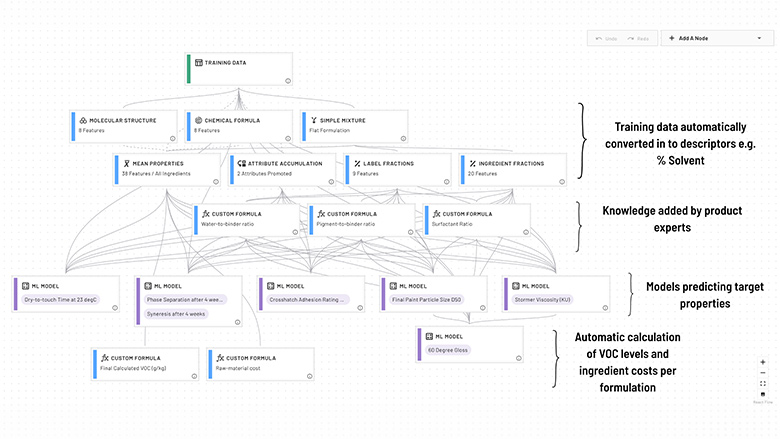
The next step is to create AI models to predict the final technical properties and calculate the ingredient costs and VOC levels. Modern AI platforms can do this in a few clicks. Graphical modeling tools in the platform allow product experts to define relationships between properties and ingredients, calculated expressions and predictive outputs without writing any code. This can now be done using natural language. Figure 1 shows how formulation descriptors, expert-defined relationships, predictive models and calculated outputs can be connected in a graphical model.
Credit: Citrine
Search Space
The search space constrains the area that the AI model explores to practical options. Raw-material identity and composition in the formulation, number of ingredients and processing conditions such as temperature, mixing speed and mixing time, etc., can all be constrained to ensure that any suggested formulations are feasible from a business and practical perspective as well as being technically interesting.
Candidates
Desired outcomes, including both properties to optimize and requirements that must be met, can be set. A trim coating, for example, may seek to improve VOC performance while treating adhesion, gloss, dry time and water resistance as constraints. In an adhesive or sealant, the same approach can balance VOC and PFAS-related requirements with peel or shear strength, tack, cure speed, cohesion, substrate adhesion and application viscosity.
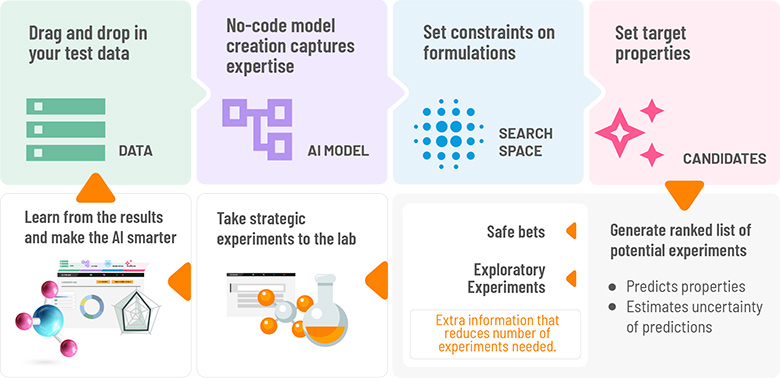
AI models can then be run over the search space and estimate the likely property ranges for untested candidate formulations. Crucially, they also quantify the uncertainty of their predictions. It is this extra information that means product development teams can be more strategic about what to take to the lab. Candidate selection can then weigh predicted performance against the likelihood of success. The result is a short, practical batch for the laboratory rather than an unmanageable list of possible formulas. The closed-loop sequence from historical data to candidate selection, laboratory testing and model updating is summarized in Figure 2.
How AI Drives Iterative Learning
AI is the engine of iterative learning in this workflow. After each experimental batch, the model incorporates the new results, updates its predictions and estimates where its uncertainty remains highest. It then helps the team choose the next experiments by balancing predicted performance against the value of the information that each test can provide. In a formulation program with several targets and several constraints, the first set of candidates rarely provides a complete answer. Instead, it provides new evidence about the boundaries of the viable design space. Results that fail a target are still valuable when they reveal the direction, magnitude and likely cause of failure.
This AI-driven cycle is especially useful when the design space is nonlinear. A small change in an additive package or emulsification condition can produce a disproportionately large response in stability or final performance. Traditional design of experiments remains highly effective for controlled, lower-dimensional questions. AI-guided experimentation becomes increasingly helpful as the number of variables, property interactions and feasibility constraints grow, because it can continuously update candidate selection as the evidence changes.
A disciplined process matters. Each test batch should contain formulations that validate the model and, where appropriate, candidates selected by the AI to reduce uncertainty in poorly understood regions. Test methods, sample preparation and pass-fail criteria should remain consistent enough to make results comparable. The formulation team should review each AI-proposed batch before release, using its knowledge of application requirements, manufacturability and raw-material practicality to reject unsuitable candidates and then including this knowledge in the search space so that all future suggestions are within specification.
An Example in Alkyd Emulsification
Alkyd emulsification illustrates why a multivariable workflow is valuable for coatings development. The outcome depends on the interaction of alkyd chemistry, surfactant selection, emulsification conditions and vessel hydrodynamics. The desired product must satisfy more than a fresh particle-size target. It must also maintain stability over time and provide a viable route for downstream coating evaluation.
In an industrial alkyd-emulsification program, a model-guided workflow was used to direct experimental work toward formulations and process conditions most likely to meet defined particle-size and stability requirements. Across the broader initiative, the team solved 17 alkyds in eight months, compared with approximately five years using the historical development approach, and reported a twofold improvement in R&D efficiency. The result was not a single “best” formulation. It was a set of viable routes that could be evaluated further for downstream coating use.
Screening Raw Materials Beyond Product Names
Raw-material substitution presents another frequent bottleneck. A familiar replacement may be unavailable, too costly or incompatible with a new regulatory requirement. Screening only by product name or broad chemistry class can be limiting because it does not directly address the characteristics that influence coating, adhesive or sealant performance. A more useful approach links historical raw materials and formulation results to appropriate molecular or chemical fingerprints. AI models identify which characteristics of the ingredient to be substituted are having positive effects on the target properties and then use this information to screen untested alternative raw materials.
The purpose is not to replace technical validation with a database search. It is to identify which candidate raw materials are most likely to provide the required function in the existing formulation context. Those candidates can then be prioritized for physical testing. The approach is particularly valuable when the supplier landscape is large and when the team needs to evaluate alternatives without restarting development from the beginning.
PFAS Removal
PFAS removal is a good example of where this works. One adhesive reformulation program illustrates the value of this approach. A global materials company needed to reformulate a plastic-melt adhesive to exclude PFAS while maintaining required performance. The team used AI to evaluate millions of potential ingredient combinations and narrowed the field to 30 viable candidates for further assessment. The company identified a breakthrough candidate in just four months and estimated that the workflow saved two years of R&D work on a project expected to take five years. The broader lesson is that AI does not remove the need for laboratory validation. It enables the team to test a more selective set of candidates while keeping technical experts in control of the final decision.
Building a Reusable Reformulation Capability
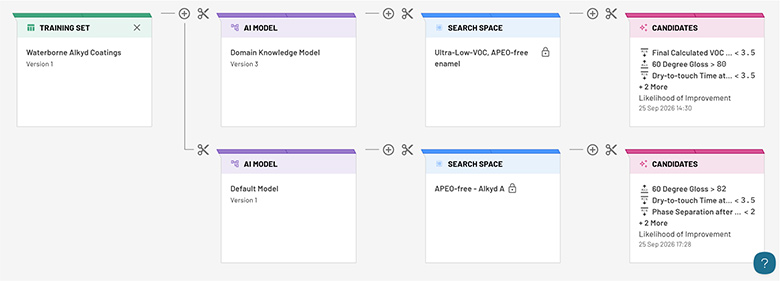
A reformulation project delivers more value when it leaves behind a reusable technical asset. The AI workflow, including the dataset, AI models, search space and pass-fail criteria, can be retained in a form that another product team can understand and extend. This reduces dependence on individual memory and gives newer formulators a more informed starting point. It can also make a later response to a raw-material disruption or regulatory change faster and more consistent. Figure 3 illustrates how the same training data can support multiple search spaces as regulatory or customer requirements change.
For coatings, adhesives, sealants and elastomers (CASE) R&D leaders, the most practical first AI project is usually bounded, important and supported by experienced formulators. It should have a clear business or technical purpose, measurable performance criteria and enough relevant historical data to establish a starting point. Lower-VOC or PFAS-free reformulation can meet these conditions when a team has an existing product family, a defined application and a real constraint to address. Success should be measured not only by the final formulation but also by the quality of the experimental learning, the reduction in unnecessary testing and the usefulness of the workflow for the next challenge.
Conclusion
Lower-VOC and PFAS-free reformulation in coatings, adhesives and sealants requires careful control of interacting formulation and process variables. AI-driven iterative learning provides a practical way to search more of that space without attempting to test every possible combination. After each batch of experiments, AI models update their predictions and recommend the next tests that best balance performance targets with unresolved uncertainty. By combining that learning cycle with the judgment of product experts, teams can focus laboratory work on candidates that are more likely to satisfy the full set of performance and feasibility requirements. Just as importantly, they can retain the resulting knowledge for the next reformulation program.
Reformulating to lower VOCs or remove PFAS can change the properties that make a coating, adhesive or sealant work in its intended application. Explore related formulation coverage in PCI’s Adhesives and Sealants section.
Looking for a reprint of this article?
From high-res PDFs to custom plaques, order your copy today!