Coat It!
PODCAST | Regulatory Reformulation Requires a Full-System View
Need to Know
- Regulatory pressure involving cobalt, oximes, PFAS, cyclosiloxanes, organotin catalysts and other materials is driving new formulation work.
- Direct one-for-one substitutions are often difficult because additive changes can affect multiple coating properties.
- Early testing and collaboration across the raw-material supply chain can help formulators prepare for emerging requirements.
Regulatory-driven reformulation rarely involves replacing one raw material and moving on. Changes prompted by substance classifications, exposure limits, VOC requirements, reporting rules or customer expectations can also affect drying, cure, wetting, flow, storage stability, appearance and long-term coating performance.
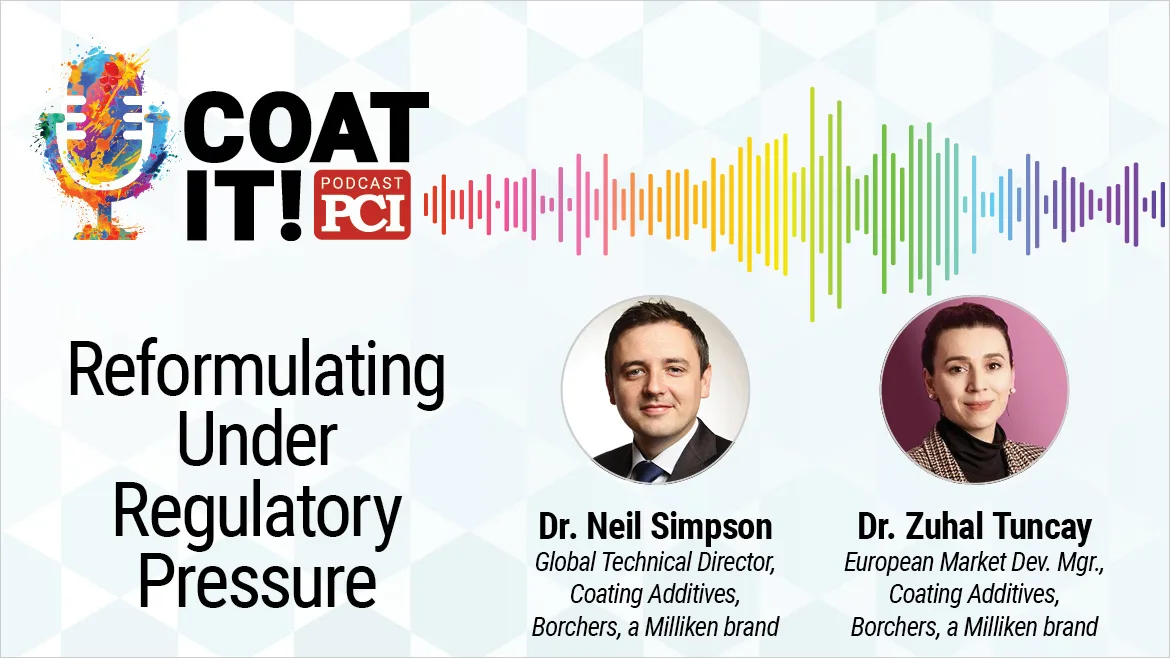
That was a central theme of a recent Coat It! conversation with Dr. Neil Simpson, Global Technical Director of Coating Additives, and Dr. Zuhal Tuncay, European Market Development Manager of Coating Additives, with Borchers, a Milliken brand.
The discussion explored several regulatory and formulation issues currently drawing attention, including cobalt driers and oxime anti-skinning agents in alkyd coatings, the continuing move toward lower-VOC systems, PFAS replacement, cyclosiloxane impurities and alternatives to dibutyltin dilaurate.
Across those examples, Simpson and Tuncay emphasized the importance of understanding the function a material provides before selecting an alternative. Matching one characteristic, such as cure speed or surface tension, may not be enough if the replacement changes pot life, hardness development, adhesion, wetting, storage stability or another critical property.
The conversation also looked beyond additives themselves. Changes to pigments, resins and other upstream raw materials can alter how an entire formulation behaves, making collaboration among suppliers increasingly important.
Tuncay encouraged formulators to begin evaluating alternatives before regulatory changes become urgent. Screening, optimization and longer-term performance testing can take time, and early work can give coatings manufacturers more flexibility as regulations and customer requirements evolve.
The full episode takes a deeper look at the technical tradeoffs involved in these transitions, including why PFAS alternatives can be difficult to identify, how cobalt driers and anti-skinning agents interact in alkyd systems, what formulators should consider when moving away from tin catalysts, and how suppliers can work together when upstream raw-material changes affect coating performance.
Listen to the full Coat It! episode for the complete conversation with Simpson and Tuncay and a deeper technical discussion of regulatory-driven additive reformulation.
Learn more about Borchers, a Milliken brand, and its work in coating additives at borchers.com.
Regulatory-driven formulation changes can affect far more than compliance. Understanding the technical role of each raw material, and its interaction with the rest of the coating system, can help formulators make more informed decisions as regulatory requirements evolve.
Looking for a reprint of this article?
From high-res PDFs to custom plaques, order your copy today!