Painting & Coating Industry (PCI) logo Powder coating summit logo
search
cart
facebook twitter linkedin youtube
  • Sign In
  • Create Account
  • Sign Out
  • My Account
Painting & Coating Industry (PCI) logo Powder coating summit logo
  • NEWS
    • Latest News
    • Market Trends & Reports
    • Finishing News
    • Price Alerts
    • Subscribe to Newsletters
    • Global Top 10/ PCI 25
    • Weekly Featured Article
    • COATLE Word Game
  • PRODUCTS
    • Product News
    • Must See Products and Services
  • MATERIALS
    • Additives
    • Resins/Polymers
    • Pigments
    • Equipment
    • Distributors
  • TECHNOLOGIES
    • Adhesives
    • Architectural Coatings
    • Finishing Articles
    • Finishing Technologies
    • Finishing Equipment
    • Industrial Coatings
    • Nanotechnology
    • Powder Coatings
    • Solventborne
    • Special Purpose Coatings
    • Sustainability
    • UV Coatings
    • Waterborne
  • RESOURCES
    • Columns
      • Did you know?
      • Distribution Dive
      • Formulating With Mike
      • Innovation Insights
      • Powder Coating Perspectives
      • TiO2 Insider
    • Blogs
      • Editor's Viewpoint
      • Industry Insights
    • Coatings Supplier Handbook
    • Podcasts and Videos
      • COAT-IT! Podcast
      • Videos/PCI TV
    • PCI Store
    • Classifieds
    • eBooks
    • Sponsor Insights
    • White Papers
    • COATLE Word Game
  • EVENTS
    • Coatings Trends & Technologies Summit
    • Paint and Coatings Academy
    • Webinars
    • Calendar of Events
    • Lifetime Achievement Award
  • DIRECTORIES
    • Buyer's Guide
    • Equipment Directory
    • Materials Directory
  • EMAGAZINE
    • Current Issue
    • eMagazine Archive
    • China Issue Archive
    • Editorial Advisory Board
  • CONTACT
    • Contact Us
    • Advertise
    • Subscribe to eMagazine
    • Subscribe to Newsletters
  • SIGN UP!

New Curing Agents for Dimensionally Stable, Aqueous Epoxy Resin Coatings

June 1, 2005
Development of modern, dimensionally stable, environment-friendly and water-dilutable epoxy resin coatings is an important objective.

Many polymeric or plastic materials are subject to considerable change in dimension during the production or curing process caused by shrinking and volume contraction. This applies in particular to coatings that contain a polymeric binder and solvents. The shrinkage is, in most cases, not directly observable in the comparatively thin paint films. The volume contraction is often only distinctly visible at coating layers of more than 0.5 mm. Relevant negative effects such as crack formation or, in severe cases, a complete peeling of the coatings, are not unusual. Solvent-free systems may be affected just as solventborne systems. The phenomenon of shrinkage is particularly crucial for aqueous-based coatings. Development of modern, dimensionally stable, environment-friendly and water-dilutable epoxy resin coatings is, therefore, an important objective.


Shrinkage Causes

Two major types of shrinkage are distinguished for polymer materials: shrinkage in the course of the process and the so-called after-shrinkage. The combination of both types is considered as total shrinkage.

One of the best-known causes for shrinkage of synthetics is the temperature-conditioned contraction or density increase of polymer materials after hot processing. It is considerably lower for amorphous synthetic materials compared with crystalline, respectively semi-crystalline synthetics. The temperature-conditioned density increase is, in crystalline synthetic materials due to the more regular molecule orientation, substantially larger than the density modification in the solidification of amorphous synthetics to vitreous solids. This type of shrinkage, known from the processing of synthetic materials, is virtually irrelevant for coating materials.

After-shrinkage may, on the whole, be a consequence of chemical reactions, substance release, after-crystallization or relaxation. Two of the aforementioned causes for after-shrinkage, the chemical reaction and substance release, are of particular significance1,2 for coatings such as unsaturated polyester, epoxy or acrylate resin systems.

The chemical reaction may be relevant in some ways both for solvent-free and solventborne coating systems. As is known, a distinct volume contraction can be observed in the polymerization of low-molecular-weight monomers to high-molecular-weight polymers. For instance, ethylene polymerizes to polyethylene at a 66% volume decrease and styrene to polystyrene at a 14% volume decrease. The cause for the contraction is the building up of chemical bonds between the molecules formerly individually present. Figuratively speaking, the molecules "move closer"3 during polymerization. The chemical reaction in coatings may be a significant reason for the shrinkage at a correspondingly high percentage of polymerization or wetting groups per volume unit.

The shrinkage by substance release, in particular by solvent evaporation, is of influential importance for all solventborne systems. F. Ruf4 explains the processes initiated. Because of the film formation process, a reduction of the coating thickness occurs that entails a volume shrinkage (Figure 1), in particular by evaporating the solvent.

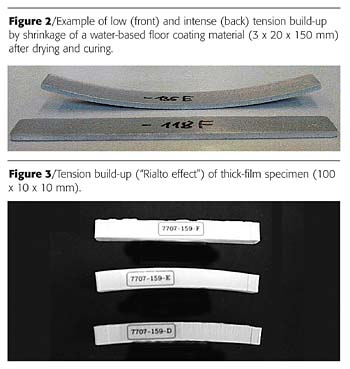
Shrinkage is a time-dependent variable, as the filming process does not proceed simultaneously in the entire layer. This means that the process of volume decrease does not take place in all three directions in space uniformly. In the direction of the film thickness there is an unimpeded shrinkage. Besides the volume contraction, a tension build-up may follow, which is produced by a time- and direction-dependent density change of the resin during the drying and curing process (Figure 2).


Significance of Shrinkage for the Application

As explained, the coating volume is reduced by chemical reaction, evaporation of solvents such as water, or regular molecule orientation. Unsaturated polyester, epoxy and polyurethane compounds show a considerable shrinkage potential (0.4 - 4.0 percent) in the course of the curing process. Particularly affected in these applications are all solvent- and water-based systems. In accordance with general observations, mainly traditional aqueous epoxy systems are susceptible to shrinkage. This particularly applies to thick-film applications at a layer thickness of more than 500 mm (Figure 3). The changes in internal stress may achieve an order of magnitude that produces crack formation or even peeling of the coating from the substrate.

Temperatures of above 25 °C may severely affect the dimensional stability of coatings. The faster curing process of the coating initiated by an increase in temperature frequently entails a more stress-oriented formulation component, which may again result in crack formation. Only a skillful selection of raw materials allows one to compensate for this impact.

Fillers and pigments may produce both positive and negative results. Spherical products have the advantageous property of reducing shrinkage. Fibrous fillers/additives impede the internal alignment of the molecules, thus decreasing shrinkage accordingly. Lamellar fillers, however, enhance in general the shrinkage behavior.

Dimensionally Stable, Shape-Retentive Aqueous Epoxy Coatings

Modern coatings are aqueous-based in order to facilitate handling, reduce health hazards, decrease danger of fire and explosion, and diminish VOCs. Moreover, Sustainability and Responsible Care are of fundamental significance for the selection of raw materials for coating materials.5 This is reflected among other facts by the enhanced employment of renewable raw materials or aqueous systems.

The development of dimensionally stable coatings is therefore an important objective for modern, water-dilutable epoxy resin coatings.

In contrast to solventborne systems, the specific feature of water-dilutable products is the evaporation behavior of water. Compared with, to a great extent, variably adjustable evaporation rates in solventborne systems there is only one single flash-off time. Correspondingly, the scope for developing a formulation for a dimensionally stable, shape-retentive epoxy resin coating is on the whole limited to the fillers and binding agents used.

In a variety of applications of aqueous epoxy resin coatings, the dimensional stability and consistency can be significantly increased by adding special pigments and fillers. An increase in the percentage of fillers induces a decreasing portion of resin used and thus also the moiety responsible for the shrinkage in the formulation. Usual dosages of fillers can be as large as 70 percent. A well-balanced adjustment of the binder with the fillers is however a prerequisite to achieve a stress-free coating with low-grade shrinkage. By controlled drying and curing conditions, coating shrinkage can be further minimized; these are nevertheless, particularly in construction, often not controllable.

An additional possibility is the chemical inclusion of flexibilizing components into the binder system. Figures 4 and 5 clearly show the change in the curing behavior of curing agents in aqueous epoxy resin systems. Figure 4 demonstrates a compact, impermeable resin matrix with significant shrinkage behavior as it can be achieved with customary hardeners. In comparison, Figure 5 depicts a foam-like structure as produced by modern curing agents. For this structure the volume shrinkage is essentially reduced by the cavities formed and at the same time the water loss facilitated by the pore structure.6


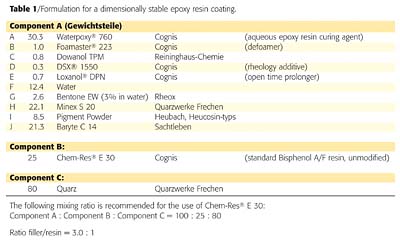
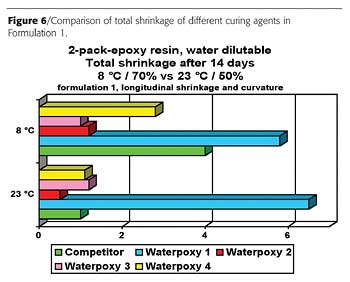
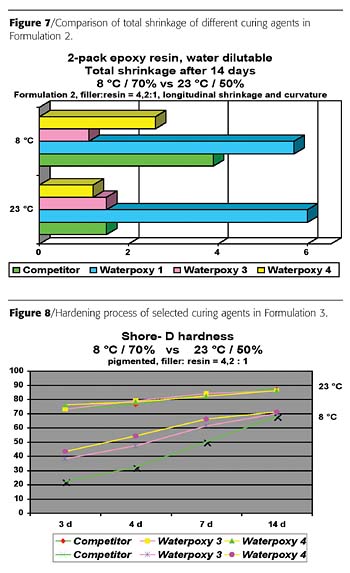
Ideally, the composition of binders, fillers and additives is effected in such an optimal way that the interplay of components entails an excellent dimensionally stable epoxy resin coating. Formulation 1 (Table 1) serves as an example for such a standard formulation. This self-leveling floor coating allows a shrinkage-free film thickness of up to 5 mm - a layer thickness that is today called for by many users. Figure 6 shows the standard formulation with several newly developed curing agents at temperature conditions of 23 °C and 8 °C. It becomes clear how the overall shrinkage can be decreased by chemical modification of the curing agent.

The result is corroborated in two additional formulations (Figures 7 and 8). Also the course of the curing process, based on the shore-D hardness, demonstrates that the shrinkage-free desiccation rapidly produces ready-to-use films.

Measurements have been made on rectangular and circular specimens. The dimensions were as follows: 1 x 1 x 10 cm; 0.5 x 10 x 20 cm; and 0.5 x 10 cm diameter. The overall change of the specimen, length, width and height alterations, was subject to the evaluation.


Summary

Test results revealed that modern water-dilutable epoxy systems allow thick-film and dimensionally stable, low-shrink coatings. It has been shown that the formulation largely influences the results. However, the formulator is easily able to achieve the expected results for coatings by means of a new modified curing agent.

It has to be emphasized that practice-oriented values are attainable even at unfavourable temperatures of 8 °C and increased atmospheric moisture for aqueous systems. This way, the demands by the user for practical, thick-film protective coatings are fulfilled. The same applies to legal and ecological demands for the solvent and VOC content of the formulation.

References
1 Hellrich/Harsch/Haenele, Werkstoffführer für Kunststoffe, C. Hanser Verlag München Wien, 8. Auflage, S. 447-452, 2001.
2 Svoboda, M.; Kuchynka, D.; Knapek,B.; Farbe + Lack, 77, 11, (1971).
3 Elias, H.-G.; Makromoleküle Bd 1, Hüthig & Wepf Verlag Basel, S 212-214 (1990).
4 Ruf, J.; Organischer Metallschutz, Vincentz Verlag Hannover, S 460-471, 1993.
5 Henkel KGaA, Hrsg., Nachhaltigkeitsbericht 2002, Düsseldorf (2003); Cognis Deutschland GmbH&Co.KG, Hrsg., Der Cognis Nachhaltigkeitsbericht 2002, Düsseldorf (2003).
6 Roloff, T.; Nagorny, U.; Epoxidharzgebundene Systeme - Wirkungsweisen, Eigenschaften, Anwendungsgebiete, 7. Seminar, Beschichtungen und Bauchemie, Kassel, Oktober 2003.

Share This Story

Looking for a reprint of this article?
From high-res PDFs to custom plaques, order your copy today!

Recommended Content

JOIN TODAY
to unlock your recommendations.

Already have an account? Sign In

  • pci1022-Kinaltek-Lead-1170.jpg

    A Novel Pigment Production Technology

    Following an extensive R&D program that demonstrated...
    Paint and Coating Pigments
    By: Jawad Haidar and Nitin Soni
  • pci global top 10

    2025 Global Top 10: Top Paint and Coatings Companies

    The following is PCI’s annual ranking of the top 10...
    Paint and Coating Market Reports
    By: Courtney Bassett
  • 2025 pci 25

    2025 PCI 25: Top Paint and Coatings Companies

    PCI's annual ranking of the top 25 North American paint...
    Paint and Coating Market Reports
    By: Courtney Bassett
You must login or register in order to post a comment.

Report Abusive Comment

Manage My Account
  • eMagazine
  • Newsletters
  • Online Registration
  • Subscription Customer Service

More Videos

Sponsored Content

Sponsored Content is a special paid section where industry companies provide high quality, objective, non-commercial content around topics of interest to the PCI audience. All Sponsored Content is supplied by the advertising company and any opinions expressed in this article are those of the author and not necessarily reflect the views of PCI or its parent company, BNP Media. Interested in participating in our Sponsored Content section? Contact your local rep!

close
  • colorful building exterior
    Sponsored byDow

    Insights into Exterior Architectural Coating Degradation: Bridging Accelerated and Natural Weathering

  • digital pigments
    Sponsored bySiltech

    The Fourth Dimension of Silicon: Siltech Q Resins

Popular Stories

Company News

What the AkzoNobel–Axalta Merger Means for the Future of Coatings

AkzoNobel and Axalta Headquarters

AkzoNobel and Axalta Announce $25 Billion Merger

Wacker logo

WACKER Plans More Than 1,500 Job Cuts

pci academy

PCI Buyers Guide

Submit a Request for Proposal (RFP) to suppliers of your choice with details on what you need with a click of a button

Start your RFP

Browse our Buyers Guide for manufacturers and distributors of all types of coatings products and much more!

Find Suppliers

Events

September 4, 2025

N-Butylpyrrolidone (NBP) as a Green Solvent to Replace N-Methylpyrrolidone (NMP) in Industrial Coating Applications

ON DEMAND: EPA published a regulation proposal around N-methylpyrrolidone (NMP) in June 2024 to ban or limit NMP in many applications, such as paints and coatings and their removers. N-butylpyrrolidone (NBP) is a powerful and versatile solvent for a variety of industries looking for alternatives to substance of very high concern (SVHC)-listed solvents.

March 24, 2026

The Manufacturing & Automation eXchange (MAX)

MAX presents a rare opportunity to observe the full scope of manufacturing in one environment. From systems integration and materials handling to automation, quality, safety, and packaging, each discipline is represented through live, operational displays. By experiencing these technologies side by side, as they are on actual production floors, attendees gain a grounded understanding of how manufacturing functions align, overlap, and evolve in practice.

View All Submit An Event

Poll

Longest-running laboratory experiment

What is the longest-running laboratory experiment?
View Results Poll Archive

Products

Automotive Paints and Coatings, 2nd Edition

Automotive Paints and Coatings, 2nd Edition

Now in its second edition and still the only book of its kind, this is an authoritative treatment of all stages of the coating process.

See More Products
pci voices from the top ebook

PCI webinar

Related Articles

  • pci1221-Cardolite-1219311003-1170.jpg

    Novel CNSL-Based Epoxy Curing Agents for Zero-VOC Floor Coatings and Underwater Cure Applications

    See More
  • Innovative Amine Curing Agents for Epoxy Resins

    See More
  • pci1220-Bitrez-627864824-Lead-900.jpg

    A New Generation of REACH-Compliant Ketamine Epoxy Curing Agents

    See More

Related Products

See More Products
  • marketsandmarketslogo.jpg

    Protective Coatings Market by Resin Type...

See More Products
×

Keep the info flowing with our eNewsletters!

Get the latest industry updates tailored your way.

JOIN TODAY!
  • RESOURCES
    • Advertise
    • Contact Us
    • Directories
    • Store
    • Want More
    • Manufacturing Division
  • SIGN UP TODAY
    • Create Account
    • eMagazine
    • Newsletters
    • Customer Service
    • Manage Preferences
  • SERVICES
    • Marketing Services
    • Reprints
    • Market Research
    • List Rental
    • Survey & Sample
  • STAY CONNECTED
    • LinkedIn
    • Facebook
    • Youtube
    • X (Twitter)
  • PRIVACY
    • PRIVACY POLICY
    • TERMS & CONDITIONS
    • DO NOT SELL MY PERSONAL INFORMATION
    • PRIVACY REQUEST
    • ACCESSIBILITY

Copyright ©2025. All Rights Reserved BNP Media.

Design, CMS, Hosting & Web Development :: ePublishing