Novel Matting Agent for Low-Gloss UV Coatings
Matting agents, or additives to increase surface roughness, have evolved over the decades based on a variety of sources, and include ground polymeric types to those based on silicon dioxide. This article focuses on those based on SiO2 from precipitated and gel processes, which are marketed specifically for the UV coatings segment. This coatings segment presents its own unique challenges to achieve low-gloss finishes because there is typically no solvent, little film shrinkage, and varying line speeds and curing conditions.
The combination of specific amorphous, synthetic silica combined with a specific polydimethylsiloxane surface treatment was found to improve matting efficacy, and a new product designed for low gloss, high transparency and low viscosity was developed for UV coatings. The new matting technology, noted as Matting Agent #4 (MA #4), will be compared to those currently available on the market.
Experimental Discussion
Matting Agents Studied
First we will outline the physical/chemical properties of the matting agents included in the study, and then review the formulation used and data pertaining to performance. Values tested include matting efficiency @ 60° and 85°, and viscosity build-up, which is a major consideration in UV coatings especially when trying to achieve low-gloss finishes in the area of 10 @ 60°. Other results presented pertain to transparency, surface smoothness and morphological differences in technology as assessed through SEM analysis of films.

|
| Table 1 Click to enlarge |
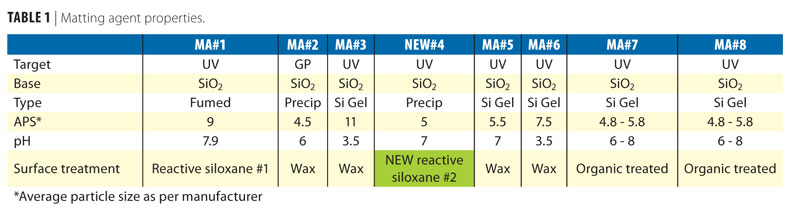
Table 1 compares the physical and chemical data of the matting agents studied. Matting agents of this class vary in particle size, pH, morphology and treatment type. The main innovation differentiating Matting Agent #4 from other current technology available is the new reactive siloxane treatment with acrylate functionality that adds greater compatibility in UV coatings systems.
Gloss and Loading Level
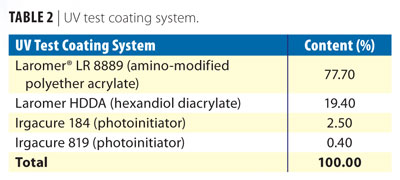
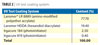
Matting agents were all added at varying levels to achieve a gloss of 15 @ 60°. Once the gloss level was fixed, matting efficiency, viscosity build-up and transparency were assessed. Table 2 shows the formulation used for the study.
|
| Table 2 Click to enlarge |
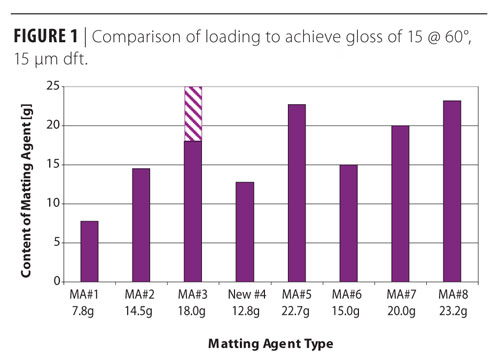
To achieve the desired gloss range, loadings varied for the eight grades tested from a low level of 7.8 g to a high of 23.2 g. Matting Agent #3 showed a very high viscosity increase when transitioning down from a gloss level of 25 to the target area of 15 @ 60°.

|
| Figure 1 Click to enlarge |
The higher formulation viscosity encountered presented several application problems, which is discussed in the SEM analysis later in this article. Figure 1 compares the loading differences to achieve the target gloss range.
Clarity
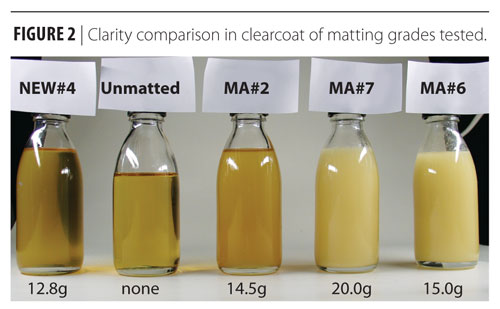
Clarity in the formulation itself is loading-level-dependent, however it is also a function of the treatment type. Figure 2 shows a visual comparison of grades tested. The point to note is the very high clarity of the system matted with the new technology designated MA #4. This high clarity is directly due to its novel acrylate functional siloxane treatment and the lower loading level needed to achieve the gloss target.
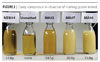
|
| Figure 2 Click to enlarge |
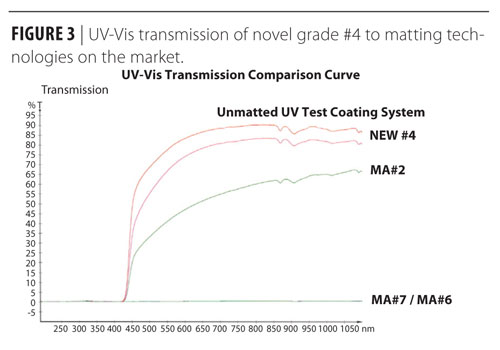
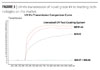
The UV-Vis transmission curve comparison in Figure 3 also demonstrates that even though there are 12.8 g needed to achieve this gloss range, there is little reduction in the transmission curve, and the shape mirrors, almost identically, the UV coating system with no matting agent.
|
| Figure 3 Click to enlarge |
Matting Efficiency
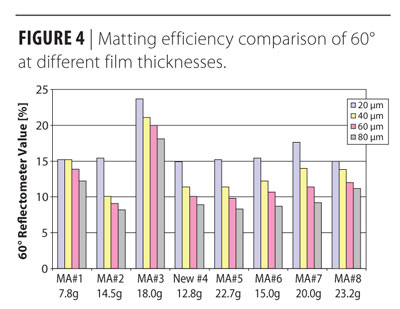
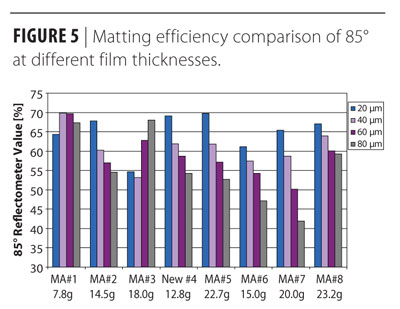
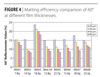
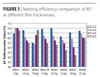
Figures 4 and 5 present the gloss data at 60° and 85° over four different film thicknesses of 20, 40, 60 and 80 microns. Coatings were applied by wire wound rod to BYK contrast cards No. 2854. Matting efficiency in UV systems is dependent on several factors, and certainly the physical/chemical properties of the matting agents themselves are influential.
Average particle size and surface treatment play a major role. The choice of initiator, level of oligomer reactivity, and curing line speed are also critical factors to consider when matting UV coatings.
|
| Figure 4 Click to enlarge |
Photoinitiators
The matting agents were added and dispersed after photoinitiators were added. They also can be premixed with monomers. Typically, dispersants are not suggested, as they could act to reduce matting efficiency.
|
| Figure 5 Click to enlarge |
Typically, fast line speed and highly reactive oligomers lead to higher gloss. Slower line speed, allowing for better orientation, combined with the use of lower reactive oligomers, will contribute to improved matting. In this system we worked with two different initiators from BASF, taking advantage of the different sensitivities to the wavelengths. Irgacure® 184 is used for shorter wavelengths, while Irgacure 819 (normally used for pigmented coatings) is used for longer wavelengths. In matted clear coatings the Irgacure 819 has an advantageous influence on the curing process for thicker films. This leads to higher film shrinkage and results in improved matting efficiency (lower gloss). Generally it is recommended to use these initiator combinations for thicker films.
An interesting trend for matting UV coatings, which differs from other types of coatings, is that we observed that gloss decreased as film thickness increased. In UV systems the higher the film thickness the higher the related film shrinkage effect. To achieve low gloss, the goal is to have the highest volume shrinkage combined with the highest packing density of matting agent. Film shrinkage, comparatively speaking for UV systems, is somewhat limited compared to other technologies, and we observed that finer matting agents were more effective to reduce 60° gloss in thicker films.
|
| Figure 6 Click to enlarge |
Viscosity Build
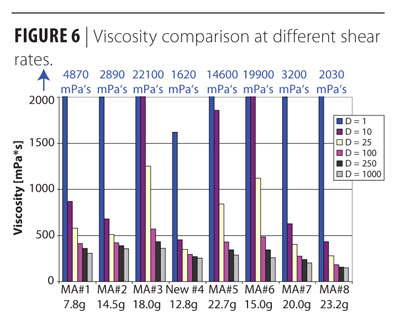
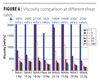
Another critical factor in matting UV coatings is the influence on viscosity build-up that results with some grades, mainly due to the higher loading needed to reduce gloss down to a very matte finish. Higher viscosity build has detrimental effects on application and overall appearance. Figure 6 reviews behavior of the eight products tested. The new MA #4 grade demonstrated the least influence, and after the very low shear rate of 1 sec-1, viscosity behavior was close to being Newtonian, in the range from 10-1000 sec-1.
Cured Films
|
| Figure 7 Click to enlarge |
Transparency
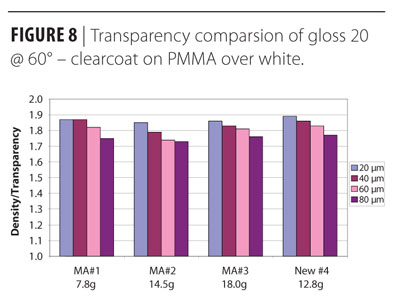
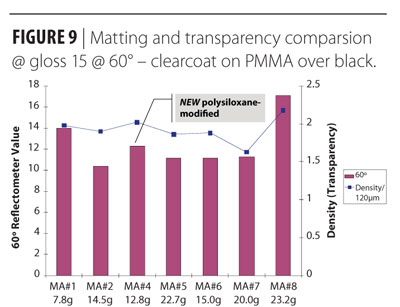
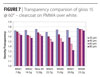
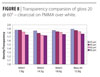
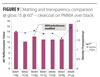
Cured coating transparency results are reviewed in Figures 7-9. Comparisons were made at different film thicknesses (20, 40, 60, 80 and 120 microns) and at two different gloss ranges (15 @ 60° and 20 @ 60°). To assess transparency, drawdowns were made over polymethyl-methacrylate (PMMA) panels at different film thicknesses. These matted, clear-coated panels (with the eight matting agents tested) were placed over both white and black contrast charts.
|
| Figure 8 Click to enlarge |
A densitometer was used to assess transparency. In both cases, transparency was measured over white and black contrast, and higher values indicate higher clarity/transparency. (For those not familiar with this type of test, the human eye can typically detect a difference of 0.1.) As expected, when film thickness increased, transparency decreased. With some grades, this difference was very minimal, however, with others the decrease was significant.
An overall very good transparency level was maintained using the new grade MA #4. In this case, MA #8 showed the best performance over thicknesses from 20-80 microns. This was also an unexpected result, given this grade required a high loading of matting agent to achieve the targeted gloss of 15 @ 60°. A significant reduction in transparency was observed at higher film builds with MA #7.
|
| Figure 9 Click to enlarge |
Surface Roughness
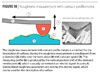
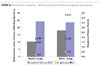
Surface roughness performance is summarized in Figures 10-12. Figure 10 describes the surface roughness (surface profile) measurement using a contact profilometer.
Roughness measurement, using contact profilometers, is used to describe coating surfaces. During the measurement, a needlepoint from a diamond (2) slides over the substrate (work piece) (5) with constant speed (3). The measuring profile (6) is produced by the vertical position shift of the diamond needlepoint (4), which is usually converted in an electric signal. As a result, standardized roughness parameters are detected by the electric signals, which can be used for the surface description. The resulting roughness values that are reported from this measurement are Ra and Rz.
|
| Figure 10 Click to enlarge |
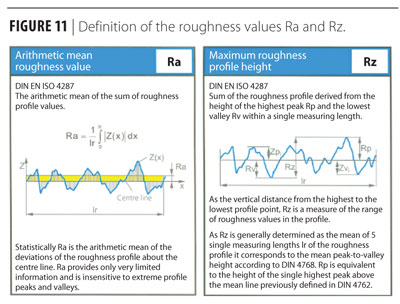
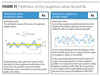
The Ra value is the arithmetic mean roughness value from the absolute value of all profile values of the measuring section. The Rz value indicates the distance from the highest peak to lowest part of the trough. These two values together give a description of the roughness by indicating whether there are few or many peaks (high roughness) and the depth of the peaks (whether they are shallow or deep troughs). The technical definitions of these values are given in Figure 11.
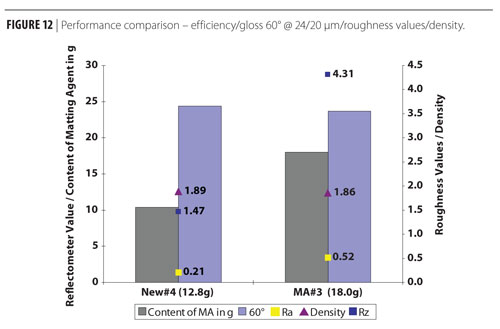
Results overall show (Figure 12) that the New MA #4 gives a balanced combination of high matting efficiency, with minimal roughness (lower Ra and Rz) values, indicating high surface smoothness with comparable high transparency.
|
| Figure 11 Click to enlarge |
Microscopic Analysis
|
| Figure 12 Click to enlarge |
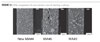
Photomicroscopy (Figure 13) indicates differences in morphology and particle distribution of the various grades included in this study. SEM analysis shows that this current technology targeted to matte UV coatings has highly angular and irregular shapes, with wide particle size distributions. Air bubbles can be easily observed in several cross sections of UV coatings matted with technology MA #6, and this can be attributed to the higher formulated viscosity encountered to achieve the target gloss level.
Conclusion
|
| Figure 13 Click to enlarge |
In summary, the new reactive siloxane-treated, precipitated silica technology represented by MA #4 gives the UV coatings formulator a new and novel option to achieve low-gloss finishes, while maintaining low application viscosity, high clarity and transparency, and achieving high surface smoothness.
This paper was presented at the RadTech 2010 Technology Expo and Conference, Baltimore, MD, www.radtech.org.
Looking for a reprint of this article?
From high-res PDFs to custom plaques, order your copy today!