Technology of Wood Finishing
Wood/Substrate Properties and Interactions with Coatings



Coatings, particularly wood coatings, are typically utilized to beautify and protect a substrate. Beautification is normally accomplished through adept color styling, generally through accentuating the wood grain with transparent stains and/or semi-transparent stains, or by applying an adeptly styled and designed opaque coating system. Protecting the beautified article may be accomplished by applying a clear or translucent coating system having physical properties such that environmental and/or use stresses that the item may be exposed to are sufficiently resisted in order to maintain the beauty and functionality of the item. The coating protection property is dependent upon the coating having adequate and uniform film build, proper physical properties, combined with longevity or durability of such physical properties. The coating beautification property is dependent upon the designed color and/or effect of the coating system, the coating having excellent flow and leveling, and, particularly for wood finishes, the coating system having excellent finish clarity or patina.
Finishing wood is an art and science that is based upon knowledge of the properties of the wood and the finishing materials. It is important to consider the properties of wood, its species, anatomy, color, chemical composition and extractives to successfully finish wood such that a beautiful, durable finish is obtained. In this regard, it is wise to consider the wood substrate as part of the finishing system.
Planes of Cut
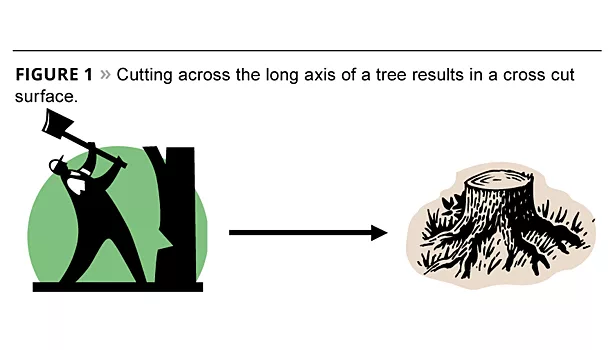
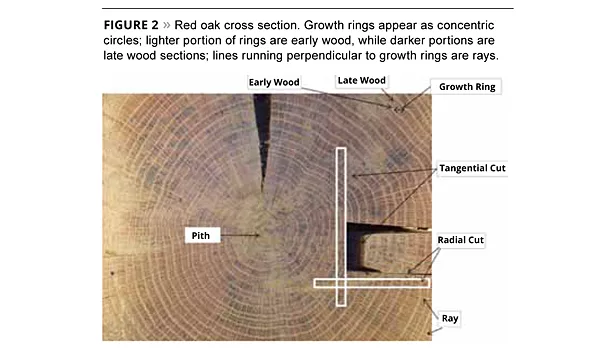
The properties of wood vary within a given species and among different species. Appearance and properties also vary due to growing season. Additionally, wood properties vary between types of woods, e.g., hardwoods (trees that produce enclosed seeds within flowers), and softwoods (coniferous wood). To complicate matters further, wood is anisotropic, that is, it behaves and looks differently depending on its plane of cut. Typically, we speak in terms of three planes of cut: cross cut, tangential cut (flat sawn) and radial cut (quarter sawn). Cross cut is produced by cutting across the long axis of the tree (Figure 1). This cross-sectional face is referred to as the end grain and is the cut shown in the plane of the paper in Figure 2. Growth rings appear as concentric circles while rays appear as radial lines perpendicular to the growth rings. A radial cut is a longitudinal cut made by cutting down parallel to the rays and perpendicular to the growth rings, as viewed in cross section. This cut extends from the outside to the center of a tree. Growth rings appear as straight lines. A tangential cut or flat sawn wood is a longitudinal cut made by cutting down parallel to the surface of the tree cylinder and growth ring boundaries and perpendicular to the rays, as seen in cross section. Growth rings appear as stacked V’s when this cut is viewed face on.
Anatomy of Wood
The anatomy of hardwoods and softwoods varies significantly. Table 1 summarizes the different cell types and their respective amounts between hardwoods and softwoods.
As can be seen from Table 1, the softwood tracheid (long fibrous lignified cells) make up 90-95% of softwood cell type; this cell type can extend great distances within the tree. Conversely, hardwoods have many different cell types that impact their appearance, properties and performance.
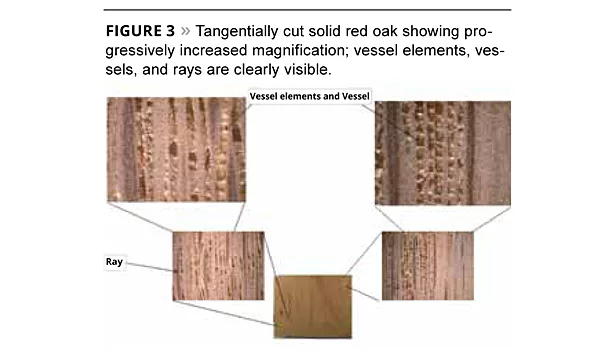
The vessel element is a distinguishing cell type of hardwoods. These are open-ended cells of variable sizes and shape with variable wall markings. They have relatively thin cell walls and large open lumens. The size of these cells ranges from about 0.05 mm to 0.3 mm in diameter and about 0.2 mm to 1.0 mm in length; shapes can range from tube-like to barrel shaped. Within a growth ring, early wood vessel elements are larger in size and have thinner cell walls; late wood vessel elements are smaller in size and have thicker cell walls. In a hardwood tree, these vessel elements exist as aggregates resulting from the stacking of the open ended vessel elements on top of one another to form relatively long pipe-like vessels. When viewed in cross section, these vessels are referred to as pores.
Figure 3 shows a tangentially cut face of solid red oak. In the zoomed-in image, one can easily see where the vessels have been sliced through and the outline of the vessel elements that make up the vessel. Additionally, one can easily see ray cells; this cell type is composed of a different chemical composition than the surrounding wood.
How Coatings Are Affected by Wood Anatomy
Figure 4 shows a cross sectional face view of the solid red oak portion. Early wood and late wood vessels/pores are easily visible along with rays. It is important to note that the pores are not circular, but are more oval in shape. One can visualize then that longitudinal planes of cut will always produce wood having cavities of varying sizes and shapes. This is because of varying cell types and sizes and the fact that longitudinal woody cells are hollow pipe-like structures. This is particularly important when considering requirements for staining and finishing the wood part, whether utilizing conventional solvent-based coatings, waterborne, or UV-cured coatings.
For instance, stain bleed-back (sometimes called stain spew out) and blistering can be a problem when finishing open pore woods. These defects appear to be due to stain and/or coating flowing into the pore of the wood, and, before completely drying, percolating back out of the pore, particularly when exposed to force-dry conditions. (Surface tension effects are important here as well, although outside the scope of this report.) Close examination of Figure 3 shows that when the wood is cut, some areas of the pores are only partially exposed; stain that flows down into a pore that is deeper or at such an angle that stain is partially covered will result in a slower stain and/or coating dry in that area. Additionally, if the stain is a UV-curable stain, decreased exposure to UV radiation for curing the stain will ensue. Subsequent exposure to infrared radiation from the UV reactor will result in stain blistering/bleed-back and/or blistering of the coating.
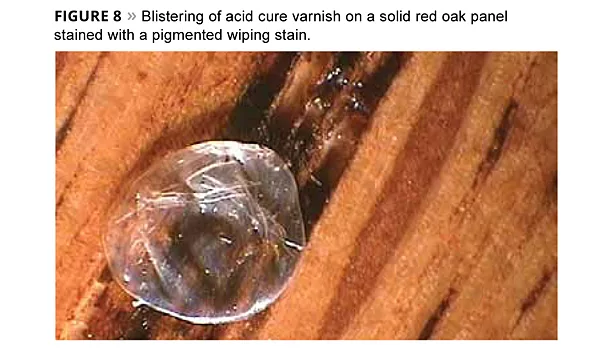
Figure 5 displays a red oak panel stained with a pigmented wiping stain that shows stain bleed-back. It is interesting to note that at the center of the many bleed-back defects, the wood appears fibrous in nature, and there appears an area of stained and unstained interconnected pore; stain appears concentrated in the fibrous region. Figure 6 displays another bleed-back area on the same panel; close examination of the bleed-back area coupled with coaxial polarized lighting reveals a very small pore hole approximately center of the bleed-back area. Close examination of Figure 7 reveals how certain pores are angled, resulting in a concentrated accumulation of stain in the pore under the surface of the wood. Further, the figure shows that the bleed-back defect area is several microns away from the main pore and appears to be associated with vertical wood cell structure at the defect area. Figure 8 displays blistering of an acid-catalyzed finish over a pore area, indicating that clear coatings are impacted by the anatomy of the wood as well.
Conclusions
Wood is an extremely variable substrate. Its appearance and properties are impacted by species, growth location, growing season, as well as how it is cut. These characteristics make it particularly challenging from a finishing standpoint. However, having a good understanding of the chemistry and anatomy of wood and how the properties of wood change with species and plane of cut, combined with a clear understanding of the science of finishing materials, will lead to a successful finish, one that beautifies, protects and is durable. In this short report, we have briefly discussed the properties of wood and how those properties can lead to appearance and performance defects of stains and coatings. Another critical area for future discussions is wood/water relationships. n
For more information, e-mail r.obie@woodcoatingsresearchgroup.com.
References
1 Wood Adhesion, A short Course. Presented by Virginia Tech University – The Wood-based Composites Center.
Looking for a reprint of this article?
From high-res PDFs to custom plaques, order your copy today!