Can Paint Films Disrupt Traditional Coatings?
The Expanding Role of Paint Protection Films for Surface Protection

Dr. Vickie Scarborough also recently joined PCI on our Coat It! podcast episode, “Can Paint Performance Films Replace Liquid Coatings?” to discuss how paint films are disrupting traditional coatings markets. Listen here.
As industries evolve under increasing demands for sustainability, performance and customization, new technologies are reshaping traditional practices. One such innovation is the rise of paint protection films (PPFs), also known as paint performance films. Originally developed for military applications, PPFs have grown into a versatile, high-performance alternative to conventional paints and coatings.
This transformation, driven by technological advancements and market shifts, is ushering in a new era in surface protection across automotive, aerospace, construction and energy sectors. How are these films disrupting traditional paint paradigms and offering sustainable, high-performance alternatives for a variety of industries?
The Origins and Evolution of PPF Technology
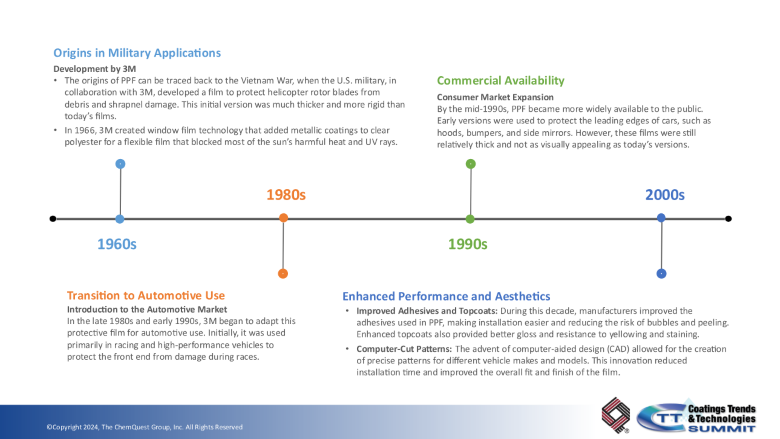
PPFs began their journey during the Vietnam War when the U.S. military collaborated with 3M to develop a protective film for helicopter rotor blades. These early films were rigid and thick, designed to withstand debris and shrapnel damage. Over time, 3M advanced its film technology by incorporating metallic coatings into clear polyester substrates to create UV-blocking window films.
By the 1980s and 1990s, this military-grade technology was adapted for civilian automotive use, especially in high-performance vehicles where the front ends of cars required protection during races. As technology improved, PPFs transitioned from a niche product into a consumer-grade application. The addition of improved adhesives and topcoats enhanced installation ease and durability, while the advent of computer-aided design (CAD) enabled precision-fit installations tailored for individual vehicle models.
FIGURE 1 | History of PPF technology.
 Credit: The ChemQuest Group, Inc.
The 2000s saw an explosion in innovation: polyurethane-based films offered better elasticity, self-healing properties and enhanced clarity, transforming PPFs from protective tools into style-oriented, high-performance solutions.
Advances in PPF Technology
Modern PPFs represent a convergence of material science, nanotechnology and manufacturing excellence. These films offer a multitude of functional and aesthetic improvements, including:
- UV-resistant coatings prevent yellowing and degradation, extending the film’s life.
- Nanocoatings provide hydrophobic surfaces, repelling water, dirt and environmental contaminants, which makes maintenance easier.
- Polyurethane development has led to films with superior elasticity, abrasion resistance and clarity.
- Self-healing polymers enable scratches to disappear under heat, maintaining the aesthetic appeal over time.
- Improved adhesives ensure strong bonding without damaging the underlying surface, while allowing clean removal.
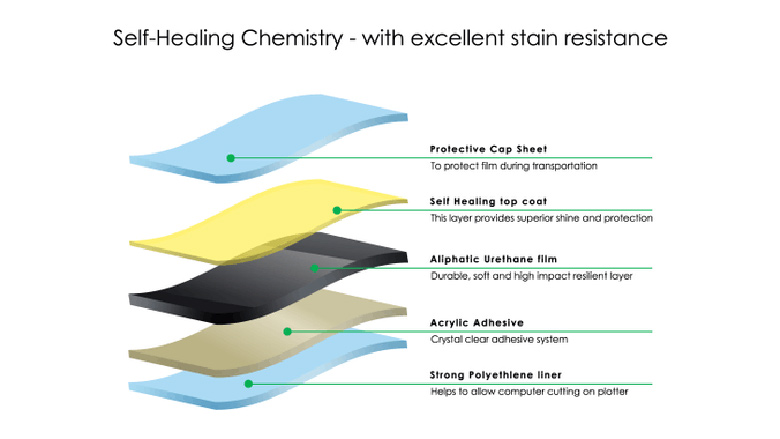
FIGURE 2 | Typical PPF construction.
 Credit: Gulf Coast Detailing Co.
These characteristics contribute to the perception of PPFs as more than just protective coatings. They are now a part of the integral design and performance elements in modern manufacturing.
Market Landscape and Growth
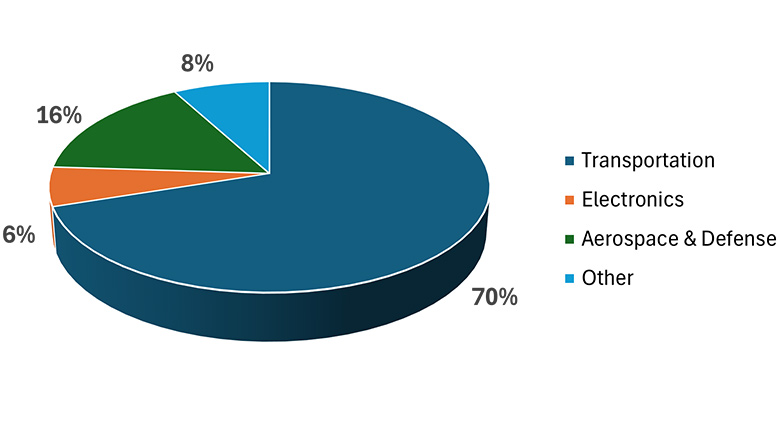
Globally, the PPF market is undergoing rapid expansion. Valued at an estimated $600 million in 2024, the market is projected to grow to $1.3 billion by 2030, with a compound annual growth rate (CAGR) of 6%. The transportation sector accounts for 70% of PPF applications, followed by aerospace, defense and electronics (see Figure 3).
FIGURE 3 | PPF market segments, 2024.
 Credit: The ChemQuest Group, Inc.
The dominance of aliphatic thermoplastic polyurethane (TPU), accounting for 85% of the market, highlights the material’s superiority in performance. First-generation films based on polyvinyl chloride (PVC) still exist, but they represent only 10%, while other materials like polyester and polypropylene comprise 5% of the market.
Major players in North America are innovating not only in film production but also in application methods, offering an edge in cost, performance and sustainability. The largest suppliers of PPF include 3M, Avery Dennison, Xpel, Eastman, CoreTech, Hexis, PPG, Orofol, Renolit, Premium Shield and Saint-Gobain.
Applications Across Industries
Automotive and Transportation
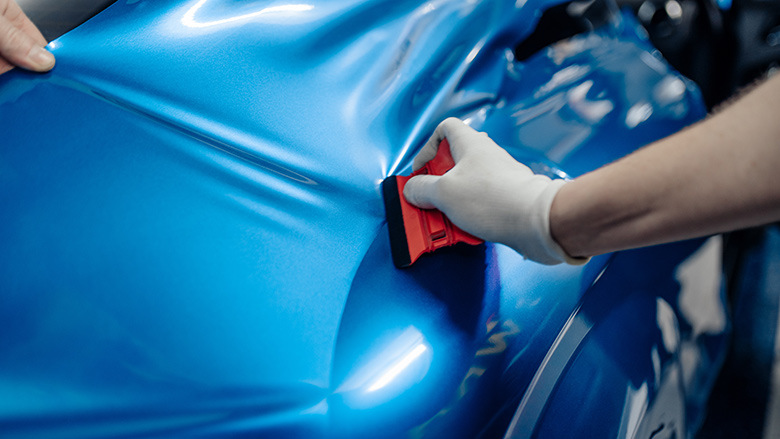
PPFs have emerged as cost-effective alternatives to traditional automotive paint jobs. While a high-end paint job may cost upwards of $10,000, a full-vehicle PPF installation can cost between $2,500 and $5,000 while offering better long-term value due to reduced maintenance. Moreover, PPFs reduce energy use associated with factory-applied liquid paint, which requires intensive drying and curing processes.
FIGURE 4 | Application of blue automotive PPF.
 Credit: hedgehog94 - stock.adobe.com
The flexibility of design with PPFs is also noteworthy. Unlike paint, films come in a wide variety of finishes—matte, gloss, mirror and even custom graphics—allowing for individualization and easier customization. High-quality wraps can last more than seven years, resist environmental damage and enhance resale value.
Interior automotive applications are also growing. PPFs are now used on dashboards, seat backs, door sills and consoles to protect against scratches, UV damage and wear.
For recreational vehicles (RVs) like motorcycles, boats, jet skis, snowmobiles and bicycles, PPFs offer a similar set of advantages, including quick installation, easy cleaning and improved durability, all while reducing environmental impact compared to repainting. PPF suppliers offer specialized graphics and patterns for every brand and model of RV.
Aerospace
The aerospace industry has embraced TPU films for their lightweight, high-performance attributes. These films are used for both interior and exterior components, seat covers, cabin panels, canopies and even wings. When embedded with graphics, PPFs reduce drag, save fuel and weigh less than a traditional painted system.
One notable innovation is the ability to embed electronics within films, enabling smart, connected surfaces for both civilian and military applications. Additionally, the high resistance of TPU films to environmental extremes makes them ideal for use in aircraft subjected to harsh weather and UV exposure.
FIGURE 5 | Numerous properties make PPFs ideal for aerospace applications.
 Credit: ricardoreitmeyer / iStock via Getty Images Plus
Built Environment
Beyond transportation, PPFs are finding applications in architecture and furniture. Films are now designed for use on doors, ceilings, walls and cabinetry. These architectural films are waterproof, mold resistant, scratch and abrasion resistant and free from harmful chemicals like formaldehyde and plasticizers. They also offer fingerprint-resistant and soft-touch finishes, broadening their appeal for high-end residential and commercial interiors.
Roofing applications represent another frontier. Passive radiative cooling films (PRCFs), such as those developed by 3M, mimic butterfly wing structures to reflect solar radiation and enable cooling without energy consumption. Materials absorb more solar energy during the day than they can radiate to the sky. At night, the surrounding environment cools the material to a temperature that is below the dew point.
3M’s PRCF reflects enough solar energy to allow passive radiative cooling to occur during the day. The film controls the refractive index by having alternating layers of birefringent polymers and isotopic polymers (PEN-PMMA) and are tunable and 99% reflective. This work was funded as an ARPA-E project in conjunction with Lawrence Berkley National Labs ($2.77 M). These films are being explored for use in buildings, vehicles and data centers to reduce cooling loads.
Anti-graffiti films also fall under the PPF umbrella. These serve as sacrificial protective layers on glass and other surfaces, enabling easy removal of vandalism without permanent damage.
Energy Sector
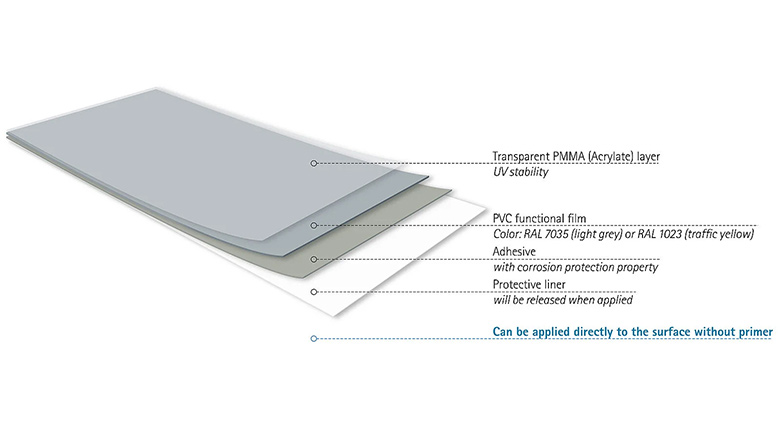
Wind turbines, especially offshore installations, benefit from PPFs’ corrosion resistance and ease of application. These films reduce maintenance costs, minimize downtime and comply with environmental standards, offering long-term durability of 10 years or more.
FIGURE 6 | Construction of anti-corrosion PPF for wind turbines.
 Credit: Renolit SE
In energy systems and refrigeration, passive cooling films developed by companies like Heat Inverse LLC leverage selective photonic emitters to radiate heat into the atmosphere. This innovative “reverse greenhouse effect” results in temperature drops of over 12.5°C without energy input, supporting sustainable cooling solutions in refrigeration, transformers and battery energy storage systems. These cooling films are aimed at reducing electricity consumption for air conditioning, refrigeration systems, transportation and data centers.
PPF as a Disruptive Technology
The core advantage of PPFs lies in their disruptive potential. Compared to traditional paints, PPFs require less energy to produce and apply, emit fewer volatile organic compounds (VOCs) and offer longer-lasting protection. They support sustainability goals through reduced greenhouse gas emissions, lower waste and improved energy efficiency. Key factors in the automotive industry to consider include:
- Factory paint spray booths can be a source of fire and explosion hazards due to the presence of flammable paints and solvents, as well as the potential for ignition sources, alongside risks of chemical exposure from airborne paint particles and toxic fumes if proper ventilation and personal protective equipment (PPE) are not used.
- Paint spray booths can be a major energy consumer, accounting for up to 90% of a body shop’s energy use.
- PPF manufacturers are developing eco-friendly formulations that prioritize environmental responsibility, free from harmful chemicals and solvents, making them safer for both the user and the environment.
In addition to these considerations, other key advantages of using PPFs include:
- Longevity (up to 10 years or more)
- Wide variety of aesthetic options
- Superior durability and ease of maintenance
- Abrasion, impact and UV resistance
- Self-healing and hydrophobic properties
Importantly, PPFs can be manufactured using extrusion and roll-to-roll processes—more efficient and less wasteful than conventional spray-paint systems. PPFs also share certain challenges with paint (namely, the need for careful surface preparation and skilled labor during application), but these are outweighed by their overall advantages in many scenarios.
Industry Examples and Collaboration
Major industry players are recognizing the potential of PPFs. For instance, PPG’s acquisition of Wörwag and subsequent formation of Advanced Surface Technologies (AST) with entrotech, Inc. and Aero Sustainable Material Technology reflects a shift toward embracing film-based solutions.
AST’s state-of-the-art facility in New Albany, Ohio, exemplifies the commitment to integrating film manufacturing into the coatings landscape. These collaborations between traditional paint companies and film innovators are setting a precedent for hybrid business models and portfolio expansions.
Redefining Expectations
Paint protection films represent a fundamental shift in how industries approach surface finishing and protection. Their evolution from military tools to high-tech commercial products reflects a broader movement toward sustainable, customizable and high-performance materials.
Across the automotive, aerospace, architecture and energy sectors, PPFs are redefining expectations around durability, aesthetics and environmental responsibility. With continued advances in materials science, such as bio-based formulations and embedded smart sensors, the next generation of PPFs will offer even more sophisticated functionality.
As the industry faces growing regulatory and consumer pressures to improve sustainability and performance, PPFs stand out as a forward-looking solution. Paint companies, film manufacturers and end users alike have an opportunity to embrace this disruptive technology, enabling the next era of smart, sustainable surface protection.
To learn more, contact the author at vscarborough@chemquest.com or visit https://chemquest.com.
Looking for a reprint of this article?
From high-res PDFs to custom plaques, order your copy today!