Rehabilitating a Municipal Water Tower with Protective Coatings
- How coastal exposure influenced coating system selection for a municipal potable water storage asset.
- Why epoxy primers and polyurethane topcoats were combined to balance corrosion resistance with long-term color and gloss retention.
- How stripe coating and elevated film builds were used to protect weld seams and high-risk corrosion areas.
- Where NSF-certified 100%-solids epoxy linings support potable water quality and extended maintenance intervals.
- What role color matching and application sequencing played in executing a technically complex exterior finish.
In Little Egg Harbor, New Jersey, a 500,000-gallon municipal water tower serving the Four Seasons at Sea Oaks retirement community underwent a comprehensive rehabilitation that combined protective coating performance with a highly detailed exterior finish. The project required close coordination between asset owners, engineers, applicators and coatings specialists to achieve long-term corrosion resistance while maintaining visual precision in a coastal environment.
The Little Egg Harbor Municipal Utilities Authority led the project with the goal of extending the service life of the structure while enhancing its visibility within the community. Execution involved collaboration among mural artist Peter Goetzinger and his son Orion, coatings applicator United Painters Inc., engineering firm Remington & Vernick Engineers and Sherwin-Williams Protective & Marine. The scope demanded both artistic accuracy and strict adherence to coatings performance requirements.
Exterior rehabilitation began with removal of deteriorated coatings to prepare the steel substrate for a long-lasting system. For corrosion protection, applicators applied Corothane I GalvaPac 1K primer, selected for its performance in coastal environments. Weld seams received stripe coating before application of a full coat of Macropoxy 646 epoxy to provide barrier protection against salt-laden air. The final exterior finish utilized Acrolon Ultra, a polyurethane topcoat engineered for ultraviolet resistance, color retention and long-term gloss stability.
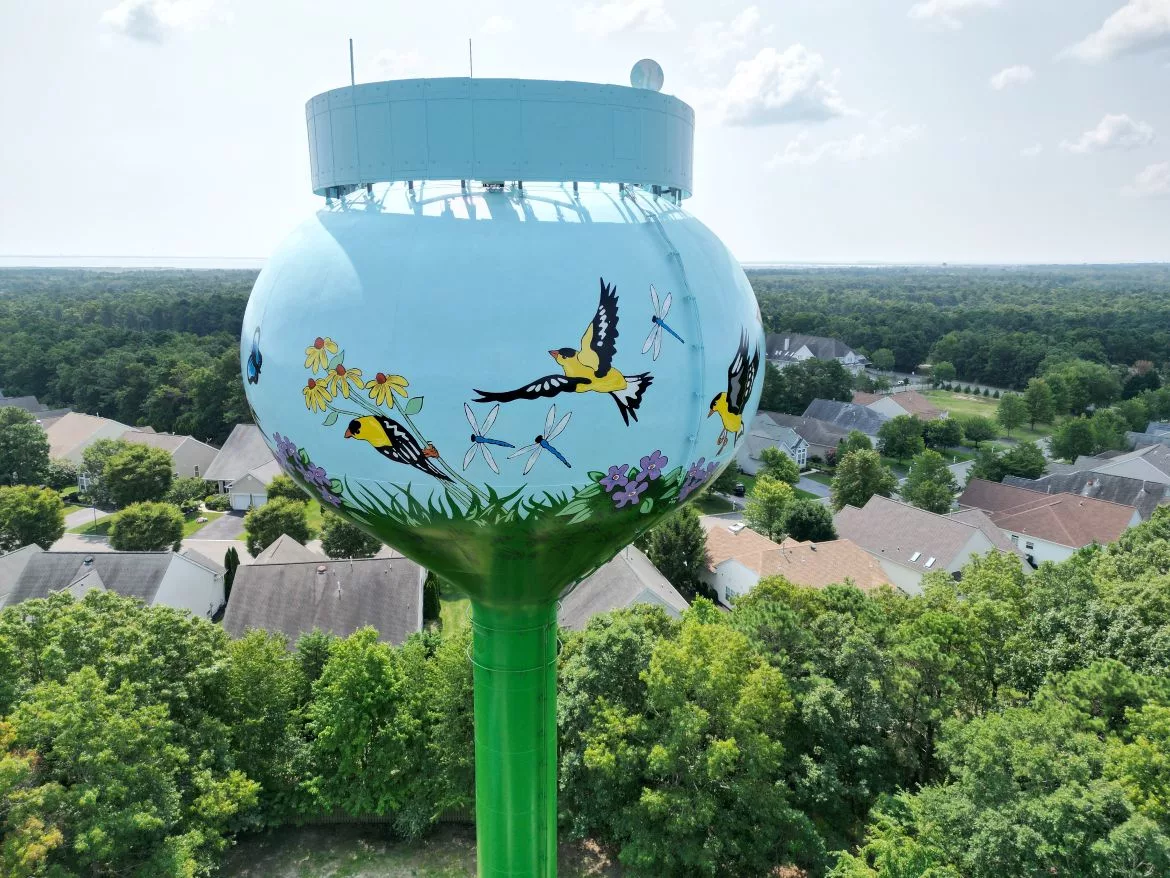
The exterior coating system also supported the execution of a 360-degree mural incorporating detailed wildlife imagery. Achieving realism required extensive color control and placement planning. The project used 21 custom-matched colors to capture natural tones without distortion under varying light conditions. Each element was positioned to maintain visibility from surrounding community vantage points while preserving continuity around the curved tank surface.
Interior rehabilitation focused on protecting potable water quality and extending lining service life. After minor structural repairs, applicators applied Corothane I GalvaPac 1K primer followed by stripe coating of Sherplate 600 on weld seams to ensure edge coverage. A full topcoat of Sherplate PW, a high-build 100%-solids epoxy lining, was applied at elevated dry film thickness to provide maximum protection in immersion service.
Both interior coatings were selected for low VOC content and NSF/ANSI/CAN 600 certification for potable water applications. Sherplate PW, which the utility authority had used successfully on previous tank projects, was selected to promote extended maintenance intervals and reduce long-term operational disruptions. Aligning interior and exterior coating durability allowed the authority to coordinate future recoating cycles on a shared 15- to 20-year schedule or longer.
Completed in 2024, the Sea Oaks water tower rehabilitation demonstrates how coating system selection, surface preparation and application control can extend asset life while supporting community-facing infrastructure improvements in challenging coastal environments.
Looking for a reprint of this article?
From high-res PDFs to custom plaques, order your copy today!