
Market Update: Near-Term M&A Outlook Is Improving

In this article:
- Chemicals M&A activity trends
- Private equity exit pressure
- Specialty materials consolidation
- Water treatment acquisitions
- Industrial chemicals deal flow
After recent market dynamics created uncertainty, business owners considering a sale are searching for ways to get comfortable when considering the timing of a sale process. Despite the year-to-date slowdown in M&A activity throughout the chemicals and materials value chain (largely due to uncertainty around global trade and tariffs), there are signs for optimism as we begin Q4 and head toward 2026. Market participants and leading indicators are pointing to an uptick in activity in the months ahead. For this edition of Grace Matthews Insights, we analyzed both market data and communications from industry executives to gauge recent conditions and the near-term outlook. The takeaways are encouraging.
The first half of 2025 was marked by a period of tariff-driven macroeconomic uncertainty that led many would-be sellers to hit the pause button on sale plans. Acquisitions (by deal count) of North American based chemicals and materials science companies declined more than 40% year-over-year. This occurred despite expectations for healthy levels of M&A activity as we entered 2025.
We view this as a classic case of supply and demand imbalance. While many potential sellers of businesses (supply side) stayed on the sidelines searching for clarity in market conditions and their own near-term outlook, potential buyers, both strategic buyers and private equity (demand side), remain well capitalized and eager to deploy capital.
We saw sequential improvement in transaction volumes in Q3 as conditions improved, and entering Q4, the tone throughout the industry is turning more optimistic. Based on our conversations with industry participants and a review of recent earnings transcripts from dozens of public company CEOs throughout the chemicals and materials industry, we note the following themes indicating where markets are today and where they may be headed:
- Temporary slowdown in M&A is bouncing back – The climate of uncertainty in the first half of the year caused many transactions to pause or delay as sellers waited for more clarity. This has started to turn, and deal activity is becoming more robust.
- Earnings remain healthy as tariff effects have been hit or miss – Despite the uncertainty, earnings remain steady. Tariff announcements and subsequent pauses or trade agreements have directly impacted some markets more than others, but companies are adapting quickly.
- M&A remains a priority, and strategic buyers are well capitalized – Corporate acquirers are ready to deploy capital, with a focus on smaller and highly synergistic bolt-on deals. Balance sheets remain strong, with average public company Net Debt to EBITDA ratios hovering at comfortable levels around 2.0x.
- Incentives to invest in the U.S. – Tariffs and an overall healthy economic environment relative to other geographies are creating incentives for reshoring and foreign acquisitions of U.S. companies.
- Private equity in need of exits – The average duration of current private equity investments is the longest it has been in at least ten years, increasing pressure to realize investments and return capital to investors.
- Emerging trends driving future M&A – Tailwinds to watch in the coming quarters that could accelerate M&A include interest rate reductions, massive investments in infrastructure to support AI, and the ripple effects of China’s anti-involution policy on cross-border trade.
Below, we expand on these themes by combining insights from industry executives and analyzing key market trends.
An Underwhelming First Half as Would-Be Sellers Hit Pause
Announced transactions in Q1 and Q2 2025 were off significantly from the same period in 2024. Acquisitions of North American chemicals and materials science companies declined over 40% during this period.
This came as a surprise to many forecasters (including Grace Matthews) who less than a year ago were anticipating a strong level of M&A activity in 2025, as interest rates were widely expected to continue to fall early in the year and a new administration, expected to be more pro-business, was set to take office. Needless to say, much has changed in the last twelve months.
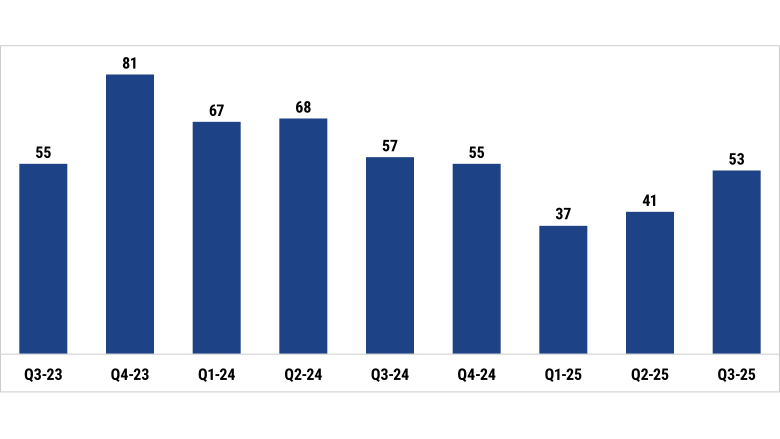
A key driver of the change in sentiment and resulting reduction in M&A volumes was the uncertainty created by U.S. and retaliatory tariffs. After the April 2 “Liberation Day” tariffs were announced, many potential sellers chose to focus on securing supply chains, implementing pricing initiatives, and assessing how customer demand might be impacted. As a result, the prevailing sentiment in the first half of the year was to wait and see, hoping that improved visibility and financial performance could lead to higher valuations and more deal certainty in the future.
Earnings Remaining Stable and M&A Outlook Is Improving
Fortunately, much of the negative sentiment and uncertainty has begun to subside, and activity has been increasing. M&A volumes rebounded in Q3 2025 and were on par with Q3 2024.
Despite the tumultuous tariff environment over the past several months, the overall chemicals and materials sector has navigated the situation quite well. Many industry participants were well prepared, perhaps because the last few years of industry shocks have hardened the chemical sector’s collective capability to weather uncertainty. Few have forgotten the COVID shutdowns, Texas freeze, supply chain shortages and inflation, and freight cost increases.
“Many of the headwinds are merely delays […] underlying drivers of long-term growth remain strong.” -Christian Koch, CEO, Carlisle Companies
When tariffs were enacted, companies took action quickly and creatively in efforts to mitigate their impact. Where necessary, companies have shifted trade flows to domestic or lower tariff sources, substituted away from disadvantaged raw materials, optimized inventory levels, and taken selective pricing actions. Due to these actions, effects have been largely secondary for many companies, though select sectors with greater exposure to foreign-sourced materials have seen more meaningful direct impacts. In our opinion, managers in the chemicals and materials sector have never been performing better, and they have had to considering the challenges they have faced.
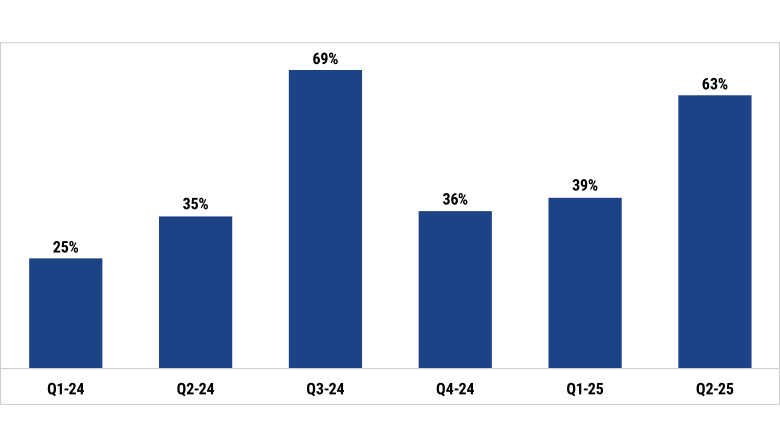
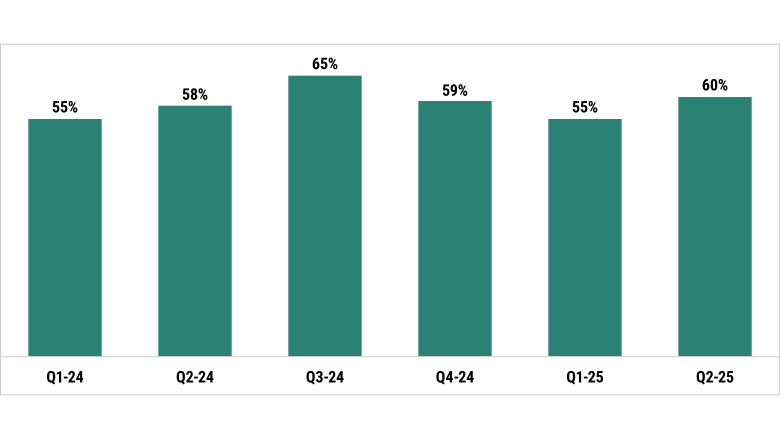
On net, many companies in the Grace Matthews Chemicals & Materials Index posted reasonable financial results through the first half of the year. The number of companies posting year-over-year EBITDA growth in Q1 and Q2 was consistent with 2024, hovering around 55–60% of companies. Interestingly, though not surprisingly, the number of companies posting revenue growth jumped significantly in Q2 2025, as companies quickly pushed through price increases as tariffs took effect. Prior to that, the majority of companies dating back to the beginning of 2024 had been posting revenue declines, indicating overall softness in the market.
Long-Term Fundamentals Remain Healthy: Multiple Drivers of Investment in the U.S.
On the topic of acquisitions, strategic buyers have remained committed to M&A, as investor pressure to demonstrate growth is ever-present. Sluggish organic growth in many markets tends to put even more pressure on large companies to pursue M&A.
Numerous executives have recently cited that their M&A pipelines remain robust, with a focus on disciplined capital deployment. While buyers are cautious about large-scale, transformative “bet the farm” acquisitions, they are eager to invest in smaller bolt-on deals. Key areas of focus include targets with obvious synergies, those that grow market share in high-value end markets and geographies, expand capabilities, and opportunistic investments that arise when market dislocations occur.
Enabling these investments, balance sheets and availability of capital have remained quite healthy. Net Debt to EBITDA ratios are hovering just under 2.0x for the Grace Matthews Chemicals and Materials Index, in line with historical averages. As a rule of thumb, Net Debt under 4.0x EBITDA is manageable, and many public companies unofficially aim to stay at 3.0x or less to preserve flexibility.
If borrowing costs decline, as some predict they will in the coming quarters, it will also help private equity buyers, who typically rely more on leverage than strategic buyers do to finance acquisitions.
“Reshoring is no longer a headline. It is becoming a funded reality.” – Michael Battles, Co-CEO, Clean Harbors
One aspect of the current environment that should not be overlooked is the incentives U.S. tariffs are creating for both reshoring of manufacturing and for international buyers to seek investments in the United States. Michael Battles, Co-CEO of Clean Harbors, commented during their second quarter earnings call that “reshoring is no longer a headline. It is becoming a funded reality.” The firm is seeing this play out in several recent and ongoing projects.
Two closed engagements earlier this year involved a U.S.-based business that was acquired by an international buyer, one headquartered in Germany and another in India. In both instances, the acquirers had a limited presence in the United States and were seeking to establish a manufacturing footprint. The current environment only seems to be accelerating the growth in cross-border M&A that has been on the rise in recent years.
Private Equity in Need of Exits
Another driver of near-term activity is the growing backlog of private equity investments. According to Pitchbook, the median holding period for private equity backed companies in the United States is now up to 3.8 years, the longest it has been in at least ten years. The acceleration from the end of 2024 to June 2025 is quite remarkable and another indicator that very few private equity firms exited investments in the first half of the year.
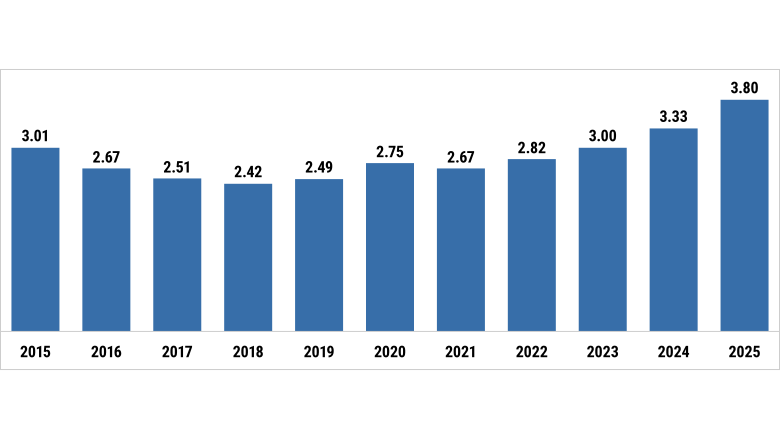
It is obvious that private equity firms have viewed market conditions for selling a business as sub-optimal in recent years. However, the upward trend we are seeing will have to reverse at some point as pressure to return capital to investors grows. Grace Matthews is already seeing and hearing of an increasing number of private equity platforms being brought to market as we approach the end of the year.
Other Trends Driving Future M&A
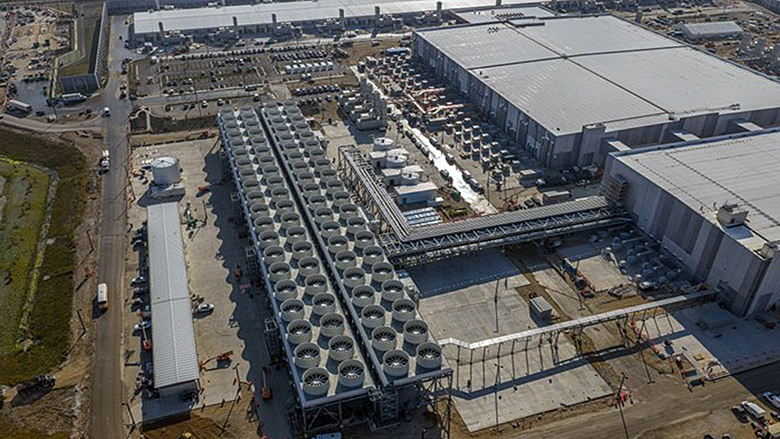
Another noteworthy development is the artificial intelligence boom. Serving this rapidly growing market requires huge investments, almost all of which require chemicals and materials inputs.
For example, Microsoft’s latest AI data center in Mt. Pleasant, Wisconsin, called Fairwater, spans 315 acres and has 1.2 million square feet under roofs, 46 miles of deep foundation piles, 120 miles of underground cable, and 72 miles of mechanical piping. The inputs required to build and maintain something like this are extensive: building products and construction chemicals for foundations and structures, metals and metal treatment chemicals for steel piping and structures, water treatment and refrigeration chemicals for cooling towers, fire suppression systems, diesel fuel and lubricants for generators, and cleaning chemicals for server rooms to reduce static and prevent dust buildup, to name just a few.
This phenomenon has and will continue to provide a boost in demand for companies serving these markets for years to come. Longer term, AI infrastructure will also create competition for electricity, raising potential issues for other energy consumers, including chemicals and materials manufacturers.
Other factors that can influence business owners’ confidence in launching sale processes include interest rates, consumer confidence, and housing starts. In the longer term, Grace Matthews is also monitoring factors impacting cross-border trade and global production capacities.
Specifically, as a result of higher U.S. tariffs on Chinese imports, many European companies allege that they are seeing an influx of Chinese producers dumping products into their markets. Yet another long-term variable is the potential ripple effects of China’s anti-involution policy, the Chinese government’s agenda to reduce overcapacity and price wars by promoting an orderly exit from outdated capacity. This will take time for its effects to be felt but could have positive implications for higher-cost-of-production North American and European producers in markets threatened by low-cost Chinese suppliers. If meaningful capacity truly is taken out of some markets, this could provide a strong tailwind for Western producers.
Looking Ahead: A Reason for Optimism
Looking ahead, Grace Matthews is optimistic that M&A activity will accelerate over the coming 12–18 months. The firm sees more factors pointing potential sellers to launch sale processes than those causing them to continue to wait.
The fundamental drivers of M&A in chemicals and materials remain intact. Amid all the uncertainty throughout 2025, companies have proven to be quite resilient, despite slower organic growth. Large strategic buyers need acquisitions for growth. If anything, slower organic growth has made acquisitions even more important as growth catalysts.
Likewise, private equity’s appetite for deals is not going anywhere, and firms will increasingly turn to becoming sellers as they work through their growing backlogs.
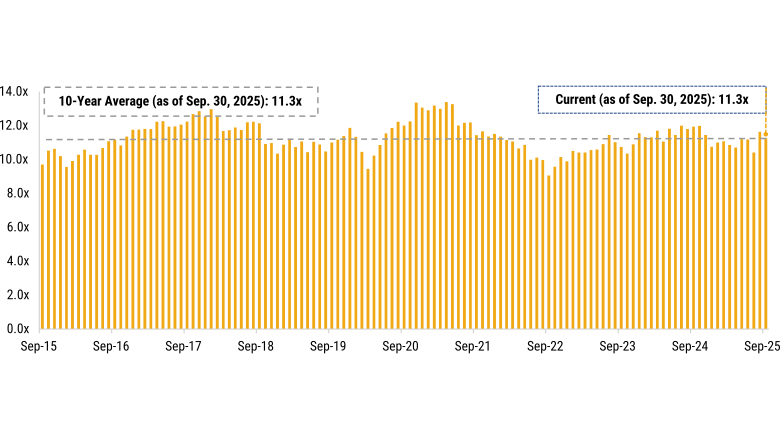
The Grace Matthews Chemical & Materials Index tracks the Enterprise Value / EBITDA ratios (EV / EBITDA multiples or EBITDA multiples) of approximately 100 publicly traded chemicals and materials companies that span multiple sub-sectors and geographies. The Index aggregates the latest reported financial data and stock prices and tracks valuation trends and operating metrics across different industry sectors. Index averages are equally weighted, as opposed to weighting by market capitalization. The current multiple (as of September 30, 2025) is 11.3x, which is in line with the 10-year average of 11.3x.
Grace Matthews is recognized globally as a leader in transaction advisory services for manufacturers, distributors, and service providers across the chemicals, materials science, and life sciences value chain. Grace Matthews’ clients include privately held businesses, private equity funds, and large multinational corporations. Each quarter, Grace Matthews publishes its newsletter, which covers a wide range of M&A-related topics, including current market trends, transaction considerations for buyers and sellers, and profiles on different industry segments.
For more insights on market shifts shaping the industry, explore our coverage of Market Reports.
Looking for a reprint of this article?
From high-res PDFs to custom plaques, order your copy today!