Elevating Performance Across the Coatings Landscape
How Robust and Diverse Resins Offer Versatile, Trend-Aligned Solutions
Inside this article:
- Advanced resin technologies are enabling architectural coatings to meet rising expectations for durability, hiding efficiency and sustainability while maintaining application performance across diverse environments.
- Composite-forming and TiO₂-adsorbing polymer binders can improve pigment efficiency and allow formulators to reduce TiO₂ loading while maintaining equivalent hiding and barrier performance.
- All-acrylic resins provide excellent scrub resistance, gloss and tint retention and long-term exterior durability due to their resistance to UV-driven polymer degradation.
- Self-matting acrylic resins bridge the durability of higher-sheen coatings with the aesthetic qualities of flat paints, enabling stain resistance without sacrificing low-sheen appearance.
- Vinyl acrylic binders support cost-effective interior formulations that meet contractor-grade and MPI specifications while maintaining good hiding and formulation flexibility.
- Bio-based acrylic emulsions and optimized TiO₂ usage are helping coatings manufacturers improve life-cycle assessment profiles and reduce carbon footprint without compromising performance.
The architectural coatings market is experiencing rapid evolution as consumer expectations, regulatory pressures and sustainability demands reshape how coatings are formulated and positioned. There is significantly more emphasis on adding label claims and functionality to address consumer and painters’ needs, moving beyond incremental improvements toward more step-out changes and driving new technology development and evolution.
There is a new bar for traditional performance expectations in interior and exterior coatings, including stain resistance, exterior durability, scrub resistance, and tint and gloss retention. In addition, new claims are emerging to address consumer demands for simplification, eliminating steps, expanded application windows and longer intervals between repainting. Popular paint label claims now include early rain resistance, scuff and mar resistance, one-coat hide and expanded application windows. Beyond paint performance, sustainability in coatings has evolved beyond regulatory compliance. Paint manufacturers are increasingly focused on addressing broader environmental challenges, such as carbon footprint reduction, removing harmful materials from indoor air and decreasing reliance on fossil-based feedstocks. For consumers, sustainability translates into claims around plant-based materials, improved indoor air quality and various green certifications. By pushing the boundaries of innovation through key raw materials, paints can deliver on consumer expectations—enhanced durability, scuff and stain resistance, ease of application across diverse environments, while keeping sustainability at the forefront of formulation and use.
Today’s architectural paints are highly complex materials that protect and beautify structures while delivering ever-increasing functionality. These paints are multiphase systems that primarily consist of polymeric binders, pigments or extenders and water. The polymeric binder, which is often synthesized from acrylate, styrene, or vinyl monomers, is the component that binds all the paint ingredients together in the final film. The polymer binder is typically responsible for many of the critical dry film properties of paint such as stain resistance, washability, substrate adhesion and many more. Pigments and extenders also contribute significantly to paint performance, offering opacity and ultimately the ability to hide the substrate. They can also be used to alter the color of the paint film for decorative purposes. Raw material suppliers and paint producers are removing ingredients that have become materials of concern, and this can often result in compromised performance if a suitable replacement is not available.
Interior Trends: High Hiding, Long-Lasting, Scuff and Stain Resistance
Traditionally, DIY painters and professional painters have looked for slightly different qualities in interior paint. DIY painters expect interior paints to offer a range of sheens, be tintable to their color of choice, be easy to apply, require as few coats as possible while effectively hiding the previous color, and last long enough that the only reason to repaint is to change the color. Professional painters’ performance expectations are centered on efficiency to complete the job and achieve a flawless finish. They value qualities such as application experience, speed of application, good coverage, ability to spray, good touch-up performance and overall durability to reduce customer call-backs. While these properties remain baseline expectations in the interior segment, emerging trends among formulators and consumers are driving new, market-differentiated performance and sustainability profiles.
Credit: Scovad / iStock via Getty Images Plus
DIY painters are seeking interior paints that offer durability profiles typically associated with higher-sheen paints, such as scuff and stain resistance, while maintaining aesthetic properties of lower-sheen paints, including improved hiding of surface imperfections and a softer appearance. DIY users also care about how their paint choice can impact, and ideally improve, indoor air quality. Professional painters have an increased focus on speed of application, which helps maximize productivity and completion of projects without compromising the quality their customers expect. They also perform a broad range of jobs, from residential repainting to new construction or commercial projects, and often select paints based on the specific job requirements and problems they are trying to solve. For example, when painting a bathroom, a contractor may look for a paint that can withstand high humidity and resist surfactant leaching. When repainting kitchen cabinets, a contractor is likely to choose a paint that sprays well and provides a smooth, durable finish with excellent adhesion. In short, professional-grade paints are typically formulated to deliver a specific property as opposed to an overall balance of film properties.
Exterior Trends: Durability, Early Weather Resistance and Application Flexibility
Excellent durability is the performance trend for exterior coatings that prevails above all else. Durability can be defined as long-lasting adhesion, robust resistance to moisture, mildew and UV exposure, the ability to withstand temperature fluctuations and more. Tint retention and dirt pick-up resistance are among the most popular label claims for exterior formulations, and the market continues to push toward the development of increasingly durable paint formulations that maintain their originally painted appearance for longer periods. While durability will continue to be a key trend in the exterior segment, paint formulators and consumers are showing growing interest in more specialized performance attributes, including self-cleaning finishes, early rain resistance and extended application windows. These features support both DIY and contractor users by addressing specific regional climate challenges and offering consumers more flexibility to apply the paint independently of weather conditions.
Credit: Radoslav Cajkovic / iStock via Getty Images Plus
A Versatile Chemistry Toolbox Meeting Market Demands
A resin portfolio that spans acrylic, vinyl acrylic, styrene/acrylic polymers and a range of functional technologies built into the resins offers solutions for every architectural coating’s formulation. A comprehensive resin toolbox gives formulators flexibility to meet both performance and economic targets across quality tiers. Composite-forming binders and acrylic polymers provide high-quality film formation, improved hiding, excellent adhesion and long-term durability across interior and exterior applications. The introduction of new biocarbon-based acrylic polymers addresses emerging needs toward a more circular economy and can contribute to carbon footprint reduction. Self-matting acrylic resins represent a new category of all-acrylic matting products with a unique performance profile targeted for higher sheen-level durability properties in a lower-sheen appearance.
Vinyl acrylic resins offer versatile options based on different compositions and polymer properties to meet contractor-grade targets, including MPI specifications and cost/performance balance in formulation.
Resins targeted for interior applications typically provide:
- Hiding
- Potential for TiO₂ reduction in the formulation without compromising performance
- Scuff and stain resistance
- Low emissions [CDPH Standard Method V1.2-2017 (California 01350 version 1.2)], low bulk VOC profiles (ASTM D-6886), and potential for carbon footprint reduction
- Functionality to improve Indoor Air Quality (IAQ) through formaldehyde abatement (JCT-1074 testing standard)
- Blendability across different resin chemistry for higher performance at attractive economics
Credit: piovesempre / iStock via Getty Images Plus
For the exterior coatings segment, robust resins offer:
- Durability beyond hiding
- Adhesion across different substrates
- Paint and primer properties
- Crack and blister resistance in harsh weather
- Tint retention
- Dirt pick-up resistance
- Low-temperature film formation
Composite-Forming Polymers
For paint formulators, there are significant benefits to optimizing the use of TiO₂. Beyond its high cost, TiO₂ is often one of the largest contributors to the carbon footprint of a can of paint. In some higher-sheen grades (high gloss and semigloss) and certain paint bases, TiO₂ can account for 50% of the paint’s total carbon footprint.1 Accordingly, life-cycle assessments (LCAs) have shown that reducing TiO₂, or using it more efficiently, can reduce the carbon footprint of the paint. In addition, excess TiO₂ can have a deleterious impact on coating performance, as it may agglomerate and compromise the barrier properties of the final film.
Figure 1. Composite paint films distribute TiO₂ particles more evenly than conventional coatings, producing smoother surfaces and allowing lower pigment loading while maintaining hiding performance.
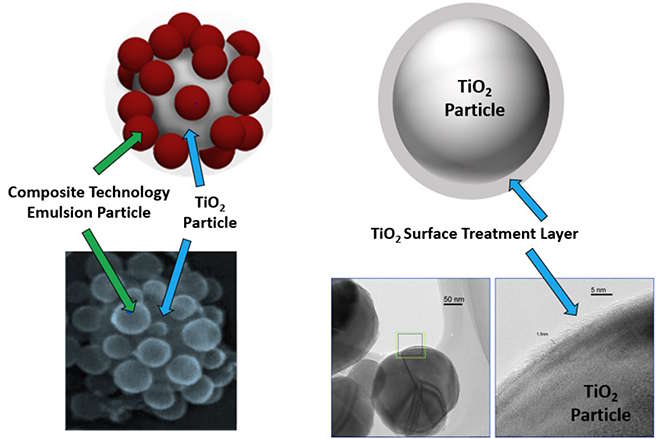
The green arrows are delineating the composite technology emulsion particles; the blue arrows are for TiO2. Credit: Dow
Composite-forming polymers are known for their ability to increase pigment efficiency while enhancing film properties. TiO₂-adsorbing polymers utilize a precisely engineered polymer binder morphology that is achieved through both the molecular structure of the polymer binder and the emulsion polymerization. This morphology is predicated on the ability to precisely control chemistry at the nanometer scale. As a result of the polymer composition and manufacturing process, the functionality that enables this technology can be concentrated at a specific location on the particle surface in a reliable and reproducible manner.
Figure 2. Composite technology emulsion particles interact with TiO₂ pigments to control dispersion and improve pigment efficiency through engineered polymer morphology.
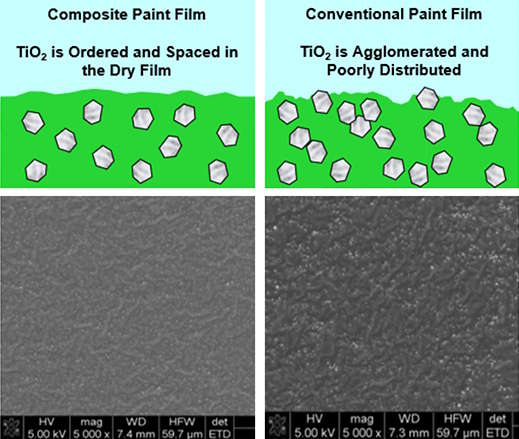
The paint made with composite technology has a smoother surface, and less TiO2 is needed to maintain the performance of the coating. Credit: Dow
This polymer morphology results in a unique, high-performance material that addresses multiple critical market needs while allowing paint formulators to use 15–20% less TiO₂ while maintaining equivalent hiding. Additionally, this morphology can enable higher-solids formulation that requires less water and energy to manufacture and transport.
By offering a more durable film, these resins support exceptional hiding and coverage despite reduced TiO₂ loadings, enhanced barrier properties, and increased resistance to dirt pickup and humidity. This makes composite-forming resins most suitable for high-quality segments seeking high-end performance coupled with TiO2 reduction benefits.
All-Acrylic Polymers
Acrylic binders underpin both interior and exterior coatings with robust performance attributes characteristic of acrylic chemistry, while offering versatility to meet nearly any formulation target. All-acrylic resins are easy to formulate and deliver excellent scrub and stain resistance, color acceptance, gloss and tint retention, enhanced water resistance, crack resistance and film flexibility, all critical for maintaining long-term film integrity for interior and exterior conditions.
For exterior durability, polymer binder degradation is driven by a combination of UV light, water and oxygen. This process is complex, with multiple degradation pathways that can occur. Most organic polymers, including the polymer binders used in architectural coatings, absorb radiant energy across a range of wavelengths. As wavelength decreases, energy increases to the point where chemical bonds can be cleaved. This bond cleavage generates highly reactive radicals, which can induce further damage to the polymer in the coating film (Figure 1). UV radiation has sufficient energy to disrupt the chemical bonds in these organic polymers.
Tighter, more highly reinforced films formed with acrylic resins also limit permeability to water and oxygen. Both components play a multiplicative role in radical generation and in the transport of radicals within the polymeric binder.
These properties make 100% acrylic binders a great option for both high and standard quality formulations across architectural coating applications. All-acrylic resins are also distinctly developed for specialty architectural waterborne coatings, ranging from high-gloss finishes to primers to exterior wood stains, garage floor coatings and more.
Plant-Based Polymers
Newer to the family of architectural coatings resins are 100% acrylic emulsions that incorporate plant-based feedstocks, measured through C-14 testing using ASTM D-6866 method, supporting a reduced carbon footprint without compromising on the performance expected from acrylic resins.
Credit: HHLtDave5 / iStock via Getty Images Plus
Self-Matting Polymers
Lower-sheen paints, such as matte or flat paints, tend to be products with higher pigment volume concentration (PVC) due to their ability to mask surface defects in the building substrate, and their uniform appearance. Despite these performance advantages, lower-sheen paints are generally more susceptible to scuffing, staining, and marking compared to higher-sheen alternatives, which can induce a change in the visual appearance of the final film. In addition, attempts to clean scuffed or stained surfaces with a sponge or damp cloth can further impact color or visual appearance of the surface. Self-matting 100% acrylic resins represent a distinct technology that bridges durability and stain resistance of higher-sheen paints with desirable application and appearance properties of flat or matte paint. This is achieved by enabling the development of a precisely engineered surface with controlled topography that is generated during the film-formation process.
These resins also allow for the removal of traditional inorganic extenders while boosting performance, supporting grind-free formulation and truly distinct paint formulations. Eliminating traditional extenders can have significant downstream benefits for paint manufacturers. The use of this self-matting technology allows the manufacturer to eliminate the grinding step, which saves time in the production environment while simultaneously simplifying the overall formulation through the removal of additional raw materials in the final product. Additionally, the removal of inorganic extenders and fillers results in lower-density paints, which can translate into tangible benefits in ease of transportation and application.
Vinyl Acrylic Polymers
Vinyl acrylic polymers offer performance-balanced coatings for cost-effective options without sacrificing essential properties. Targeted toward standard and economy paint segments, vinyl acrylic resins offer high solids content, good hiding, and the formulation flexibility needed for economy and contractor-grade paints. With a focus on meeting MPI specifications, these resins also support Green Buildings specifications which focus on durability, environmental responsibility and resource efficiency.2 While acrylics remain the gold standard for exterior durability and vinyl acrylic polymers are not designed for outdoor applications, their favorable cost-to-performance balance makes them well suited for meeting multiple MPI specifications.
Different resin technologies can be paired with strategically selected additive packages to further enable tailored application properties across a range of functional performance targets, including applied hiding, sag-leveling balance, thickening efficiency, shear-thinning rheology and improved water resistance.
The versatility of a coating materials portfolio ensures resin families can be tuned for specific performance profiles and strategically paired with additive packages to optimize formulations across coating types, from premium high-gloss paints to durable, scrubbable flats to contractor-grade wall paints.
Supporting Innovation and Future-Forward Solutions
A strong innovation pipeline for architectural coatings spans interior, exterior and specialty segments with continued investment in research and development to push performance boundaries through different technology and functionality approaches. Resin innovation remains focused on enhancing durability and enabling new functionalities that address evolving consumer demands. A robust resin portfolio, including composite-forming polymers, all-acrylic polymers, biobased resins, self-matting technologies and vinyl acrylic polymers, continues to expand step-change improvements in durability, stain resistance, early rain resistance, and scuff and mar resistance. As sustainability becomes increasingly central to innovation, greater emphasis is placed on addressing environmental challenges through resin technology without sacrificing durability. By reducing TiO2 usage, all acrylic resins can support improved LCA profiles and reduced environmental impact.3,4
Powering Customer Success Beyond a Strong Product Portfolio
Coatings resin innovation can be further reinforced by technical service capabilities, supply chain scale and global manufacturing footprint. Investments in high-performance chemistries, advanced waterborne resins and silicone-acrylic hybrids are designed to meet evolving market expectations for durability, sustainability and ease of application. This end-to-end ecosystem, from polymer design to formulation expertise, positions raw material suppliers as trusted partners to formulators worldwide.
References
¹ British Coatings Federation Ltd. Demystifying “Eco” Paints. https://coatings.org.uk/page/DemystifyingEcoPaints.
² U.S. Environmental Protection Agency. Green Building. https://www.epa.gov/smartgrowth/green-building.
³ Kheradmand, H. Comparative Life Cycle Assessment (LCA) of Water-Borne Paints for Internal and External Wall Decoration and Protection; Presentation to Peers for Project Review, Dow Coating Materials (DCM) EMEA: September 20, 2011.
⁴ Trapani, A.; Bleuzen, M.; Kheradmand, H.; Koller, A. The Use of TiO₂–Polymer Composites to Lower Environmental Impact and Improve Performance of Waterborne Paints. Paintistanbul 2012; September 2012.
Explore more innovations shaping modern architectural coatings formulation in PCI’s coverage of advances in binder chemistry and coating durability.
Looking for a reprint of this article?
From high-res PDFs to custom plaques, order your copy today!