Optimizing Rheology in Waterborne Industrial Coatings with Polyamide Wax Additives

Understanding Settling, Sagging and Application Challenges
A coating system is essentially a complex multiphase dispersion system composed of resins, solvents, pigments, fillers and functional additives. At different application stages, the system requires different rheological behaviors.
Storage Stability and Pigment Settling
When a coating remains in a static state for a long period, pigments and fillers tend to move downward under the influence of gravity.
If the system lacks sufficient low-shear structure, particles cannot be effectively supported, settling speed increases and hard sediment may form after long-term storage. Therefore, the key to storage stability is not simply increasing overall viscosity but improving the structural strength of the system under low-shear conditions.
Controlling Wet-Film Sag During Application
After spraying, brushing or roller coating, the wet film continues to be affected by gravity. When the system cannot quickly rebuild its structure, the wet film may flow downward, sagging may occur on vertical surfaces and film thickness uniformity decreases. Therefore, an ideal rheology system should provide structure at rest, flow easily during application and recover quickly after application.
Why Can’t Simply Increasing Viscosity Solve Rheological Problems?
Traditional rheology control methods usually reduce pigment and filler movement by increasing system viscosity.
Although this can improve settling resistance to some extent, it also creates new challenges:
Higher viscosity increases application resistance.
Spray atomization performance decreases.
Flow and leveling time become longer.
Coating appearance may be affected.
Modern coating rheology control has therefore shifted from “how to increase viscosity” to “how to enable the system to exhibit different structural states under different shear conditions.” This is the foundation of thixotropic rheological additives.
Maintaining Storage Stability While Preserving Good Application Flow and Leveling
If the structural buildup is insufficient, pigments and fillers are prone to settling. This would decrease long-term storage stability. Also, sagging may occur during vertical application.
However, increasing viscosity to improve stability may result in insufficient leveling and poor spray performance, reducing coating appearance quality.
Therefore, modern coating systems do not require simple viscosity enhancement but rather a dynamic rheological structure that changes with shear conditions.
Polyamide wax achieves this by forming a reversible three-dimensional network, enabling the system to provide structural support in static conditions and release flowability during application.
The system can quickly recover after shear is removed. This is the core value that distinguishes polyamide wax from conventional thickeners.
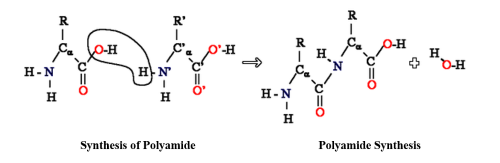
Figure 1. Schematic illustration of amide bond formation with the release of water.
 Corechem
How Does Polyamide Wax Form a Three-Dimensional Network Structure?
The rheological effect of polyamide wax originates from its unique molecular structure. Its molecular structure mainly contains two key components:
Fatty Chain Segments: These provide compatibility. The nonpolar fatty chain segments in polyamide wax improve compatibility with organic systems, allowing uniform dispersion within coating formulations.
Amide Groups: These provide network formation capability. Amide groups possess strong polarity and can serve as intermolecular interaction sites.
After sufficient activation, polyamide molecular chains gradually unfold and amide groups become exposed. Molecules connect through hydrogen bonding so that a three-dimensional network structure is formed throughout the system.
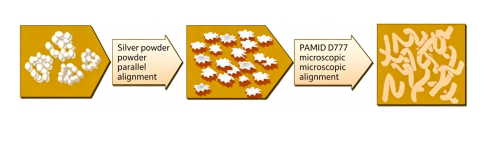
Figure 2. Schematic illustration of particle arrangement and polyamide wax microscopic structure.
 Corechem
Understanding the Activation Process
This process can be understood as a progressive transition from molecular structure to intermolecular interaction, followed by the formation of a three-dimensional network, which ultimately leads to changes in rheological performance.
Unlike conventional thickeners, polyamide wax does not simply increase the viscosity of the continuous phase. Instead, its primary contribution is to improve yield stress, increase low-shear viscosity and enhance the structural recovery capability of the coating system.
The Importance of Activation Efficiency
In practical coating formulations, the same dosage of polyamide wax can produce significantly different performance in different systems. In most cases, the difference is not caused by insufficient dosage but by insufficient formation of an effective three-dimensional network.
The rheological function of polyamide wax generally develops through four successive stages.
Dispersion and Wetting
After being incorporated into the formulation, polyamide wax must first be thoroughly wetted and uniformly dispersed throughout the system. Insufficient dispersion limits the exposure of active sites on the wax particles, reducing the efficiency of subsequent network formation.
Molecular Chain Unfolding
With the combined effects of shear and temperature, polyamide molecular chains gradually unfold, allowing additional amide groups to participate in intermolecular hydrogen bonding. This activation process creates the conditions necessary for network development.
Three-Dimensional Network Formation
As hydrogen bonding continues between activated molecules, a continuous three-dimensional network gradually develops throughout the coating system. The formation of this network increases yield stress, restricts the movement of pigments and fillers and significantly improves anti-settling performance.
Dynamic Structural Recovery
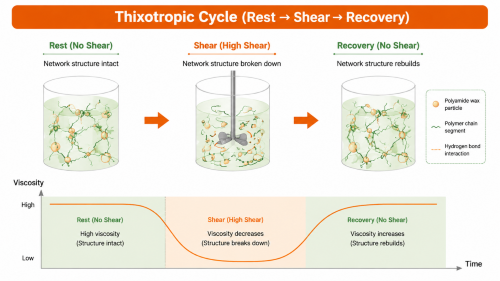
During coating application, high shear temporarily disrupts part of the network structure. Once shear is removed, molecular interactions are gradually reestablished and the network recovers, allowing the coating to regain its original rheological properties.
Therefore, the effectiveness of polyamide wax depends less on the amount added than on whether a stable and efficient dynamic network can be successfully established.
Relationship Between the Three-Dimensional Network and Application Performance
The three-dimensional network continuously responds to changes in shear conditions throughout the coating process, allowing the material to exhibit different rheological behavior at different stages.
Storage Stability
Under static or low-shear conditions, the three-dimensional network remains essentially intact. This stable structure increases the yield stress of the system, slows the settling of pigments and fillers and provides excellent long-term storage stability together with reliable anti-settling performance.
Application Performance
During spraying, roller coating or other application processes, increased shear temporarily disrupts part of the network structure. As flow resistance decreases, the coating exhibits improved application characteristics while maintaining good leveling performance.
Film Formation
After application, shear forces disappear and the molecular network gradually rebuilds. As the system structure recovers, wet-film stability improves and the risk of sagging is significantly reduced. Rather than acting as a simple thickener, polyamide wax enables the coating to achieve a dynamic balance between flowability during application and structural stability afterward.
Factors Affecting Polyamide Wax Performance
The final performance of polyamide wax depends not only on the additive itself but also on the overall formulation design.
The solvent system influences dispersion quality, activation efficiency and the ability of molecules to form hydrogen bonds. The resin system affects compatibility, network stability and ultimately the overall coating performance. Pigments and fillers determine the structural requirements of the formulation, their tendency to settle and the rheological window required for optimum performance.
Dosage is another important consideration. An insufficient dosage may prevent the network from developing completely, while excessive dosage may negatively affect leveling, reduce gloss and increase the likelihood of surface defects. Consequently, formulation optimization should focus on establishing the most efficient network structure rather than simply increasing the amount of additive.
Figure 3. The thixotropic cycle: The network remains intact at rest, breaks down under high shear and rebuilds after shear is removed, with corresponding changes in viscosity.
 Corechem
Evaluating Rheological Performance
For formulation engineers, evaluating the effectiveness of polyamide wax requires consideration of several rheological parameters. Low-shear viscosity reflects storage stability, while yield stress provides an indication of anti-settling capability. Thixotropic recovery speed is closely related to sag resistance, and high-shear viscosity influences application performance. Leveling performance and system compatibility should also be evaluated because they determine coating appearance and long-term formulation stability.
An effective polyamide wax system should ultimately provide excellent storage stability, smooth application, rapid structural recovery and consistent coating appearance.
Building a Stable Rheological Network with Polyamide Wax
For waterborne industrial coatings, anti-corrosion coatings and wood coatings, formulation engineers commonly face challenges such as maintaining long-term pigment and filler suspension, preventing sagging at high film thickness and achieving an appropriate rheological window.
Corechem PAMID D777 is a polyamide wax slurry specifically developed for waterborne coating systems. Rather than simply increasing viscosity, it is designed to facilitate the rapid and stable formation of a dynamic three-dimensional network.
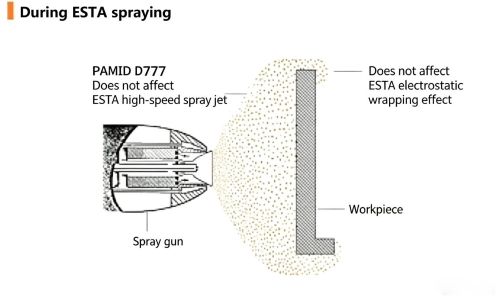
Figure 4a. Schematic illustration of a polyamide wax-containing coating during electrostatic spraying, showing the spray jet and wraparound effect at the workpiece.
 Corechem
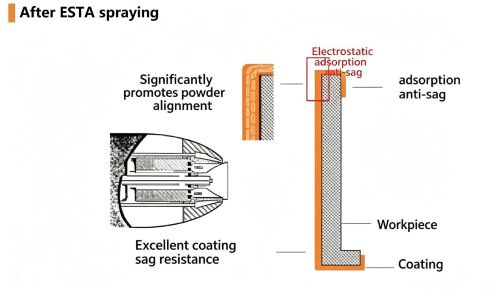
Figure 4b. Schematic illustration of coating behavior after electrostatic spraying, highlighting pigment alignment and sag resistance.
 CoreChem
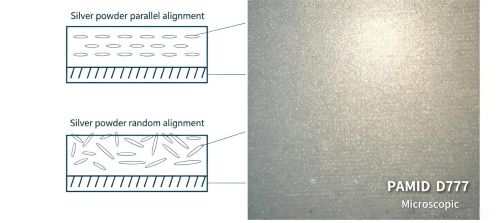
Because the polyamide wax slurry is supplied in a predispersed form, it reduces the complexity of on-site activation and improves the efficiency of network formation. In practical applications, this can contribute to improved pigment and filler suspension stability, enhanced sag resistance, a better balance between application flow and structural stability and more consistent coating appearance. In metallic coating systems, the improved rheological structure may also contribute to better flake pigment orientation and overall coating performance.
Figure 5. Parallel and random pigment alignment schematics alongside a microscopic image of the polyamide wax additive.
 Corechem
Conclusion
The value of polyamide wax extends far beyond increasing the viscosity of a coating formulation. Its primary function is to establish a dynamic three-dimensional network that continuously adapts to different stages of the coating process.
During storage, the network provides structural support that minimizes pigment settling. During application, it temporarily releases flowability to improve application characteristics. After application, the network gradually rebuilds, restoring structural integrity and reducing the risk of sagging.
From this perspective, polyamide wax should be regarded not simply as a thickener but as a functional rheology modifier that controls coating behavior through the formation and recovery of a dynamic molecular network.
Looking for a reprint of this article?
From high-res PDFs to custom plaques, order your copy today!