The Power of Plasma
Designers of consumer products constantly seek new approaches to improve their products' appearance and quality, while lowering cost. Low Temperature Arc Vapor Deposition™ (LTAVD™) systems have been used extensively in the kitchen and bath fixture industry to deposit decorative and colorfast finishes on diverse, low-cost materials, while providing a uniform look and the durability of more expensive materials.

Designers of consumer products constantly seek new approaches to improve their products' appearance and quality, while lowering cost. Low Temperature Arc Vapor Deposition™ (LTAVD™) systems have been used extensively in the kitchen and bath fixture industry to deposit decorative and colorfast finishes on diverse, low-cost materials, while providing a uniform look and the durability of more expensive materials. Appliances and trim would also benefit from the distinctive appearance and durability possible with these coatings.
LTAVD technology provides the ability to deposit most metal alloys, metal nitrides, and metal carbide compounds onto almost any substrate, including plastic, plastic/polycarbonate blends, foam, graphite, and metals. The resultant coatings can be produced in an array of colors, and can be formulated to provide superior resistance to abrasion, corrosion, ultraviolet light, chemicals, wear, and scratches. LTAVD is also a dry process and environmentally safe.

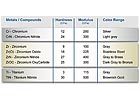
Listed in Table 1 (p. 20) are several metals and alloys and associated compounds with some of the optical and mechanical properties that are inherent to the materials. By forming compounds with reactive gases or alloys with target materials, vastly different functional and cosmetic colors can be attained.
Properties of the coatings such as density, composition, adhesion, stress, color, hardness and resistance to corrosion help match a coating to the appropriate application. As an example, a coating on a faucet should have an appealing, permanent color that won't fade, but also be resistant to scratching from scouring pads and corrosion from harsh chemicals used around the sink like drain cleaners.
In addition, mechanical properties of the substrate should also be considered. A hard ceramic layer on a soft polymer is mechanically analogous to ice on water. Thin ceramic layers, like the ice layer, must be relatively thick to avoid fracturing under a load. More preferably, the substrate should be stiff. For this reason, plastic and soft metallic plumbing parts are electroplated with metallic layers, which increase the effective stiffness of the support structure and level the substrate surface, prior to applying an LTAVD coating.

Since the mid 1990s, many high end kitchen and bath fixtures have used LTAVD finishes as alternatives to lacquered brass or chrome plating. Additionally, LTAVD finishes offer a broad range of metallic colors and reveal the texture of the supporting structure. This has enabled the kitchen and bath industry to offer colorfast, cosmetic finishes never before available, with surface finishes guaranteed for a lifetime against the harsh environment present in the kitchen, which can include chemicals and abrasives.
One of the more significant applications for PVD coatings that is emerging is as an alternative to hexavalent chrome plating. The U.S. Department of Labor's Occupational Safety and Health Administration (OSHA) has issued a ruling that lowers the permissible exposure to hexavalent chrome from 52 mcg/m3 to 5 mcg/m3 over an eight hour time period. Studies have shown the effectiveness of LTAVD coatings of non-hazardous chrome and chromium nitride as equivalent alternatives to the health risks and increased costs of chrome plating.
Many other industries are now investigating how the functional and cosmetic properties of LTAVD coatings can be used to enhance their products' appearance while reducing costs. By using lower cost base materials with attractive metallic finishes that can withstand the ultraviolet, chemical, abrasive, and corrosive environment of the house, manufacturers now have a wider range of choices.
Appliance manufacturers can also benefit from the distinctive appearance and functionality afforded by these coatings. Coatings as finishes on appliances have, for decades, been restricted to a limited number of choices. These include porcelain-coated steel, stainless steel and recently, powder paint coated steel and vinyl clad materials. These finishes provide high quality and good performance, but are limited in their ability to satisfy consumer demands for new and different looks and increased durability.
LTAVD coatings address both of these issues. In the case of stainless steel, for example, LTAVD coatings can provide a variety of colors for the stainless steel and enhance its performance. Stainless steel is a soft metal that tends to scratch easily. This is easily observed on sinks, cook tops, refrigerator doors and other kitchen appliance surfaces. LTAVD coatings allow the manufacturer to offer its customers stainless steel in colors ranging from champagne gold to nickel to gold to graphite and more. Further, these cosmetic finishes can be endowed with superior performance characteristics including high levels of scratch resistance, easy-to-clean properties, resistance to discoloration, and more. The result can be that the manufacturer can offer products that present new and different appearances and styles, while providing superior durability and performance.
A major problem in the appliance industry is that colors fade at different rates on parts made from different materials. The parts' colors match when the product is new, but environmental exposure over time causes the colors to shift to different shades, especially on plastics. Significantly, the ability of LTAVD to be applied to dissimilar materials, such as plastic components, opens the door for appliance designers to create new product configurations while retaining the desirable performance and appearance characteristics of coated metals. For example, a graphite coated oven can be equipped with matching controls and trim pieces that otherwise would require different finishes.
The ability to coat plastics and components of other materials gives designers an important opportunity to improve product designs and manufacturing processes. For example, part designs that were previously limited by traditional processes such as sheet metal bending or casting, can now be designed for injection-molding. This opens the possibility of combining parts functionality, improving the simplicity of manufacturing and reducing time-to-market cycles and costs.
LTAVD coatings offer manufacturers much more than the ability to apply a cosmetic finish. By providing a unique combination of appearance and performance, along with the ability to enhance design and manufacturing processes, LTAVD coatings provide an important competitive opportunity.
Patrick Sullivan is a senior scientist, and Gary Larson is sales account manager, Vapor Technologies, Longmont, Colo. For more information, visit www.vaportech.com.
For information on reprints of this article, contact Jill DeVries at devriesj@bnpmedia.com.
The LTAVD process takes place in a high-vacuum environment, where a powerful electric arc vaporizes material, creating a plasma that coats parts placed in the chamber.
Designers of consumer products constantly seek new approaches to improve their products' appearance and quality, while lowering cost. Low Temperature Arc Vapor Deposition™ (LTAVD™) systems have been used extensively in the kitchen and bath fixture industry to deposit decorative and colorfast finishes on diverse, low-cost materials, while providing a uniform look and the durability of more expensive materials. Appliances and trim would also benefit from the distinctive appearance and durability possible with these coatings.
LTAVD technology provides the ability to deposit most metal alloys, metal nitrides, and metal carbide compounds onto almost any substrate, including plastic, plastic/polycarbonate blends, foam, graphite, and metals. The resultant coatings can be produced in an array of colors, and can be formulated to provide superior resistance to abrasion, corrosion, ultraviolet light, chemicals, wear, and scratches. LTAVD is also a dry process and environmentally safe.
The Process
In LTAVD, a chamber is loaded with parts to be coated (see Figure 1, p. 20). The chamber is then closed and pumped down, creating a vacuum. Then, an inert gas, argon for example, is fed into the chamber. Subsequently, a high current is applied to create an arc across the solid metal target. The intense, dense energy from the arc evaporates the metal, ejecting charged atoms. These charged atoms from the target, along with energetic argon atoms create a plasma, an energetic gas. The plasma provides a conductive path that sustains the arc in the vacuum. As the evaporation occurs, parts are rotated around the evaporating target. The gas condenses on the parts, growing a thin solid film atom by atom.Parts to be coated are loaded on a rack and the chamber is pumped to a low pressure. Once the arc is initiated, parts undergo two-axis rotation for complete coverage and uniformity of the coating.
The Coatings
As the target material is being evaporated, reactive gases like nitrogen, oxygen and methane (containing carbon) can be added in precise amounts and at precise times within the process, creating coatings that are metal compounds with significantly different characteristics than the metal target. For example, adding nitrogen gas during evaporation of chromium can produce the ceramic (or metal compound) chromium nitride. Adding oxygen instead of nitrogen can produce another ceramic, chromium oxide. Alternatively, adding methane will produce chromium carbide.Listed in Table 1 (p. 20) are several metals and alloys and associated compounds with some of the optical and mechanical properties that are inherent to the materials. By forming compounds with reactive gases or alloys with target materials, vastly different functional and cosmetic colors can be attained.
Properties of the coatings such as density, composition, adhesion, stress, color, hardness and resistance to corrosion help match a coating to the appropriate application. As an example, a coating on a faucet should have an appealing, permanent color that won't fade, but also be resistant to scratching from scouring pads and corrosion from harsh chemicals used around the sink like drain cleaners.
Examples of coatings and approximate substrate-independent properties. The nitride of a metal can have vastly different properties than the metal alone.
Substrate Considerations
Since LTAVD coatings are typically very thin, less than 1 micron, the properties of the substrate will help determine the function and appearance of the end product. As an example: an opaque coating less than a micron thick will establish the color of a sample but will have little influence on the texture of a surface that has roughness in the range of microns. Therefore, the texture of the substrate, not the coating, will determine the final texture.In addition, mechanical properties of the substrate should also be considered. A hard ceramic layer on a soft polymer is mechanically analogous to ice on water. Thin ceramic layers, like the ice layer, must be relatively thick to avoid fracturing under a load. More preferably, the substrate should be stiff. For this reason, plastic and soft metallic plumbing parts are electroplated with metallic layers, which increase the effective stiffness of the support structure and level the substrate surface, prior to applying an LTAVD coating.
Components of an assembly can be finished with the same metallic coating, even though they are made from different metal or plastic materials. In this case, a brushed texture and a coating of zirconium oxide makes all of the parts look like stainless steel, with improved durability over the original materials.
Applications
LTAVD coatings have been used for many years. Titanium compounds have been applied to carbon steel drill bits, industrial cutting tools and plastic molds; increasing the life of the tools by 10 to 20 times. Chromium nitride is a hard, low-friction coating that is employed to improve the wear resistance of metal valves in engines and roller bearings.Since the mid 1990s, many high end kitchen and bath fixtures have used LTAVD finishes as alternatives to lacquered brass or chrome plating. Additionally, LTAVD finishes offer a broad range of metallic colors and reveal the texture of the supporting structure. This has enabled the kitchen and bath industry to offer colorfast, cosmetic finishes never before available, with surface finishes guaranteed for a lifetime against the harsh environment present in the kitchen, which can include chemicals and abrasives.
One of the more significant applications for PVD coatings that is emerging is as an alternative to hexavalent chrome plating. The U.S. Department of Labor's Occupational Safety and Health Administration (OSHA) has issued a ruling that lowers the permissible exposure to hexavalent chrome from 52 mcg/m3 to 5 mcg/m3 over an eight hour time period. Studies have shown the effectiveness of LTAVD coatings of non-hazardous chrome and chromium nitride as equivalent alternatives to the health risks and increased costs of chrome plating.
Many other industries are now investigating how the functional and cosmetic properties of LTAVD coatings can be used to enhance their products' appearance while reducing costs. By using lower cost base materials with attractive metallic finishes that can withstand the ultraviolet, chemical, abrasive, and corrosive environment of the house, manufacturers now have a wider range of choices.
Appliance manufacturers can also benefit from the distinctive appearance and functionality afforded by these coatings. Coatings as finishes on appliances have, for decades, been restricted to a limited number of choices. These include porcelain-coated steel, stainless steel and recently, powder paint coated steel and vinyl clad materials. These finishes provide high quality and good performance, but are limited in their ability to satisfy consumer demands for new and different looks and increased durability.
LTAVD coatings address both of these issues. In the case of stainless steel, for example, LTAVD coatings can provide a variety of colors for the stainless steel and enhance its performance. Stainless steel is a soft metal that tends to scratch easily. This is easily observed on sinks, cook tops, refrigerator doors and other kitchen appliance surfaces. LTAVD coatings allow the manufacturer to offer its customers stainless steel in colors ranging from champagne gold to nickel to gold to graphite and more. Further, these cosmetic finishes can be endowed with superior performance characteristics including high levels of scratch resistance, easy-to-clean properties, resistance to discoloration, and more. The result can be that the manufacturer can offer products that present new and different appearances and styles, while providing superior durability and performance.
A major problem in the appliance industry is that colors fade at different rates on parts made from different materials. The parts' colors match when the product is new, but environmental exposure over time causes the colors to shift to different shades, especially on plastics. Significantly, the ability of LTAVD to be applied to dissimilar materials, such as plastic components, opens the door for appliance designers to create new product configurations while retaining the desirable performance and appearance characteristics of coated metals. For example, a graphite coated oven can be equipped with matching controls and trim pieces that otherwise would require different finishes.
The ability to coat plastics and components of other materials gives designers an important opportunity to improve product designs and manufacturing processes. For example, part designs that were previously limited by traditional processes such as sheet metal bending or casting, can now be designed for injection-molding. This opens the possibility of combining parts functionality, improving the simplicity of manufacturing and reducing time-to-market cycles and costs.
LTAVD coatings offer manufacturers much more than the ability to apply a cosmetic finish. By providing a unique combination of appearance and performance, along with the ability to enhance design and manufacturing processes, LTAVD coatings provide an important competitive opportunity.
Patrick Sullivan is a senior scientist, and Gary Larson is sales account manager, Vapor Technologies, Longmont, Colo. For more information, visit www.vaportech.com.
For information on reprints of this article, contact Jill DeVries at devriesj@bnpmedia.com.
Links
Looking for a reprint of this article?
From high-res PDFs to custom plaques, order your copy today!