Painting & Coating Industry (PCI) logo Powder coating summit logo
search
cart
facebook twitter linkedin youtube
  • Sign In
  • Create Account
  • Sign Out
  • My Account
Painting & Coating Industry (PCI) logo Powder coating summit logo
  • NEWS
    • Latest News
    • Market Trends & Reports
    • Finishing News
    • Price Alerts
    • Subscribe to Newsletters
    • Global Top 10/ PCI 25
    • Weekly Featured Article
    • COATLE Word Game
  • PRODUCTS
    • Product News
    • Must See Products and Services
  • MATERIALS
    • Additives
    • Resins/Polymers
    • Pigments
    • Equipment
    • Distributors
  • TECHNOLOGIES
    • Adhesives
    • Architectural Coatings
    • Finishing Articles
    • Finishing Technologies
    • Finishing Equipment
    • Industrial Coatings
    • Nanotechnology
    • Powder Coatings
    • Solventborne
    • Special Purpose Coatings
    • Sustainability
    • UV Coatings
    • Waterborne
  • RESOURCES
    • Columns
      • Did you know?
      • Distribution Dive
      • Formulating With Mike
      • Innovation Insights
      • Powder Coating Perspectives
      • TiO2 Insider
    • Blogs
      • Editor's Viewpoint
      • Industry Insights
    • Coatings Supplier Handbook
    • Podcasts and Videos
      • COAT-IT! Podcast
      • Videos/PCI TV
    • PCI Store
    • Classifieds
    • eBooks
    • Sponsor Insights
    • White Papers
    • COATLE Word Game
  • EVENTS
    • Coatings Trends & Technologies Summit
    • Paint and Coatings Academy
    • Webinars
    • Calendar of Events
    • Lifetime Achievement Award
  • DIRECTORIES
    • Buyer's Guide
    • Equipment Directory
    • Materials Directory
  • EMAGAZINE
    • Current Issue
    • eMagazine Archive
    • China Issue Archive
    • Editorial Advisory Board
  • CONTACT
    • Contact Us
    • Advertise
    • Subscribe to eMagazine
    • Subscribe to Newsletters
  • SIGN UP!
Paint and Coatings AdditivesPaint and Coating Resins & PolymersIndustrial Coatings

Unique Aliphatic Polyurethane Hardcoats from CO2-Based Polyols
By Michael Quinn, Sam Wang, Guy Stokes, Tudor Samoila, Jason Anderson, Chris Simoneau
novomer
Credit: Hanson Group LLC and Novomer, Inc.
novomer
Credit: Hanson Group LLC and Novomer, Inc.
novomer
Credit: Hanson Group LLC and Novomer, Inc.
novomer
novomer
novomer
March 3, 2014

Aprocess to synthesize hydroxyl-terminated polycarbonates from carbon dioxide and epoxies was originally developed a number of years ago.1 This is a fertile research area, and the reference is one of many issued patents in the field. The promise of using carbon dioxide as an inexpensive and renewable raw material to produce polymers was sufficiently attractive that Novomer, Inc. was founded to commercialize this technology. Building upon this pioneering work of Coates et al., Novomer has advanced the catalyst technology and developed a family of proprietary catalysts with improved activity and selectivity. These catalysts maximize carbon dioxide incorporation and provide polycarbonates with perfectly alternating CO2/epoxide monomer incorporation. These polymers also have low polydispersity indices. In addition to improving the performance of the resulting polymers, these catalysts allow Novomer to conduct polymerization using parts per million catalyst levels. Not only can the product be labeled “green”, but it also offers advantages as a commercial raw material that can be made using waste carbon dioxide.

Hardcoats to improve the surface properties of plastics, glass and metals are commercially available. This work examines hardcoats that can be applied to plastic and glass. They could be applied to metals, but the work has not progressed in that direction yet. Commercial hardcoats for plastic and glass generally are very low-solids formulations. They may also be cured by UV radiation.

The use of Novomer polycarbonate polyols to make hardcoats started when other work with these materials showed their inherent adhesive and solvent-resistant properties. The hardcoats described in this work are made by adding an isocyanate A side to a B side containing a polycarbonate diol. The hardcoat formulations may be catalyzed, as well as have other additives incorporated into them. Even though these formulations are a two-part system, their pot life is long enough that they may be treated as a one-part curable system.

Experimental

Adhesion testing was performed according to ASTM D3359 using a six blade cutter. Typically, the cutter was used to make a long cut. Then the cutter was used to make multiple, transverse cuts at 90° to the long cut. The scribed cuts were brushed with a soft brush and adhesive tape firmly applied to the scored areas. The tape was removed and adhesion measured by comparison to the ASTM/ISO adhesion scale. A rating of 5B is best.

Pencil hardness was performed according to ASTM D3363. A Gardco pencil holder was used. The pencil hardness was tested until a non-removable mark was formed on the hardcoat. Pencil hardness was recorded as the pencil used previously to the one making the non-removable mark.

Resistance to UV radiation was tested by exposure to UVB radiation. Coated samples were placed facing the UVB light source.

Solvent resistance was tested by immersing coated samples in various solvents, acids and a base. The properties of the coating were tested before and after exposure.

Results and Discussion

Hardcoats are made by combining an isocyanate-containing A side with a B side containing a hydroxyl-terminated polycarbonate resin. The B side contains solvents, and the solvent content ranges between 20 and 45 percent by weight, depending on the application and product requirements of the hardcoat.

High-boiling solvents have been successfully used to make hardcoats. Three examples of these solvents are PMA (propylene glycol methyl ether acetate), DBE (aliphatic dibasic esters) and DPMA (dipropylene glycol methyl acetate).

Hardcoats have been successfully applied by dip coating, spraying and brushing. The pot life can be several days, which allows the formulation to be used as a one-component mixture. The viscosity of the combined A and B sides is relatively low at 50 cps. The coated material sets in 90 min at room temperature, and is dry in about 220 min. Set and dry times can be accelerated by raising the temperature or the catalyst level.

Adhesion and Hardness

Typical hardcoat adhesion to several substrates and hardness values are shown in Table 1. The 5B level of adhesion is the highest measurable value using ASTM D3359. These hardcoats show good adhesion to a variety of substrates. The 7H pencil hardness is a reasonable level of hardness.

Properties may be modified by the use of additives commonly supplied to the coatings industry. Many of the additives improve performance while maintaining the clarity of the hardcoat. Properties can be improved by the choice of additive, but clarity is not always maintained with every additive.

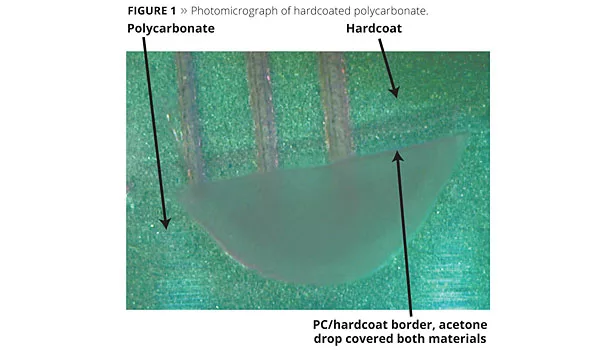
A photomicrograph of hardcoated polycarbonate is shown in Figure 1. The dark, etched lines are 2 mm apart. Uncoated polycarbonate at the bottom of the photo shows scratches made by rubbing steel wool across the surface of the polycarbonate. Scratches are not seen on the hardcoat treated in a similar manner.

A drop of acetone was placed at the boundary between uncoated and coated polycarbonate and allowed to dry. The uncoated polycarbonate turned cloudy in the area that was in contact with acetone. The hardcoat remained clear where it was treated with acetone.

UV Stability

Hardcoats on glass were exposed to UVB radiation continuously for six months in a QUV test chamber. Neither the adhesion to glass nor the pencil hardness was affected by this exposure. In addition, the coating neither cracked nor yellowed. Glass was used as the substrate since it would not yellow or crack under these conditions and complicate data analysis. The results are promising and long-term tests are being done.

Solvent Resistance

Solvent resistance results for hardcoats are shown in Table 2. Twenty-four-hour immersion test results show that the hardcoats are not impacted except for methanol, which causes the hardcoat to become semi-clear rather than clear. The hardcoat is not affected. Immersion tests were performed by coating the hardcoat on glass because it is not affected by the solvents, acids and base as would the plastic substrates.

Abrasion Resistance

Abrasion resistance testing was performed using polycarbonate as a control. The hardcoat lost only one-half of the material abraded from polycarbonate in a Taber abrasion test. The abrasion resistance was also examined qualitatively by rubbing the hardcoat and polycarbonate with steel wool. The hardcoat remained unaffected, while the polycarbonate showed visible scratching.

Temperature Cycling

Glass coated with the hardcoat was tested after exposure to ambient conditions, 24 h at -20 °C and 24 h at 60 °C.The pencil hardness, adhesion and clarity were not affected by this temperature exposure.

Summary

The carbon dioxide-based hardcoats developed in this project offer a unique balance of properties that make them viable alternatives to existing hardcoat technologies, in particular for substances such as thermoplastic polycarbonate. From a formulating perspective, the system is quite flexible. It can be cured at elevated temperatures and offers a long pot life, enabling use as either a one- or two-component system. Its low viscosity allows for multiple application techniques including dip coating, spraying and brushing.

The finished hardcoat demonstrates an attractive balance of hardness, adhesion, chemical/solvent resistance, temperature resistance and abrasion resistance. The formulations tested here yielded pencil hardness of 7H, crosshatch adhesion to thermoplastic polycarbonate of 5B, improved abrasion resistance vs. untreated polycarbonate, excellent UV aging, and good resistance to numerous acids and bases. The Hanson Group and Novomer are currently commercializing high-performance transparent hardcoats similar to the system described herein with a particular focus on thermoplastic polycarbonate and polyurea transparent armor substrates. 


References

1   Coates, G.W.; Chen, M. 2000. Polycarbonates made Using High Activity Catalysts, US Patent 6,133,402.


 This paper was presented at the 2013 Polyurethanes Technical Conference, Sept. 23-25, Phoenix, AZ. 

KEYWORDS: catalysts Green Paint Technology Protective Coatings

Share This Story

Looking for a reprint of this article?
From high-res PDFs to custom plaques, order your copy today!

 Michael Quinn, Ph.D., Senior Scientist,  Hanson Group LLC, Alpharetta, GA

 Sam Wang, Ph.D., Technical Director, Hanson Group LLC, Alpharetta, GA

 Guy Stokes, Vice President,  Hanson Group LLC, Alpharetta, GA

 Tudor Samoila, Development Chemist; Hanson Group LLC, Alpharetta, GA 

Jason Anderson, Polymer Business Development, Novomer, Inc., Waltham, MA
Chris Simoneau, Ph.D., Senior Scientist; Novomer, Inc., Waltham, MA

Recommended Content

JOIN TODAY
to unlock your recommendations.

Already have an account? Sign In

  • pci1022-Kinaltek-Lead-1170.jpg

    A Novel Pigment Production Technology

    Following an extensive R&D program that demonstrated...
    Paint and Coating Pigments
    By: Jawad Haidar and Nitin Soni
  • pci global top 10

    2025 Global Top 10: Top Paint and Coatings Companies

    The following is PCI’s annual ranking of the top 10...
    Paint and Coating Market Reports
    By: Courtney Bassett
  • 2025 pci 25

    2025 PCI 25: Top Paint and Coatings Companies

    PCI's annual ranking of the top 25 North American paint...
    Paint and Coating Market Reports
    By: Courtney Bassett
You must login or register in order to post a comment.

Report Abusive Comment

Manage My Account
  • eMagazine
  • Newsletters
  • Online Registration
  • Subscription Customer Service

More Videos

Sponsored Content

Sponsored Content is a special paid section where industry companies provide high quality, objective, non-commercial content around topics of interest to the PCI audience. All Sponsored Content is supplied by the advertising company and any opinions expressed in this article are those of the author and not necessarily reflect the views of PCI or its parent company, BNP Media. Interested in participating in our Sponsored Content section? Contact your local rep!

close
  • colorful building exterior
    Sponsored byDow

    Insights into Exterior Architectural Coating Degradation: Bridging Accelerated and Natural Weathering

  • digital pigments
    Sponsored bySiltech

    The Fourth Dimension of Silicon: Siltech Q Resins

Popular Stories

Company News

What the AkzoNobel–Axalta Merger Means for the Future of Coatings

AkzoNobel and Axalta Headquarters

AkzoNobel and Axalta Announce $25 Billion Merger

Wacker logo

WACKER Plans More Than 1,500 Job Cuts


PCI Buyers Guide

Submit a Request for Proposal (RFP) to suppliers of your choice with details on what you need with a click of a button

Start your RFP

Browse our Buyers Guide for manufacturers and distributors of all types of coatings products and much more!

Find Suppliers

Events

September 4, 2025

N-Butylpyrrolidone (NBP) as a Green Solvent to Replace N-Methylpyrrolidone (NMP) in Industrial Coating Applications

ON DEMAND: EPA published a regulation proposal around N-methylpyrrolidone (NMP) in June 2024 to ban or limit NMP in many applications, such as paints and coatings and their removers. N-butylpyrrolidone (NBP) is a powerful and versatile solvent for a variety of industries looking for alternatives to substance of very high concern (SVHC)-listed solvents.

March 24, 2026

The Manufacturing & Automation eXchange (MAX)

MAX presents a rare opportunity to observe the full scope of manufacturing in one environment. From systems integration and materials handling to automation, quality, safety, and packaging, each discipline is represented through live, operational displays. By experiencing these technologies side by side, as they are on actual production floors, attendees gain a grounded understanding of how manufacturing functions align, overlap, and evolve in practice.

View All Submit An Event

Poll

Longest-running laboratory experiment

What is the longest-running laboratory experiment?
View Results Poll Archive

Products

Automotive Paints and Coatings, 2nd Edition

Automotive Paints and Coatings, 2nd Edition

Now in its second edition and still the only book of its kind, this is an authoritative treatment of all stages of the coating process.

See More Products
pci voices from the top ebook

PCI webinar

Related Articles

  • PCI1223-CovationBio-1170.jpg

    Evaluation of 1,3-Propanediol-Based Polyester and Polyether Polyols in Polyurethane Water Dispersions

    See More
  • pci0518-Resinate-156206694-900.jpg

    Polyurethane Dispersions from Sustainable Polyols with Recycled and Renewable Content

    See More
  • Polyester Polyols Based on Polymerized Fatty Acids From Renewable Resources

    See More

Related Products

See More Products
  • biopolymer.jpg

    Biopolymer-Based Films and Coatings Trends and Challenges

  • social media

    Optimizing Social Media from a B2B Perspective

See More Products

Related Directories

  • Ingredients + Specialties from Univar Solutions

    Univar Solutions is a focused team of technical and product experts dedicated to solving paint and coating challenges. We provide materials and supply chain solutions needed to innovate and get products to market faster. With the most comprehensive supplier base, global distribution and state-of-the-art laboratories, we are here for you.
×

Keep the info flowing with our eNewsletters!

Get the latest industry updates tailored your way.

JOIN TODAY!
  • RESOURCES
    • Advertise
    • Contact Us
    • Directories
    • Store
    • Want More
    • Manufacturing Division
  • SIGN UP TODAY
    • Create Account
    • eMagazine
    • Newsletters
    • Customer Service
    • Manage Preferences
  • SERVICES
    • Marketing Services
    • Reprints
    • Market Research
    • List Rental
    • Survey & Sample
  • STAY CONNECTED
    • LinkedIn
    • Facebook
    • Youtube
    • X (Twitter)
  • PRIVACY
    • PRIVACY POLICY
    • TERMS & CONDITIONS
    • DO NOT SELL MY PERSONAL INFORMATION
    • PRIVACY REQUEST
    • ACCESSIBILITY

Copyright ©2025. All Rights Reserved BNP Media.

Design, CMS, Hosting & Web Development :: ePublishing