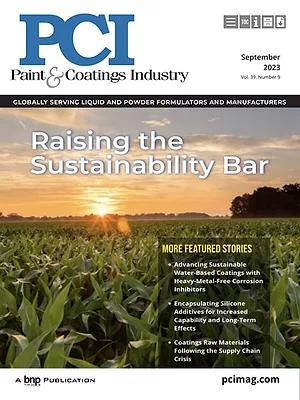
PCI’s September issue features information on the coatings raw material market current and future outlook, the latest in powder coating, additive, and sustainable coatings technologies, and more.
This month’s Formulating with Mike columncontinues the focus on resins and discusses acrylic emulsion polymerization, in particular, surfactant design and how it affects the polymerization of a vinyl-acrylic emulsion.
Is moisture an important measurement in the manufacturing of powder coatings? What is the best way to degrease steel and aluminum prior to powder coating? Joe Powder, aka Kevin Biller of ChemQuest Powder Coating Research, shares his powder coating knowledge and expertise by answering questions like these sent in from around the world.
A more sustainable industry requires the discovery and utilization of new raw materials and technologies, presenting an opportunity to develop products with unique properties not previously explored in the additives sector.
Increased regulatory scrutiny of lead, chromium, and zinc is driving the migration to heavy-metal-free corrosion inhibitors. In this article, several water-based resin technologies were selected to demonstrate the performance of heavy-metal-free corrosion inhibitors versus their zinc-containing counterparts.
In 2019, the coatings industry did not anticipate any problems surrounding raw material supplies and availability. Then COVID and the global supply chain crisis hit. This article offers an analysis of the current and future outlook of the raw materials market, highlighting lingering issues with raw material production, pricing, transportation, and delivery.
Many waterborne coating formulations utilize eco-friendly biopolymers, which have beneficial properties such as being biodegradable, and contain much fewer VOCs. Today, there are renewable materials that are worth consideration and greater investigation to further improve sustainability of products at the end of their useful lives; these materials are carbohydrate-based polymers produced from starch.
As the coatings industry continues to prioritize waterborne systems, further research to provide coatings with comparable properties to those based on solvent-based systems is required. This paper, winner of the PCI Award for Technical Excellence at the 2023 Waterborne Symposium, presents a surfactant-free encapsulation process that enables the enclosure of polysiloxanes of arbitrary molecular weight in capsules of nanometer size in a simple, scalable process.
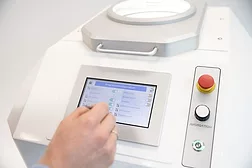
The pictured ROSS sanitary double planetary mixer model DPM-4S and sanitary discharge system model DS-4S are fully customized and engineered for efficient processing of medical-grade silicone formulations in a portable workstation.
The modular design allows for multiple impeller, shaft diameter, gear ratio, and motor horsepower combinations, with robust designs that can handle tank volumes up to approximately 100,000 gallons (378.5 m3).
The new coating delivers a finer mica effect that enables an ultra matt surface to change appearance depending on the way light reflects on it, giving architects a quality finish that also offers superdurability.
They are well suited to guide the flow of liquids and powders into small openings on other contains, making them ideal for the safe, fast, and efficient filling or refilling of plunger cans, spray bottles, drums, totes, and more.
PCI will be broadcasting six CTT Summit sessions live on September 7, and then immediately archiving them on our website for the next 12 months. Read our Editor's Viewpoint to learn about each presentation, and how to watch them.