Thermal Additive Conserves, Rejects or Contains Heat

Image courtesy of NanoTech.
Record temperatures and extreme weather events are pressuring the built environment to rethink traditional building materials. Engineers, architects and building managers must enhance the resilience of structures while ensuring they meet Building Performance Standards (BPS) as designated by the U.S. Department of Energy. These requirements have catalyzed a wave of innovation in building materials designed to address the complex relationship between environmental stressors and energy consumption. Efficiency materials come in many forms, requiring careful evaluation for environmental consequences.
Climate change also worsens the frequency and intensity of wildfires by exacerbating hot, dry conditions that fuel and spread them.
A pioneering innovation with a bold scientific advancement has emerged, offering uncommon heat conservation, rejection or containment properties. This material is positioned to become an industry standard for energy conservation and fire prevention.
Thermal Ceramic Additive
The Insulative Ceramic Particle™ (ICP), developed and marketed by NanoTech Materials, Inc., is a dual-function thermal additive powder that can be integrated into other materials to reduce heat penetration or improve fire resistance. Unlike traditional thermal additives, ICP is easy to apply, cost-effective and highly durable. Its versatility allows for broad applications, ranging from commercial properties to critical infrastructure in fire-prone regions.
The Insulative Ceramic Particle is a specialized blend of a synthesized ceramic-based matrix embedded within advanced nanotechnology particles. It is based on energy band theory, which describes how a large number of atoms interact in solids, resulting in closely spaced energy levels that form bands. This technology departs from low-density technology, enabling material properties or coating formulations not previously realized, as can be seen in Figure 1.
FIGURE 1 | Insulative ceramic particle.
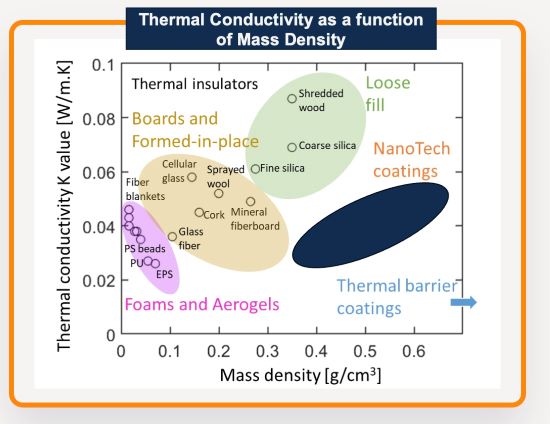
This dual-action mechanism, essential for modern materials, ensures a significant portion of incident and infrared radiation is deflected via emissive properties. At the same time, the low thermal conductivity reduces heat loading. These properties can be combined with highly reflective materials, making them especially relevant where traditional building materials struggle with extreme heat.
In addition to reflecting, dissipating and slowing the progress of absorbed energy, ICP is also formulated to resist the thermal extremes found in fire-prone environments. By combining high reflectivity, emissivity and low thermal conductivity, ICP reduces heat absorption and facilitates rapid heat re-emission. This minimizes temperature spikes on coated surfaces while slowing heat transfer to substrates.
Thermal Management of Roof Coatings
The ICP coating's efficacy stems from its ability to reduce thermal load by actively managing incident heat. Its high reflectivity allows the material to deflect a significant portion of solar radiation, reducing the heat transferred into a building’s envelope. When heat does penetrate, the ceramic structure’s high emissivity radiates the energy away, preventing temperature spikes.
At the molecular level, emissivity is influenced by the material’s surface properties. When heated by solar absorption, a high-emissive surface can more effectively radiate the heat away, unlike low-emissive materials that trap heat. This process is particularly vital in urban settings, where the heat island effect can exacerbate local temperatures. It is also critical in regions subject to severe heat waves or direct sunlight exposure, such as Yuma and Lake Havasu City, Arizona, or the Al-Nafūd desert in Saudi Arabia.
ICP technology acts as a microscopic thermal barrier, limiting heat transfer through conduction. This synergy allows for maximum reflection of solar radiation, efficient emission of absorbed heat and minimal heat transfer. For example, a roof coating formulated with ICP can be highly effective across diverse climatic conditions. The combination of high emissivity, high reflectivity and low thermal conductivity in a single roof coating provides a holistic approach to energy efficiency.
Case Study: Cutting Roof Temperatures and Enhancing Heat Rejection
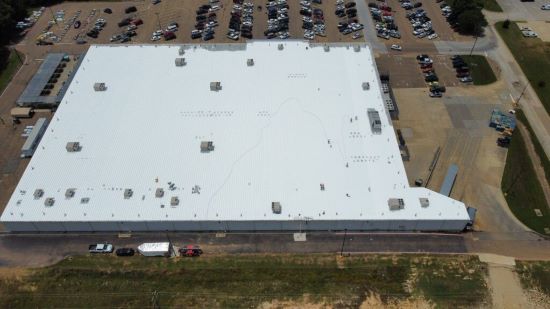
NanoTech Materials’ cool roof coating was applied to the roof of a Fortune 500 big-box store to help the retailer meet its aggressive emission reduction goals. The facility’s trapezoidal metal roof spans 180,000 ft², with interior ceilings reaching 30 ft high. The ambient outside temperature was recorded at 90 °F. During baseline scans of the facility on the uncoated roof, the surface temperature was 149 °F, and the ceiling temperature taken underneath the batt insulation inside the building was 112.28 °F. The store’s HVAC system was struggling to bring the internal temperature down from 112 °F to approximately 70 °F for employees and customers at ground level.
The entire roof was coated with cool roof coating technology (Figure 2). Subsequent scans showed the internal ceiling temperature dropped to 73 °F, and the cooling component of HVAC use was reduced by 49%.
FIGURE 2 | A Fortune 500, big-box store coated with NanoTech Materials cool roof coat.
With NanoTech cool roof coating, traditional metrics like the solar reflectance index (SRI) and thermal resistance (R-value) provide valuable insights. However, they have limitations in capturing the dynamic thermal behavior of rooftop surfaces. Field test results of the ICP roof coating have demonstrated significant reductions in the internal temperatures of structures, leading to notable energy savings and reduced strain on HVAC systems.
The long-term performance of the coating, as evidenced by a minimal decrease in SRI over time, underscores its durability and effectiveness. Through meticulous formulation and testing, a product has been developed that not only meets but exceeds industry standards, offering a promising avenue for sustainable building practices. As ongoing research continues to explore the potential of thin-film coatings in non-steady-state conditions, organizations must remain at the forefront of innovation — redefining the future of energy-efficient building materials.
Not All Coatings are Created Equal
When assessing elastomeric roof coatings, researchers found that application requires a primer on asphaltic surfaces, and the coatings cannot be applied using high-pressure spray. Without proper preparation, they may not bind properly, resulting in delamination, peeling or blistering. They also lose performance with soiling, an issue compounded without routine maintenance. Adherence tests showed less than 2 lb/linear ft (PLI), and, most importantly, there was no demonstrable proof of substrate cooling capability.
Acrylic coatings were found to be easy to install with superior damage protection against debris, foot traffic and hail, but they cloud and degrade within days of exposure to ponding water. Silicone coatings performed well in ponding water conditions, but the surfaces became slick and could not handle foot traffic or debris as effectively as acrylic coatings.
The duration of cool roof coating technology’s peak performance is not solely reliant on reflectivity. Even when soiled, it still provides emissivity and low thermal conductivity. It can be applied with a 3,000 psi sprayer at more than 8 in., and primer is only required for bleed-through. Adhesion tests revealed 18 PLI on galvalume and more than 23 PLI on modified bitumen.
The unique formulation of ICP results in a highly durable coating that is exceptionally resistant to ponding water.
Engineers focused on new construction or retrofitting roofs on existing buildings find that utilizing a roof coating with ICP offers a balanced solution that meets stringent energy codes, is efficient and is environmentally responsible.
Based on the same material as the ICP-integrated roof coating, the technology has also been used to create a fire protectant that shields open-air wooden infrastructure from collapsing under wildfire conditions by limiting toxic smoke and heat penetration. Also formulated by NanoTech Materials, its Wildfire Shield is currently deployed in California to protect wood timber lagging on California Department of Transportation projects from the state’s devastating wildfire seasons (Figure 3).
FIGURE 3 | Coated timber laggings, Sequoia National Park, California.

Case Study: Stopping the Burn
According to The Washington Post, in 2022, one in six Americans lived in areas with significant wildfire risk. Today, approximately 33% of people living in Western states are at risk, a number expected to grow to 39% by 2052.
Field results demonstrated that structures coated with the ICP fire protectant experienced markedly reduced surface temperatures due to the particle’s ultralow thermal conductivity. Heat transfer is minimized through the coating itself, and thermal stability is maintained after prolonged fire exposure. This level of protection extends beyond fire suppression, actively preventing damage to vital structures and infrastructure components. The coating has been shown to withstand temperatures as high as 3,272 °F while maintaining protection. In addition to preventing material damage, the coating reduces the harmful effects of noxious smoke.
Conventional fire prevention coatings degrade after one to two hours of exposure to fire. Coating materials fortified with ICP provide prolonged protection, lengthening the time a structure can withstand the burn. This is crucial for preventing fire spread and safeguarding structural integrity, especially during fires where response times are delayed.
Environmental Profile
The development and application of ICP technology align with international safety and energy performance standards. The material has undergone rigorous testing for fire resistance and thermal efficiency, meeting and often surpassing codes such as those set by the International Building Code (IBC) and standards relevant to energy conservation. The high ratings in emissivity and reflectivity have made ICP coatings valuable for attaining certifications under programs like LEED, which emphasize sustainability and efficiency.
A distinguishing feature of ICP is its environmental profile. The coating is formulated without volatile organic compounds (VOCs), making it safe for application in residential, commercial and industrial settings. This non-toxic composition aligns with increasing environmental regulations and sustainability goals that prioritize occupant health and reduced ecological impact.
Conclusion
The critical role of advanced coatings sets a new benchmark for energy performance and heat resistance. ICP's unique combination of high reflectivity, superior emissivity and environmentally safe composition positions it as a critical tool for modern engineering, architecture and fire prevention.
The practical benefits of ICP coatings have been observed in various field applications. In terms of energy management, ICP coatings have been integral to projects aimed at reducing peak energy loads in the built environment. By maintaining lower surface temperatures and improving thermal resistance, buildings experience a decreased reliance on air conditioning during summer months. This translates to cost savings and a reduced environmental footprint — an important consideration as businesses and institutions navigate increasingly stringent regulations to balance operational efficiency with sustainability.
In fire-prone regions, the technology is used to coat critical infrastructure, such as utility poles and wooden timber lagging along highways, that would otherwise be vulnerable to fire and extreme heat. Structures treated with ICP showed minimal damage even after exposure to prolonged high temperatures, demonstrating the coating's value in maintaining service continuity and safety during emergencies.
As the industry continues to push the boundaries of building design and strive for sustainability, it is crucial for engineering teams to integrate advanced material technologies into their projects or retrofit initiatives.
*Images courtesy of NanoTech.
Looking for a reprint of this article?
From high-res PDFs to custom plaques, order your copy today!