Protective Coating Strategies Safeguard Sioux Falls Wastewater Expansion
- How early coatings specification influenced life cycle performance decisions for a large municipal wastewater expansion project.
- Why epoxy phenalkamine, polysiloxane and polyurethane systems replaced coal tar epoxy in high-corrosion service areas.
- How applicators addressed concrete outgassing, temperature extremes and immersion exposure during large-scale wastewater construction.
- Where 100%-solids epoxy linings and mastic epoxies were used to extend service life of new and aging assets.
- What role surface preparation, inspection and coating thickness verification played in ensuring long-term asset protection.
For the City of Sioux Falls, a $215 million expansion and rehabilitation of its Regional Water Reclamation Facility marked the largest infrastructure project in the city’s history. The effort focused on increasing treatment capacity while protecting both new and existing assets against corrosion and chemical exposure to support decades of reliable service.
The multi-year project brought together the City of Sioux Falls, McCarthy Building Companies, industrial painting contractor MVP Painting and Sherwin-Williams Protective & Marine. Collaboration among the project team was central to expanding the 23-acre facility with new aeration basins, clarifiers and storage tanks while rehabilitating infrastructure originally constructed in the 1980s. Each component required coating systems capable of withstanding immersion service, corrosive gases and fluctuating environmental conditions.
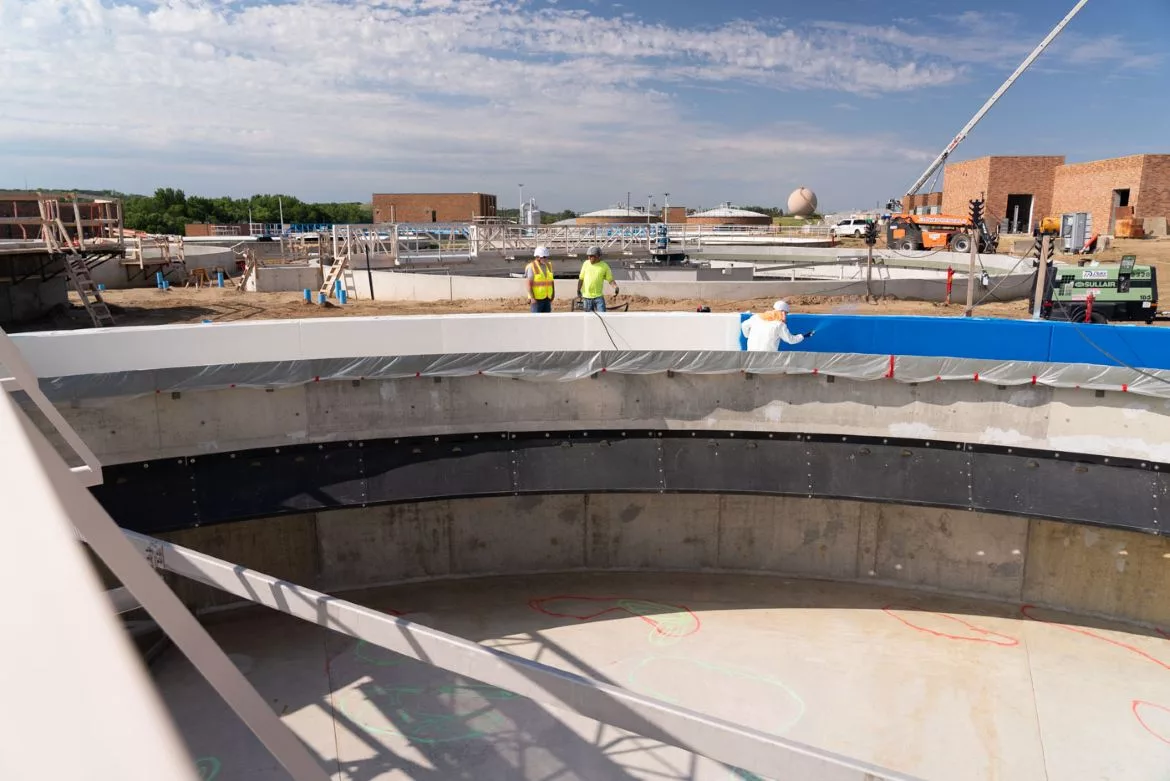
Coatings specifications were addressed early in the design process, with system selection guided by durability and long-term life cycle performance. One of the most significant decisions involved the four new final clarifier pools. Initial plans specified coal tar epoxy in the sludge troughs, but the team determined the material would not provide adequate longevity in such a harsh service environment. Instead, a three-coat system was selected consisting of a cementitious resurfacer, an epoxy phenalkamine intermediate coat and a flexible polyurethane topcoat. The multilayer approach created a more resilient barrier designed to tolerate temperature variation, corrosive gases and continuous immersion.
Application conditions presented challenges throughout construction. Elevated summer temperatures caused severe outgassing from concrete substrates, increasing the risk of coating defects and adhesion loss. To mitigate these risks, MVP Painting worked closely with Sherwin-Williams technical service representatives to monitor surface conditions and adjust application methods. Crews modified spray schedules to avoid peak heat exposure and refined equipment settings to maintain coating integrity.
Elsewhere in the facility, coating strategies were tailored to both new construction and rehabilitation needs. Exterior piping above aeration basins was continuously exposed to hydrogen sulfide gases and salt-laden environments, creating a high-corrosion risk. For these components, the team specified a high-performance polysiloxane system applied over an epoxy phenalkamine primer to provide chemical resistance, UV stability and long-term gloss retention. The system was selected to support extended service intervals without recoating.
Aeration basins received a 100%-solids epoxy lining formulated for severe immersion service, while assets in the facility’s older headworks building were restored using a mastic epoxy selected for its ability to adhere to marginally prepared steel surfaces. Across the site, surface preparation and quality control were emphasized, with blasting, spark testing and ultrasonic inspections used to verify proper film build and application consistency.
Project coordination extended beyond materials selection. McCarthy’s project management team worked closely with MVP Painting and Sherwin-Williams to address unfamiliar coating systems and navigate technical complexities as construction progressed.
Completed in 2024, the expanded facility increased treatment capacity from 21 million to 30 million gallons per day. Supported in part by funding from the federal American Rescue Plan Act and the U.S. Environmental Protection Agency, the project balanced upfront investment with long-term performance considerations. The result is infrastructure designed to meet projected population growth while maintaining asset protection and operational reliability for years to come.
Looking for a reprint of this article?
From high-res PDFs to custom plaques, order your copy today!