Advancing Pigmented Powder Coating Topcoats via Resin Blending and Single-Pass Extrusion Processing
Need to Know
- Single-pass co-extrusion incorporated FEVE and super-durable polyester resins during melt processing, eliminating the separate post-extrusion dry-blending step.
- Both systems achieved a 5B adhesion rating. The FEVE co-extruded system also passed the 3/8-inch mandrel bend test, while the polyester control cracked.
- After 10,000 hours of QUV-A exposure, the FEVE system retained 77% of its initial gloss versus 36% for the control and showed no chalking. After 24 months in South Florida, gloss retention was 100% versus 91%.
Optimizing pigmented powder coating topcoat systems involves balancing appearance, mechanical strength and weather resistance to achieve a well-rounded coating performance. The following study presents a systematic approach to resin co-blending through single-pass extrusion as an alternative to traditional dry-blend processing. By incorporating high-performance topcoat resins, such as fluoroethylene vinyl ether (FEVE), directly into the extrusion stage along with various additives, the method promotes uniform resin dispersion and eliminates variability associated with post-extrusion blending.
The resulting pigmented powder coatings were evaluated according to established industry standards for adhesion (ASTM D3359),1 flexibility (ASTM D4145),2 gloss retention (ASTM D523),5 and both accelerated and natural weathering performance (ASTM D4587),3 with additional reference to exterior durability guidance such as Paint 474 and specification benchmarks AAMA 2605.9
Overall, this work aims to demonstrate that controlled resin co-blending through extrusion can produce next-generation topcoat systems with superior mechanical strength, long-term gloss stability and enhanced environmental resistance, all while reducing formulation complexity and eliminating multistep blending processes.
Introduction
Powder coatings continue to gain momentum across industrial, architectural and infrastructure markets because they eliminate volatile organic compound (VOC) emissions while delivering durable, high-quality finishes. Within these systems, pigmented topcoats play an important role in both appearance and performance, providing properties such as gloss and color consistency while helping protect coated surfaces from mechanical and environmental stress.
Balancing these requirements remains a challenge as end-use sectors demand coatings that combine strong visual appeal with long-term durability. Pigmented powder topcoats are widely used in exterior architectural applications such as curtain wall systems, façade panels and window frames, as well as in transportation and general industrial applications where coatings must maintain their appearance and protective properties under prolonged environmental exposure.
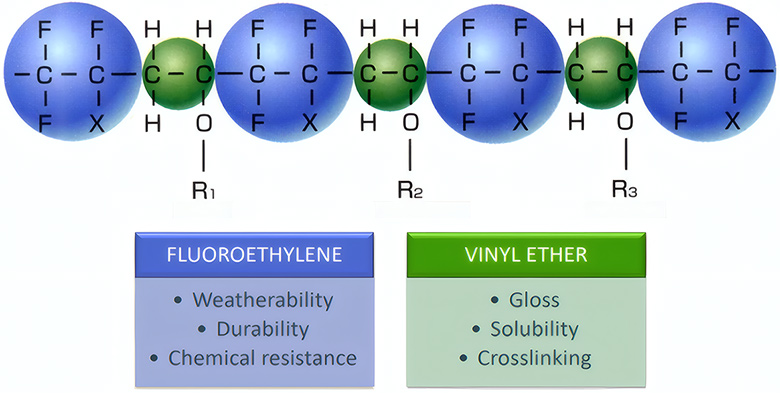
Fluoroethylene vinyl ether (FEVE) resins have emerged as a leading class of high-performance polymers capable of meeting these demands. The chemistry, performance attributes and long-term durability of the FEVE system are well documented in the literature.6-8 FEVE is a perfectly alternating copolymer composed of fluoroethylene and vinyl ether monomers (Figure 1), each contributing distinct and highly desirable properties. The fluoroethylene segments impart exceptional weatherability, UV resistance and chemical stability. These attributes are associated with the carbon–fluorine backbone typical of fluoropolymers. In parallel, the vinyl ether segments provide improved solubility, high gloss potential and hydroxyl functionality that supports crosslinking. This combination enables FEVE-based binders to deliver long-lasting gloss retention, resistance to chalking and robust mechanical durability, making them attractive candidates for exterior powder coating applications.
Despite the advantages of FEVE and other high-performance topcoat resins, many formulation strategies still rely on dry-blending multiple resin components. In these systems, pre-compounded powders based on different resin chemistries, such as polyesters and epoxies, are physically blended after extrusion to combine performance attributes or to accommodate differences in processing conditions. While straightforward, dry blending introduces variability in polymer distribution, which can compromise uniformity, affect mechanical properties and reduce overall coating reliability, particularly in accelerated or natural weathering environments. As performance expectations rise in sectors such as transportation, architecture and heavy-duty infrastructure, these inconsistencies highlight the need for improved formulation control.
Methodology
Materials
Pigmented powder coating formulations were prepared using a combination of high-performance topcoat resins that were selected depending on the formulation’s targeted performance profile. The primary binders included a super-durable polyester resin and a FEVE resin containing hydroxyl-functional groups suitable for thermoset crosslinking.
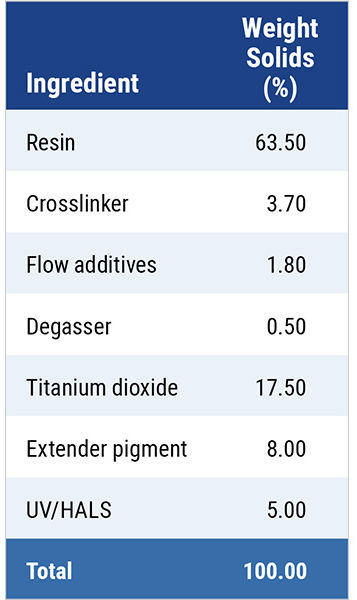
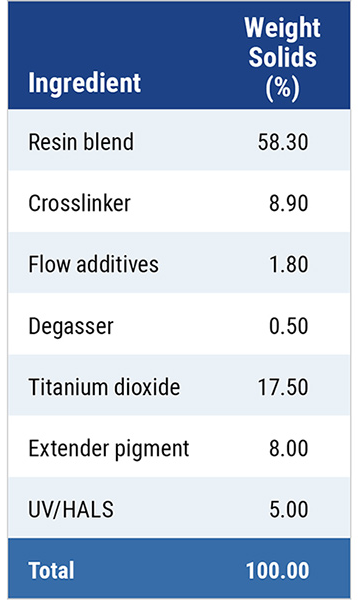
Crosslinking was achieved using standard curing systems typical of exterior powder coatings, including polyester-compatible curing agents such as triglycidyl isocyanurate or isocyanate-based chemistries. Standard additives used in powder coatings, such as flow modifiers, degassing agents, curing agents and pigments, were incorporated at levels typical of exterior-grade systems (Tables 1 and 2). All raw materials were sourced at production-representative grades. Pigment dispersions were produced with titanium dioxide at loading levels typical of high-opacity exterior topcoats to ensure adequate hiding and gloss development.
Formulation and Compounding
Each formulation was prepared using a controlled single-pass extrusion process. This approach was selected to eliminate resin segregation commonly observed in traditional dry-blend systems and to ensure uniform distribution of FEVE and secondary resins throughout the coating system.
Premix Preparation
All solid raw materials were weighed to ±0.05 g accuracy and premixed using a laboratory high-speed grinder for less than 10 seconds to minimize heat buildup and ensure sufficiently uniform particle size before feeding into the extruder. This step reduced agglomeration and improved initial homogeneity prior to melt processing.
Extrusion
Formulations were compounded on a co-rotating twin-screw extruder operated under standardized thermoset powder coating processing conditions. Typical temperature-zone settings ranged from 90 to 130 °F (32 to 55 °C), and the discharge temperature was maintained below the deblocking temperature of 347 °F (175 °C). Screw speeds were adjusted to maintain consistent torque. Materials were processed through a single pass, cooled and flattened on a chill roll belt, and then flaked and ground to target particle sizes of 35–55 μm using a laboratory high-speed grinder and a standard 75 μm sieve mesh for particle classification.
Application and Curing
Sieved powders were electrostatically sprayed onto aluminum panels using an electrostatic spray gun with a setting of 65 kV. Panels were coated to a dry-film thickness of 51–63 μm and cured according to the resin’s requirements, typically at 180–200 °C for 15–20 minutes.
Mechanical Testing
To establish a baseline for coating durability, the mechanical integrity of the cured films was evaluated to ensure they met the fundamental performance requirements for demanding architectural applications. Standardized ASTM methods were used to quantify adhesion and flexibility, two critical fundamental tests for long-term service life.
Adhesion to the aluminum substrate was assessed according to ASTM D3359, Method B.1 This crosshatch test is a crucial indicator of the coating’s bond strength and resistance to peeling or flaking under environmental stressors. Flexibility was evaluated using a 3/8-inch mandrel bend test as specified in ASTM D4145,2 which measures the coating’s ability to withstand fabrication stresses and thermal cycling without cracking or delamination. Before long-term weatherability can be considered, a coating must demonstrate robust mechanical performance. Therefore, a primary objective was to confirm that single-pass co-extrusion of different resins produced a film with mechanical integrity. As detailed in the results, this process not only met but, in the case of flexibility, exceeded the performance of the super-durable polyester control, underscoring the robustness of the FEVE co-blended system.
Optical and Surface Property Evaluation
Optical and surface properties were systematically evaluated to quantify both the initial appearance and any changes over the course of weathering. Gloss was measured in accordance with ASTM D523, using a 60° geometry standard for high-gloss coatings. To ensure accuracy, at least three readings were taken per panel and averaged.5 In addition to instrumental measurements, appearance uniformity was visually inspected to assess any defects or inconsistencies. For a more detailed analysis, surface imaging was conducted using Axio microscopy at 20x magnification to closely examine film integrity and the microscopic surface characteristics of the cured coatings.
Accelerated Weathering Testing
Accelerated ultraviolet (UV) exposure was conducted in accordance with ASTM D4587.3 For QUV-A testing, panels were exposed using 340 nm lamps and subjected to alternating cycles of four (4) hours UV at 60 °C, followed by four (4) hours condensation at 50 °C. Gloss retention and visual changes (chalking, gloss change) were monitored at predetermined intervals of 500 hours. The test duration was selected to reflect typical exterior architectural exposure profiles and to allow comparison between resin systems.3
For QUV-B testing, panels were evaluated using UVB-313 nm lamps to simulate higher-energy UV conditions known to accelerate degradation mechanisms and loss of gloss over time. Exposure cycles followed ASTM D4587 Method 2, which includes eight (8) hours of UV exposure at 60 °C and four (4) hours of condensation at 50 °C.3 Gloss retention and visual changes (such as chalking and gloss alteration) were monitored at predetermined intervals of 500 hours. This method was employed to assess system durability under intense artificial weathering and to compare the performance of FEVE-based coatings with other resin chemistries.
Natural Weathering
Panels were evaluated under natural outdoor conditions to align with architectural durability benchmarks used in AAMA 2605 (the most stringent FGIA/AAMA performance specification for organic coatings on architectural aluminum, which anchors long-term durability to extended South Florida exposure).9 Panels were mounted on south-facing racks at 45°, and gloss/appearance were recorded at regular intervals under the region’s high-UV, hot-humid climate.
Data Analysis
All performance data were compiled and compared across formulations to evaluate the impact of resin co-blending during extrusion. Mechanical, optical and weathering results were assessed and compared between the two resin systems. Gloss retention curves, mechanical property observations and qualitative weathering observations were used to determine whether single-pass co-extrusion improved uniformity and long-term durability.
Results
Initial Film Build, Cure and Appearance (Pre-Weathering)
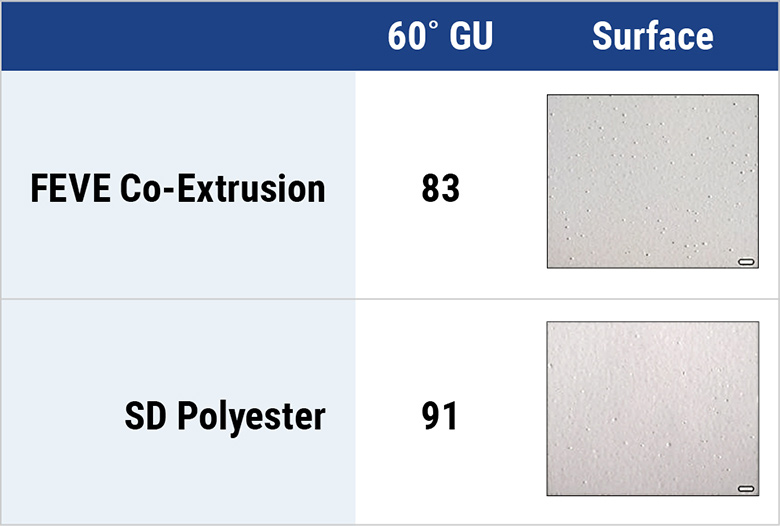
All formulations achieved target dry-film thickness (DFT) within 50.8–63.5 μm. Curing at 200 °C for 20 minutes produced a smooth surface with minimal surface defects in the dry film. Initial 60° gloss measurements were taken per ASTM D5235 to establish a pre-weathering baseline. The super-durable polyester control exhibited a high gloss of approximately 91 GU. The FEVE co-extruded system also produced a high-quality finish, registering a slightly lower but still high gloss of 83 GU (Figure 2). This minor variation is a predictable outcome when blending polymer systems with different melt-flow characteristics and rheology. Importantly, it demonstrates that incorporating the high-performance FEVE resin via co-extrusion does not compromise the coating’s excellent initial aesthetic quality, achieving a premium appearance right from the start.
Mechanical Performance
One objective of this study was to confirm that the single-pass co-extrusion process of multiple resins could produce a mechanically robust coating without compromising the fundamental properties required for high-performance applications. The mechanical testing results demonstrated that the FEVE hybrid formulations not only met but, in the case of flexibility, exceeded the performance of the industry-standard super-durable polyester control used in the study.
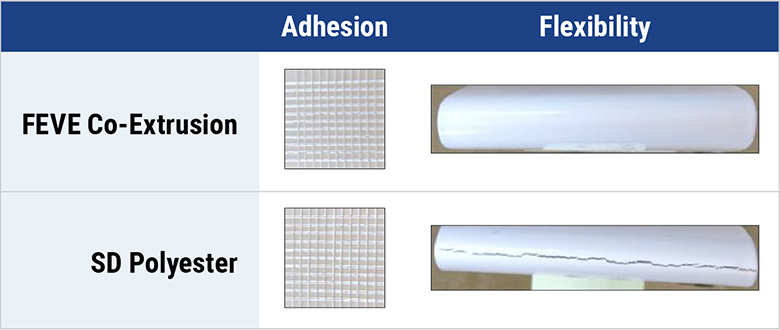
In adhesion testing per ASTM D3359, the FEVE hybrid formulation achieved a 5B rating, indicating zero loss of adhesion at the scribe. This perfect result was equivalent to the super-durable polyester control, confirming that the co-blending process successfully maintains the highest level of adhesion to the substrate.
A performance advantage for the FEVE system was observed in flexibility testing. The co-extruded FEVE system passed the 3/8-inch mandrel bend test (ASTM D4145) without any signs of cracking or delamination, demonstrating its ability to withstand fabrication stresses. In stark contrast, the super-durable polyester control failed this test, exhibiting distinct cracking along the bend radius.
Collectively, these results are highly significant (Figure 3). They prove that the single-pass co-extrusion of FEVE and super-durable resins is not a compromise. The process yields a coating that maintains excellent adhesion while delivering superior flexibility, resulting in a more durable, resilient film than the control. This robust mechanical foundation is crucial, as it ensures the coating’s integrity is maintained while its advanced weatherability properties protect the finish over the long term.
Gloss Retention Under Accelerated Weathering
Under accelerated weathering per ASTM D4587,3 FEVE co-extruded coatings demonstrated significantly better gloss retention and surface stability compared to the super-durable polyester control.
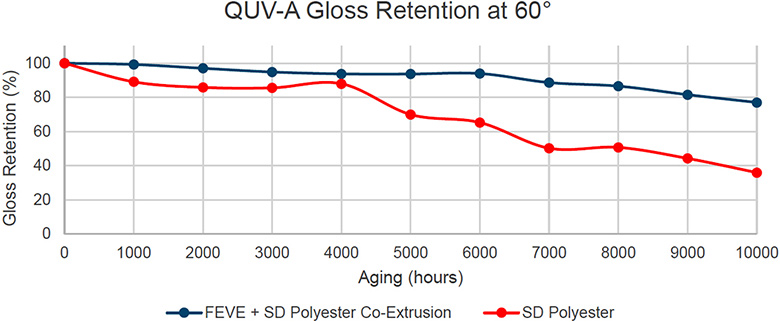
When subjected to QUV-A (340 nm) exposure, the FEVE co-extruded system retained 77% of its initial gloss after 10,000 hours, whereas the super-durable polyester control retained only 36% (Figure 4). Furthermore, no chalking was observed on the FEVE system throughout the 10,000-hour test, while the control began to show chalking at 4,500 hours.
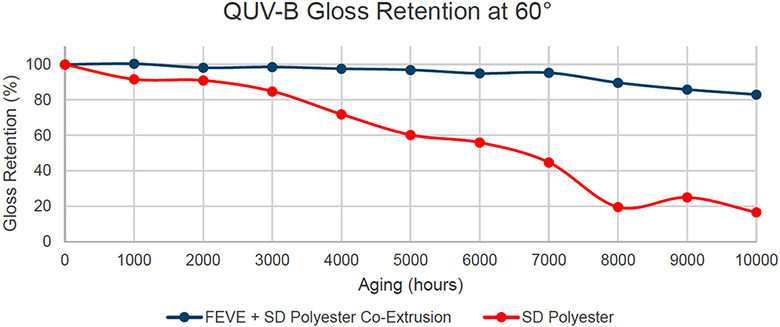
In alignment with industry guidance such as SSPC Paint 47,4 the formulations were also subjected to QUV-B exposure as part of the ASTM D4587 test method. The results mirrored the QUV-A findings, with the FEVE-containing formulation again outperforming the super-durable polyester, maintaining substantially higher gloss retention throughout the exposure period (Figure 5).
Natural Weathering Performance
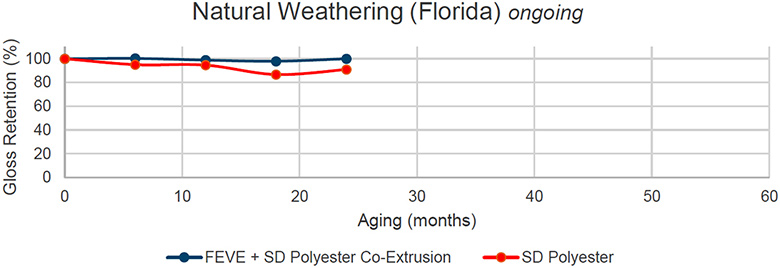
To validate the accelerated test results and assess real-world durability, the coatings were subjected to natural weathering in South Florida, as described in (FGIA) AAMA 2605,9 a standard environment for architectural coatings due to its high UV exposure, heat and humidity. After 24 months of continuous exposure, the FEVE co-extruded formulation exhibited exceptional durability, retaining 100% of its original gloss.
In comparison, the super-durable polyester control showed a slight decline, with gloss retention dropping to 91% over the same period (Figure 6). The comparison between these real-world results and accelerated weathering data confirms that accelerated weathering is a reliable predictor of long-term performance, demonstrating that single-pass co-extrusion of FEVE resins produces a durable coating suitable for the most demanding architectural projects. This long-term study is still ongoing, and the panels will continue to be monitored for a total of ten years to collect extended performance data.
FEVE Contribution to Long-Term Performance
The inclusion of FEVE resin displayed significant improvements in long-term performance observed in this study. The data from both accelerated and natural weathering exposures confirm that the inherent weatherability and chemical stability of FEVE chemistry translate to superior gloss retention and surface integrity.6-8 After 10,000 hours of QUV-A and QUV-B exposure, the FEVE-containing showed gloss retention more than 40 percentage points higher than the non-FEVE control, a substantial incremental benefit.5 From a practical standpoint, these results demonstrate that incorporating FEVE resin via single-pass co-extrusion provides a streamlined and reliable manufacturing process for producing powder coatings that meet the stringent exterior performance requirements of AAMA 2605, eliminating the complexities and variability of multistep or dry-blending methods.9
Summary of Key Findings
This study successfully demonstrated a streamlined method for producing high-performance powder coatings. The key findings are as follows:
- Excellent Mechanical Robustness: The co-extruded FEVE hybrid formulations met and exceeded performance targets, achieving the highest rating (5B) for adhesion per ASTM D33591 and passing mandrel bend testing without cracking or delamination, unlike the control.2
- Superior Optical Durability: The FEVE co-extruded systems exhibited outstanding gloss retention and chalk resistance under both accelerated QUV-A/B exposure (ASTM D4587)3,5 and natural South Florida weathering, aligning with the stringent AAMA 2605 specification.5,9
- Significant Process Advantage: The single-pass co-extrusion method ensures uniform resin distribution, yielding consistent and predictable performance while eliminating the property variability and additional steps associated with traditional dry-blend systems.
- Stable Surface and Aesthetics: Blending dissimilar resins via single-pass co-extrusion produces a smooth, defect-free surface, confirming that the process does not adversely affect the coating’s initial high-gloss appearance.
- Clear Material Contribution: The dramatic improvements in weatherability are unequivocally linked to the incorporation of FEVE resins, whose performance benefits are well documented and validated by the results of this study.6-8
Conclusion
This work demonstrates that single-pass co-extrusion of high-performance topcoat resins, specifically FEVE-containing systems, provides a practical pathway to achieve uniform resin distribution, high initial appearance and durable exterior performance in pigmented powder coating topcoats.
Formulations produced by co-extrusion met baseline mechanical expectations in adhesion and flexibility (per ASTM D3359 and ASTM D4145),1-2 while maintaining high 60˚ gloss in the cured state (ASTM D523).5 Under accelerated UV-condensation exposure (ASTM D4587),3 FEVE-containing co-extruded coatings preserved gloss substantially longer than non-FEVE controls, and natural exposure trends were directly consistent with architectural durability expectations referenced by AAMA 2605.9 Practice-oriented guidance from Paint 47 supported the interpretation of exterior topcoat behavior in high-UV environments.4
Overall, findings indicate that resin co-blending during melt processing can reduce the variability associated with dry-blend methods, enabling long-term gloss stability and robust surface integrity under both accelerated and natural weathering conditions. From a formulation and manufacturing perspective, this approach offers a streamlined processing route that eliminates multistep blending without compromising performance, thus positioning FEVE-based co-extrusion systems as strong candidates for exterior architectural and infrastructure applications where sustained appearance and durability are critical.
Future work will prioritize expanding the study into broader pigmented systems and diverse resin chemistries to evaluate how pigmentation, binder structure and crosslink density collectively influence long-term durability. Additional efforts will incorporate multi-climate natural and accelerated exposures to verify performance trends and establish whether durability mechanisms observed in clear and pigmented systems remain consistent.
References
- ASTM International. ASTM D3359 Standard Test Methods for Rating Adhesion by Tape Test; ASTM: West Conshohocken, PA, 2017.
- ASTM International. ASTM D4145/D4145M Standard Test Method for Coating Flexibility of Prepainted Sheet; ASTM: West Conshohocken, PA, 2019.
- ASTM International. ASTM D4587-23 Standard Practice for Fluorescent UV–Condensation Exposures of Paint and Related Coatings; ASTM: West Conshohocken, PA, 2023.
- SSPC. Paint 47: Highly Weatherable Fluoropolymer Topcoat, Performance-Based; SSPC: Pittsburgh, PA, 2020.
- ASTM International. ASTM D523 Standard Test Method for Specular Gloss; ASTM: West Conshohocken, PA, 2014.
- Parker, R.; Blankenship, K. Fluoroethylene Vinyl Ether Resins for High-Performance Coatings. In ASM Handbook, Vol. 5B: Protective Organic Coatings; ASM International: Materials Park, OH, 2015.
- AGC Chemicals. Lumiflon FEVE Resins—Solvent-Soluble Fluoropolymer Resins; AGC Chemicals: Exton, PA, 2020.
- ALPOLIC/AGC. Lumiflon Fluoropolymer Resins: Long-Term Performance vs. PVDF; ALPOLIC Materials: Chesapeake, VA, 2017.
- American Architectural Manufacturers Association (AAMA). AAMA 2605-05: Voluntary Specification, Performance Requirements and Test Procedures for Superior Performing Organic Coatings on Aluminum Extrusions and Panels; AAMA: Schaumburg, IL, 2005.
Looking for a reprint of this article?
From high-res PDFs to custom plaques, order your copy today!