Thermolatent Tin Catalysts for Low-Temperature Polyurethane Cure
Four thermolatent catalysts are evaluated for pot life, dust-free time and hardness in two-component polyurethane coatings under ambient and elevated-temperature cure conditions.

Need to Know
- In the tested 2K polyurethane coating, formulations containing TC1 and TC2 took 240 min to double in viscosity, compared with 30 min for the traditionally catalyzed control.
- Both formulations were dust-free immediately after a 20 min bake at 60 °C.
- Lower catalyst activation temperatures may provide opportunities for temperature-sensitive substrates and more flexible coating processes.
Tin(IV) catalysts have been well known for their efficacy as urethane catalysts. Traditionally, the difference in the cure speed of a given coating formulation prior to application, known as the pot life, and the cure speed after application relied primarily on concentration of the reactants subsequent to solvent loss after application. In the case of an ambient-cure coating, this is the only significant change. In the case of thermal curing, increased temperature also plays a significant role. Regardless, there is a strong direct correlation between the pot life and the cure speed after application. There are some formulation practices that allow for some pot life extension with the use of volatile or consumable components that inhibit catalytic activity in the pot but can evaporate or react after application. Another approach, first developed for use in coatings around 2009,¹ is the use of thermolatent tin catalysts. Through use of a thermoresponsive tin chelation group, catalytic activity at ambient temperature is reduced through chelation of the tin, while at high temperatures, the tin is exposed and allowed to act as a urethane catalyst.¹ This approach was later commercialized and is used in coatings with cure temperatures in the range of about 80–140 °C. While this is an effective approach, it does not provide a benefit for low-temperature cure systems. The work herein aims to leverage the beneficial thermolatent behavior while also enabling effective cure at lower temperatures. With an ever-increasing focus on sustainability, the use of lower temperatures can help to reduce energy consumption and therefore lower the carbon footprint.
Experimental
Tin Catalysts
A variety of tin catalysts were used to compare the cure behavior of a two-component (2K) polyurethane coating. Dibutyltin dilaurate (DBTDL) is a very common catalyst for polyurethane coatings and will serve as a control to demonstrate cure with a traditional catalyst. Also, systems with no added catalyst are included to elucidate the baseline cure of the system.
Four different thermolatent catalysts (TC) were evaluated:
Supplier TC + Iso: A commercially available thermolatent catalyst, trade name Blulogiq® 3190, available from Covestro, was used (designated “Supplier TC + Iso”). This catalyst is provided as a mixture with hexamethylene diisocyanate trimer.
Comparative TC: A thermolatent catalyst comprising two cyclic ligands, wherein a nitrogen heteroatom is included in the cyclic portion of the ligand, was prepared in accordance with reference 1, having the general structure as shown in Figure 1. Synthetic details were previously published.²

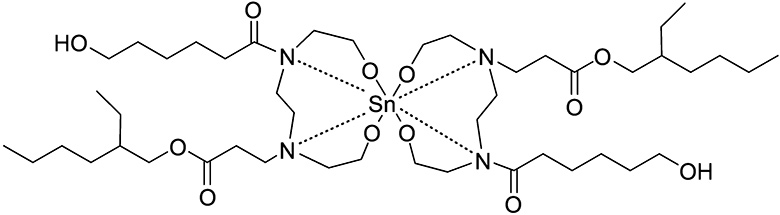
TC1: A new thermolatent catalyst was synthesized comprising two cyclic ligands, wherein two nitrogen heteroatoms were included in the cyclic portion of the ligand as shown in Figure 2. Synthetic details were previously published.²
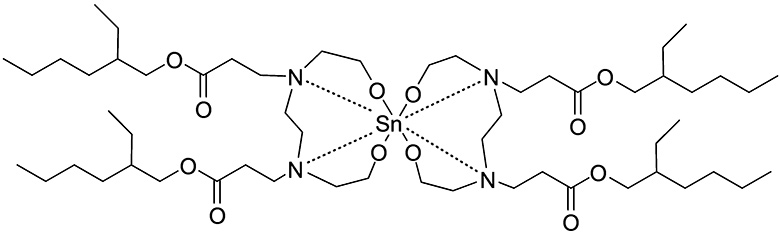
TC2: A second new thermolatent catalyst was synthesized comprising two cyclic ligands, wherein two nitrogen heteroatoms were included in the cyclic portion of the ligand as shown in Figure 3. Synthetic details were previously published.²
Coating Formulations
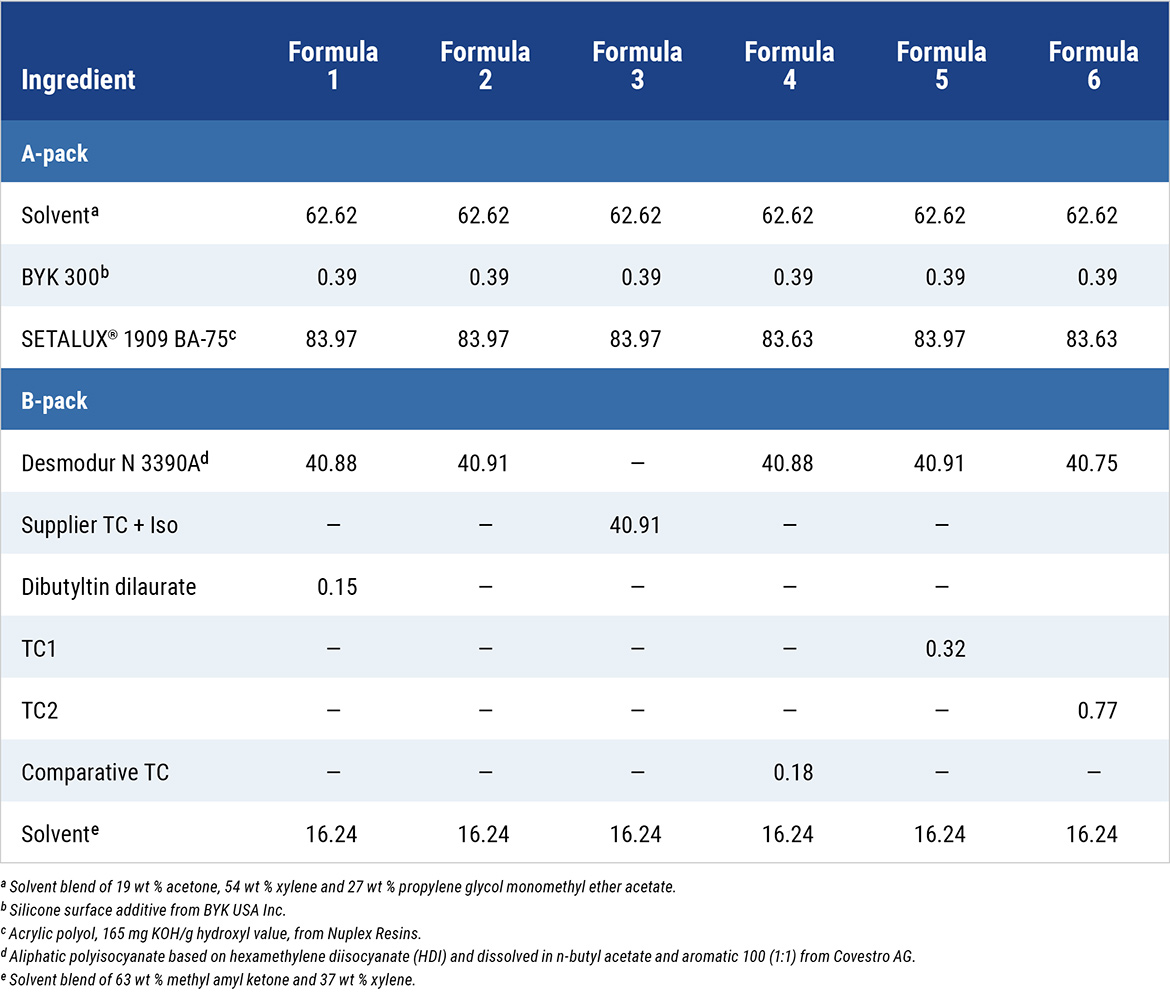
Two-component coating formulas were prepared by first preparing each component (A-pack, B-pack). The formulas were prepared as outlined in Table 1:
ᵃ Solvent blend of 19 wt % acetone, 54 wt % xylene and 27 wt % propylene glycol monomethyl ether acetate.
ᵇ Silicone surface additive from BYK USA Inc.
ᶜ Acrylic polyol, 165 mg KOH/g hydroxyl value, from Nuplex Resins.
ᵈ Aliphatic polyisocyanate based on hexamethylene diisocyanate (HDI) and dissolved in n-butyl acetate and aromatic 100 (1:1) from Covestro AG.
ᵉ Solvent blend of 63 wt % methyl amyl ketone and 37 wt % xylene.
The B-packs contain similar preparations with variations in the catalyst content using either free dibutyltin dilaurate (DBTDL), no catalyst, commercially available thermolatent catalyst, previously disclosed thermolatent catalysts or the thermolatent catalysts of this work as outlined in Table 1. It is important to note that the catalyst levels are such that an equal level of Sn is used in each catalyzed formula to facilitate a direct comparison of the catalyst behavior. The A- and B-packs were combined and mixed just prior to use.
Coating Application
The above formulations were spray-applied onto electrocoated steel panels. The panels used were ACT cold-rolled steel panels (10.16 cm by 30.48 cm) with ED6060 electrocoat available from ACT Laboratories Inc. The coating compositions were each applied by hand spray using a DeVilbiss GTi HVLP spray gun with a 1.4 mm nozzle at ambient temperature in two coats with an ambient flash between coats. Clearcoats were targeted for 2–2.5 mils (about 51–64 μm) dry film thickness. After coating application, coating drying and curing properties were monitored under three conditions: ambient, 10 min at ambient followed by 20 min at 60 °C or 10 min at ambient followed by 20 min at 80 °C.
Test Methods
Pot Life: Viscosity
Viscosity of the formulations was measured with a Brookfield CAP 2000 viscometer with a No. 1 spindle at 900 rpm to observe pot life. Measurements were recorded after the formulation was mixed by combining A-pack and B-pack and stirring by hand until homogeneous. Viscosity measurement times were initial, every 15 min until 60 min, then every 30 min until 120 min and then every 60 min until 300 min.
Dust-Free Time
Dust-free time was recorded as the time at which no cotton fibers adhered to the coating surface as applied after placing a cotton ball on the surface. This was measured at 15 min intervals, and the first time with no remaining cotton fibers was recorded. For ambient-cure samples, the first measurement was 15 min after application was completed. For samples that were cured at elevated temperatures, the first measurement was immediately upon removal from the oven.
König Hardness
Hardness of the coating was measured using a BYK pendulum hardness tester (article No. 5858) in the König hardness testing configuration. König hardness was measured at 1 day and 11 days after application of the coating.
Results and Discussion
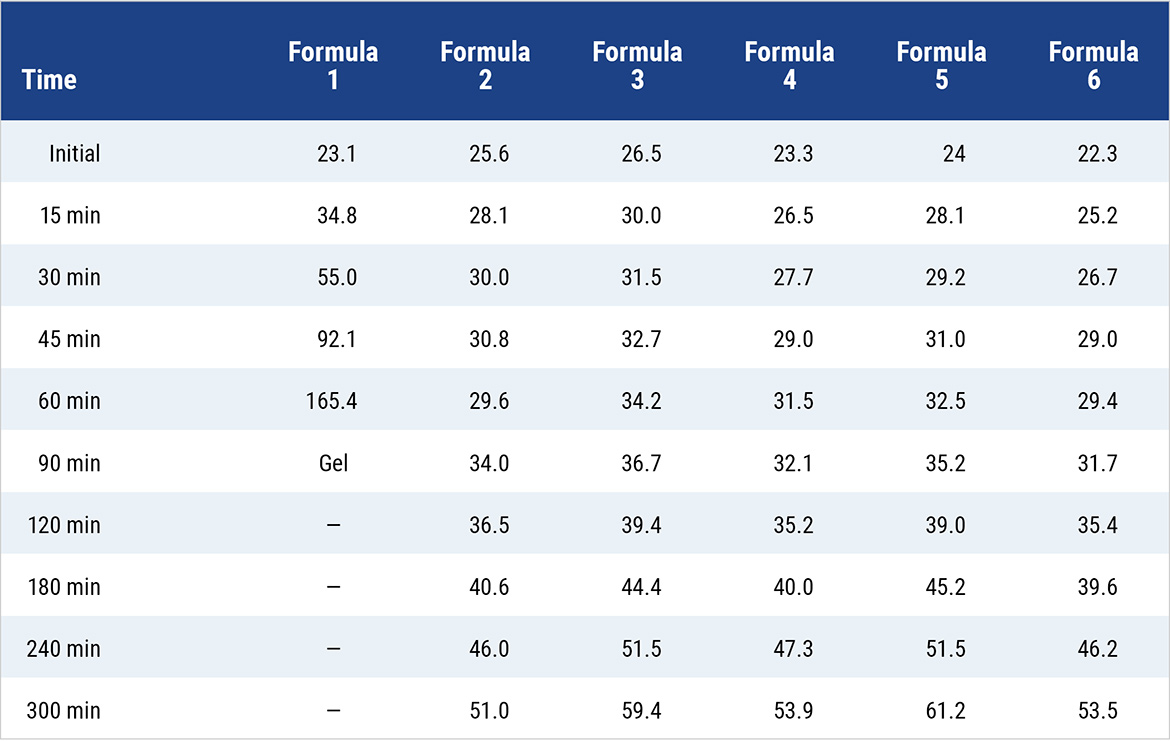
Table 2 below shows the viscosity of the formulas collected over time to monitor pot life. The traditionally catalyzed coating of Formula 1 doubled in viscosity in 30 min while Formulas 5 and 6 took 240 min, demonstrating a longer usable time of the formulas as compared to the traditionally catalyzed coating of Formula 1. The pot life of Formulas 5 and 6 was also similar to that of the uncatalyzed Formula 2, the commercially available thermolatent catalyst in Formula 3 and the Comparative TC used in Formula 4.
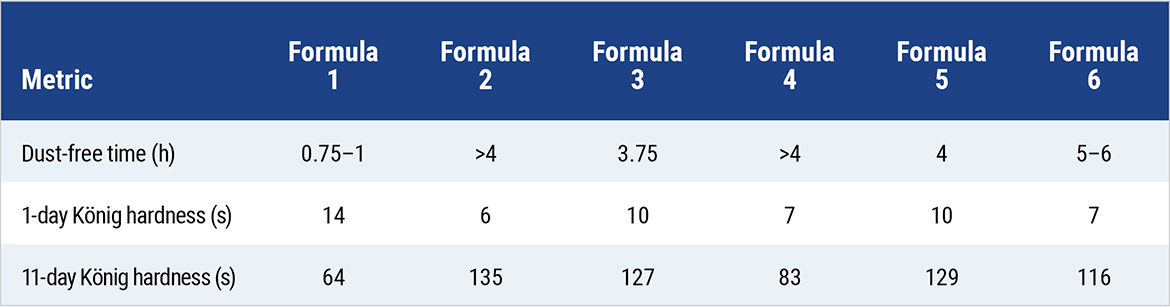
After application, the various formulations were allowed to cure under ambient conditions (approximately 22 °C, 50% RH). Dust-free time was monitored as well as 1- and 11-day König hardness as listed in Table 3. When looking at the dust-free time at ambient temperature, Formulas 5 and 6 and Formulas 3 and 4 all behaved similarly to the uncatalyzed Formula 2, with very long dust-free times. Only the traditionally catalyzed Formula 1 had a dust-free time under 1 h. This is in line with expectations since the various thermolatent catalysts are expected to remain largely inactive at ambient temperature; thus, latency at room temperature is confirmed. Furthermore, the hardness of Formulas 2 and 4 through 6 was similar. This again demonstrated room-temperature latency, with most of the thermolatent-catalyst-containing formulas having developed hardness similar to Formula 2, which had no added catalyst.
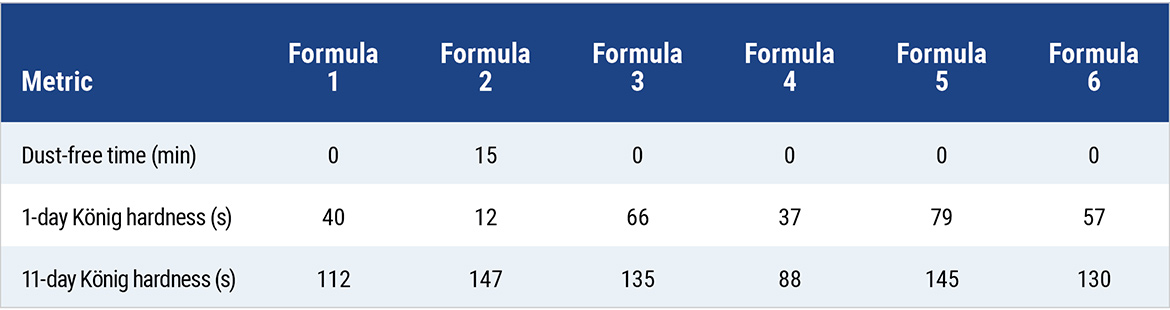
The cure metrics of the formulas cured with a 20 min bake at 80 °C are displayed in Table 4. Formulas 1, 3 and 4 and Formulas 5 and 6 were all dust-free after the bake. This is in line with the expected behavior of Supplier TC + Iso and Comparative TC. The 1- and 11-day König hardness was notably highest for Formula 5 compared to all of the other catalyzed formulas.
The cure metrics of the formulas cured with a 20 min bake at 60 °C are displayed in Table 5. The dust-free times of Formulas 5 and 6 and Formula 4 when baked at 60 °C were similar to that of the traditionally catalyzed coating of Formula 1, being dust-free immediately after the bake. In comparison, Formulas 2 and 3 required an additional 2.75 h and 15 min, respectively, until dust-free status was achieved. Furthermore, the 1-day König pendulum hardness of Formula 5, while similar to Formulas 1, 3 and 6, was the highest hardness observed. Additionally, the 11-day hardness of Formula 5 was the highest of the catalyzed compositions. The formulations of Formulas 3 and 4 and Formulas 5 and 6 all showed some degree of thermally induced catalytic activity, with Formula 5 having had the highest observed hardness of the thermally induced catalytic formulas.
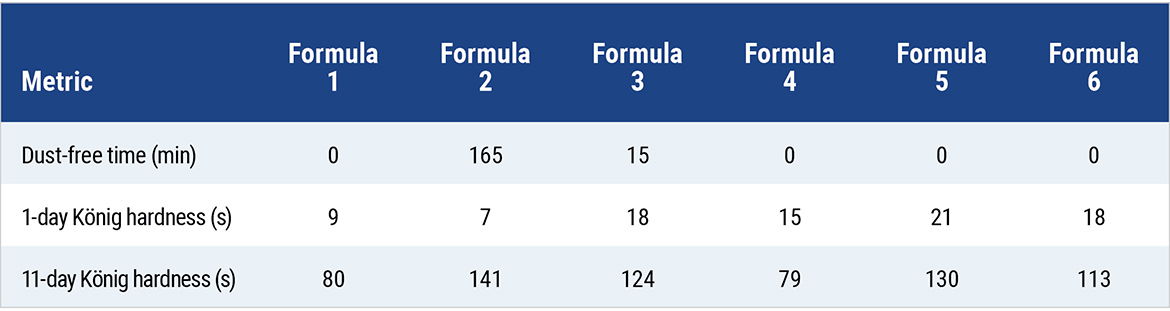
As demonstrated by the data above, pot life and cure speed can both be optimized in a thermally cured composition such that the typical pot life/cure speed paradigm is not applicable. This allows for long pot life to be achieved while still having efficient cure when cured at 60–80 °C or at higher temperatures. Previously known thermolatent catalysts are effective for both pot life and cure at 80 °C while it can be seen that TC1 and TC2 show an advantage by leveraging both latency for extended pot life and improved cure capability at an even lower cure temperature of 60 °C. Having the capability to effectively activate the catalyst to cure the coating at such a low temperature allows for many uses of the coating with a variety of substrates, in particular temperature-sensitive substrates. Additionally, there may be opportunities to improve sustainability of processes through improved throughput and reduced waste.
Conclusions
Thermolatent catalysts are an effective formulation tool to enhance formulation capabilities in terms of pot life and cure speed, breaking from the normal paradigm when using traditional catalysts. The catalysts developed and shown herein improve upon the existing capabilities by lowering the cure temperature required to effectively activate cure upon bake while still maintaining the benefit of an extended pot life, having a pot life similar to that of an uncatalyzed coating.
Acknowledgments
Thank you to Jun Deng and Johnathan Martz for helping with some aspects of this work.
References
1. Richter, F.; Pires, R.; Reiter, S.; Krause, J.; Jurkschat, K.; Iovkova, L.; Schürmann, M.; Bradtmöller, G. Use of Tin Catalysts for the Production of Polyurethane Coatings. U.S. Patent 8,946,372, Feb. 3, 2015.
2. Zhou, H.; Moravek, S. J.; Schwartzmiller, D. J.; Deng, J. D.; Martz, J. T. Thermolatent Catalyst and Its Use in Curable Compositions. U.S. Patent 10,773,243, Sept. 15, 2020.
This research on paint and coatings additives is relevant to formulators and manufacturers evaluating how catalyst design affects pot life and low-temperature cure.
Looking for a reprint of this article?
From high-res PDFs to custom plaques, order your copy today!