
Could Structural Color Repaint the Coatings Industry?

Need to Know
- Structural color comes from micro- or nanoscale features that redirect light through interference, scattering or diffraction.
- Coatings can use multilayer interference flakes, colloidal photonic crystals, self-assembling polymers or plasmonic structures to create structural color.
- Changes in layer thickness, particle size or drying can shift hue. Multi-angle color measurement and weathering tests help qualify these finishes.
This quarterly column, written by Victoria Scarborough, Ph.D., Vice President Collaborative Innovation of The ChemQuest Group, Inc., provides a look into the latest trends and technologies within the coatings and adjacent industries that impact the value chain.
In the coatings industry, color is both a powerful selling tool and a persistent technical challenge. A finish may still protect the substrate long after its original appearance has begun to fade, chalk, or shift in hue. Once that happens, consumers often judge the entire coating as having failed. Formulators therefore rely on careful pigment selection, UV absorbers, light stabilizers, and antioxidants to preserve color, but these additives raise raw material costs while only slowing the degradation process.
Traditional pigments produce color through chemistry. Their molecules or crystals absorb certain wavelengths of visible light and reflect others. Exposure to ultraviolet radiation, heat, oxygen, moisture, pollutants, and reactive coating ingredients can alter either the pigment or its surrounding binder. Organic pigments are particularly vulnerable when photochemical oxidation damages the molecular structures responsible for color. Inorganic pigments generally offer better light stability, but some can still undergo oxidation-state changes, surface reactions, or interactions with binders and additives that alter their appearance.
When Nature Builds Color
Nature offers another way to create color. Through biomimicry, the study and adaptation of nature’s designs, researchers are learning from the brilliant blue of Morpho butterflies, the metallic green of beetles, and the shifting hues of peacock feathers. Much of this color does not come primarily from light-absorbing pigments. Instead, microscopic structures manipulate light through reflection, scattering, and interference. Because the color is encoded in physical architecture rather than solely in a photosensitive molecule, it can remain vivid even when conventional colorants might fade. These natural optical systems are inspiring a new generation of coatings designed to deliver not only distinctive color, but also potentially improved light stability, infrared reflection, passive cooling and other functional benefits.1
 Courtesy of www.bionnov.com/en/post/the-morpho-butte1
The Chemistry Behind the Optics
Traditional Pigments: Color by Absorption
Traditional pigments create color through their chemical composition. When white light strikes a pigmented surface, several things occur:
- The pigment molecules or crystals absorb certain wavelengths of light.
- The remaining wavelengths are reflected or scattered to our eyes.
- Our visual system interprets those reflected wavelengths as a particular color.
For example, a blue pigment absorbs much of the red, orange, and yellow light and reflects more blue light. Because its color depends on chemical structure, the pigment may fade if ultraviolet light, heat, oxygen, or moisture alters that structure.
Structural Color: Color by Controlling Light
Structural color is produced by microscopic (or nanoscale) features rather than primarily by light-absorbing molecules. These structures are similar in size to wavelengths of visible light and manipulate light through several mechanisms:
- Interference, in which reflected light waves reinforce some wavelengths and cancel others
- Scattering, which redirects selected wavelengths
- Diffraction, which separates light according to wavelength
- Photonic effects, in which periodic structures strongly reflect a narrow range of wavelengths
In simple terms, pigments create color by subtracting wavelengths from white light; structural materials create color by organizing and redirecting light.2
Figure 1. Coloration mechanisms.
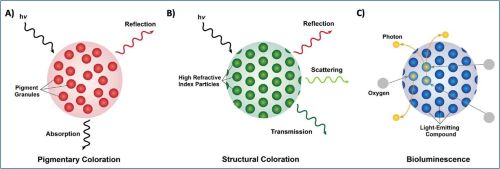 Chatterjee, A., “At the Intersection of Natural Structural Coloration and Bioengineering,” Biomimetics, 2022, 7(2), 6.
Four Ways to Create Structural Color
Four main technologies can create structural color in coatings.
Multilayer Interference Flakes
These flakes contain extremely thin layers of metals and metal oxides that reflect light, producing colors that change with the viewing angle. An example of this technology is provided by VIAVI’s ChromaFlair® pigments.The flakes can be mixed into conventional coatings, but their orientation and the thickness of the coating affect the final appearance.3
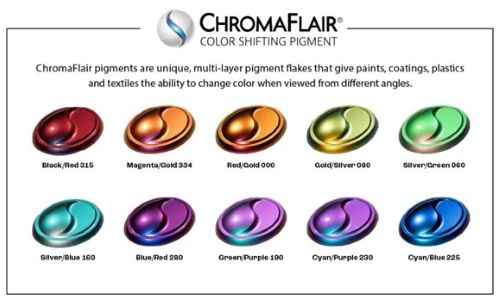 Courtesy of VIAVI
Colloidal Photonic Crystals
Colloidal photonic crystals are made from very small, uniform silica or polymer spheres that arrange themselves into ordered structures. The spacing between the spheres determines which wavelength of color is reflected. Highly ordered structures often appear iridescent. Introducing some controlled disorder can make the color less angle-dependent, although it may also reduce its intensity. A precious opal provides a natural example of a colloidal photonic crystal (see Figure 2). Regularly packed silica spheres selectively reflect visible wavelengths, producing color without conventional pigments.4
Figure 2. Molecular structure of a precious opal.
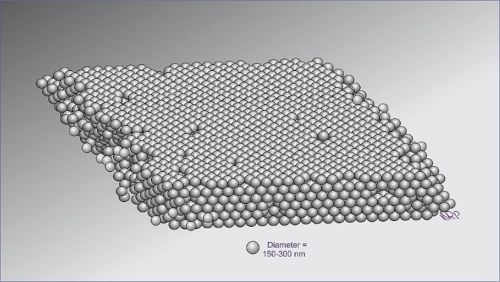 Wikimedia Commons, CC BY-SA 4.0
Self-Assembling Polymers and Biopolymers
These materials naturally form nanoscale layers as the coating dries. Cypris Materials, a startup company, developed synthetic block copolymers that self-assemble at the nanoscale level to bend and refract light into brilliant colors without chemical colorants. It has since licensed its intellectual property, and BASF has used the technology to create its ZENOMENON automotive coating concept.5 The unique color effect arises from self-assembled layered structures.
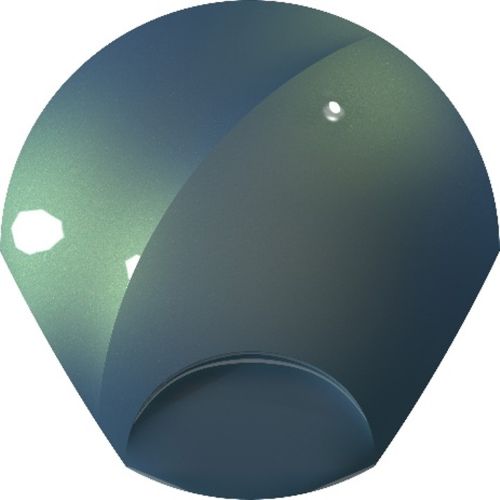 Courtesy of BASF
Cellulose nanocrystals (CNCs) can produce similar effects from renewable plant material. CNCs are elongated, birefringent nanoparticles that, due to their high aspect ratio, behave as a colloidal liquid crystal when dispersed in water via a cholesteric self-assembly process. Their final color depends on particle spacing, additives, humidity, and drying conditions.6
Figure 3. Self-assembly of CNC/GLU films with structural coloration.
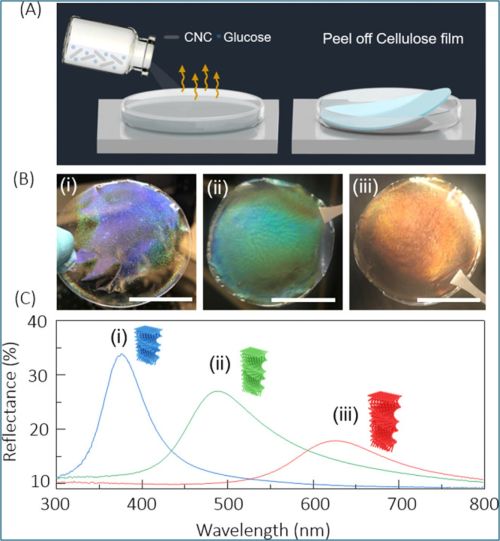 (A) Schematic illustration of the process of making self-assembled CNC ColPRC films. (B) Digital photographs of centimeter-sized ColPRCs producing (i) violet-blue , (ii) green, and (iii) red structural colors. The scale bars are 2.5 cm. (C) Reflectance spectra of the CNC ColPRC films, showing clear peaks that redshift with increasing GLU content. The insets show (false colored) schematics of the chiral nematic CNC structure, with corresponding increasing helical pitch. 6Bruno Frka-Petesi, et. al., “Structural Color from Cellulose Nanocrystals or Chitin Nanocrystals: Self-Assembly, Optics, and Applications,” Chem. Rev., (2023) 123 (23): 12595–12756.
Plasmonic Structures
Plasmonic structures use nanoscale metals to control how light is reflected. Researchers at the University of Central Florida (UCF) created aluminum and aluminum-oxide flakes whose dimensions determine their visible color. The aluminum also reflects infrared energy, potentially helping coated surfaces remain cooler. The flakes were mixed with a commercial binder and spray applied, although lower-cost manufacturing is still needed for broad commercial use.7
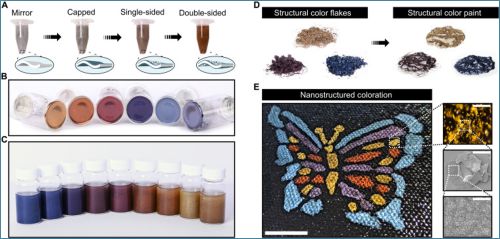 UCF
An Opportunity for Coatings Companies
Why should coating manufacturers invest in the development of structural color? Several drivers make this technology an interesting opportunity:
- Durability is the most intuitive benefit. Pigments and dyes fade when photons, oxygen, or heat damage the chromophore. While structural color can be intrinsically photostable, binders can yellow, interfaces can corrode, particles can be abraded, and porous structures can fill with water or contaminants. Thus, the coating system and long-term color change still require weathering validation.
- Appearance is another significant advantage. Structural colors can deliver unusually pure, saturated hues and dramatic flop because they reflect selected wavelength bands rather than subtracting color through broad absorption. A single chemistry may yield multiple colors by changing only feature size, potentially reducing the number of distinct pigment chemistries needed in a palette and enabling digitally or spatially programmed effects.
- Sustainability may be the strongest long-term driver, but it is platform specific. Cellulose systems can replace mined mica, metal oxides, synthetic dyes, or plastic glitter with renewable, biodegradable material. Polymer systems may incorporate renewable feedstocks. Plasmonic aluminum systems can achieve color in extremely thin layers (lowering mass) and can reflect infrared radiation to reduce solar heat gain. None of these benefits should be assumed from the phrase structural color alone. Vacuum deposition can be energy intensive, nanofabrication can create yield losses, and some architectures still depend on metals, solvents, or durable polymer binders. Comparative life-cycle assessment will be essential.
- Specialized functionality provides another reason to study structural color. Nanostructures that manage visible light can also be engineered to influence ultraviolet and infrared wavelengths, enabling functions such as passive cooling and optical authentication.7,8 Sensor compatibility may also become increasingly important in future mobility, although lidar and radar performance depend strongly on the materials, pigment loading, and complete coating construction; metallic structures can interfere with radar transmission.9 UCF reported that its experimental plasmonic paint reflected infrared radiation and kept the underlying surface 25–30 °F cooler than a surface covered with conventional commercial paint. The researchers emphasized that manufacturing scale and cost must still be addressed.6
Structural color will not make conventional pigments obsolete. Carbon black, titanium dioxide, iron oxides, and organic pigments remain efficient, familiar and economical. The more plausible future is a hybrid approach. Absorptive pigments will establish hiding and background tone; structural components will add chroma, flop, thermal management, sensor compatibility, or a difficult-to-copy optical signature.
Evaluation methods must evolve with the technology. Coatings teams should also test whether abrasion, stone chipping, polishing, and field repair change particle orientation or disrupt the periodic structure. For cooling claims, total solar reflectance and thermal emittance are more meaningful than visible color alone. For sensor-compatible coatings, lidar and radar transmission must be measured through the complete primer, basecoat, and clearcoat stack. These methods are familiar individually, but structural color brings another dimension to the qualification program.
The Challenges Ahead
Structural color technology is in its infancy. Emerging commercial suppliers like VIAVI and others are paving the way to create a family of multilayer interference pigments for use in for paints, plastics, textiles, and packaging. Formulators will need to discover how best to work with these new materials. The challenges include:
- Scale-up: A small change in layer thickness, particle diameter, swelling, or drying rate can create an obvious hue shift. Conventional tint strength can often tolerate modest variation in particle geometry; structural color cannot. Batch uniformity, metrology, and inline process control therefore become central manufacturing technologies.
- Application: Shear can disrupt assemblies or damage delicate flakes. Surface tension and evaporation gradients can create banding. Substrate roughness scatters light. Flake orientation changes color travel, and clearcoat refractive index alters the optical response. Waterborne cellulose structures can swell with humidity unless protected, while highly ordered colloidal crystals may crack during drying.
- Repair and color matching: More difficult to achieve when appearance depends on angle and microstructure rather than composition alone. A single spectrophotometer reading at normal incidence cannot describe a gonio-apparent finish. Development programs need multi-angle color measurement, bidirectional reflectance data, microscopy of the optical architecture, and accelerated exposures that track both hue and structural integrity.
- Cost: Structural color is best positioned initially where appearance, weight, cooling, or authentication creates enough value to support a premium, such as luxury automotive, aerospace, consumer electronics, cosmetics, packaging, textiles, and brand protection. Architectural and general industrial coatings will require inexpensive, high-throughput particles that tolerate normal mixing, spray, and cure conditions.
Final Thoughts
In business, we often ask, “Is the juice worth the squeeze?” Structural color still faces significant challenges, including cost, manufacturing scale, application consistency, and integration into existing coating systems. But none of these barriers appear insurmountable. As universities, startups, and early adopters push the technology forward, these biomimetic approaches could deliver distinctive finishes, improved color durability, and functional benefits that conventional pigments cannot easily provide.
Structural color is unlikely to replace traditional pigments anytime soon. Instead, it will expand the formulator’s toolbox, adding new effects and performance possibilities to the already-rich palette consumers demand. Nature has spent millions of years learning how to manage light; the coatings industry is only beginning to translate those lessons into products it can manufacture. And in an industry where color is sold, that may make the juice well worth the squeeze.
To learn more, reach out to the author at vscarborough@chemquest.com or visit https://chemquest.com.
References
- “Making life more colorful on the wings of a butterfly,” American Chemical Society, August 26, 2026,www.acs.org/pressroom/presspacs/2026/august/making-life-more-colorful-on-the-wings-of-a-butterfly.html.
- Chatterjee, A., “At the Intersection of Natural Structural Coloration and Bioengineering,” Biomimetics, 2022, 7(2), 6.
- ChromaFlair Light Interference Pigments data sheet and product information, VIAVI Solutions, , 2023, www.viavisolutions.com/en-us/osp/products/chromaflair.
- Zhu, K.; Fang, C.; Pu, M.; Song, J.; Wang, D.; Zhou, X., “Recent Advances in Photonic Crystal with Unique Structural Colors: A Review,” Journal of Materials Science & Technology, 2023, 141, 78–99.
- Outstanding design: Automotive color by BASF recognized with renowned Red Dot Award, from BASF New Media Release, June 26, 2024, www.basf.com/global/en/media/news-releases/2024/06/p-24-228.
- Bruno Frka-Petesi, et. al., “Structural Color from Cellulose Nanocrystals or Chitin Nanocrystals: Self-Assembly, Optics, and Applications,” Chem. Rev., (2023) 123 (23): 12595–12756.
- Pablo Cencillo-Abad, et. al., “Ultralight plasmonic structural color paint,” Sci. Adv., 9, eadf7207 March 2023.
- Minh, N. H., et. al., “Anti-Counterfeiting Labels of Photonic Crystals with Versatile Structural Colors,” Nanoscale Advances, 2024, 6(23), 5853–5860.
- Huber, A.; Maile, F., “Radar and Lidar Suitable Car Paints,” CoatingsTech, September 2023, https://www.coatingstech-digital.org/coatingstech/library/item/sept-oct_2023/4127947/.
Structural color gives formulators another way to control a finish’s appearance alongside conventional paint and coating pigments.
Looking for a reprint of this article?
From high-res PDFs to custom plaques, order your copy today!