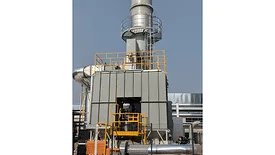
An emissions-control specialist explains how capture design, oxidizer selection, heat recovery and future capacity shape VOC-control decisions for coating operations.
Four thermolatent catalysts are evaluated for pot life, dust-free time and hardness in two-component polyurethane coatings under ambient and elevated-temperature cure conditions.
PPG researchers explore how thermolatent tin catalyst design changes the balance between working time and low-temperature cure in polyurethane coatings.
Tests in water-reducible and high-solids enamels compare dispersion, viscosity, suspension stability and sag resistance across aqueous and solvent systems.
This work shows how CE10P acrylic and hybrid polyols improve flow, drying speed and appearance in acetone-rich clearcoat formulations while meeting strict VOC limits.
This study evaluates how open time extending additives influence open time, wet edge, viscosity, gloss and blocking across architectural and wood coatings.
This article details how aerosol paint systems align can design, propellants and water-based chemistries with air quality rules to ensure consistent performance.
An introduction to isocyanates in coatings, covering types, properties, reactivity and key formulation considerations for self-leveling urethane systems.

 RSS
RSS