Atmospheric Durability of a Triple-Resin DTM Coating
An evaluation of QUV stability, corrosion resistance, chemical spot testing and heat aging performance in a single-coat system for industrial and rail applications.

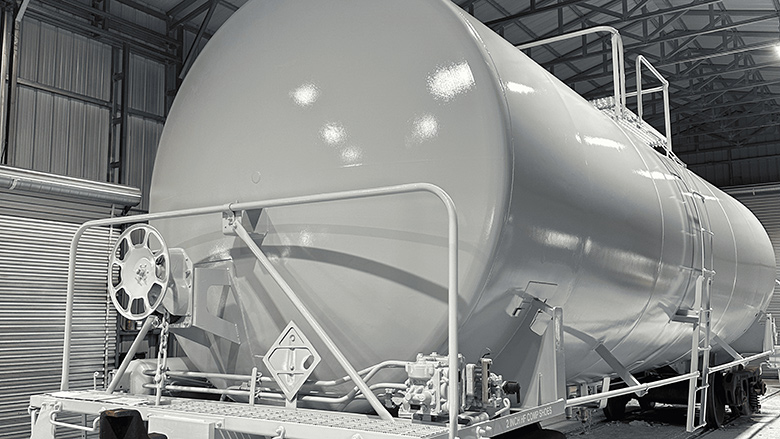
Conceptual illustration of UV, heat, moisture and chemical exposure affecting rail tank-car coatings.
Need to Know
- A single-coat, triple-resin DTM system was evaluated for resistance to UV exposure, dry heat, corrosion, chemical contact and humidity.
- After 720 h at 120 °C, the manuscript reports pull-off adhesion exceeding 3,600 psi, with mild discoloration and gloss reduction.
- The reported corrosion results include meeting C4 very high, Regime 1, requirements but not Regime 2 because of greater scribe creep.
- Field-exposure testing is recommended to correlate the laboratory findings with real-world conditions.
Atmospheric exposure is a significant cause of coating failure in industrial environments, particularly in assets subjected to outdoor weathering, cyclic humidity and chemical contamination. The ability of a coating system to retain its physical and chemical properties under prolonged exposure to ultraviolet light, temperature extremes and corrosive agents is critical to maintaining long-term asset performance and reducing life-cycle maintenance costs.
This triple-resin coating system was developed as a next-generation DTM solution that merges the chemical durability of an epoxy with the weathering resistance of a polyurethane, enhanced by a third proprietary resin designed to fortify long-term environmental resistance. This single-coat system simplifies application while preserving the multifunctional performance required for modern asset protection. The following evaluation characterizes the atmospheric resistance of the triple-resin coating system using a battery of industry-standard laboratory tests.
Background
Typical exterior-grade epoxy and polyurethane coatings are formulated to handle limited exposure to environmental stressors but often require multilayer application or suffer degradation under extended service. UV degradation can cause chalking and color loss. Acid rain or splash exposure can lead to film embrittlement or failure. High humidity and thermal cycling can accelerate underfilm corrosion or lead to coating delamination.
The triple-resin coating system addresses these limitations by integrating three resin systems into a unified film that resists breakdown through co-cured polymeric reinforcement. This paper outlines the triple-resin coating system’s performance under QUV accelerated weathering, dry heat aging, corrosion exposure per ISO 12944-6, and chemical spot and humidity testing.
Materials and Test Methods
QUV Accelerated Weathering (ASTM D4587)
Steel panels measuring 12 × 12 in. (approximately 30.5 × 30.5 cm) were sprayed with the triple-resin coating system, along with three competitive epoxies. Each panel was partially masked to preserve an unexposed control area. Panels were subjected to 750 h of UV exposure using UVA-340 bulbs. Color stability was measured using L*a*b* color space and ΔE calculations to quantify change.
Dry Heat Aging (120 °C, 720 h)
Testing was performed by GPI Laboratories, project ID N102301.B. The triple-resin coating system panels were exposed to 120 °C for 720 h to simulate continuous high-temperature service. The post-exposure evaluation included visual assessment per ASTM D660 and D772 and adhesion testing per ASTM D4541.
Corrosion Testing (ISO 12944-6:2018)
Testing was performed by KTA-Tator Inc., project No. 66075853-R2. Panels coated at 6.0–8.0 mils (approximately 152–203 μm) were subjected to salt spray (ISO 9227), humidity (ISO 6270-1) and cyclic aging. Each test included multiple durability classifications from C3 to C4 (low through very high). The assessment included rusting, blistering, cracking and scribe creep.
Chemical Spot and Humidity Testing (ASTM D1308, D2247)
Panels were exposed to 10 aggressive chemicals for 72 h at 23 °C. The post-exposure evaluation included blistering (ASTM D714), rusting (ASTM D610) and visual degradation. Separate humidity exposure was performed at 38 °C in 100% humidity for 1,000 h.
Spot and Spill Acid Resistance
Panels were exposed to concentrated acids, including nitric, phosphoric, sulfuric, acetic and hydrochloric, for up to 72 h. Gloss loss, discoloration and film integrity were evaluated.
Results and Discussion
QUV Accelerated Weathering (ASTM D4587)
After 750 h of UVA-340 exposure, the triple-resin coating system panels displayed minimal discoloration and gloss loss compared to competitive epoxy systems. ΔE measurements confirmed that the coating maintained superior color stability, reflecting its enhanced UV resistance. The masking technique allowed for a direct comparison between exposed and unexposed sections on each panel, demonstrating the coating’s ability to preserve its aesthetic properties in long-term exterior environments. This performance is attributed to including UV-stable polyaspartic and polyurethane resins within the tri-resin matrix, which effectively absorb and dissipate ultraviolet radiation without undergoing the polymer chain scission commonly observed in conventional epoxies.
Dry Heat Aging Performance (120 °C for 720 h)
Post-exposure analysis revealed that the triple-resin coating system retained structural and adhesive integrity following prolonged exposure to elevated temperatures. Panels exhibited no cracking, flaking or blistering under ASTM D660 and D772 evaluations. Adhesion testing using ASTM D4541 showed values exceeding 3,600 psi (24.8 MPa), with failure occurring cohesively within the film rather than at the substrate interface. This indicates that not only did the coating maintain its mechanical properties under thermal load, but it may have benefited from additional crosslinking due to heat exposure.
While mild discoloration and gloss reduction were noted, these changes were superficial and did not indicate any underlying degradation of the protective film. These findings confirm that the triple-resin coating system is well suited for continuous dry heat service up to 120 °C, with minimal impact on coating performance.
Corrosion Resistance (ISO 12944-6:2018)
Comprehensive corrosion testing conducted by KTA-Tator included neutral salt spray, humidity chamber exposure and cyclic aging per ISO 12944-6 protocols. Across all C4 durability categories (low, medium, high and very high, Regime 1), the triple-resin coating system panels met or exceeded performance requirements. Key performance indicators such as rusting (Ri 0), blistering (S0), flaking (S0) and cracking (S0) remained within the strictest allowable thresholds. Cross-cut adhesion testing consistently returned a 0 rating, confirming complete coating retention after exposure.
In scribe creep evaluations, corrosion propagation was minimal, averaging below the 1.5 mm requirement. Although the coating did not meet the C4 very high Regime 2 classification due to greater scribe creep during cyclic exposure, this failure occurred under extremely aggressive accelerated conditions that exceed standard field service severity. Overall, the results validate the triple-resin coating system as a high-performance corrosion barrier, particularly in coastal or industrial atmospheres requiring extended maintenance cycles.
Chemical Spot and Humidity Resistance (ASTM D1308 and D2247)
The triple-resin coating system demonstrated broad-spectrum chemical resistance when spot-tested with highly aggressive reagents, including concentrated acids and alkaline solutions. When exposed for 72 h, the coating showed minimal visual degradation, mainly limited to gloss loss or surface yellowing in the most aggressive environments. In a side-by-side comparison with a leading competitive epoxy, the triple-resin coating system outperformed it in aesthetic retention and film integrity. Extended humidity exposure (1,000 h at 38 °C and 100% humidity) further confirmed the robustness of the coating under prolonged moisture stress. The coated panels displayed fewer signs of underfilm corrosion, lower blister formation and higher overall adhesion retention than the comparator system. These findings indicate that the coating is well suited for applications where frequent chemical contact and high humidity may compromise traditional coatings.
Spot and Spill Acid Resistance
Exposure to strong acids, including nitric, hydrochloric, phosphoric and multiple concentrations of sulfuric acid, confirmed the triple-resin coating system’s ability to withstand aggressive splash and spill events without catastrophic failure. Surface observations revealed slight gloss reduction or color change, but no blistering, delamination or substrate exposure occurred within the 72 h test period. Only superficial effects were observed in the case of highly oxidizing acids such as nitric acid. The integrity of the film barrier remained intact, affirming the coating’s utility in sectors such as chemical transport, tank linings and processing infrastructure, where incidental acid exposure is common.
To date, the triple-resin coating system has been tested against more than 100 chemicals as part of this study, further validating its broad chemical resistance and versatility in demanding industrial environments.
Conclusion
The triple-resin coating system demonstrates a high level of atmospheric durability that positions it as a best-in-class solution for protective DTM applications. It resists degradation from UV, high humidity, elevated temperature and chemical exposure. The results confirm that the coating’s tri-resin design can maintain barrier performance, film integrity and visual appearance under various atmospheric stressors. These results reinforce its role as a reliable single-coat system for long-term asset protection in harsh service environments.
Further testing under field-exposure scenarios is recommended to correlate laboratory findings with real-world conditions and broaden the durability profile across more application categories.
For technical inquiries or collaboration opportunities, readers are encouraged to contact the technical services team at Advanced Polymer Coatings.
For formulators and manufacturers developing industrial coatings, this evaluation examines how a single-coat resin system responds to multiple exposure conditions and where its reported performance has limits.
Looking for a reprint of this article?
From high-res PDFs to custom plaques, order your copy today!