Generally speaking, a vacuum mill can deliver better quality product in about the same time as a pressure mill that uses twice the amount of media, as well as produce a better-quality product in one quarter the time of a comparably media-loaded pressure mill.
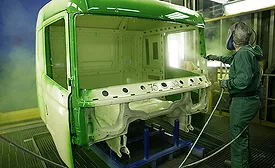
Overspray-free painting technology revolutionizes this time-consuming and material-intensive process. Audi works with Dürr, who supplies the application technology.
Interfacial chemistry plays a significant role when working with coatings, specifically the surface tension (SFT) of liquids and the surface free energy (SFE) of solids. These parameters are often measured or calculated in order to optimize the adhesion properties and obtain long-lasting adhesion that will inhibit delamination and adhesion failures.
With the help of EFSEN and AkzoNobel, furniture maker SC Freda was able to transform the majority of its coating line to a UV-LED system, maintaining a stable, robust production method that ensures a high-quality end product that meets the target requirements.
During both the production process at the TiO2 producer and the manufacturing process of paints, coatings and composite materials, avoiding the coagulation and agglomeration of the TiO2 dispersion is important. Surface chemistry of the TiO2 dispersion can be controlled during the measurement of Electrokinetic Sonic Amplitude (ESA) by regulating the pH value, e.g. for avoiding flocculation of dispersion.
What does the smart paint shop look like? An ecosystem that leverages information technologies, communication, sensors, data and cognitive tools to be more efficient.
CAS DataLoggers supplied a temperature monitoring solution for an industrial paint curing oven used by a manufacturer of commercial snow removal equipment. This customer was experiencing periodic problems with the quality of their powder-coated parts.
A brief overview of RadTech 2020, as well as insights from JP Masson, Director of Sales and Marketing, Nagase America, Chemicals Division, on trends in the curing market.
Automated wastewater treatment systems help manufacturers remain in compliance with EPA and local standards, while significantly reducing the cost of treatment, labor and disposal.
Currently there are two types of advanced appearance measurement instruments avail¬able on the market capable of determining radiometric and texture information of effect color shades at various directional and quasi-diffuse measurement geometries.

 RSS
RSS