A Novel Approach for Applying 2K Coatings to Improve Outcomes and Reduce Cost

2K coatings are being heralded as an innovative means to increase the move towards 100% solids materials and reduce the need for thermal curing, thus reducing the energy required for the coating process. While the benefits are indisputable, there are issues associated with these technologies that can make them difficult to process in the manufacturing environment. All of these must be dealt with as part of the application process and, if not properly handled, can result in production delays that reduce throughput, reduce quality, and increase costs. Obviously, this runs counter to the objectives of these advanced technologies.
2K Defined
In polymer chemistry, all curing requires energy to cross-link the monomers into oligomers to form a “solid”. For most conventional coatings, this energy is provided in the form of heating – usually the parts are “baked” in an oven. 2K (or multi-k) refers to formulations that cure through a chemical reaction, rather than heating.
These systems generally consist of a base resin (often called “Part A”) and a catalyst or hardener (often called “Part B”). When these components are mixed, a chemical reaction starts that causes the material to cure - or harden into a solid. The most common chemistries include epoxies and polyurethanes, though others are available. The selection is based on the final film properties desired. This holds true for coatings, and for adhesives and sealants as well.
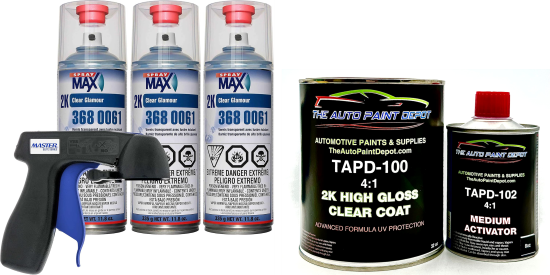
Figure 1 shows examples of common 2K coating packaging you might use around your home.
FIGURE 1 | Common 2K packaging for home use.
 Source:Saint Clair Systems
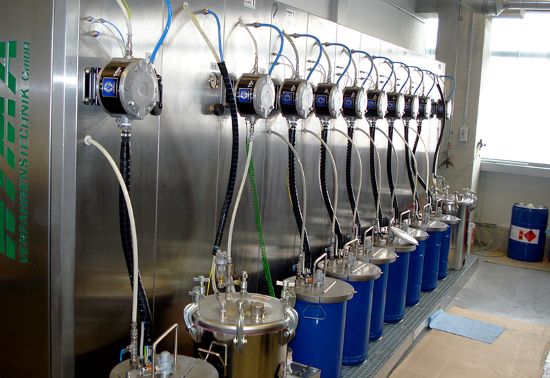
In industrial applications, however, they more often look like the system shown in Figure 2 with the base resins in the blue containers on the right and the catalysts or hardeners in the stainless containers on the left.
Why 2K?
Though there may be some solvent used to reduce viscosity, 2K’s are often defined as 100% solids and therefore eliminate or significantly reduce solvent content.
FIGURE 2 | Industrial 2K system.
 Source: Saint Clair Systems
Because the cure reaction is chemically induced, little or no heat is required. These materials can often be cured at room temperature – often referred to as “Ambient Cure”. This makes them particularly attractive when there is no other heat cycle required in the process, making it possible to also eliminate harmful combustion by products like SOx or NOx, resulting in a more sustainable process.
Varying the formulation allows you to control curing times so you can match the cure cycle with the assembly process. Moreover, this can be used as either a primary or secondary cure method, which means it can be combined with other technologies and is often included to act as a secondary cure method for UV/EB cure systems.
The 2K Reaction
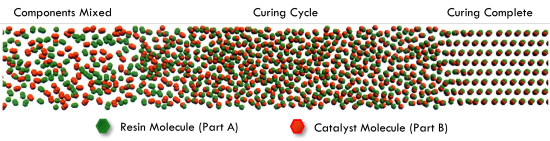
The reaction is represented by the graphic in Figure 3.
FIGURE 3 | 2K reaction diagram.1
 Saint Clair Systems
 It starts by mixing the resin and catalyst components, which starts the chemical reaction. This continues through the curing cycle – ideally ending with all the resin molecules reacting with all the catalyst molecules. This provides optimal film characteristics but requires perfect ratio control and perfect mixing. Any variation results in unreacted components in the film.
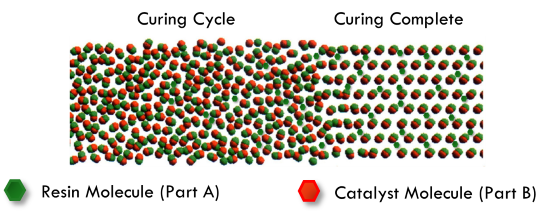
For instance, if there is too much resin (or insufficient catalyst) in the mix, we end up with unreacted resin molecules in our final product as shown in Figure 4 and represented by the extra green resin molecules. Because these are still free and fluid, they compromise film performance.
FIGURE 4 | Under-catalyzed 2K reaction diagram.
 Saint Clair Systems
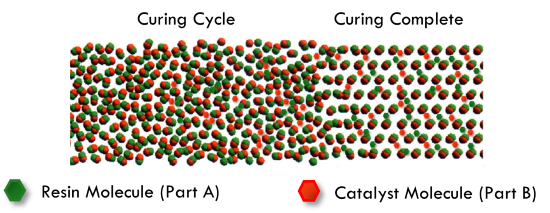
 Conversely, there may be too much catalyst (or insufficient resin) in the mix. As shown in Figure 5, we end up with unreacted catalyst molecules in our final product as represented by the extra red molecules here. These compromise the film performance in the same fashion as the excess resin did.
And even if the ratio is perfect, if it is not thoroughly and evenly mixed, we can still end up with unreacted molecules of both resin and catalyst as we see in Figure 6. The end result is the same – a compromised film!
So, obviously, ratio and mix are important, but there are two other properties that we must consider in this discussion: Induction Time and Pot Life.
Induction Time
Induction Time is the time it takes for the resin and catalyst to combine and begin the curing reaction. It starts right after mixing the two components and can last from minutes to hours – or even days! It may be a function of formulation, mix ratio, mix quality, ambient exposure, and temperature.
FIGURE 6 | Under-mixed 2K reaction diagram.
 Saint Clair Systems
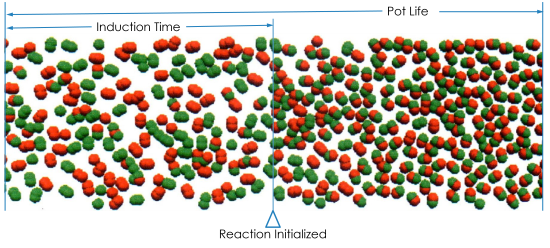
 FIGURE 7 | Pot life including induction time.
 Saint Clair Systems
 Pot Life
Pot life is the time from mixing the two components together to the point at which the mixed material is no longer useable. Technically, it is defined as how long it takes the mixed material to double in viscosity but can also simply be when the material becomes too thick to apply. It is often referred to as the “working time” or “useable life”.
It includes the Induction Time and therefore it can also last from minutes to hours or even days. It too, may be a function of formulation, mix ratio, mix quality, ambient exposure, and temperature.
Turning back to our graphic, as shown in Figure 7, we can see the distinction. The Induction Time starts at mixing with the molecules trying to find one another. We don’t want to apply this material until the reaction has initialized, but once we cross that line, there is no turning back – the material will cure and any that is not used on our parts will reach the end of its useful life, the Pot Life, and be discarded as waste.
The Importance of Temperature
To understand the importance of temperature, there are a few things that must be put into perspective. First, the formulation is determined by the requirements of our application and really can’t be changed on-the-fly in our process. Next, the mix ratio is determined by our formulation and the need to completely react both resin and catalyst.
Ambient exposure, which we generally think of as temperature, actually includes both temperature and atmosphere in the form of oxygen and humidity. It is a function of our manufacturing environment, which can be controlled through HVAC and humidity control – and even nitrogen blankets if oxygen exposure is a problem, but these things are expensive, especially in large-scale operations.
However, Mix Quality, Induction Time, and Pot Life are all affected by temperature, which makes fluid temperature a critical process control parameter!
It’s All About Viscosity
All liquids change viscosity as a function of temperature. As shown in Figure 8, even water goes through a 2:1 change in viscosity between 10 °C and 40 °C. You probably don’t think of a glass of ice water as being thicker than a cup of coffee, but it is!
All coatings (and sealers and adhesives for that matter) follow this same pattern. And it’s important to note that this is a physical property – not a defect – and therefore we can use it to our advantage in our process.
And that begs the question: “What is viscosity anyway?” In its simplest form, viscosity is the property of resistance to flow in a fluid or semifluid.
FIGURE 8 | Viscosity of water vs. temperature.2
 Saint Clair Systems
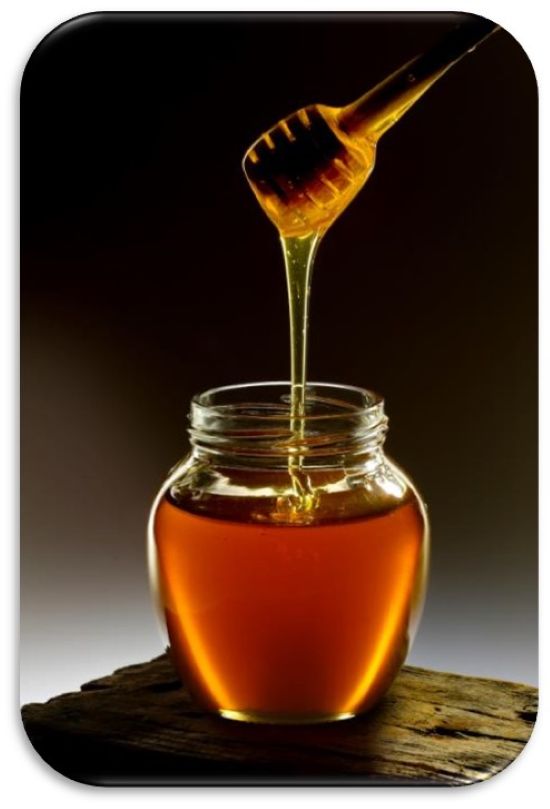
 Water is the universally accepted definition of a “fluid”. But what is a “semi-fluid”? Honey is a great example! Think of honey when you put it in the refrigerator. It gets thick – very thick – in fact, almost solid. But take that same “block” of honey out of the fridge and place it in the sun on a hot day, or in the microwave, and as it warms up it thins out significantly and you can pour it – almost like water.
FIGURE 9 | Honey as a viscosity example.
 Saint Clair Systems
 The change in how it flows represents its change in viscosity. And in this case, the cause is its change in temperature.
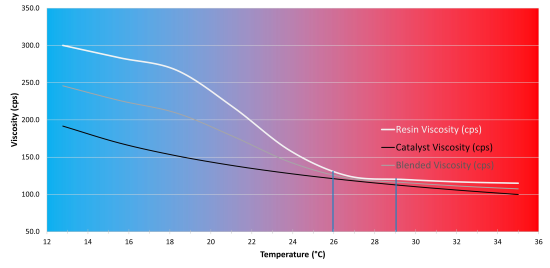
Figure 10 shows the viscosity vs. temperature curves for the “A” and “B” components of a 2K coating. They’re the curves we’re used to seeing. They’re non-linear and both show the viscosity falling as the temperature increases. Of particular interest is the region from about 26 °C to 29 °C where both components are at roughly the same viscosity.
FIGURE 10 | 2K “A” and “B” component viscosities.
 Saint Clair Systems
 Mixing 2K Components
The 26 °C – 29 °C region is especially important when we focus on the complexities of mixing the two components. In his October 2016 article, “Mixing Two-Component Fluids in Exacting Proportions”, which appeared in ASI Magazine, Anthony Martucci noted:
“Before 2K [materials] can be applied, they must be properly mixed; this mixing process cannot be taken for granted. Studies have shown that poorly mixed 2K [materials] can suffer a loss in adhesion strength, resulting in compromised long-term durability and reliability.”3
Joachim Schöck expanded on this in his October 2023 article, “Influence of Rheology on Mixing Behavior in Static Mixers”, which also appeared in ASI Magazine:
“The optimal achievable mixing quality depends on the type of mixer, the number of mixing elements, the mixing ratio, and the viscosity ratio of the two components. A pre-defined mixer generally achieves the best mixing quality when materials with a mixing ratio of 1 to 1 and the same viscosity are mixed.”4
In short, if the two components are of dissimilar viscosities; it makes blending them difficult – for several reasons. First, higher viscosity fluids require greater pressure to move at the same velocity as lower viscosity fluids, which can significantly increase the stress on the mixing elements. In addition, during the mixing process, higher viscosity fluids tend to displace lower viscosity fluids, pushing them aside instead of combining with them. As we’ve already demonstrated, this can impact the induction time. Moreover, the different viscosities will have different coefficients of friction with the mixing elements – again adding stress to the mixer. All these factors make it difficult, if not impossible, to optimize mixer performance.
The most common solution is to add more mixer elements by extending the length of the static mixer. Though this may produce the desired outcome, it exacerbates the issues cited and adds to the cost and the maintenance overhead of the mixing system.
Fortunately, there is a better alternative. As we showed in the viscosity example in Figure 10, choosing the proper temperature (26°C - 29°C in that case), can help address these issues by bringing the “A” and “B” components very close in viscosity. Of course, not every formulation is as convenient as the one we’ve chosen for this example and in those cases, it may be necessary to deliver each component to the mixer at significantly different temperatures.
Induction Time Revisited
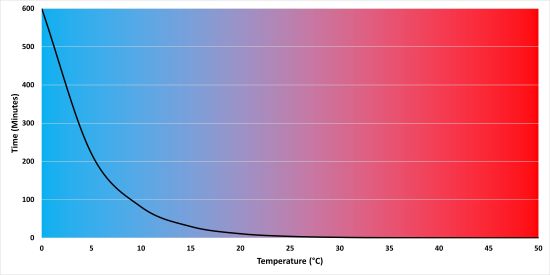
Of course, in addition to mixing, we also have to consider induction time in our process. As noted earlier, Induction Time is the time it takes for the resin and catalyst to combine and begin the curing reaction. If we apply before we have reached our induction time, our application will suffer. But, as shown in Figure 11, induction time is also affected by temperature. In fact, this shows that we can vary the induction time from nearly immediate to many hours, simply by changing the temperature of the mixed components. In practice, we can use this to our advantage. For instance, if we experience an unscheduled breakdown, we can drive down the temperature of our fluids to slow the induction time thus saving the mixed material in the lines to reduce waste.
FIGURE 11 | Induction time vs. temperature.
 Saint Clair Systems
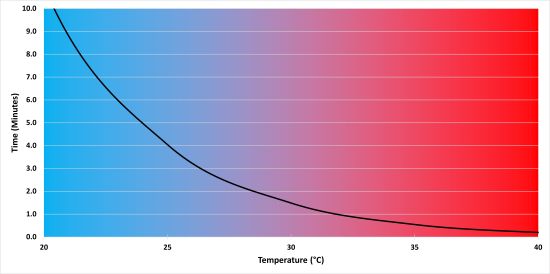
 But there are other ways to exploit this phenomenon. For instance, zooming in on the chart, as shown in Figure 12, we can see that we can use temperature to set our induction time to match our transfer time from the point-of-mixing to the point-of-application.
FIGURE 12 | Induction time vs. temperature (20 °C – 40 °C zoom)
 Saint Clair Systems
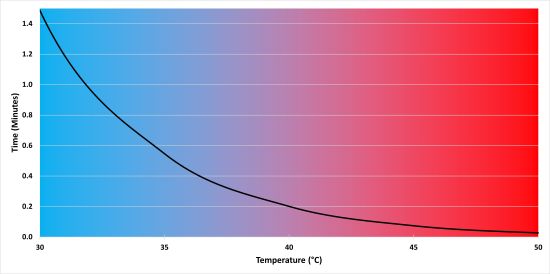
 Taking this concept further, as shown in Figure 13, it gives us the ability to move our mixer closer to the point of application, which improves our efficiency and reduces our waste by putting less material at risk in our process.
FIGURE 13 | Induction time vs. temperature (30 °C – 50 °C zoom).
 Saint Clair Systems
This makes temperature a great control parameter for Induction Time but requires careful coordination of the component temperatures to achieve efficient mixing and a final temperature the sets our “perfect” induction time for our process.
But of course, we also must respect the Pot Life of our material once it has been mixed.
Pot Life Revisited
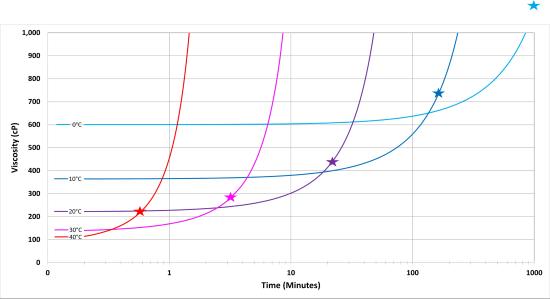
The chart in Figure 14 shows the relationship between Pot Life and Temperature and is based on the generally accepted definition of Pot Life as “the time it takes for the viscosity to double”, so we have placed time in minutes on the X-axis. We’ve made this a log scale because of the wide time range we’re talking about. Since viscosity is the determining factor, we’ve placed that on the Y-axis. As labelled, each curve represents a different temperature.
FIGURE 14 | Pot life vs. temperature.
 Saint Clair Systems
 As we’ve already demonstrated, the temperature of the mixed coating will determine our starting viscosity, with the viscosity being lower as the fluid temperature gets higher. This is obvious as we move from the 0 °C curve down to the 40 °C curve.
Based on the definition, we can quickly determine the pot life at each temperature. At 40 °C, the coating starts at about 110cP, so the pot life will be defined by the 220cP point, which occurs in less than one minute. Likewise, at 30 °C the coating starts at about 135cP, so the pot life will be determined by the 270cP point, which occurs somewhere between 3 and 4 minutes. At 20 °C the coating starts at about 220cP, so the pot life is determined by the 440cP point, which occurs at about the 11-minute mark. At 10 °C, the coating starts at about 365cP, so the pot life determined by the 730cP point at about the 150-minute mark, or about 2-1/2 hours. Finally, at 0°C the coating starts at about 600cP, so the pot life is at 1,200cP, which is completely off this chart out at about 1000 minutes or well beyond 16 hours.
All these fit with the Induction Time discussion and the classical Pot Life definition. But from a processing perspective, it’s easy to understand that you could not expect the same results from your process when the coating is at 110cP as you would get when the coating is at 1,200cP. This shows that, while the classical definition may be fine for a lab environment, in the real world, it’s impractical. What it does clearly demonstrate is the importance of temperature as a control variable in determining your process outcomes.
Conclusions
From the examples shown, it’s clear that temperature can be exploited as a control variable in our 2K application processes to:
- facilitate mixing, allowing control of each component at the optimal temperature to match their viscosity to make the mixer more effective and efficient, and to prepare the mixed material for the induction process.
- control Induction Time, to manage throughput by eliminating a common bottleneck in 2K applications. In some cases, this can allow placement of the mixer closer to the point of application which keeps the components separate longer putting less material at risk of becoming waste.
Of key importance is that fact that controlling temperature assures that we are applying our material at the optimal viscosity to achieve consistent and repeatable results. It also allows us to shorten or extend pot life and control cure time to accommodate changes in manufacturing requirements as they occur.
Looking for a reprint of this article?
From high-res PDFs to custom plaques, order your copy today!